NEW RELEASE: Erebus - now available on Amazon
All of your favorite characters are back - James, Ananke, William, and Hitoshi - with a few new ones in this exciting follow-up to 43 Seconds and Silver-Side Up. Bernard's Beauty flies again, but so does the newest Riggs ship, Gossamer Goose. Get the new Hayden's World novelette, Erebus, on Amazon now for 99 cents.


Sneak Peek - Erebus
A few sneak peeks at what I'm currently writing.
In "Silver-Side Up", James gives us a sneak peek at the next Riggs ship, Gossamer Goose, and mentions Sarah is slated to be Gossamer's pilot. You'll recall Sarah appears at the end of "43 Seconds" as the pilot on stand-by near Mars if anything went wrong.
I've been writing Sarah's story, and thought I'd share a few snippets from it. Let me know your thoughts:
Sarah pushes the Pintail’s flight stick forward and the aquamarine sky rolls away. Below, the cloud deck is an impossible swirl of cinnamon and gold with pockets of flickering lightning. Thunder rumbles in bursts, its audio out of sync with the light show. Through the cockpit windows great banded rings fade into the horizon and the scale of it is almost too much to take in at once. Motion catches her eye as a silver glimmer carves a vapor trail across the sky, alternating red and green strobes pulsing from its wings. It changes course, the vapor trail bending behind it, then corkscrews a white spiral before matching her altitude. Saturn’s moons are an audience of bright stars behind it.
“Well, now you’re just showing off,” Sarah says to her helmet mic.
The stars behind Bernard’s Beauty swirl to an invisible periphery as if pushed by a great unseen force. Each brightens and blues. In the blink of an eye the ship collapses into the nothingness of space, the stars rotating back into place in its wake.
Transmission Four: +9 days/+21 hours
Sarah’s having lunch with her mother. Gaige sits beside her, happy to be reunited after her two-week trip. Sarah’s mother has been a saint taking care of him each time she’s been away.
In James’s video the cabin lights are dimmed and he’s weightless in a wall-mounted sleeping bag, his arms floating in front of him. There’s just not enough room in Bernard’s for a separate sleeping area. He gives a salute before turning off the light.
William pilots the Sandpiper on final approach to Hayden-Pratt’s MEO2 construction dock. It’s a twin to the Cassini One shipyard, a great wheel in space filled with brilliant blue Earthshine and sharp shadow. Mounted perpendicular to the wheel is a sixty-two meter wedge with gold light spilling from its cockpit windows. It’s sunlit-side is blinding white, washed out, but its shadow side is illuminated with pockets of running lights and strobes. Black registry letters read HP-G01 Gossamer Goose. Below it the Earth is a sun-washed ocean swirled with powder.
Hitoshi drums his fingers against his thumb.
“You okay?” Sarah asks.
“Okay to design the ships. Not so much for the flying, I’m an engineer, not a test pilot,” he says.
“Well, you’re more of a test passenger, if that makes you feel any better.”
“No. Not really.”

Hayden's World Shorts - Paperback Artwork
The paperback edition of Hayden's World Shorts is now available. I created new full-cover artwork for it.
One of the bits of trivia about me is that I majored in mechanical engineering but minored in graphic design. As I began self-publishing, it's been fun to dust off the graphic design skills and create my own book covers.
After a few requests for a print edition of Hayden's World Shorts, I decided to release the paperback. This required designing wrap-around artwork for the front and back covers.
Here's the final art. You can get the print edition here.


80s Problems That Never Happened
There’s a popular meme which states “When I was a kid, I thought quicksand was going to be a much bigger problem than it really is.” Thinking back, there’s a whole host of things which always happened in my favorite 80s shows that never materialized into problems in my future adult life.
There’s a popular meme which states “When I was a kid, I thought quicksand was going to be a much bigger problem than it really is.”
I grew up in the 80s. I had a Members Only jacket, one pair of parachute pants, an assortment of skinny ties, and some rocking velcro black Reeboks. I lived and breathed cheesy sci-fi, drank coke from my McDonald’s Star Wars glass collection, and went to bed under a sky-blue Empire Strikes Back blanket. I can still see Luke with his blaster drawn, Bespin behind him. I remember watching countless flicks where the hero sank into quicksand and I always made a mental note to heed his advice. Don’t struggle, it only makes you sink faster.
Thinking back, there’s a whole host of things which always happened in my favorite 80s shows that never materialized into problems in my future adult life:
- Getting sucked into a comic book and needing to fight my way back out
- Jealous computers
- Needing to dive at just the right time to outrun an explosion
- Knowing how to pick a lock with a bobby pin borrowed from a woman’s hair
- Outsmarting a killer computer in a dazzling display of logic
- Switchblades
- Anyone from the future
- Fights on ledges over lava
- Getting frozen by liquid nitrogen (or carbonite)
- Escaping by crawling through HVAC ducts
- Falling through the ceiling while crawling through HVAC ducts
- Meteor strikes
- Knowing how to close a demonic portal
- Ninjas
- Using proper form when swinging across chasms (kiss the girl, first!)
- Identifying cursed talismans
- Dealing with bounty hunters
- Crashing my car through a fruit cart
- Being recruited to fight in an alien war
- Getting trapped in the past
Well, okay, I suppose #20 did actually happen.

Aero One (First Chapter, 1400 words)
Jia’s stomach burns and she jolts awake. She flails against the suffocation as if she can beat it away with her own two hands. Tears well in a weightless film across her eyelids and she scrubs the back of one hand across her face while the other fumbles with the harness release. Her head throbs. When she sets her hand to the site of the pain, it returns sticky and red. Thoughts spark and fizzle in an overlapping jumble of competing primal urges. Air. She needs air.
One
Breathe
Jia’s stomach burns and she jolts awake. She flails against the suffocation as if she can beat it away with her own two hands. Tears well in a weightless film across her eyelids and she scrubs the back of one hand across her face while the other fumbles with the harness release. Her head throbs. When she sets her hand to the site of the pain, it returns sticky and red. Thoughts spark and fizzle in an overlapping jumble of competing primal urges. Air. She needs air.
Stop. Right side, right side. Her right hand slides down, finds the emergency kit. The breather feels cool against her palm, then she has it, bites down like a scuba diver, and there’s a hiss as liquid O2 expands. The first breath hurts her chest like January air, but it’s a sweet pain and she closes her eyes for a moment to just breathe. It’s like a drug, electric, hyper-sensitizing. Neurons fire through the haze. She blinks and assesses the room.
Emergency lights trace psychedelic patterns in the zero gee drifting smoke. Bits and pieces of chair foam, loose fasteners, and pieces of soot coast by. Each casts a long, moving shadow, a dark tail like an inverse comet. Ethereal amber light shifts with scrolling alerts.
She inhales deeply from the breather, pops it out of her mouth. “Ship?”
No response.
“Ping? Are you there? Ping, respond.”
An explosion somewhere and her head whiplashes. She keys icons for damage assessment.
Battery three is gone, fire suppression is depleted. Engines are offline. There’s damage everywhere. It’s her fault.
Ping. Ping was down there.
She’s about to unclick her harness and stand when a pulsing red smudge catches her eye. She wipes the fire suppression snowfall and her finger shakes. Orbital diagrams spin on the display. Uranus is an infinite sky stretching in a plane parallel to the ship. The Prosperity plows through the upper atmosphere.
Her stomach drops. She tries to send power from the remaining batteries to the shredded engines, but there is no response. Her pulse races and a clawing digs within her chest, then she remembers the breather, bites down, takes several breaths, pops it back out and opens the emergency channel. Nothing. She slams her fist down on the workstation. Think.
Ping.
She’s out of the chair and diving down the transit tube. The wind picks up mid-tube, whistling, and she looks over to the comms room. Scorch marks stain the pressure seal and a dozen holes make the metal look moth-eaten. Blue sunlight shafts connect the trajectories of each hole with a matching breach on the far wall. Her ears and eyes hurt.
She descends deeper until she comes to the core junction. To the starboard, the emergency area beckons, a fully self-sufficient life pod with its own RF drive, food, water, air and medicine. Get Ping, get inside, jettison it, climb to a stable orbit and activate the beacon. Rescue in twelve days.
Jia ignores it and descends to the aft door. She hooks on a rung, stretches, and keys in the override. Red lights strobe and the seal flashes open, then she’s fighting against the wind as she climbs down the ladder head first. When the door slides down she takes the breather out of her mouth and gulps atmosphere. It tastes bitter, acrid, like burning plastic.
The hangar houses two aerostats shaped like giant Apollo-era capsules. The first is fully extended on its tracks at the edge of the hangar door. A large red number one is printed on its nose. Ping is not here at aerocon, but a slate drifts by and Jia grabs it, tucks it into her belt, then watches the pattern of drifting debris to find an opening before pushing off towards the next room.
Extravehicular Prep. The air here smells strongly of solvent and tickles her throat. Ping is here drifting helmetless in a red spacesuit. Jia kicks off the entrance and collides with him. She takes the breather from her mouth and works it into his. “I got you, Ping.”
The slate recommends airway anti-spasmodics, increased suit oxygen, drugs to counter the volatiles from the battery fire, and inhaled nano-cellular therapy. Some of that is here at the emergency EV station and she presses an injector to his neck. She takes the breather back, places her hand on his cheek, then snaps his helmet on.
Several red EV and blue PLEX suits are here. She slips into the red suit nearest Ping and the slate’s display fizzes over her faceplate as she tethers to his suit’s carabiner. “Okay, we’re getting out of here.”
Something huge rips off the Prosperity and crashes into the starboard hull. Jia can’t tell if she is spinning or if the room is turning around her. She reaches out, curls her fingers around Ping’s chest handle and pulls him into an embrace. Her back bounces off the ceiling.
“Jia?” Ping asks, eyes half parted. “Tried to…tried to get to you. Fire in the battery room.”
“Ping! Hey, stay with me. We’re getting off the ship.”
Jia pushes off the ceiling and navigates Ping back to the core junction. A blast of air and they’re through the door, but her eyes are dark adjusted and the hall is filled with intense light. She hooks a rung and they pendulate for a moment.
The junction is different. Chaotic bursts of yellow firelight spear through the comms door holes and a dazzling shaft of aquamarine carves a luminous corridor bisecting the hall. Sunlight reflected off Uranus.
Jia’s voice cracks. “No!”
She pulls Ping up to the lifepod window, squints and peers inside. There should be the welcoming glow of the lifepod’s interior lights through the airlock, but instead there is no lifepod, no airlock, just ripped, bent metal splayed open like a flower. As she watches, more pieces of the umbilical twist, snap and streak away awash in flames.
“That is not good,” Ping says, coughing.
Jia wants to cry. She puts both hands on Ping’s faceplate, tilts her head forward and makes contact with his.
“How long?” asks Ping.
Her response is nearly a whisper. “Minutes.”
“Have an idea.” Another cough. “You’re not going to like it.”
“Ping?”
“Back down, back down, to the hangar.”
She searches his face and her brow tightens. “Oh.” She shakes her head. “Oh, no.”
“Yeah, yeah. We can make it.”
Jia grabs Ping’s suit handle and they emerge from the hangar ceiling. Flames flash in sparking globes from EV Prep.
“Needs to be Aero One,” Ping says. “It’s all set up.”
She brings them down right beside the red number one on the aerostat’s nose. The screen illuminates and Jia pairs her slate to it. Startup icons scroll by. A whine of servos and the capsule’s middle unfurls like a metal blossom.
They slip inside. It’s tight in here, designed for maintenance access only. Sitting cross-legged she taps the slate and the six panels seal them in. Ping’s face is lit underneath by his helmet and her own glow spills warm light on his suit.
“I’m going to try and equalize the bay,” she says.
The klaxon sounds before the air hisses away. Jia taps another icon and the bay doors slide open.
Ping reaches up with both hands and anchors on the steel framework.
She eyes his hands, reads his expression. “Ready?”
“Not really, but, yeah.”
Aero One lurches as the track extends outside the door. It’s a four-thousand-kilometer drop underneath them. She reads off her helmet HUD. “Here we go. Five, four, three, brace, brace.”
The clamps disengage and the thrusters fire with an ear-numbing blast. Her teeth clatter from the vibrations of the shimmying walls.
Ping looks at her and she hears his rapid breaths over the comm. He nods. They are free, free of the dying ship and flying and falling, both at once.
She remembers the slate and pulls it out, linking into the aerostat’s externals. Ping leans forward as she shares the screen with him.
In the aft camera, a gossamer ring bisects the sky, icy white against a powder gradient fading to ultraviolet. A few pale stars dapple the top of the screen. The Prosperity falls behind them. It sputters and flickers, a great blinding meteor in a cyan haze. Sparks shred off the front and veer away like missiles, each tracing its own path.
Tears well in Jia’s eyes as the fireball divides, splits again, until all that remains of the Prosperity is a rain of fire in a cloudless sky.
* * * *

Signal Loss (First Chapter, 1400 words)
Kyan Anders drifted in a room brimming with a hundred billion stars. Radiant golds spanned familiar constellations, but it was what lay between the stars that captured his attention. Smudges of galaxies against ebony sky. Glowing stellar lanes dusted with rose. Objects no man could see from Earth, but here they were impossible to miss. It was like seeing, truly seeing, for the first time.
One
Seventy Days
Kyan Anders drifts in a room brimming with a hundred billion stars. Radiant golds span familiar constellations, but it is what lies between the stars that captures his attention. Smudges of galaxies against ebony sky. Glowing stellar lanes dusted with rose. Objects no man can see from Earth, but here they are impossible to miss. It’s like seeing, truly seeing, for the first time.
“I’m sorry to interrupt,” Rios says, “but I’ve just received Harmony’s morning broadcast.”
Kyan glances at his watch. “On my way.” He hooks his instep under a rung and descends into the habmod. A loose gray blanket and sock drift by. He pushes towards the port comms module, sails through the daylight rings of the transit tube, and emerges in a halo of screens. An ocean-blue baseball cap velcroed to a command chair reads Aristarchus. “Give me a quarter gee vectored along the hab axis.”
The floor falls against Kyan’s feet as he dons the cap and laces his arms through the chair’s harness. The Addison Aerospace logo fades on with the comms log. Thirty-five conversations separated by seven hundred and sixteen minutes. Kyan scrolls to the newest entry.
A young woman wears an Aristarchus cap over blond hair. Behind her, late afternoon sunlight dapples leafy greens. “Hi, Dad. So, first things first, if I know you, you’re probably all stressed out thinking something happened because my message is early.” The signal pixelates as she spreads her fingers, palms facing him. “Don’t worry, everything’s fine. There are some morning alerts for flares and I’m trying to avoid them. They’re going to get worse, and it might screw up the blackout window. So this sucks. I hope you’ve got some good music queued up.”
An alert bubbles on the screen:
RIOS - Received 06:20 local - HELIOS reports M-class flare activity expected 08.02.80 06:48 through 08.02.80 13:21.
Expected magnitude M2-M4. Minor communications disruptions expected with inner planet broadcasts.
A graphic illustrates the line-of-sight between the Aristarchus and Earth. Waypoints show the Earth’s path over the next few days, a string-of-pearls slipping behind the Sun. Complex field line patterns signify radio interference. Rios updates them with the HELIOS info and the patterns swell. Earth’s comm tag changes from green to yellow and all of the pearls shift colors. Yellow, orange, red, black. Signal loss in three days.
Harmony swipes a finger over her bracelet and an ultrasound pops up. Kyan leans forward. Harmony Richardson, 18 weeks. “There’s your grandson, looking good! I think we’ve browsed a thousand names. I like traditional, but Ryce prefers trendy. You know him. We’ll figure it out. Anyway, we’re keeping the name secret until he’s born. You know, keep a little bit of a surprise.”
Kyan’s eyebrows raise and he mirrors her smile. He rests his fingers on the screen. His grandson. She’d told him the evening before his departure. Eight more mission days, then twenty-six transit days. A little more than a month until he can be back with his family.
“Oh, and not sure how much news you’re picking up,” Harmony says, “but something wild happened yesterday. You know that guy who’s always in the tech feeds with the ‘keep dreaming big’ meme? He’s been talking about this new ship that twists space, and yesterday he finally got it to work. Well, sort of. He flew to Mars in twelve minutes. Crazy, huh? Check this out.” She flicks her bracelet. Twelve Minutes to Mars. The photo shows James Hayden propped up in a hospital bed, wearing a neck brace, giving a thumbs up. “It says the tech’s at least three years out, but can you imagine? Instead of twenty-six days, you could be home in twelve hours.” A white cat springs onto her lap and she strokes its fur. “Okay, looks like Halley wants to say hi, too. Well, I miss you. I’ll check the feed for flares, and may need to bump our time tomorrow. Talk to you soon.”
Kyan smiles and tags the ultrasound. “Rios, give me a hard copy of that.” He slides the photo into the elastic board beside his chair. A dozen other photos are nestled there, pictures of him and Harmony wearing backpacks, family photos of him, Harmony, and Lake during the holidays, when Lake was still his wife, and a dog-eared postcard with azure ocean water lapping over bare feet. Getting Away from It All.
He does a quick once over. A little silver stubble, but acceptable. “Hey, kiddo. Bummer about the flares. Rios updated comms loss to Monday. How are you feeling? Have you felt the baby move yet? I have a million questions.” He taps the interface and a new window shows orbital diagrams. Earth, Mars, Jupiter, Saturn, Uranus, all on one side of the sun and the Aristarchus on the other. “Not too much to report. I’ve got my final images of Sedna. Today I’ll switch to Eris, then it’s Oort cloud cataloging and heliopause measurements for the next eight days. You know, I’m not looking forward to comms loss, but it’s awesome for sensors. I’ll be at the quietest place in the system.” Kyan glances at the family photo. “And for today’s musical selection I’ve got one that your mom and I listened to a million times when she was pregnant. Classic 50’s progressive rock.” The opening chords of Farther strum in. “Enjoy. Talk to you tomorrow. I love you.” He sends the message and stares at the Addison logo a minute before a sweet scent resets his attention. “Okay, Rios, what’s on the docket for today?”
“Breakfast. I’ve got some eggs and french toast heated for you. It’s the most important meal of the day.”
Kyan raises his eyebrows. “Going with the mom approach today?”
Rios’s voice is full of inflection. It’s hard to believe he isn’t sentient. “Addison parameters, crew health.”
“Okay, so, after breakfast?”
“Reposition the drones for Eris imaging. Review night log anomalies.” Rios pauses. “Would you like to know about the anomalies?”
Kyan leans his head on a bent arm. “Do I have to say it?”
“Three visual occultations during wide-field imaging. Would you like to review them now?”
Kyan sighs. “Just put them on the screen.”
Three circled stars appear, each turning black as an object passes before it. Infrared, ultraviolet, x-ray, and radio data accompany the images. Object one is fifty degrees kelvin with moderate reflectivity. Distance is unknown. Rios guesses it is a scattered disc object, and Kyan confirms. Object two has similar properties. Object three, though, is unexpected.
“You ran sensor diagnostics?”
“Twice. Sensors are within norm.”
No reflectivity, temperature near cosmic background radiation. As far as the sensors can tell, it is a hole in space passing in front of a star. Except it isn’t a hole. Even a black hole would have some sensor data.
“Any ideas?”
“I checked microwave and x-ray wide-field imaging, and found occultations along the same flight line. Based on parallax, it’s probably close, less than half an AU.”
Kyan scratches his cheek. “Okay, retask the drones along the flight line and configure for narrow field imaging. Let’s log it for now.”
“Logged as Unidentified Scattered Disc Object 235C. We need twenty hours of Eris imaging. It’ll add another mission day if we retask.”
He glances at the ultrasound and back to the unidentified object. Now seventy mission days. It’s tempting to just forget about it, log it as an unknown, but he’s curious, and curiosity was one of the main things that brought him out here. “Proceed. Let’s also try a radar burst and see what we can see. Can’t hurt.” He unclicks his harness and stands. One-quarter gravity is similar to the Moon, and he bounds like an Apollo-era astronaut. “I’m going to grab some breakfast while everything gets positioned.”
“We seem to have a mystery.”
“I know,” Kyan says, emerging from the transit tube. The usual weariness in his voice is absent, replaced by something different. Excitement. “Isn’t it great?”
Find out what happens next for 99 cents on Amazon

43 Seconds (First Chapter, 1200 words)
James Hayden smiled as his dream died. It was the polished, charismatic smile that had glossed the feeds of Frontier and Momentum. In the silence he could hear the soft pulse of Hayden-Pratt’s logo spinning on the wall behind him. He paused and gripped the podium. A room full of tuxedos and gowns looked back.
“It’s gone, James,” a voice in his earbud said.
One
43 Seconds
James Hayden smiles as his dream dies. It’s the polished, charismatic smile that glossed the feeds of Frontier and Momentum. In the silence, Hayden-Pratt’s logo pulses from the wall behind him. He grips the podium. A room full of tuxedos and gowns stares back.
“It’s gone, James,” a voice in his earbud says. “We lost telemetry forty-three seconds after wave initiation. They’re reviewing imaging now, but the debris field and trajectory are consistent with a cascade implosion. Distance traveled was twelve million kilometers.”
The A speech indexes in his vision. Twelve Minutes to Mars. The timing of it, here at the Industry Innovators awards, would have been perfect. He blinks, changes to the B speech, and considers the first sentence. The audience watches, waiting. He clears his throat.
“A great man once said, ‘Rules are made for people who aren’t willing to make up their own.’ He was one of the nineteen pilots who flew the one hundred and fifty-seven test flights of the Bell X-1 aircraft. The fiftieth flight, in October nineteen forty-seven, is the one everyone remembers.” A murmur of recognition sweeps across the room. “The X-1 had no ejector seat. Each of its pilots was committed, in a single-seat rocket designed to look like a fifty-caliber bullet with wings.”
The voice in James’s ear says, “Okay, Skyway3 just picked up the story, and it’s starting to go viral.”
He can see the Skyway3 news filtering across his audience as haptics signal notifications. Eyes dart to wearables and look back to him.
“As a pilot, Chuck Yeager is a personal hero of mine,” James says. “He represents an age and spirit of unbridled exploration and courage. The Bell X-1 flights paved the way for supersonic flight design, forever changing the way we travel.” He grips the award and the cold bevels of the etched letters bite his fingers. “I’m honored to receive the Aerospace Innovators award on behalf of my team for the development of the Riggs drive. Like the X-1, the test flights for the Riggs vehicle are pioneering a new frontier in travel, and I am humbled to be a part of the team pushing the envelope.” He pauses, seeming to want to say more, but simply smiles and raises the award. “Thank you.”
A short round of applause and the host wraps up the ceremonies. James strides casually back to his table, setting the award behind his plate with a solid thunk.
William Pratt sips a scotch, the ice clinking as he swirls the glass. “That was not the B speech.”
James shrugs. “When in doubt, quote Yeager. Besides, I think better off the cuff.” He sends a private message to William: I’ve just been getting verbal updates from Hitoshi. What’s the latest on the crash?
William’s expecting this. “Let’s get some air.” He sets his napkin on the table as he stands, picks up his drink, and smiles at everyone. “Excuse us.”
The two walk past the bar through a frosted glass door onto the balcony. The distant, rhythmic white noise of the Pacific’s crashing waves greets them. Crimson light fades into an ultramarine skyline with the first stars brightening. A few people sit at tables with flickering oil lamps, chatting and watching the night’s arrival. James and William find a quiet corner and lean against the railing.
“Manifold irregularities at thirty-one seconds, then resonance.” William gestures a tired spiral with his free hand. “Cascade failure, implosion. Same as last time, although the upgraded compensators did keep everything together three more seconds. This is the problem with space. For something that’s filled with nothing, it’s not very uniform.”
James nods. “Hitoshi thinks we need an AI to manage the flux changes. The interferometers aren’t cutting it. We need to go predictive, not reactive.” William quirks his head, but James continues. “Plus, the mass dynamics of the Riggs vehicle are part of the problem. Hitoshi’s working on a Comet for the next run.”
William leans forward and lowers his voice. “We’re fortunate these have all been unmanned flights. You put an AI or pilot in there, and they’ll be a glowing field of wreckage before they know they’re dead.”
James thinks about that for a minute, but says nothing.
William pauses to take a swig of his drink. “All right, consider this. When the US shuttle program collapsed, astronauts went to Soyuz launchers. It was forty-year-old technology, but it was still the most reliable rocket in the world.”
“Your point?”
“Tried and true technology doesn’t kill you. RF and Mach-Lorentz drives can achieve similar speeds without all of the drama.”
“That’s true, except you skipped the part where a one gee acceleration takes a year to get near light speed. The Riggs engine takes nine seconds.”
William points his finger, clinking the ice again in his drink. “Sure, but no one needs to spend a year taking an RF drive near light speed. You can literally fly to the end of the solar system in fifteen days. Riggs could change that from days to minutes, which, sure, is amazing, but really, is it necessary?” He gestures towards twin contrails glowing brilliant rose against the navy sky. “Your supersonic flight story is the perfect example. Commercial supersonic was available since the nineteen seventies. I mean, we’re talking disco-era technology, here. It was pricy, and it folded.” He shrugs. “Daily life worked fine at subsonic speeds. Unless you’re talking military, that is.”
James sighs. “Yeah, well, I think we’ve beat that horse to death.”
“Yup. There you have it.”
James laces his fingers and leans his elbows against the railing. “You know, this is all about getting people interstellar. Everyone’s imagination is fired up from those Proxima images. Timing’s right.”
“How many interstellar drives do you think we’re really going to sell, considering the premium? It doesn’t even get you that much. Six years to Proxima with RF, four years with Riggs. Everything crashes into the light-speed limit.”
James’s expression brightens. “But time dilation tips that scale. The RF crew experiences four years, but only eight months for Riggs. And that’s with current design. Tack on more nines after the decimal point, and months become days.”
William considers the point. “I’ll give you that one. But for now, forty-three seconds is the best we can do. The power costs alone are prohibitive.” He clasps James on the shoulder. “Look, the award is great recognition, and I won’t complain about the PR, but there’s a lot more baking to do. We can’t endlessly implode ten-billion-dollar test vehicles.”
James glances at William’s hand, and William withdraws it, shifting back to his scotch. James knew the inevitable conclusion of this debate before it started. Still, he pauses a long second and sends a private message: You’re not going to side with me on Monday’s board vote, are you? You’re going to mothball the Riggs drive.
William tilts his watch and responds: Sorry, James. I’m sure you knew this was the last swing at the ball. On to brighter projects.
Find out what happens next for 99 cents on Amazon

Folded Like a Cheap Suit
After last week's rant about the new MacBook Pro, I finally chose my replacement.
Last week I posted my rant about the new MacBook Pro. Afterwards, I began my PhD-level research into alternatives. Sites were Googled, YouTube reviews analyzed, and even CES2017 stalked for updates. Armed with my new knowledge, I stepped through the doors of Best Buy on Saturday.
If there's one thing Best Buy's probably never been accused of, it's being understaffed. Trying to make a beeline to the computer section without being overcome with assistance offers looked a bit like the airport scene in Airplane:
The contenders were the Dell XPS 13 and HP Spectre x360, both of which have updates coming out of CES2017. But, they both had one huge tradeoff: they didn't run Mac OS. So, it came down to this: which tradeoff was more significant to me? Loss of Mac OS or loss of keyboard travel?
Due to a sale the difference between the MacBook Pro without touchbar versus with was $250. It was tempting to go with the higher end model to get the higher processor speed, but I really like physical keys. My first e-reader was a Nook which had a dual interface of physical keys plus a touchbar. It drove me nuts. I'm in the camp of "eyes on the screen, fingers on the keys". So, the touchbar was a negative for me. I opted for the non-touchbar version.
Yes, I know. I folded like a cheap suit to my Apple overlords.
But it's a really nice computer. It's the Retina MacBook Air we've been waiting for, even if Apple calls it the MacBook Pro. First things first. It's amazing how much smaller it is than the 13-inch MacBook Air. Here they are side-by-side:
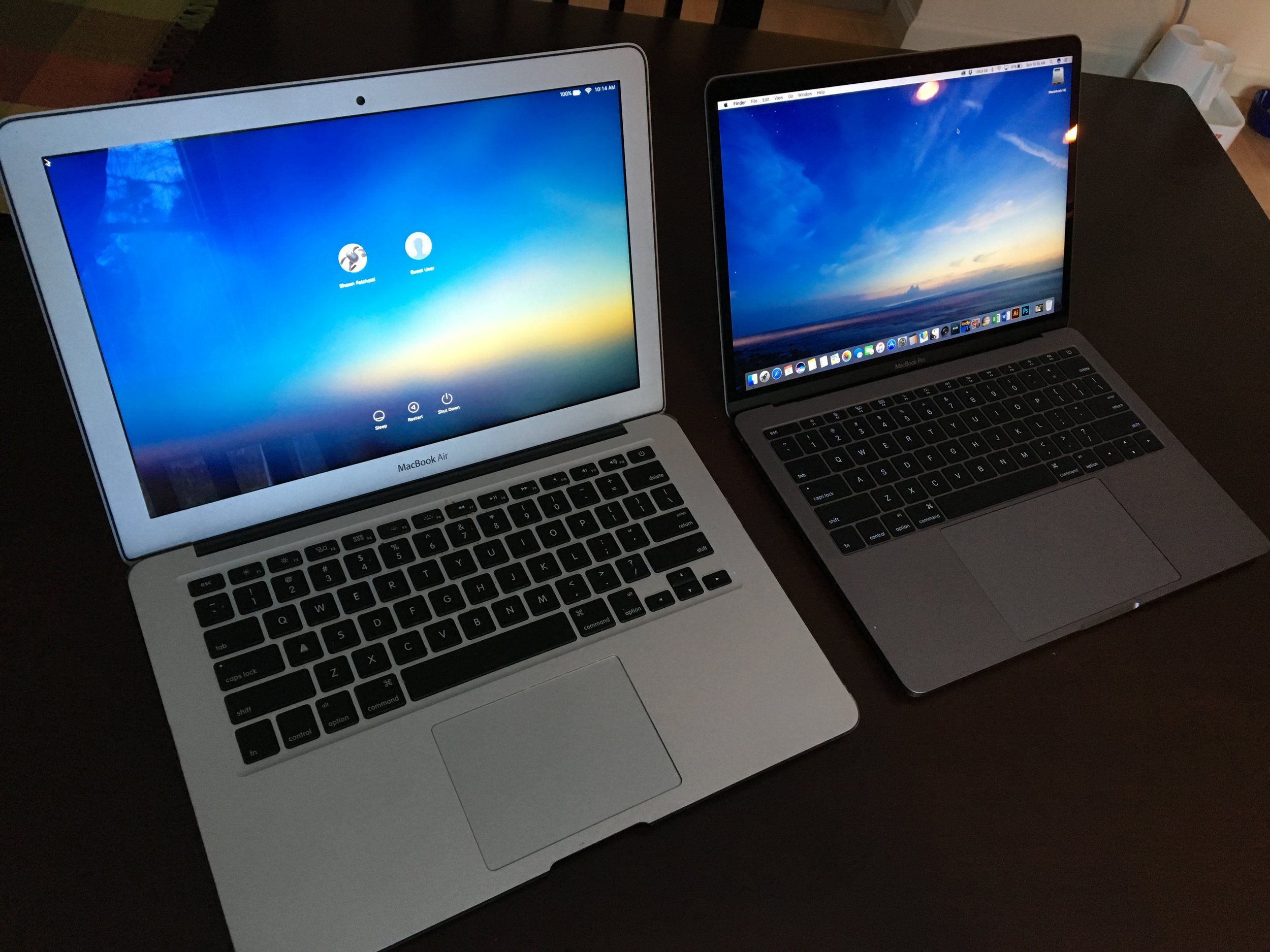
There's a little bit of perspective exaggerating the difference in that photo, but still, it's a huge difference. The second thing is the jump from non-Retina to Retina screen combined with the increase in color gamut. Here's the effect the resolution change has on the same text in Scrivener's binder:
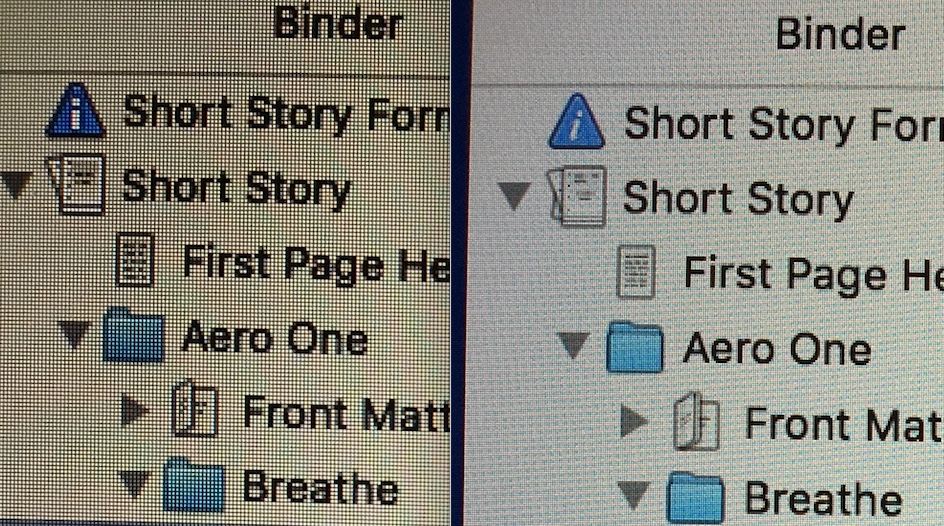
Left: Macbook Air display; Right: MacBook Pro
The color's a little harder to see in screenshots, although with your eyes it smacks you in the face:

Left: Macbook Pro display; Right: MacBook Air
So, this leaves the keyboard. Many YouTube reviewers said they hated it at first, but after a month, they loved it. I don't know if I'll end up there. I do realize I'll adjust to it the same way that I adjusted from typing on a desktop versus laptop. I haven't done extensive typing yet on the new keyboard, but during the days-worth of typing since buying the new computer I've adjusted and can type accurately. Both of my wrists get a little sore on the tops after typing, however, so hopefully I'll determine how to adjust my typing angle to avoid this. The clacky noise of the keys seem less than what I heard in the store the first time I tried it (although they're still louder than my quiet Air's keyboard). The little click at the bottom of the keystroke feels nice and is good feedback. I just wish the keys had dampening, or if they do, well, more of it. Fans of the keyboard say that the old style is squishy and unstable and the new keyboard is laser-accurate. I think it's a solution in search of a problem which made more sense on the super-thin MacBook than it does on the thicker MacBook Pro. All I can say about it is that you should try it in the store first. Here's a picture so you can see how much the keys rise above the laptop surface:

0.5 mm of travel. They keys are raised enough that you can find the right keys comfortably with touch typing, however.
A few other features which weren't major selling points for me, but really stand out:
- The speakers are fantastic. Loud and clear with nice bass and stereo separation. Probably the first laptop I'd consider listening to music with the built-in speakers.
- The ginormous touchpad is fun and I prefer it to my Air's
- The much-complained about USB-C change doesn't phase me. I bought a $10 adapter. I never used all of the ports on my Air. Only having two USB-C ports doesn't bother me, either, because with USB-C you can plug in hubs which give you as many ports as you need. Not being able to plug my iPhone into my computer without the adapter doesn't bother me because who physically plugs his iPhone into his computer anymore?
- The space gray color looks great, but it's a smudge magnet. This might be the first time I purchase a skin for the upper case.
So, there you have it. Once I write a story on it, I'll post an update on my keyboard experience.

The Customer is Always Wrong
I giddily trekked to test out the new Macbook Pro, only to have expectation and reality diverge.
For the past week I've hovered my cursor over the Bhphoto cart. Nestled inside was a space gray 13" Macbook Pro. Like a siren to rocks it beckoned me. Two hesitations prevented me from clicking the buy button:
- It's very expensive
- I read several reviews warning me about the new butterfly keyboard
To end my analysis paralysis, I decided to trek down to BestBuy and lay my hands on it. I was a bit giddy, envisioning finally making a decision, buying it, and unboxing it today.
Expectation and reality diverged, though, and I left empty-handed.
The keyboard was a deal breaker. I'd seen videos which showed the keys barely depress - only 0.5 mm of travel - but it didn't quite capture the experience of trying to type on them. It's somewhat better than trying to type on the glass screen of a virtual iPad keyboard. The keys are nearly flush with the surface (they are slightly raised), wide, and a little concave. It doesn't take much force to register a keystroke, and the key makes a clack when depressed. Here's my perception, compared to the keyboard of my current 2012 Macbook Air:
- I was able to touch type, but I made numerous typos. The height of the keys messed up my aim, and it was easy to catch the corner of a neighboring key.
- The clacking sound was louder than the quiet key presses of my Air. It wasn't a big deal, though. Still much quieter than the sound of a desktop keyboard. I found the clacking pleasant, although I suspect someone sitting next to me would think I was an angry typer.
- I felt that, with practice, I could acclimate to it and make less typos.
- My wrists and hands became sore as I typed. In fairness, some of this can be attributed to standing while typing. I typed a dozen paragraphs to try and get a feel for it. I also tried typing on some other conventional laptop keyboards for comparison. The more I used the Macbook Pro's, the more I felt I would dread using it for fiction writing.
So there you have it. "Dread using it" is never a good selling point. Which is too bad, because I loved the rest of the computer:
- The new, ginormous touchpad is fantastic. It doesn't actually move when you click it, but instead tricks you into feeling like you've clicked it through haptic feedback (vibrations). No matter how I pressed it I was always certain it moved and physically clicked. It felt better than my Air's trackpad, which actually does move and physically click - probably because the Air's is hinged and has a limited click angle.
- The screen is gorgeous. The saturated colors remind me of something you'd see on an OLED display.
- The svelte factor is nice. I liked that the Pro weighed the same as my Air.
As an aside, I also looked at the Surface Book by Microsoft. I'm an artist, also, and the pressure-sensitive stylus was a nice selling point. My perceptions:
- The keyboard on the Surface Book is a joy to type on. 1.6 mm of key travel (vs. Macbook Pro's 0.5 mm) and cushy dampening. I think this is an important point because it's not just how far the keys travel but also what happens at the end of travel and how much force it takes to press them.
- The Surface Book has a neat trick where the screen separates and becomes a 13" tablet. The tablet is remarkably light and feels great to hold. It also runs a full version of Windows 10. I could definitely see myself sketching in Photoshop with the tablet and pen on my lap.
- On the downside, and this was why I didn't buy it, the tablet makes the laptop's screen top-heavy. I am constantly picking up my Air by the corner and moving it around. It felt very awkward to do this with the Surface. Plus, when the Surface is closed it folds over like a newspaper. Carrying it around felt like carrying a Trapper Keeper.
For now I'm typing happily on my trusty Macbook Air. I had to admit that I'm disappointed that Apple peaked in knowing what its consumers wanted. I recall back in the 90s seeing colorful Macs with translucent plastics but passing them over because they just weren't functional for what I needed. They sure looked nice. The new Macbook Pros have moved back into this category for me. Hopefully Apple will get their act together, stop telling us what we want, and try listening.

Reviews and Ratings
Reviews turn the cogs of Amazon, but they also help me choose which storylines to explore.
This week I gave away all of my stories for free. If you missed the giveaway, you can still get any story for 99 cents.
If you read a story, I'd love to hear what you thought on Amazon or Goodreads.
You're probably like me when shopping for new books. Your eyes scroll down to the number of reviews and the book with no reviews gets skimmed past. It's a tough hurdle to clear as an indie author.
Besides just helping others find books, reviews are upvotes for storylines and characters. 43 Seconds has James and Ananke, Signal Loss has Kyan and Rios, and Aero One has Jia and Ping. Which characters would you like to hear more from? What will James do next with Bernard's Beauty? Will Kyan change his mind and use the card James gave him? What was the bigger story behind Watts and the crew of the Egret? Will Jia try and track down Ward? Your feedback will help me determine which storylines to develop.
Amazon asks for a star rating and a little text. The text can be brief. For example, one reviewer for 43 Seconds wrote "Smart and interesting. Looking forward to more from this author" (thank you!). Goodreads, on the other hand, allows you to just leave a star rating if you choose.
You get reach all of my books via my Amazon author's page and Goodreads author's page.
Thanks for reading my stories, and, as always, keep dreaming big.

Exit Row (1200 words)
When the captain said we didn't have enough fuel to land, the night was just beginning.
NON-FICTION
AUTHOR'S NOTE: Everyone's who's flown enough times has a few stories. This true story isn't so much about a rough flight as it is about a group of people with a choice to make, and how they handled it.
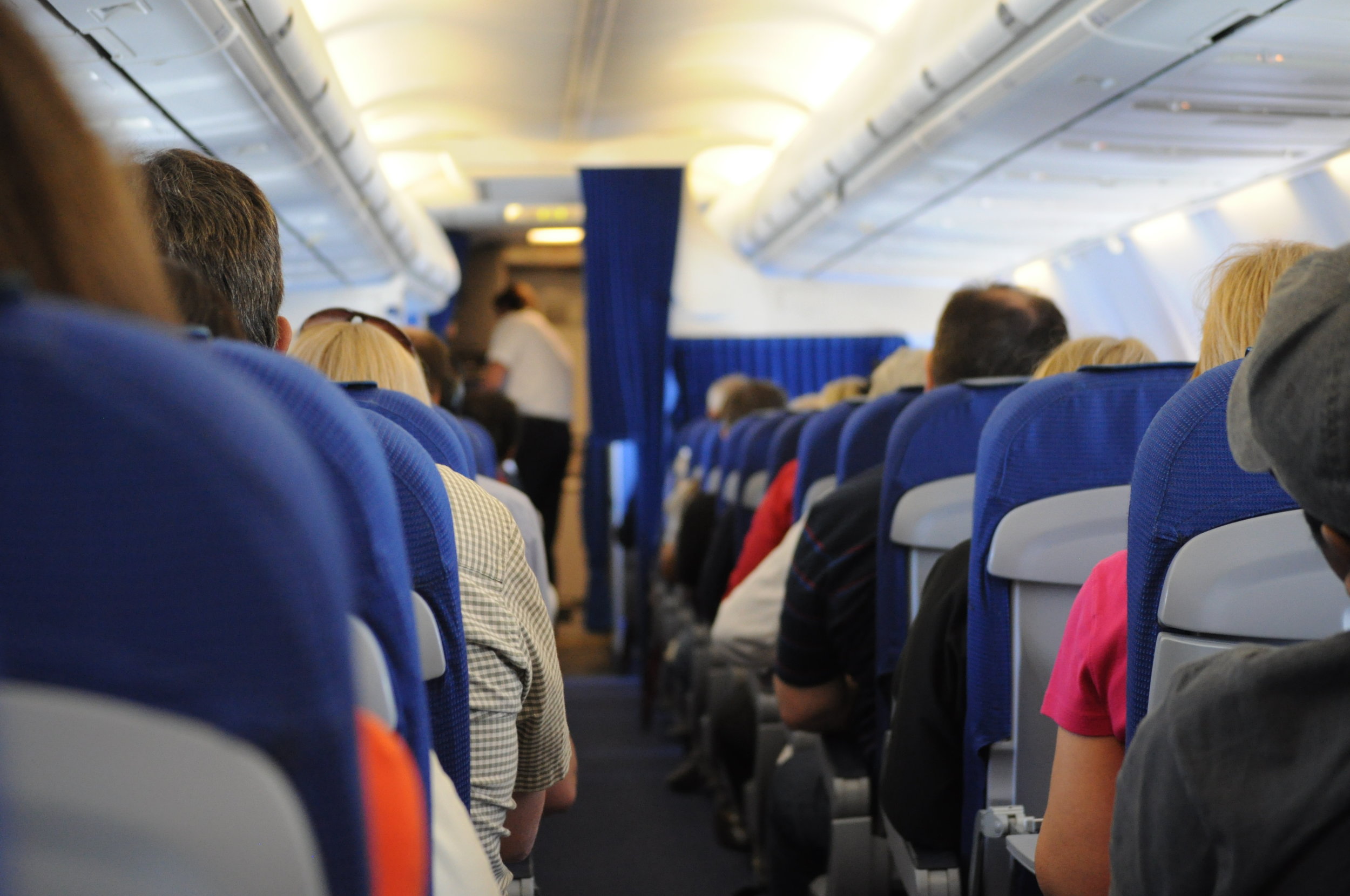
I turn the laminated emergency instructions over in my hand. The artwork is part infographic and part comic book. There’s something trendy about this style and there’s an odd simplicity to it, as if, standing in the pandemonium of a flaming fuselage, everything can be reduced to a Lego instruction.
My stomach drops as the jet careens over an invisible speed bump. I glance out the window. Sheets of rain, impenetrable clouds. I can’t even see the wing. A great hand slaps the jet from the starboard, jolting my head right, then I grow heavy with the seat pressing hard against my legs. My fingers curl around the arm rest. Up ahead, reality bends as the cabin twists left. I know it’s a trick of my inner ear messing with my perception because I am in the plane and can’t see it move, but I feel it flying off-axis. Winds push the nose one direction and tug the tail another.
We fight to line up with the runway when the engines rev with a cyclic whine and the seat pushes hard against my shoulders. I feel the nose pitch upwards and we blast back into the sky. The plane levels out. Minutes elapse, circling.
The man’s voice over the intercom is calm, reassuring. “This is the captain speaking. You may have noticed we ran into some crosswinds and things got a bit choppy, so we needed to abort the landing. We don’t have enough fuel for another landing attempt, so we’re getting some instructions from the tower. Hang tight.”
I raise my eyebrows and exchange glances with my seat mate. “Did the pilot just say that we don’t have enough fuel to land?”
The man shrugs in response.
Step one of the emergency brochure is visible above the seat pouch. A red rotational arrow indicates how to release the exit door. I study it.
“Uh, this is the pilot,” chimes the speaker. “So, I’d like to clarify that we have enough fuel to land, but if we need to abort the landing we will not have enough fuel to power back up to a holding altitude. Looks like we’re going to a different airport where the weather’s better. Should be about fifteen minutes.”
The analytical side of my brain ponders how this works from a fuel consumption standpoint. I glance at my watch. 11:15 PM.
Rain continues to pelt the window during fifteen minutes of uneventful flight. Gravity eases as we descend, and, out of nowhere, the runway appears a few feet beneath us. Wheels bounce and squeal. Everyone leans forward in a coordinated lurch. Once the plane has stopped, the pilot informs us we are in another state, he’s waiting on a decision to either refuel or deplane, and we can use our phones.
The blue glow of a hundred phones springs to life. I text my wife. Weather trouble. Will be late. Don’t wait up.
A murmur filters through the passenger cabin. People are forming sides: deplaners versus refuelers. I am a deplaner. We don’t really get a vote, but it’s what people do.
We all sit inside the plane for twenty minutes. I swipe through Google Maps trying to figure out where we are. GPS locates us. We are nowhere.
“Uh, this is your captain speaking. Looks like we’re going to deplane.” A small, happy cheer sounds from the deplaners. “We’ll work out transportation to get you back.”
It’s a tiny airport. After we shuffle off the plane and meander through the gate we all find ourselves herded next to the baggage claim conveyor. It’s near midnight and the only employee is a young man wearing a fluorescent orange vest. He’s cheerful. “Hey, folks. Grab your luggage and make yourself comfortable. We’ll try and get some buses here to drive everyone back.”
Google Maps shows a two hour drive. I’m looking forward to dozing off on the bus.
The woman next to me is a refueler and is unhappy with the bus option. We chat for a minute before the conveyor buzzes. I fetch my luggage, find a seat, and use my suitcase as an ottoman. I’ve got my earbuds in, tuning out the world in favor of a playlist.
I don’t see the orange-vested man for forty-five minutes. When he reappears, he says, “No luck with the buses, but we’re working on vans.” Another forty-five minutes goes by. “No luck with the vans, we’re working on cabs.”
At this point, the passengers have assembled themselves into Survivor-like clans. The refuelers are having another go at convincing people to fly back. The disgruntled are discussing formal complaints to the airline. A group of men have Googled a limo service and are looking for people to go in on the cost with them. This doesn’t seem like something I can expense. I’m still listening to my playlist.
I glance at my watch. 2:10 am. The orange-vested man returns. “We’ve got some cabs. They’ll be coming in as they’re available. First one should be here in ten minutes. If you can gather your luggage and follow me, we’ll wait out front for them.”
Our herd trudges forward, passes through the sliding doors, and stands behind the concrete pylons of the taxi stand. It’s still raining, but we are under an overhang. The breeze is cool and the night has the stillness of early morning. I find it a bit refreshing.
Ten minutes pass before headlights snake their way along the airport road. We all follow them with our eyes. As they grow nearer, we collectively realize it’s a standard yellow cab sedan. Three people can fit in the back seat.
I straighten. Seventy-six tired and grumpy people are standing in the rain at 2:20 am. We must choose the lucky three to enter the cab. I am expecting a Hunger Games event.
But, that is not what happens. There is a couple with an exhausted mother-to-be, looking very pregnant. The crowd shuffles them up from the back, parting, and nominates them to go first. No one says anything. We just all agree. There is a certain camaraderie to our group, a shared trial overcome. The woman thanks everyone as she slips into the cab with her husband.
The next couple to go is an older husband and wife who have been traveling all day. We help them to the front of the line.
And so it goes on, a new cab arriving every five to ten minutes. It’s peaceful, orderly. The orange-vested man continues to be cheerful, smiling, opening cab doors for people. I am in the last group. When he opens the door for me, I shake his hand and thank him. His positivity was infectious, and he made a long night a little better.
During the two-hour ride home the cab driver talks and texts on his phone. The car rocks like a ship in a storm, windshield wipers flicking at full. I close my eyes and put my headphones in.
When I finally walk into my bedroom, my wife is asleep in the dark. I change and crawl into bed with her. She stirs and murmurs a greeting, and I place my hand on her arm.
Orange digits on the alarm clock glow 5:46 am. I close my eyes for four minutes before the alarm goes off.

Aero One - Story Extras
Survial stories need rules, and I talk about Aero One's. Plus, some fun tidbits you might not have noticed on the first read through.
SPOILER ALERT: If you haven't read Aero One, get yourself a copy. For 99 cents you can enjoy a 9500 word sci-fi adventure. This post discusses plot points with some spoilers.
The idea for Aero One came from an illustration showing He3 mining with an aerostat suspended from what looked like a weather balloon. It gave me the idea of a hot air balloon ride in the atmosphere of Uranus, and that evolved into the thought of someone trapped in an aerostat navigating the planet's winds.
My first draft of the story had ramjets ferrying He3 up to orbit from each aerostat. When Jia and Ping arrive, they find the ramjets missing and locate them on Uranus's moon Miranda. It was a fun investigation which had some memorable imagery, but the logistics of the whole He3 mining operation didn't make sense. I kept thinking: that seems overly complicated - why would anyone do it that way? So, I stopped writing the story, opened a new file, and worked out all of the details of how the aerostats worked.
Sometimes in sci-fi you don't need to know how things work. For example, we were all fine not knowing exactly how Star Trek's phasers worked. Other times you need the details (or at least the rules). So here are the rules for the aeros:
- The aeros fly in a 12,000 km wide counterclockwise loop
- The aeros fly at 100 kph
- Doing the math, it takes 10.8 days for an aero to complete the loop
- At the end of the loop, the aero docks with Cloud Nine and empties its tank
- There are 24 aeros spaced every 1000 km. This means every 10 hours a new aerostat docks at Cloud Nine, empties its tank, and returns to the loop
Cloud Nine needs rules also:
- Cloud Nine processes what the aeros offload and separates out the He3.
- Cloud Nine is the air traffic controller and autonomous command center for the aerostats. It has its own repair facilities for repairing aerostats. The repair facility can be operated remotely, if needed. Ping mentions doing telepresense repairs in the story.
- Sometimes techs need to come down to Cloud Nine to either repair the platform itself or do repairs they can't do remotely. They use Cloud Nine's ascent vehicle, the Crane, to shuttle to and from orbit.
- The Crane can lift 100 tons of He3. Every month a cargo ship arrives in orbit and the Crane launches and transfers its He3 cargo to the ship via an orbital transfer platform.
As soon as I realized people might need to come down to Cloud Nine, it meant Cloud Nine needed to have clear emergency procedures and areas to deal with people being injured. A suit breach, for instance, would be catastropic without a warm, pressurized area to retreat into. With a twelve day wait for rescue, the emergency area would need to be a full habitat. It would also need to have spare suits.
As an engineer I work in an industrial facility. In the event of an emergency all equipment is shut down until the emergency is resolved. It seemed the same would be true of Cloud Nine. It would not keep flying in aerostats while rescuers were trying to get to the platform, nor would it do things like filling launch tanks when people might need to use the runways or ascent vehicle.
Once I had all of these rules, the story assembled itself. I thought about each next step Jia and Ping would take for their survial, what would happen when they did, and how it would affect Ward's plans. I can say that, if you're writing survival stories, your characters will try to take things apart, improvise, and work around their constraints. I struggled at first with Aero One because I hadn't worked out the constraints.
Now for the geeky fun stuff. Here's a few subtle things you might not have picked up on when reading the story:
- The Prosperity approaches the loop from the east end, flying west towards Cloud Nine. They end up overshooting Cloud Nine by 38,000 km. This means Prosperity is orbiting Uranus east to west, which is the opposite direction satellites typically orbit Earth. This is because Uranus rotates the opposite direction that Earth does.
- Jia and Ping lie on the floor of Aero One partly to avoid contact with the cold exterior walls, but also because heat from the aero's core warms the floor. Ping mentions casually that it's warmer inside the aerostat than outside.
- Just before Jia blacks out, everything to her left floats up and hits the ceiling, while everything to her right falls to the floor. This is because the Prosperity is spinning about its center axis as a result of the explosions in the battery room.
- Aero One's parachute deployment sequence is modeled after the Apollo mission's reentry capsule. If you think about it, Aero One needs to get from orbital speed (several kilometers per second) to deployment speed (nearly stopped) just through wind resistance and parachutes, without killing everyone from deceleration. Fortunately Uranus's atmosphere is much taller than Earth's, and the deceleration is spread over a longer timeframe.
- Sucrose is C12H22O11. As the story mentions, it's carbon, hydrogen, and oxygen. These elements are present in breath and water. Presumably the suits have a mechanism for stripping apart and reassembling molecules, and the water lost to create sucrose is factored into the suit's two week operational life.
- Jia references her IFR training when flying in the murk of the troposphere. Instrument Flight Rules (IFR) are aviation regulations used when visibility is poor. Visual Flight Rules (VFR) are used when you can see where you're going.
- The diamond heating pattern Jia feels when turning on her suit's heater is a nod to Kim Stanley Robinson's Red Mars.
- Astronauts overheating in space suits has occurred at least twice. In 1966, Gene Cernan needed to abort a spacewalk when vigorous physical activity caused his body to produce more heat than his suit's cooling system could handle. His pulse spiked at 195. In 2006, A bent water pipe compromised the cooling system of cosmonaut Alexander Kaleri, forcing him to return to his ship.
- If you do the math based on the distress signal response and Ward's ultimatum, poor Jia and Ping only get two hours on Cloud Nine. It's just enough time for a shower and a bowl of soup. Life is never easy for heroes.
Hope you enjoyed the story. Thanks for reading!

The Karate Tournament and the Baked Potato (1000 words)
Today my wife drove by a Wendy's and found herself remembering a true story I once told her. When she mentioned it at dinner, I had an urge to put pen to paper. Usually I write fiction, but sometimes it's fun just to tell a silly story about something that happened long, long ago
NON-FICTION
AUTHOR'S NOTE: Today my wife drove by a Wendy's and found herself remembering a true story I once told her. When she mentioned it at dinner, I had an urge to put pen to paper. Usually I write fiction, but sometimes it's fun just to tell a silly story about something that happened long, long ago.

The header image for this story is not a stock photo, by the way. It was taken at the actual tournament in 1990. The person in the black uniform (who's not doing well in the photo) is one of the five black belts in the car with me in the story.
THE KARATE TOURNAMENT AND THE BAKED POTATO
I sit in the back seat of a faded yellow car surrounded by five black belts. The car rocks back and forth coasting on the slick asphalt as the radio stutters in bursts of music and static. Lightning flashes white and gray. For a moment, we see silhouetted telephone poles against storm clouds. Streaked rain drops scatter in parallel incandescent headlight beams as the metronome whirl of the wipers goes click-clack, click-clack.
Michael is driving. It’s his car, and he’s still wearing his gi. We’re thirty minutes into the ninety-minute return drive from the Coal Kickin’ Karate Tournament. A few gym bags rest at our feet. Some have gold trophies poking out. Mine does not.
The car hits a bump and the wipers freeze mid-stroke. Through the windshield I see the headlights extinguish. All of the dashboard interior lights wink out and it seems the car is speeding much faster than it was when I could read the speedometer. We are a four-thousand pound ballistic missile ploughing through the darkness. No one reacts to this but me, and all I do is a slow double-take, reading everyone else’s expressions.
Michael raises a fist, hovering it high by the mirror. I wonder if he’s angry. Fonzerelli-style he smashes the dashboard, and, to my surprise, the interior lights snick back into existence. The road ahead is awash once again in the gold arc of high beams. The wipers are frozen, still, mid-windshield.
His fist is curled, poised for another strike. He adjusts it two inches right, slightly forward, raises, smashes down. Nothing. One inch right, slightly back, smash. Nothing. The downpour is relentless and splatters the windshield. Reflections from the road twist and turn in curlicues, bending reality like a fun house mirror.
Our driver curses, leans forward to improve his visibility. I feel blind, lean backwards, pushing my feet against the front seat. He squints. Both hands are at the twelve-o-clock position on the steering wheel.
I look at my watch, press the backlight button. It reads five past eight.
He shifts his weight, reaches for something with his left arm, then the rhythmic clunking of a window manually rolling down. The sound of rain and highway escalates with the cabin breach, and spatters of water splash their way into the back seat, cool on my cheek. Michael sticks his entire left arm and head outside the driver’s window, right hand still in the twelve-o-clock position. He’s getting soaked.
Far up ahead on the right side of the road is an oasis of light, red and white. I can’t read the sign through the drenched windshield, but I recognize the logo. Wendy’s.
The black belt next to me stirs. “Okay, I know what to do.” He’s a big guy, and has been quiet the entire trip. “We need a potato.”
No one asks what he means. We all just wait.
He holds his hand palm up, explaining. “We get a raw potato, cut it in half, rub it all over the windshield. The starches in the potato will repel the water, and we’ll be able to see through the windshield.” We stare. He shifts. “I saw it on Oprah.”
I think about it. It seems plausible. Scientific, really.
We pull into the Wendy’s drive-through.
The speaker crackles, “Welcome to Wendy’s. What can I get you?”
Michael’s hair is matted to his head, beads of water streaming down his face. He glances back at us, questioning. We silently egg him on and he sighs. His voice is gravely. “I’d like one potato.”
“Would you like that with sour cream and chives?”
“No. Not a baked potato. I’d like one raw potato.”
The expected pause occurs. “Uh. I don’t know that we can do that.”
“Sure you can. You must have potatoes, which you bake, to make baked potatoes, so, give me one of those. Just don’t bake it.”
“Uh, yeah, okay, I’ve got to ask my manager about that.” The rain patters on the roof while we wait and the group exchanges glances. There’s a shuffling of background noise from the speaker, then the cashier comes back on. “That’s one forty-nine. Please pull forward to window two.”
So, we drive to window two. The cashier eyes us briefly. Michael deposits a dollar and two quarters, and the cashier relinquishes a white bag. Michael tilts it forward to inspect, and we all peer over his shoulder.
One potato, one white plastic fork, one napkin, ketchup packet, salt and pepper packet, receipt.
We find a space in the Wendy’s parking lot. For a brief second, I wonder what we’ll cut it with, but one of the black belts has popped the trunk and produced a samurai sword. He bisects the potato.
The honor of potato application goes to the idea originator. He slathers it across the windshield. He’s the Bob Ross of starch painting. We all get back into the car.
The rain splashes onto the windshield, and we wait. Bits and clumps of potato pulp slide down, casting shadows in the orange wash of the street lamp. Through the windshield, reality is still bent into curlicues, but now the bend has taken a fuzzy smear, like a sixties television show using a soft lens to portray beauty. It’s even worse.
The driver gets out, grabs a towel from his bag, and wipes all of the potato starch off the windshield. He climbs back in, leans his left arm and head out the window, and drives back onto the road.
I glance again at my watch. Fifty-eight minutes to go.
“Maybe slow down a bit?” suggests someone.
The driver says nothing. Our speed doesn’t change. For the next five minutes we drive, no one talking, just bursts of radio music and road noise.
Then, for no reason whatsoever, the windshield wipers wake up, continue their stroke. Click-clack. It’s like the scene from Close Encounters when the UFO leaves and everything in the car works again. We nearly jump.
Michael rolls up the window, wipes his face, and puts his hands back at the top of the wheel. I can see the whites of his knuckles from where I sit.
No one mentions the potato idea, or the wipers, or the drenched seats for the rest of the car ride home.
END
Here's the one picture of me at the same tournament, still sporting my 80's hair:

I know, bad form for a front kick. Told you I didn't win. But I think the girl in the purple shirt is checking me out.

My $1.34 Ad Campaign
One of the lesser known benefits of Kindle Select is the ability to create Amazon ads. There it was, the ad button, beckoning me. Of course I pressed it.
At the end of this past week my ninety-day exclusive Kindle Select contract with Amazon expired. One of the lesser known benefits of Kindle Select is the ability to create Amazon ads. There it was, the ad button, beckoning me. Of course I pressed it.

"Maybe it does something good, maybe it does something bad."
You have two ad options: sponsored or product. Sponsored ads appear with keyword searches. Products ads appear when people look at specific books.
I chose Sponsored. You enter the title and description text for your ad, choose a daily budget and your keywords. Amazon suggests several based on phrases which have led to your book, but you can add custom ones.
And now, the tough part: determining the maximum bid for each keyword. When someone enters your search phrase, Amazon checks all the active ads using these phrases and the highest bidder wins. The actual bid will be one penny above the second place bidder.
Note you don't actually pay anything at this point. This gets you an impression (that is, your ad appears on the search page). Impressions are free. You only get charged if someone clicks on the ad.
What happens after the click doesn't matter. You pay once the click occurs, regardless if a sale occurs.
So, the internet told me to expect 1 click every 1000 impressions. Somewhere between 1% - 10% of those clicks will turn into sales.
And...math. My 99 cent book pays me a 35 cent commission. If I could miraculously manage a 100% click-to-sales rate, then it would be unwise to pay more for a click than my commission ($0.35). At a 10% click-to-sales rate, I shouldn't pay more than 1/10 of my commission. This caps my bid at a depressing $0.03.
So, I start with that, just to see what happens. And....zero impressions. Everyone's bids are higher than mine.
In the spirit of science, willing to take a loss, I up the bid. My max daily budget is capped at $6, so, I can't get into too much trouble. Amazon's ad dashboard actually encourages tinkering by showing you all of your keywords, bid amounts, impressions, clicks, and sales.
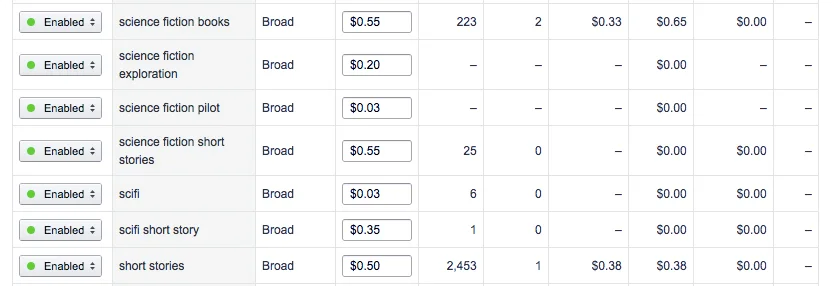
You can quickly deduce from the screenshot that "science fiction books" at 2 clicks in 223 impressions is a much better match than the general "short stories" at 1 click in 2453 impressions.
After after two days, my rate looked like this:

Similar to what the internet told me. One click every thousand impressions. My average winning bid was $0.34. Which, incidentally, means that my book would need to sell at $4.85 to break even on the ad.
I think that, with some keyword tinkering, I could probably lower my max bid and still get impressions with better targeted keywords. You can see "sci-fi" in the first screenshot has a CPC bid of $0.03 and still got 6 impressions. I think, though, it's probably not worth it to do ads for 99 cent books.
The real time analytics of the dashboard were helpful though to see how different keywords performed, and this gave me some data to update my book's regular sale keywords.
At the end of the ad run, I only had the 3 clicks, costing me $1.34. There were no sales, but I did get some insight into how different keywords performed, which was not a bad investment for a little more than a dollar.

Story Shorts
Take a second and glance up at the menu, on the right. I'll wait.
Find it? The new menu item just before the newsletter? I'm not selling athletic wear. In fact, I'm not selling anything. Those SHORTS are story shorts, and they're free.
Take a second and glance up at the menu, on the right. I'll wait.
Find it? The new menu item just before the newsletter? I'm not selling athletic wear. In fact, I'm not selling anything. Those SHORTS are story shorts, and they're free.
Some of them will be bonus scenes to existing stories, like those DVD extras you get with director's cuts. Others will be new characters or subplots I'm trying on for a bit. They're not full short stories, just vignettes to capture the flavor of an idea, or answer a few open questions from a published story.
They're posted as a blog, which means you can comment on them. If you read a short you like, and want me to write more of the story, let me know in the comments. Shorts which gain traction may become full blown stories.
The first two shorts are posted:
- Last Stand: Kyan testifies about what he found aboard the Resolve, but other agendas are in play. (2600 words)
- Red, Blue, Green: Miyu thinks she's spotting for a data breach, but her life comes apart in an instant. (1500 words)
Hope you enjoy them!

Red, Blue, Green (1500 words)
In Last Stand, Larson references an organization of radicals. I began fleshing out details of what they're trying to accomplish and how they might operate. Miyu is a character concept for this. This short contains no spoilers and can be read independent of the other works.
AUTHOR'S NOTE: In Last Stand, Larson references an organization of radicals. I began fleshing out details of what they're trying to accomplish and how they might operate. Miyu is a character concept for this. This short contains no spoilers and can be read independent of the other works.
This is a short. It's not a full story, but it is a character and concept study. If you'd like to see more of this storyline, please leave comments.
RED, BLUE, GREEN
Miyu crossed the street, titled her head so her sweatshirt’s hood draped over her face, and stepped inside the bar. An assault of bass and decade old music accompanied the smell of spirits and sweat. She pushed past the crowd, down a crimson hallway, and into the restroom. A click as she locked the door. With both hands she leaned on the sink, glanced up. Brown eyes, twenty-something face, a crescent of color-shifting hair dangling over one cheek.
“Breathe,” she said to her reflection. She reached under the sink, searching, and caught something. A blank, square card. When she pressed the corner a keypad inked itself onto the surface. As she eased the pressure the digits sank back into the card. She pocketed it. The door handle rattled behind her.
She went out the door, down the hall. A man tried to flag her, get her to have a drink, but she pulled her arm away and then was outside, flowing with the crowd, the streets a neon mix of electric blue and carmine red. When she was a few blocks from the bar she ordered a cab, composed herself as she sank into its seat, and stared out the window at the endless rectangles of streaking skyscraper lights. Ten minutes later she was taking the elevator to her apartment on the twenty-sixth floor.
Accent lights awoke as she opened the door. She crossed the room to her balcony, slid open the glass panel, and grabbed a slate off a table. The twinkling spiderweb of city lights and streets greeted her, nearby buildings showing glimpses into people’s lives.
A telescope rested here. Miyu sat beside it. The coordinate screen illuminated as she considered her square card. A press of her thumb revealed the keypad. She tapped in her code and two rows of paired digits raised up beside her thumb. She transcribed the first row’s digits into the telescope’s coordinate screen and servos whined as it adjusted to the destination.
She peered into the eyepiece. Through the lens, a black-haired man sat on a bench, hands in his pockets. Miyu reached up with her right hand, tapped a black cylinder mounted atop the telescope, then clipped a mic onto her right earlobe. A synthetic voice in her ear said, “Tightbeam connection established. Handshaking. Encryption active.”
“Okay,” Miya said, “spotter on comm.”
The man nodded, “Nice night. First time?”
Her hands shook slightly. “No.”
“You sound a bit nervous. Linked up?”
“One second.” She entered the second row of digits from the card into the telescope. It swung off axis and pointed high in the sky. There, barely perceptible against the stars, a black drone hovered in silence. Miyu spliced in the tightbeam link and the synthetic voice said, “AV datafeed. Slate link enabled.”
She tapped the slate and it paired, displaying the drone’s video. From its altitude the city was a spindly lattice of amber and sapphire light. Miyu pushed the man’s coordinates to the drone and the image zoomed onto organic green shapes with circles of light. The figure on the bench was small but in the wide field view she could see all of the adjoining streets and the flow of traffic moving past. “Yeah. We’re good.” She leaned back into the chair, tapped the slate, and patched the telescope feed into a separate window. “What should I call you?”
“Let’s stick with protocol.”
“Sure.” Runners are red, spotters are blue.
Red stood up, began walking. He was maybe thirty, handsome. Looked familiar. He left the park, headed down Wayburn Street. Both the telescope and drone followed him.
“You done many runs?” Miyu said.
Red glanced around at no one in particular. “Green online?”
A hesitation. "Not yet.”
“Not going to get very far without him.”
Miyu’s earpiece chimed from an incoming connection and a young man’s voice joined the channel. “Uh, hey, guys. Sorry. Running late.” A moment of no one talking and the man seemed to take the cue. “Oh, yeah, uh, breacher on comms.”
She resisted the urge to look around, to try and guess where Green was watching her. He’d received a card with her coordinates the same way she’d received one with Red’s. “Welcome to the party, Green.”
Red walked briskly now, crossed a sidewalk, waited at an alley entrance.
Miyu eyed the drone’s feed. “Clear.”
Red entered the alley, went to a dumpster and knelt down beside it, fishing underneath with his right hand, then slid out a black case and opened it. Miyu zoomed. Two silver cylinders, a slate, and a pistol. He gripped the pistol and spoke a passcode. The gun’s safety light cycled to armed.
Miyu placed her hand over her mouth as Red tucked the items inside his jacket.
“Well?” Red asked.
She snapped back to attention. “Sorry. Street’s clear.” A hesitation. “What’s the gun for, Red?”
“What?”
“I thought this was just a data breach.”
Red walked with his hands in his pockets, determined. “You just need to get me into and out of the Onyx building. Let me and Green worry about what happens in there.”
Miyu panned the telescope to the Onyx building. A few office lights scattered in remote patches. “There’s still…there’s still some people there.”
“And Green’s going to keep me away from them.”
Miyu heard Green taking quick breaths on the comm. He said, “Hey, Blue, don’t worry about it.”
“Don’t worry about it? Red’s got a pocket full of binary explosives and a pistol.”
Red’s voice raised, “You should be watching my back, not peeking over my shoulder.” He was one block from the Onyx building.
“It’s fine Blue, we got it,” Green said. “C’mon, c’mon, we need you.”
Red sighed. “We can do this without her.”
Green hesitated. “No, no. We need her. Stay on the line, Blue.” He waited a second for her response. “Blue?”
Miyu furrowed her brow. She watched the top-down view of Red walking, twenty meters to the entrance, then she looked to the side, thinking. A quick tap of coordinates on the slate and the drone swung off axis, panned, zoomed to her location sitting on the balcony. She swung its view down to street level, pulled it back to wide view. Moving in the darkness along the alleys flanking each side of her building were two lines of figures. She tapped the image into daylight mode and saw the agents, the rifles, the government logos. Both groups came to a stop just before the building’s front, waiting.
The air emptied around her and she struggled trying to take breaths. She grabbed her forehead with a handful of hair and tried to think. She knew where Red was. Red didn’t know where anyone was. Green knew where she was and where Red was going.
Green’s voice had an edge, nervous. “Still with us, Blue?”
She panted and swallowed, summoned enough spit to speak. “Uh, Red.” Her voice shook. “Green’s burned us. Run.”
“What?”
Miyu grabbed the slate, saw the agents surging forward towards the main entrance. In her earbud she heard men shouting, Red breathing hard, the sounds of running. She ripped the earbud out and tossed it off the balcony, then she bolted into her apartment, opened the closet, found the go bag. The slate was still in her hand. She swiped it into offline mode, dropped it in the bag, grabbed the duffel, and ran to her door, cracking it open.
Through the slit of the open door she saw the elevator up arrow glowing, floors ticking higher. Fourteen, fifteen, sixteen. She opened the door, stepped out, closed and locked it, then ran to the stairs. She took the steps two and a time, going up one flight and emerging into the hall. Apartment 2704 was three doors down. Leon’s. Sales engineer. Always traveling. She’d hacked his manual entry code a few months ago just for this reason. In a second she had the door open and was inside. It was nearly directly over her apartment one floor below.
She hit the manual switch before the lights turned themselves on, keeping the room in darkness. Quietly she locked the door, crossed to the kitchen, and leaned one hand against the wall, trying to catch her breath. Right about now the agents were overriding her apartment lock and swarming in with rifles drawn, claiming what was once her life. She could never be Miyu again.
A gleam of reflected light caught her eye, and she spied Leon’s liquor stash in the nearby cabinet. She found a nice bourbon, splashed some in a glass, and tried to steady her hand enough to take a sip. As its warmth filtered through her, she held her hand to her mouth, crying without sound.
END

Take My Book, Please
Recently I tested the Facebook Boost Post button, despite the internet telling me never to press it, and, not surprisingly the only effect it generated was vacuuming a ten dollar bill out of my wallet.
I've been trying inexpensive marketing experiments. Recently I tested the Facebook Boost Post button, despite the internet telling me never to press it, and, not surprisingly the only effect it generated was vacuuming a ten dollar bill out of my wallet. Like a gambler watching the dealer scoop up the chips of my losing hand, I slapped another ten on the table, took a swig of my drink, and said, "Deal 'em again, Sam."
I decided to change up the game, however. The past two week experiment has been with Amazon Giveaways. Amazon makes it very easy to set up a Giveaway either for your physical or digital book. Just scroll to the bottom of your reviews, and you will find the Giveaway button after the last review:

Next, you choose your lottery options. I chose Random, 1 in 50 chance, 10 prizes to give away. Amazon informed me this would result in somewhere between 450 - 500 entrants. Note you are purchasing however many copies you plan on giving away at the time that you set up the giveaway, but on the plus side you will get royalties for these purchases (at some point, more about that later):

Next, you set any requirements to enter. You can set no requirements, or require people to follow you on Twitter, or Amazon, view a video, or take a poll. I chose Follow S.D Falchetti on Amazon:

Incidentally, you should follow yourself on Amazon. This way you will see what the button does. As I suspected, followers get notifications of your new releases with links to buy them.
You set the duration (I chose the default 15 days). There's also a legal note that only US residents can enter, which seems to be an Amazon requirement.
On the last screen, you add your win/lose messages, and product details:
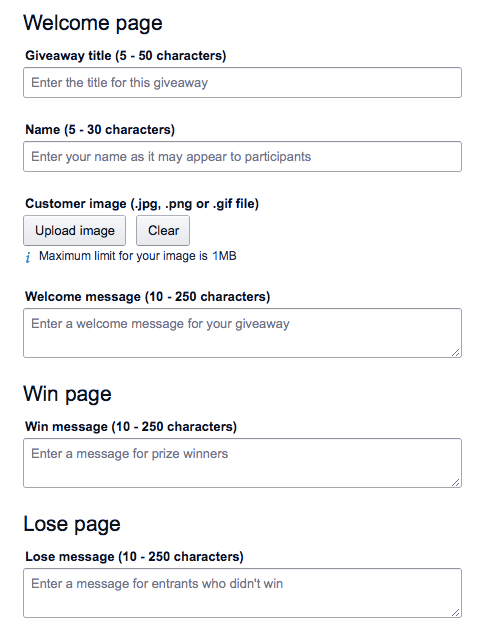
In the win message, I thanked them for entering and asked them to leave a review. In the lose I suggested they download the free sample.
You can also upload a custom image for the giveaway. I suggest doing this, because I left it at the default Amazon product image which resulted in Twitter cropping the book cover to this:

There is no way to edit the Giveaway once you submit it. The only way I was able to fix this was by making a custom graphic and using Twitshot to attach it to the link:

Once you submit it, it will go live probably with an hour. It's up to you how to promote it:
- Share the giveaway link directly with a specific audience (email it just to your newsletter followers, for example)
- Share it with everybody. The easiest way to do this is to use the #AmazonGiveaway hashtag in Twitter, which will be picked up and retweeted. I should mention that many people enter giveaways for fun, and not everyone who wins a copy will read it.
I posted it on my Twitter account with the #AmazonGiveaway hashtag. Within one hour 380 people (out of 500) had entered, winning 7 of the 10 books. Then, it petered to a trickle. I got 1-10 entrants per day for the remaining two weeks. Two more books were won, and I was left with one unclaimed book when the giveaway ended. Amazon allows you to set up a new giveaway for unclaimed books, or simply gift them to people. I gifted it.

How it all panned out:
- 9 out of 10 prizes claimed, most within the first hour
- 460 new Amazon followers
- Zero new sales
Royalties:
- As people won prizes, royalties for those prizes showed up on my royalties report.
Sales Reports:
- The 10 books I purchased as prizes did not show up in my sales report until all 10 books were claimed. Because I had one book left after the giveaway concluded, it was not until I gifted that remnant and the person accepted the gift that all 10 sales showed up in my sales dashboard at once.
Sales Rank:
- The giveaway had zero effect on my Amazon sales rank, even when the 10 books finally showed up in my sales dashboard. I found this odd because if I bought ten copes and simply gifted them, they would show up as both sales and sales rank.
Reviews:
- I'll admit, I didn't expect any reviews. Review-to-purchase ratio on Amazon is between 0.1% - 1%, so you really need to sell more than a hundred copies to have a chance at one review. But, one of the prize winners did leave a 5 star review (thank you! you're awesome!). She wrote:
I won this through a giveaway and very thrilled I read it. Once I started reading it I couldn't stop. Would of definitely bought and looking forward to reading more from the author.
All in all, not a bad experience. I picked up a few hundred Amazon followers, who will get notifications as I publish new releases, and a 5 star review. I might do it again for another book.

Aristarchus Mission Patch
I've enjoyed illustrating the covers for 43 Seconds and Signal Loss, and thought it would be fun to render the Aristarchus's mission patch.
In Signal Loss, Kyan and Harmony wear matching baseball caps with the Aristarchus logo. In the first draft of the story I described the logo having a sunburst pattern above the ship's name, but the description was edited out to pick up the intro pace.
I've enjoyed illustrating the covers for 43 Seconds and Signal Loss, and thought it would be fun to render the Aristarchus's mission patch. In the story, Kyan's cap and flight suit are ocean blue, so this formed the reference for the logo's color scheme.

Fun, huh? It picks up the story element of the Earth being occulted by the Sun while also illustrating the Greek astronomer Aristarchus, who was the first to propose the Earth revolved around the Sun (bet you thought it was Copernicus or Galileo? Aristarchus was a millennia earlier).
Enjoy!

Data Running - Story Extra
In Signal Loss, Kyan Anders is a data runner. I envisioned this as the data equivalent of the Planet Fitness commercial, "I lift things up and put them down." So, what exactly is a data runner, and why would it be necessary in the future?
In Signal Loss, Kyan Anders is a data runner. I envisioned this as the data equivalent of the Planet Fitness commercial, "I lift things up and put them down."
So, what exactly is a data runner, and why would it be necessary in the future?
Consider this: Let's say you live in New York City, and you want to move a terabyte of data to Philadelphia. What's the fastest way to do it?
- Transmit it over the internet
- Pick up the drive with your hands and walk it to Philadelphia
This may require a #2 pencil and a calculator. Show your work:
Let's say you're a residential internet user with Comcast. I ran the Xfinity speed test and got an upload speed result of 11.8 Mbps. That's 1.475 megabytes per second. 1 TB = 1,000,000 MB. Uploading my 1 TB file at 1.475 megabytes per second will take 7.8 days.
On the other hand, Google maps for NYC to PHL shows an Amtrak option (1 hour, 9 minutes) or a driving option (1 hour, 46 minutes). Or you could just walk. Walking 8 hours a day, covering 30 miles per day, it would take 3.2 days. You could enjoy the extra four days wandering around South Street, seeing the Liberty Bell, and running up the Philly Art Museum steps like Rocky.
Other places you can travel to in less than 7.8 days:
- Anyplace on Earth. You can find flights connecting antipodes (diametrically opposite points on the Earth) with 30 hour transit times, and only two stops
- The Moon. The original Apollo Earth to Moon trip took 3 days.
Now, you're probably already ahead of me and you've realized, "Aha! But you've used a terabyte. Can we figure out how small the file would need to be to get to Philly before you do?"
Easy enough. My fastest NYC->PHL option is probably the 1 hour, 9 minute Amtrak option. Upload speed of 1.475 megabytes per second times 1 hour, 9 minutes equals 6.1 gigabytes.
Similarly, for my antipode example, a 30 hour flight equals 159.3 gigabytes.
So, if you're sending things smaller than 6 gigs, the internet will probably win.
But, if you've got to move something big, and do it fast, buy a plane ticket. Or hire Kyan Anders.

Signal Loss - Story Extras Part 2
If you've stumbled upon my blog, then, congrats, you've found bonus story content! If you haven't read Signal Loss yet, stop, get a copy (seriously, it's only 99 cents), then read the rest of this post. Otherwise you'll be exposed to some major plot spoilers Here's a few excerpts and commentary from Signal Loss.
If you've stumbled upon my blog, then, congrats, you've found bonus story content! If you haven't read Signal Loss yet, stop, get a copy (seriously, it's only 99 cents), then read the rest of this post. Otherwise you'll be exposed to some major plot spoilers.
Here's a few excerpts and commentary from Signal Loss:
Thirty-five conversations separated by seven hundred and sixteen minutes.
The edge of the solar system is so far away that even light takes twelve hours to get there.
HELIOS reports M-class flare activity expected 08.02.80 06:48 through 08.02.80 13:21. Expected magnitude M2-M4. Minor communications disruptions expected with inner planet broadcasts
Solar flares are classed A, B, C, M or X. The most powerful flare ever observed was in 1859, and is estimated to be an X45 class.
She flicked her bracelet. Twelve Minutes to Mars. The photo showed James Hayden propped up in a hospital bed, wearing a neck brace, giving a toothy smile and a thumbs up.
James was injured when Bernard's Beauty collided with the boundary in 43 Seconds. He described the impact feeling like his ship had been dropped from a height onto its right nacelle.
I’ve got my final images of Sedna. Today I’ll switch to Eris, then it’s Oort cloud cataloguing and heliopause measurements for the next eight days.
Sedna and Eris are minor planets at the outer edges of the solar system. Sedna has a huge orbit with an aphelion of 936 AU and takes 11,000 years to complete one orbit.
Object one was fifty degrees kelvin with moderate reflectivity. Distance was unknown. Rios guessed it was a scattered disc object, and Kyan confirmed.
Scattered disc objects are outside of Neptune's orbit, but not as far out as the Oort cloud. Sedna and Eris are both scattered disc objects, big enough to be classed as minor planets. Finding things with low luminosity by occultation (seeing them block out the light of something else) is a tried and true astronomical practice.
“I thought at one-fifth gee it would be light enough to lift. I wasn’t thinking.”
The 500 kg drone weighs 275 lbs at 0.25 g. That's similar size and weight as the Atlas Stones used in the real life World's Strongest Man competition. Kyan's right, he wasn't thinking. The mass of the drones will come into play later with Kyan's plan to destroy the impactor.
“The simplest answer is, if you ask an A.I. about its dreams, it will tell you.”
In 43 Seconds, the A.I. Ananke tells James about her desire to see Earth from orbit, in person, and she is awed by it when it happens. She also talks about her desire to fulfill Bernard's dreams, out of loyalty to him. Rios doesn't talk about what he wants until the very last line of the story.
“Salisbury steak and noodles.”
I imagined Kyan eating tv dinners throughout his stay. I remember salisbury steak and noodles being a popular option as a teenager.
“It is a kinetic impactor. These were used for asteroid defense between 2048 and 2062.
Credit goes to NASA for the concept of kinetic impactors used for asteroid defense.
What happens when a 500 kg mass collides with your weapon at three hundred and fifty-nine kilometers per second?
Kinetic energy is just velocity squared times mass divided by two. 359 kps is 803,060 kph, which is ridiculously fast (0.1% of light speed). If you do the math it will give you an answer in joules, which converts indeed to 7 kilotons, roughly half the yield of the Hiroshima nuclear blast.
“Rios, open the fabmod pressure door.”
This was a nod to the famous 2001: A Space Odyssey line, "Open the pod bay doors, Hal." It seems humanity is destined to argue with A.I.s about opening or closing airlock doors.
“If you don’t open that door, I will be killed.”
It was subtle, but this is a variation on a classic moral dilemma, usually phrased as throwing a switch to determine which track a runaway train chooses, where both action and inaction result in someone getting killed. It's really an impossible problem for a computer programmed with an Asimov-like law, which is why Rios is only able to solve it when he makes decisions independent of his programming.
"You know, when we get back, you should take the Turing-Day test again."
The modified Turing-Day test is fiction, although Turing tests are real and well known. The general Turing standard is: if you can't tell the difference between a computer and person, the computer is sentient. I think as expert systems become more competent and convincing, this definition will need to change. This is why Rios defines sentience as having dreams of one's own.