
Exit Row (1200 words)
When the captain said we didn't have enough fuel to land, the night was just beginning.
NON-FICTION
AUTHOR'S NOTE: Everyone's who's flown enough times has a few stories. This true story isn't so much about a rough flight as it is about a group of people with a choice to make, and how they handled it.
I turn the laminated emergency instructions over in my hand. The artwork is part infographic and part comic book. There’s something trendy about this style and there’s an odd simplicity to it, as if, standing in the pandemonium of a flaming fuselage, everything can be reduced to a Lego instruction.
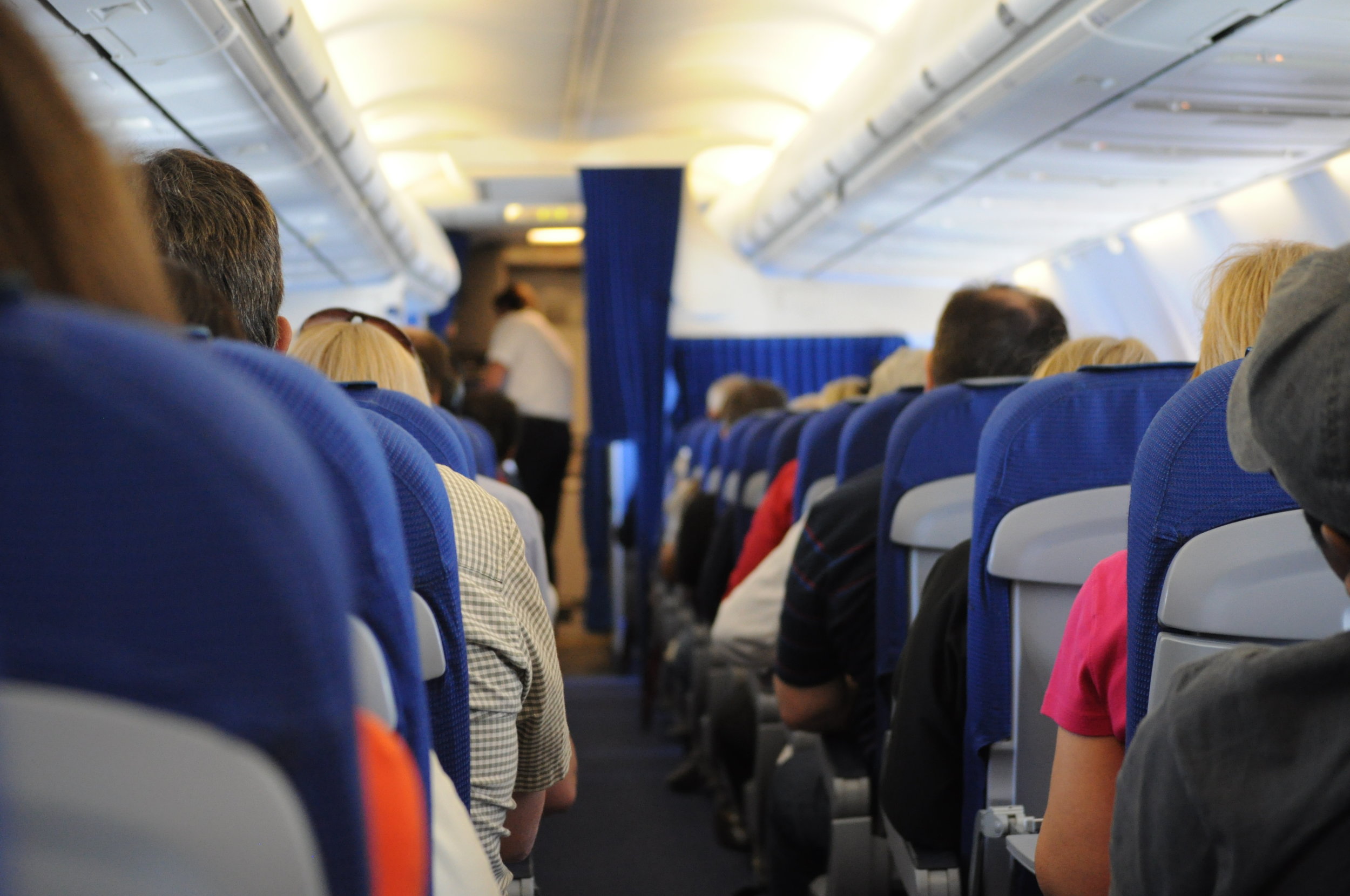
My stomach drops as the jet careens over an invisible speed bump. I glance out the window. Sheets of rain, impenetrable clouds. I can’t even see the wing. A great hand slaps the jet from the starboard, jolting my head right, then I grow heavy with the seat pressing hard against my legs. My fingers curl around the arm rest. Up ahead, reality bends as the cabin twists left. I know it’s a trick of my inner ear messing with my perception because I am in the plane and can’t see it move, but I feel it flying off-axis. Winds push the nose one direction and tug the tail another.
We fight to line up with the runway when the engines rev with a cyclic whine and the seat pushes hard against my shoulders. I feel the nose pitch upwards and we blast back into the sky. The plane levels out. Minutes elapse, circling.
The man’s voice over the intercom is calm, reassuring. “This is the captain speaking. You may have noticed we ran into some crosswinds and things got a bit choppy, so we needed to abort the landing. We don’t have enough fuel for another landing attempt, so we’re getting some instructions from the tower. Hang tight.”
I raise my eyebrows and exchange glances with my seat mate. “Did the pilot just say that we don’t have enough fuel to land?”
The man shrugs in response.
Step one of the emergency brochure is visible above the seat pouch. A red rotational arrow indicates how to release the exit door. I study it.
“Uh, this is the pilot,” chimes the speaker. “So, I’d like to clarify that we have enough fuel to land, but if we need to abort the landing we will not have enough fuel to power back up to a holding altitude. Looks like we’re going to a different airport where the weather’s better. Should be about fifteen minutes.”
The analytical side of my brain ponders how this works from a fuel consumption standpoint. I glance at my watch. 11:15 PM.
Rain continues to pelt the window during fifteen minutes of uneventful flight. Gravity eases as we descend, and, out of nowhere, the runway appears a few feet beneath us. Wheels bounce and squeal. Everyone leans forward in a coordinated lurch. Once the plane has stopped, the pilot informs us we are in another state, he’s waiting on a decision to either refuel or deplane, and we can use our phones.
The blue glow of a hundred phones springs to life. I text my wife. Weather trouble. Will be late. Don’t wait up.
A murmur filters through the passenger cabin. People are forming sides: deplaners versus refuelers. I am a deplaner. We don’t really get a vote, but it’s what people do.
We all sit inside the plane for twenty minutes. I swipe through Google Maps trying to figure out where we are. GPS locates us. We are nowhere.
“Uh, this is your captain speaking. Looks like we’re going to deplane.” A small, happy cheer sounds from the deplaners. “We’ll work out transportation to get you back.”
It’s a tiny airport. After we shuffle off the plane and meander through the gate we all find ourselves herded next to the baggage claim conveyor. It’s near midnight and the only employee is a young man wearing a fluorescent orange vest. He’s cheerful. “Hey, folks. Grab your luggage and make yourself comfortable. We’ll try and get some buses here to drive everyone back.”
Google Maps shows a two hour drive. I’m looking forward to dozing off on the bus.
The woman next to me is a refueler and is unhappy with the bus option. We chat for a minute before the conveyor buzzes. I fetch my luggage, find a seat, and use my suitcase as an ottoman. I’ve got my earbuds in, tuning out the world in favor of a playlist.
I don’t see the orange-vested man for forty-five minutes. When he reappears, he says, “No luck with the buses, but we’re working on vans.” Another forty-five minutes goes by. “No luck with the vans, we’re working on cabs.”
At this point, the passengers have assembled themselves into Survivor-like clans. The refuelers are having another go at convincing people to fly back. The disgruntled are discussing formal complaints to the airline. A group of men have Googled a limo service and are looking for people to go in on the cost with them. This doesn’t seem like something I can expense. I’m still listening to my playlist.
I glance at my watch. 2:10 am. The orange-vested man returns. “We’ve got some cabs. They’ll be coming in as they’re available. First one should be here in ten minutes. If you can gather your luggage and follow me, we’ll wait out front for them.”
Our herd trudges forward, passes through the sliding doors, and stands behind the concrete pylons of the taxi stand. It’s still raining, but we are under an overhang. The breeze is cool and the night has the stillness of early morning. I find it a bit refreshing.
Ten minutes pass before headlights snake their way along the airport road. We all follow them with our eyes. As they grow nearer, we collectively realize it’s a standard yellow cab sedan. Three people can fit in the back seat.
I straighten. Seventy-six tired and grumpy people are standing in the rain at 2:20 am. We must choose the lucky three to enter the cab. I am expecting a Hunger Games event.
But, that is not what happens. There is a couple with an exhausted mother-to-be, looking very pregnant. The crowd shuffles them up from the back, parting, and nominates them to go first. No one says anything. We just all agree. There is a certain camaraderie to our group, a shared trial overcome. The woman thanks everyone as she slips into the cab with her husband.
The next couple to go is an older husband and wife who have been traveling all day. We help them to the front of the line.
And so it goes on, a new cab arriving every five to ten minutes. It’s peaceful, orderly. The orange-vested man continues to be cheerful, smiling, opening cab doors for people. I am in the last group. When he opens the door for me, I shake his hand and thank him. His positivity was infectious, and he made a long night a little better.
During the two-hour ride home the cab driver talks and texts on his phone. The car rocks like a ship in a storm, windshield wipers flicking at full. I close my eyes and put my headphones in.
When I finally walk into my bedroom, my wife is asleep in the dark. I change and crawl into bed with her. She stirs and murmurs a greeting, and I place my hand on her arm.
Orange digits on the alarm clock glow 5:46 am. I close my eyes for four minutes before the alarm goes off.

The Karate Tournament and the Baked Potato (1000 words)
Today my wife drove by a Wendy's and found herself remembering a true story I once told her. When she mentioned it at dinner, I had an urge to put pen to paper. Usually I write fiction, but sometimes it's fun just to tell a silly story about something that happened long, long ago
NON-FICTION
AUTHOR'S NOTE: Today my wife drove by a Wendy's and found herself remembering a true story I once told her. When she mentioned it at dinner, I had an urge to put pen to paper. Usually I write fiction, but sometimes it's fun just to tell a silly story about something that happened long, long ago.

The header image for this story is not a stock photo, by the way. It was taken at the actual tournament in 1990. The person in the black uniform (who's not doing well in the photo) is one of the five black belts in the car with me in the story.
THE KARATE TOURNAMENT AND THE BAKED POTATO
I sit in the back seat of a faded yellow car surrounded by five black belts. The car rocks back and forth coasting on the slick asphalt as the radio stutters in bursts of music and static. Lightning flashes white and gray. For a moment, we see silhouetted telephone poles against storm clouds. Streaked rain drops scatter in parallel incandescent headlight beams as the metronome whirl of the wipers goes click-clack, click-clack.
Michael is driving. It’s his car, and he’s still wearing his gi. We’re thirty minutes into the ninety-minute return drive from the Coal Kickin’ Karate Tournament. A few gym bags rest at our feet. Some have gold trophies poking out. Mine does not.
The car hits a bump and the wipers freeze mid-stroke. Through the windshield I see the headlights extinguish. All of the dashboard interior lights wink out and it seems the car is speeding much faster than it was when I could read the speedometer. We are a four-thousand pound ballistic missile ploughing through the darkness. No one reacts to this but me, and all I do is a slow double-take, reading everyone else’s expressions.
Michael raises a fist, hovering it high by the mirror. I wonder if he’s angry. Fonzerelli-style he smashes the dashboard, and, to my surprise, the interior lights snick back into existence. The road ahead is awash once again in the gold arc of high beams. The wipers are frozen, still, mid-windshield.
His fist is curled, poised for another strike. He adjusts it two inches right, slightly forward, raises, smashes down. Nothing. One inch right, slightly back, smash. Nothing. The downpour is relentless and splatters the windshield. Reflections from the road twist and turn in curlicues, bending reality like a fun house mirror.
Our driver curses, leans forward to improve his visibility. I feel blind, lean backwards, pushing my feet against the front seat. He squints. Both hands are at the twelve-o-clock position on the steering wheel.
I look at my watch, press the backlight button. It reads five past eight.
He shifts his weight, reaches for something with his left arm, then the rhythmic clunking of a window manually rolling down. The sound of rain and highway escalates with the cabin breach, and spatters of water splash their way into the back seat, cool on my cheek. Michael sticks his entire left arm and head outside the driver’s window, right hand still in the twelve-o-clock position. He’s getting soaked.
Far up ahead on the right side of the road is an oasis of light, red and white. I can’t read the sign through the drenched windshield, but I recognize the logo. Wendy’s.
The black belt next to me stirs. “Okay, I know what to do.” He’s a big guy, and has been quiet the entire trip. “We need a potato.”
No one asks what he means. We all just wait.
He holds his hand palm up, explaining. “We get a raw potato, cut it in half, rub it all over the windshield. The starches in the potato will repel the water, and we’ll be able to see through the windshield.” We stare. He shifts. “I saw it on Oprah.”
I think about it. It seems plausible. Scientific, really.
We pull into the Wendy’s drive-through.
The speaker crackles, “Welcome to Wendy’s. What can I get you?”
Michael’s hair is matted to his head, beads of water streaming down his face. He glances back at us, questioning. We silently egg him on and he sighs. His voice is gravely. “I’d like one potato.”
“Would you like that with sour cream and chives?”
“No. Not a baked potato. I’d like one raw potato.”
The expected pause occurs. “Uh. I don’t know that we can do that.”
“Sure you can. You must have potatoes, which you bake, to make baked potatoes, so, give me one of those. Just don’t bake it.”
“Uh, yeah, okay, I’ve got to ask my manager about that.” The rain patters on the roof while we wait and the group exchanges glances. There’s a shuffling of background noise from the speaker, then the cashier comes back on. “That’s one forty-nine. Please pull forward to window two.”
So, we drive to window two. The cashier eyes us briefly. Michael deposits a dollar and two quarters, and the cashier relinquishes a white bag. Michael tilts it forward to inspect, and we all peer over his shoulder.
One potato, one white plastic fork, one napkin, ketchup packet, salt and pepper packet, receipt.
We find a space in the Wendy’s parking lot. For a brief second, I wonder what we’ll cut it with, but one of the black belts has popped the trunk and produced a samurai sword. He bisects the potato.
The honor of potato application goes to the idea originator. He slathers it across the windshield. He’s the Bob Ross of starch painting. We all get back into the car.
The rain splashes onto the windshield, and we wait. Bits and clumps of potato pulp slide down, casting shadows in the orange wash of the street lamp. Through the windshield, reality is still bent into curlicues, but now the bend has taken a fuzzy smear, like a sixties television show using a soft lens to portray beauty. It’s even worse.
The driver gets out, grabs a towel from his bag, and wipes all of the potato starch off the windshield. He climbs back in, leans his left arm and head out the window, and drives back onto the road.
I glance again at my watch. Fifty-eight minutes to go.
“Maybe slow down a bit?” suggests someone.
The driver says nothing. Our speed doesn’t change. For the next five minutes we drive, no one talking, just bursts of radio music and road noise.
Then, for no reason whatsoever, the windshield wipers wake up, continue their stroke. Click-clack. It’s like the scene from Close Encounters when the UFO leaves and everything in the car works again. We nearly jump.
Michael rolls up the window, wipes his face, and puts his hands back at the top of the wheel. I can see the whites of his knuckles from where I sit.
No one mentions the potato idea, or the wipers, or the drenched seats for the rest of the car ride home.
END
Here's the one picture of me at the same tournament, still sporting my 80's hair:

I know, bad form for a front kick. Told you I didn't win. But I think the girl in the purple shirt is checking me out.

Red, Blue, Green (1500 words)
In Last Stand, Larson references an organization of radicals. I began fleshing out details of what they're trying to accomplish and how they might operate. Miyu is a character concept for this. This short contains no spoilers and can be read independent of the other works.
AUTHOR'S NOTE: In Last Stand, Larson references an organization of radicals. I began fleshing out details of what they're trying to accomplish and how they might operate. Miyu is a character concept for this. This short contains no spoilers and can be read independent of the other works.
This is a short. It's not a full story, but it is a character and concept study. If you'd like to see more of this storyline, please leave comments.
RED, BLUE, GREEN
Miyu crossed the street, titled her head so her sweatshirt’s hood draped over her face, and stepped inside the bar. An assault of bass and decade old music accompanied the smell of spirits and sweat. She pushed past the crowd, down a crimson hallway, and into the restroom. A click as she locked the door. With both hands she leaned on the sink, glanced up. Brown eyes, twenty-something face, a crescent of color-shifting hair dangling over one cheek.
“Breathe,” she said to her reflection. She reached under the sink, searching, and caught something. A blank, square card. When she pressed the corner a keypad inked itself onto the surface. As she eased the pressure the digits sank back into the card. She pocketed it. The door handle rattled behind her.
She went out the door, down the hall. A man tried to flag her, get her to have a drink, but she pulled her arm away and then was outside, flowing with the crowd, the streets a neon mix of electric blue and carmine red. When she was a few blocks from the bar she ordered a cab, composed herself as she sank into its seat, and stared out the window at the endless rectangles of streaking skyscraper lights. Ten minutes later she was taking the elevator to her apartment on the twenty-sixth floor.
Accent lights awoke as she opened the door. She crossed the room to her balcony, slid open the glass panel, and grabbed a slate off a table. The twinkling spiderweb of city lights and streets greeted her, nearby buildings showing glimpses into people’s lives.
A telescope rested here. Miyu sat beside it. The coordinate screen illuminated as she considered her square card. A press of her thumb revealed the keypad. She tapped in her code and two rows of paired digits raised up beside her thumb. She transcribed the first row’s digits into the telescope’s coordinate screen and servos whined as it adjusted to the destination.
She peered into the eyepiece. Through the lens, a black-haired man sat on a bench, hands in his pockets. Miyu reached up with her right hand, tapped a black cylinder mounted atop the telescope, then clipped a mic onto her right earlobe. A synthetic voice in her ear said, “Tightbeam connection established. Handshaking. Encryption active.”
“Okay,” Miya said, “spotter on comm.”
The man nodded, “Nice night. First time?”
Her hands shook slightly. “No.”
“You sound a bit nervous. Linked up?”
“One second.” She entered the second row of digits from the card into the telescope. It swung off axis and pointed high in the sky. There, barely perceptible against the stars, a black drone hovered in silence. Miyu spliced in the tightbeam link and the synthetic voice said, “AV datafeed. Slate link enabled.”
She tapped the slate and it paired, displaying the drone’s video. From its altitude the city was a spindly lattice of amber and sapphire light. Miyu pushed the man’s coordinates to the drone and the image zoomed onto organic green shapes with circles of light. The figure on the bench was small but in the wide field view she could see all of the adjoining streets and the flow of traffic moving past. “Yeah. We’re good.” She leaned back into the chair, tapped the slate, and patched the telescope feed into a separate window. “What should I call you?”
“Let’s stick with protocol.”
“Sure.” Runners are red, spotters are blue.
Red stood up, began walking. He was maybe thirty, handsome. Looked familiar. He left the park, headed down Wayburn Street. Both the telescope and drone followed him.
“You done many runs?” Miyu said.
Red glanced around at no one in particular. “Green online?”
A hesitation. "Not yet.”
“Not going to get very far without him.”
Miyu’s earpiece chimed from an incoming connection and a young man’s voice joined the channel. “Uh, hey, guys. Sorry. Running late.” A moment of no one talking and the man seemed to take the cue. “Oh, yeah, uh, breacher on comms.”
She resisted the urge to look around, to try and guess where Green was watching her. He’d received a card with her coordinates the same way she’d received one with Red’s. “Welcome to the party, Green.”
Red walked briskly now, crossed a sidewalk, waited at an alley entrance.
Miyu eyed the drone’s feed. “Clear.”
Red entered the alley, went to a dumpster and knelt down beside it, fishing underneath with his right hand, then slid out a black case and opened it. Miyu zoomed. Two silver cylinders, a slate, and a pistol. He gripped the pistol and spoke a passcode. The gun’s safety light cycled to armed.
Miyu placed her hand over her mouth as Red tucked the items inside his jacket.
“Well?” Red asked.
She snapped back to attention. “Sorry. Street’s clear.” A hesitation. “What’s the gun for, Red?”
“What?”
“I thought this was just a data breach.”
Red walked with his hands in his pockets, determined. “You just need to get me into and out of the Onyx building. Let me and Green worry about what happens in there.”
Miyu panned the telescope to the Onyx building. A few office lights scattered in remote patches. “There’s still…there’s still some people there.”
“And Green’s going to keep me away from them.”
Miyu heard Green taking quick breaths on the comm. He said, “Hey, Blue, don’t worry about it.”
“Don’t worry about it? Red’s got a pocket full of binary explosives and a pistol.”
Red’s voice raised, “You should be watching my back, not peeking over my shoulder.” He was one block from the Onyx building.
“It’s fine Blue, we got it,” Green said. “C’mon, c’mon, we need you.”
Red sighed. “We can do this without her.”
Green hesitated. “No, no. We need her. Stay on the line, Blue.” He waited a second for her response. “Blue?”
Miyu furrowed her brow. She watched the top-down view of Red walking, twenty meters to the entrance, then she looked to the side, thinking. A quick tap of coordinates on the slate and the drone swung off axis, panned, zoomed to her location sitting on the balcony. She swung its view down to street level, pulled it back to wide view. Moving in the darkness along the alleys flanking each side of her building were two lines of figures. She tapped the image into daylight mode and saw the agents, the rifles, the government logos. Both groups came to a stop just before the building’s front, waiting.
The air emptied around her and she struggled trying to take breaths. She grabbed her forehead with a handful of hair and tried to think. She knew where Red was. Red didn’t know where anyone was. Green knew where she was and where Red was going.
Green’s voice had an edge, nervous. “Still with us, Blue?”
She panted and swallowed, summoned enough spit to speak. “Uh, Red.” Her voice shook. “Green’s burned us. Run.”
“What?”
Miyu grabbed the slate, saw the agents surging forward towards the main entrance. In her earbud she heard men shouting, Red breathing hard, the sounds of running. She ripped the earbud out and tossed it off the balcony, then she bolted into her apartment, opened the closet, found the go bag. The slate was still in her hand. She swiped it into offline mode, dropped it in the bag, grabbed the duffel, and ran to her door, cracking it open.
Through the slit of the open door she saw the elevator up arrow glowing, floors ticking higher. Fourteen, fifteen, sixteen. She opened the door, stepped out, closed and locked it, then ran to the stairs. She took the steps two and a time, going up one flight and emerging into the hall. Apartment 2704 was three doors down. Leon’s. Sales engineer. Always traveling. She’d hacked his manual entry code a few months ago just for this reason. In a second she had the door open and was inside. It was nearly directly over her apartment one floor below.
She hit the manual switch before the lights turned themselves on, keeping the room in darkness. Quietly she locked the door, crossed to the kitchen, and leaned one hand against the wall, trying to catch her breath. Right about now the agents were overriding her apartment lock and swarming in with rifles drawn, claiming what was once her life. She could never be Miyu again.
A gleam of reflected light caught her eye, and she spied Leon’s liquor stash in the nearby cabinet. She found a nice bourbon, splashed some in a glass, and tried to steady her hand enough to take a sip. As its warmth filtered through her, she held her hand to her mouth, crying without sound.
END