
Three for Free
Get the first three Hayden's World stories for FREE April 2 - April 6. http://bit.ly/haydensworld
Get the first three Hayden's World stories for FREE this week (April 2 - April 6, 2018) on Kindle: http://bit.ly/haydensworld


Grammar Police
An engineer slowly learns the rules of grammar.
I admit, the math section of the SATs was easier for me than the reading section, which is probably why I became an engineer. Despite that, I still really enjoy Weird Al's Word Crimes:
In keeping in theme with my recent post discussing what I've learned in my first year of self-publishing, I thought I'd mention a few grammar confusions I needed to work through:
Since
Apparently I've been using the word "since" incorrectly my entire life. Case in point:
Since I'm here, I may as well have some french fries.
I should be using it like Kelly Clarkson:
Since you been gone, I can breathe for the first time.
Granted, "since you been gone" isn't the best grammatical example, but hey.
"Since" references a period of time. I've been waiting here since nine o'clock. Or, Since learning that I use "since" incorrectly, I need to sing that Kelly Clarkson song to remember how to use it.
Which/That
Aaargh. Quick quiz - which is correct:
Cut the wire which is red
Cut the wire that is red
There's a better explanation detailing restrictive clauses, but I find it's easiest to replace the word "which" with "which happens to be". If the sentence still makes sense and has the same meaning, you're good.
Cut the wire, which happens to be red. It doesn't really matter that it's red. Just pointing that out for people who like the color red. Pretty!
Cut the wire that is red. There's also a black wire. Please don't cut the black...oh my God, you're not even listening to me! Give me those wire cutters!
Feeling Possessive
Sure, it's been several hundred years since I went to elementary school and my memory may be a little foggy, but I distinctly remember the rule to use an apostrophe s unless the word already ended in s, in which case just use an apostrophe. Granted, that was back in Arthurian days when we spelled town with an e.
It seems I'm supposed to use an apostrophe s for singular nouns (regardless of their ending letter) and apostrophe for plural nouns that end in s. Actually, if you Google it you'll find the Internet's definitive opinion on the matter is:
- Apostrophe s for singular nouns; apostrophe for plurals ending in s
- Apostrophe s for nouns that don't end in s; apostrophe for words that do
- Apostrophe s if you speak the s; apostrophe if you don't
- These can't all be true, but it doesn't matter, just be consistent
- Why do we even have language at all. Let's just grunt and point.
- Hey, there's a new Cinemasins videos. Wait, what was I Googling again?
Anyway, in my stories you'll see:
James's
and not
James'
That is, unless a Riggs malfunction creates an army of duplicate James, and they all collectively own something.
As an aside, why English has chosen the possessive form of "it" to be "its" is mind boggling. More accurately, it's mind boggling. I realize that "it's" has been claimed as the contraction for "it is", but there's no reason you can't contract "to be" onto any noun, as in "Hey, Bob, cat's gone missing again" or "That grammar rule's silly."
Okay, that's enough pearls for today. Back to writing.

What I've Learned in One Year of Self-Publishing
June 12th, 2016, I uploaded 43 Seconds to Kindle Direct Publishing and clicked the submit button. One hour later it was live. Since then, I've published Signal Loss, Aero One, Hayden's World Shorts, and Erebus. When I started, I recall reading many self-publisher's blog posts about how their journey unfurled. I thought I'd share mine after the first year.
June 12th, 2016, I uploaded 43 Seconds to Kindle Direct Publishing and clicked the submit button. One hour later it was live. Since then, I've published Signal Loss, Aero One, Hayden's World Shorts, and Erebus. When I started, I recall reading many self-publisher's blog posts about how their journey unfurled. I thought I'd share mine after the first year.
Writing Craft
There are endless books on story structure, plot, characters, grammar, and dialogue. I devoured them. James Scott Bell's and Marcy Kennedy's series are very helpful. By far, Self Editing for Fiction Writers is essential and probably should be required reading for self-publishers. It addresses many of the common problems newer writers face.
Here’s a few things I've needed to focus on as a newer writer:
Passive Voice (the bane of newer writers):
Long ago I wrote a story titled "Wraith's Dance" and submitted it to Weird Tales. I received a refusal letter, but was pleasantly surprised that it included a constructive critique from the editor. He liked the story, but the deal breaker was its passive voice. Keep writing, he encouraged.
When we speak, we're used to telling a story using the word "was" to indicate a transient action:
He was running down the hall when the bell rang.
Ditching the word 'was' and just using the actual verbs ran or rang changes the sentence from a state (was running) to an active verb (he ran, the bell rang):
He ran down the hall as the bell rang.
The bell rang as he ran down the hall.
Both are more engaging than "he was running down the hall".
I recommend using your word processor's Find/Replace to locate every use of "was" and determine if it's needed. I found this was littered throughout my writing.
A little less common, but even worse, is using was to put the recipient of the action first:
The martini was splashed in his face by Jane.
Much better to write:
Jane splashed the martini in his face.
I can't recall which writing book listed the acronym R.U.E, but it definitely applied to my early work. R.U.E. is "resist the urge to explain". The biggest offender for me was "to", as in:
He opened the door to search for the axe murderer.
Better to let the reader figure it out based on the character's actions:
His pulse raced as he reached for the door knob. He had to find Eugene before he killed again.
Seriously, it was everywhere in my writing. To do this, to do that. Readers like watching a character and trying to deduce what they're up to.
Tight Writing and Pacing
As you'd guess, don't use a hundred words to say something best described with a dozen. I found my biggest offender was the word "of":
Pools of radiant light filled the room.
Flowery, but better to say:
Radiant pools filled the room.
Right? Radiant is a stronger word to start the sentence and doesn't require mental gymnastics to extract the modifier between the object and verb.
Pacing's a little harder to pin down. It's easy when writing sci-fi to get swept away in descriptions, but endless description is boring and endless action is tiresome. You need to constantly mix-up description, actions and dialogue to keep things moving. The other thing I'll say is that it's often better to suggest descriptions with a few well-chosen words. For instance, the waves bled with fading sunlight conjures a complete mental image in six words.
When I wrote Aero One, the opening paragraphs were very focused on Jia's senses and confusion. The high level or detail didn't match the urgency of her situation, though. I self-edited it down to:
Thoughts spark and fizzle in an overlapping jumble of competing primal urges. Air. She needs air.
Head Hopping
Phew! This one's tough. We've grown up watching television and movies which constantly cut between different character's perspectives. Some are better than others at keeping you in the main character's head.
For example, the camera frames a close-up of Bob's expression as he looks down at a letter. Next, it cuts to what Bob reads in the letter. Off-screen, we hear the clinking glasses as Sandy opens the kitchen's liquor cabinet. Great!
More typically we see Bob reading a letter followed by a camera cut to Sandy in the kitchen. Bob can't see Sandy from where he's standing in the study, but we get to see her pouring the poison into his brandy.
When I started writing I mimicked this cinematic approach. There's no rule that says you can't do that, just keep in mind that in this case you're writing as a detached omniscient viewer and your reader will have the same experience. This weighed on my mind as I wrote my recent story Erebus. Staying with Sarah's perspective meant the reader didn't know what happened to James. If this were a tv episode, it would have cut simply to what James was doing while Sarah searched for him.
Note this doesn't mean that you can't change character point-of-views using line or chapter breaks. Just keep in mind there are pros and cons to POV changes.
Dialogue
The simplest rule is "he said/she said".
"Yup, we're all going to die," Hitoshi said.
I remember getting confused and sometimes typing it backwards:
"Yup, we're all going to die," said Hitoshi.
But that puts the verb before the object.
Even better, eliminate the dialogue tag with stage direction:
Hitoshi facepalmed and shook his head. "Yup, we're all going to die."
Formatting Your Book/Creating Cover Art
Scrivener is invaluable for organizing and writing your story. It's project management software for writers.

Scrivener project file for Erebus
If you have enough patience, you can produce well-formatted books directly out of Scrivener. I did not, so I purchased Vellum. Vellum's expensive, but produces beautiful books.

Vellum file for Erebus. Very easy to create a professional ebook or paperback.
Canva is the easiest way to create a quick book cover online, and it's cheap. Alternatively, if you have some design skills you can purchase stock photos (make sure you select the right license) and assemble your own cover in Photoshop.

Paperback cover design in Photoshop for Hayden's World Shorts. Background planet is a licensed Adobe stock photo.
If you have artistic skills, you can use Adobe Illustrator or Photoshop to create custom artwork. For Aero One, I designed the cover from scratch. The nice thing about doing all of the artwork yourself is that there is no licensing:

Pro tip when doing your own design in Illustrator: also design social media graphics, like the cluster on the left of Facebook and Twitter cards designed for ads and free promotions.
Lastly, you can also outsource it to a designer via a site like 99 designs.
Here's how I created the cover for 43 Seconds:
- The background's warp effect is a licensed Adobe stock photo
- The spaceship is a 3D model created in the free modeling software, Blender
- The foreground text is a layer in Photoshop.
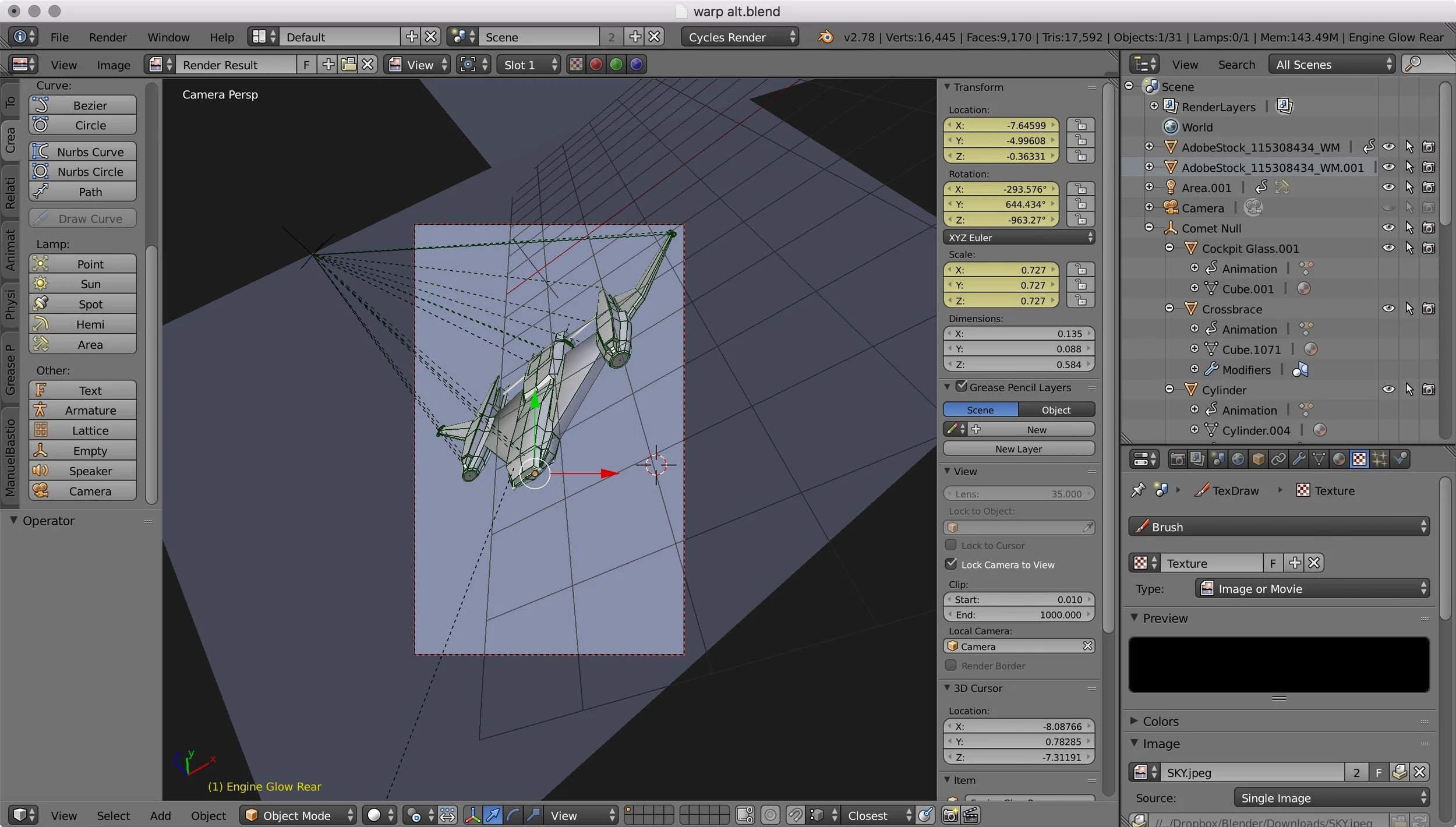
Blender 3d model of Bernard's Beauty for 43 Seconds

Photoshop composite of background art (generated in Blender) with foreground text
Reviews and Sales
And now the bad news. When I started I feared I would post my book and get peppered with one-star reviews. The reality is that next-to-no-one will see your book, and out of those that do, one-in-a-thousand will leave a review. Getting peppered with negative reviews is an upgrade to where you actually start. I've had my best luck getting reviews with Amazon Giveaways. I do use KDP free days, but they never generate reviews.
Regarding sales, my annual book sales can probably buy me a single, nice dinner. If you're looking to make money, I suggest trying to sell to magazines. If you get 6 cents per word for a 6000 word story like 43 Seconds, you'll make $360. Maybe I'll try writing some non-Hayden's World stories and submit those to magazines.
Advertising
Amazon ads do work, but they are not cost effective for 99 cent books (unless you can upsell a series). I typically land in the 40 to 50 cents-per-click range and need ten clicks to get one sale. Four to five dollars to sell a 99 cent book isn't a sound business model. Giveaways work better because four to five dollars gets you four to five sales. Without ads or giveaways, however, my books fall into obscurity. When using ads, Product Ads work much better than Keyword Ads in generating actual sales, probably because they are better targeted.

In the top chart, the blue bars represent free books purchased and the orange bars are paid books sold. The bottom chart shows pages read via Kindle Unlimited book borrows. In December 2016, I learned how to promote my Kindle free days more effectively and started using Amazon ads.
Spamming buy-my-book on twitter is counter-productive and will cost you followers. Twitter is for sharing content. I do recommend posting snippets of your good writing, especially if they fit the day's theme (SciFiFri for example), or if they're works-in-progress and fit the #amwriting tag.
Wrap-up
I feel like I've learned a lot this first year. I've taught myself Scrivener, Photoshop, Illustrator, Blender, Vellum, and KDP. Getting an occasional review from an excited reader makes my day. Writing in series for the Hayden's World stories has been challenging because each story needs to be independent, and each time I finish a work I have this self-doubt phase of wondering how I'll come up with something new. But, the stories keep churning out, and they're getting longer and more complex:
- 43 Seconds - 6000 words
- Signal Loss - 9000 words
- Aero One - 9300 words
- Erebus - 17,000 words
So, marching into year two and seeing where my keyboard takes me.

My $1.34 Ad Campaign
One of the lesser known benefits of Kindle Select is the ability to create Amazon ads. There it was, the ad button, beckoning me. Of course I pressed it.
At the end of this past week my ninety-day exclusive Kindle Select contract with Amazon expired. One of the lesser known benefits of Kindle Select is the ability to create Amazon ads. There it was, the ad button, beckoning me. Of course I pressed it.

"Maybe it does something good, maybe it does something bad."
You have two ad options: sponsored or product. Sponsored ads appear with keyword searches. Products ads appear when people look at specific books.
I chose Sponsored. You enter the title and description text for your ad, choose a daily budget and your keywords. Amazon suggests several based on phrases which have led to your book, but you can add custom ones.
And now, the tough part: determining the maximum bid for each keyword. When someone enters your search phrase, Amazon checks all the active ads using these phrases and the highest bidder wins. The actual bid will be one penny above the second place bidder.
Note you don't actually pay anything at this point. This gets you an impression (that is, your ad appears on the search page). Impressions are free. You only get charged if someone clicks on the ad.
What happens after the click doesn't matter. You pay once the click occurs, regardless if a sale occurs.
So, the internet told me to expect 1 click every 1000 impressions. Somewhere between 1% - 10% of those clicks will turn into sales.
And...math. My 99 cent book pays me a 35 cent commission. If I could miraculously manage a 100% click-to-sales rate, then it would be unwise to pay more for a click than my commission ($0.35). At a 10% click-to-sales rate, I shouldn't pay more than 1/10 of my commission. This caps my bid at a depressing $0.03.
So, I start with that, just to see what happens. And....zero impressions. Everyone's bids are higher than mine.
In the spirit of science, willing to take a loss, I up the bid. My max daily budget is capped at $6, so, I can't get into too much trouble. Amazon's ad dashboard actually encourages tinkering by showing you all of your keywords, bid amounts, impressions, clicks, and sales.
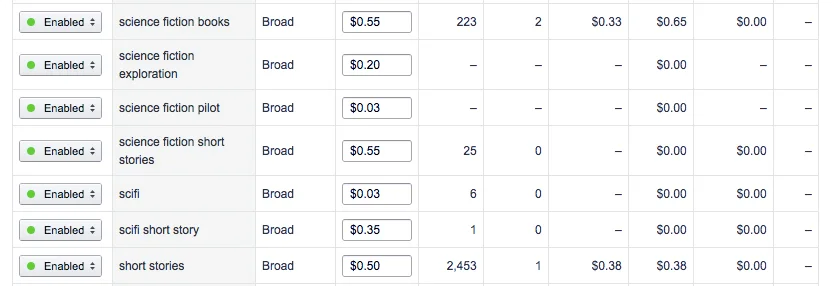
You can quickly deduce from the screenshot that "science fiction books" at 2 clicks in 223 impressions is a much better match than the general "short stories" at 1 click in 2453 impressions.
After after two days, my rate looked like this:

Similar to what the internet told me. One click every thousand impressions. My average winning bid was $0.34. Which, incidentally, means that my book would need to sell at $4.85 to break even on the ad.
I think that, with some keyword tinkering, I could probably lower my max bid and still get impressions with better targeted keywords. You can see "sci-fi" in the first screenshot has a CPC bid of $0.03 and still got 6 impressions. I think, though, it's probably not worth it to do ads for 99 cent books.
The real time analytics of the dashboard were helpful though to see how different keywords performed, and this gave me some data to update my book's regular sale keywords.
At the end of the ad run, I only had the 3 clicks, costing me $1.34. There were no sales, but I did get some insight into how different keywords performed, which was not a bad investment for a little more than a dollar.
Take My Book, Please
Recently I tested the Facebook Boost Post button, despite the internet telling me never to press it, and, not surprisingly the only effect it generated was vacuuming a ten dollar bill out of my wallet.
I've been trying inexpensive marketing experiments. Recently I tested the Facebook Boost Post button, despite the internet telling me never to press it, and, not surprisingly the only effect it generated was vacuuming a ten dollar bill out of my wallet. Like a gambler watching the dealer scoop up the chips of my losing hand, I slapped another ten on the table, took a swig of my drink, and said, "Deal 'em again, Sam."
I decided to change up the game, however. The past two week experiment has been with Amazon Giveaways. Amazon makes it very easy to set up a Giveaway either for your physical or digital book. Just scroll to the bottom of your reviews, and you will find the Giveaway button after the last review:

Next, you choose your lottery options. I chose Random, 1 in 50 chance, 10 prizes to give away. Amazon informed me this would result in somewhere between 450 - 500 entrants. Note you are purchasing however many copies you plan on giving away at the time that you set up the giveaway, but on the plus side you will get royalties for these purchases (at some point, more about that later):

Next, you set any requirements to enter. You can set no requirements, or require people to follow you on Twitter, or Amazon, view a video, or take a poll. I chose Follow S.D Falchetti on Amazon:

Incidentally, you should follow yourself on Amazon. This way you will see what the button does. As I suspected, followers get notifications of your new releases with links to buy them.
You set the duration (I chose the default 15 days). There's also a legal note that only US residents can enter, which seems to be an Amazon requirement.
On the last screen, you add your win/lose messages, and product details:
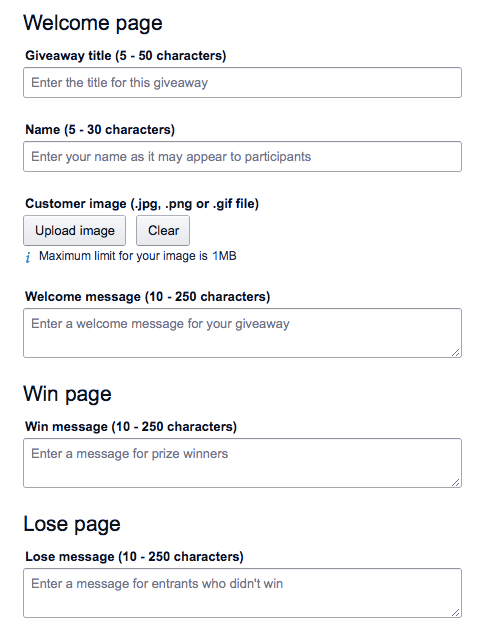
In the win message, I thanked them for entering and asked them to leave a review. In the lose I suggested they download the free sample.
You can also upload a custom image for the giveaway. I suggest doing this, because I left it at the default Amazon product image which resulted in Twitter cropping the book cover to this:

There is no way to edit the Giveaway once you submit it. The only way I was able to fix this was by making a custom graphic and using Twitshot to attach it to the link:

Once you submit it, it will go live probably with an hour. It's up to you how to promote it:
- Share the giveaway link directly with a specific audience (email it just to your newsletter followers, for example)
- Share it with everybody. The easiest way to do this is to use the #AmazonGiveaway hashtag in Twitter, which will be picked up and retweeted. I should mention that many people enter giveaways for fun, and not everyone who wins a copy will read it.
I posted it on my Twitter account with the #AmazonGiveaway hashtag. Within one hour 380 people (out of 500) had entered, winning 7 of the 10 books. Then, it petered to a trickle. I got 1-10 entrants per day for the remaining two weeks. Two more books were won, and I was left with one unclaimed book when the giveaway ended. Amazon allows you to set up a new giveaway for unclaimed books, or simply gift them to people. I gifted it.

How it all panned out:
- 9 out of 10 prizes claimed, most within the first hour
- 460 new Amazon followers
- Zero new sales
Royalties:
- As people won prizes, royalties for those prizes showed up on my royalties report.
Sales Reports:
- The 10 books I purchased as prizes did not show up in my sales report until all 10 books were claimed. Because I had one book left after the giveaway concluded, it was not until I gifted that remnant and the person accepted the gift that all 10 sales showed up in my sales dashboard at once.
Sales Rank:
- The giveaway had zero effect on my Amazon sales rank, even when the 10 books finally showed up in my sales dashboard. I found this odd because if I bought ten copes and simply gifted them, they would show up as both sales and sales rank.
Reviews:
- I'll admit, I didn't expect any reviews. Review-to-purchase ratio on Amazon is between 0.1% - 1%, so you really need to sell more than a hundred copies to have a chance at one review. But, one of the prize winners did leave a 5 star review (thank you! you're awesome!). She wrote:
I won this through a giveaway and very thrilled I read it. Once I started reading it I couldn't stop. Would of definitely bought and looking forward to reading more from the author.
All in all, not a bad experience. I picked up a few hundred Amazon followers, who will get notifications as I publish new releases, and a 5 star review. I might do it again for another book.

Tales of a Rookie - Part 3
Last week I posted a book trailer for 43 Seconds on my Facebook page. You may have noticed an enticing "Boost Post" button sits at the bottom of your page posts. I've always ignored it. But there it sat, calling to me like a siren leading a sailor to rocks.
Self-promotion is a necessary evil of indie publishing. I could just hand it over to my agent, except I'm my agent. I feel a bit like Barf from Spaceballs:
Last week I posted a book trailer for 43 Seconds on my Facebook page. You may have noticed an enticing "Boost Post" button sits at the bottom of your page posts. I've always ignored it. But there it sat, calling to me like a siren leading a sailor to rocks.
So I Googled it, and the internet told me never to press that button. Instead, just go light a handful of my own money on fire. It would have the same effect.
Of course I immediately pressed the button. Sure, the wisdom of the internet said it was pointless, but I was willing to conduct a ten dollar experiment. The boost button creates a type of ad which shows up in people's feeds. Just like regular ads, you configure your target audience and create a duration. When the duration and money are used up, the ad ends.
I boosted my video trailer for two days in the United States targeting men 18 - 55 using keywords related to science fiction. I added a link to my Amazon's book page with a teaser "Hop in the pilot's seat with James for 99 cents at http://amzn.to/28TDGpt." As the two days progressed, Facebook sent me cheery updates about all of the extra reach my post achieved. At the end, it gave me a summary:

Fifteen hundred people reached (which means, appeared in their newsfeed) with 364 video views. Facebook autoplays videos, so this was really 364 autoplays. 27 people actually clicked the play button on the video. Zero people clicked on the teaser link. The Likes/Shares were existing Facebook page fans.
Interestingly, demographics are also reported. Twice as many people in the 18-24 year old bracket had the video play in their feed. Because these were autoplays and not actual clicks, I interpreted this as 18-24 year olds were more likely to have the science fiction keywords in their interests, meeting my ad criteria. It's also possible Facebook simply has more users in the 18-24 age bracket than older brackets.

Lastly, the final test: sales. No impact on book sales. Doh! The wisdom of the internet was right.

Tales of a Rookie - Part 2
I decided to self-publish 43 Seconds on Kindle Direct Publishing because I loved the idea of owning the project start to finish. KDP is remakably easy to use. It’s really just a few screens of selections, followed by pushing the “publish” button.
I decided to self-publish 43 Seconds on Kindle Direct Publishing because I loved the idea of owning the project start to finish. KDP is remakably easy to use. It’s really just a few screens of selections, followed by pushing the “publish” button. The steps were:
Create an account
Upload my story (in this case, a .mobi file generated from Scrivener)
Upload my cover art
Enter my product details (title, blurb, author name, etc)
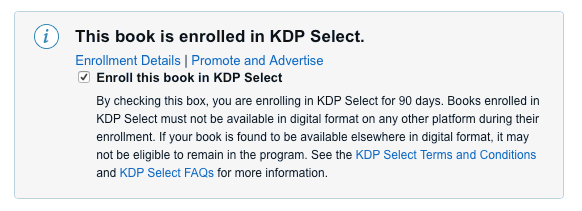
Choose if I wanted to enroll in Kindle Select (90 day exclusive contract with Amazon) or just Kindle Direct (non-exclusive)
Select my markets/royalty options
Click publish
Once I clicked “publish”, the story went into Pending status. After thirty minutes, it was live.
The main decision point was Kindle Select versus Direct. I chose Select (90 day exclusve contract) for the following reasons:
People with Kindle Unlimited can read it for free (more people may see it, and potentially leave a review)
I can choose five promotion days where I can offer the book for free, or at a discount. The days do not need to be consecutive. I planned offering them the first weekend after launch to try and get more people to see it, and potentially leave a review.
I don’t have any other markets yet (iBooks, epub) for the story, so I wasn’t losing anything by limiting myself only to Amazon for 90 days. I can always add other markets after the 90 day contract.
Once the book was live, I was able to create an Author Central account and begin filling in my bio. This is the page people see when they click your name on Amazon. It has options to link your personal website/blog, so I hooked those up to my blog.

Self-Marketing
I made a Facebook author page, invited my friends, and posted updates about the upcoming free download weekend
I’m also an artist, and have an established Facebook page for selling art. It’s taken me years to grow it to 500+ fans. I did a bit of self cross-promotion and announced the upcoming free download weekend along with links to my writing page. Based on demographics I didn’t think there were many sci-fi fans in my art group, but even if I picked up one or two it was helpful.
I added a banner to my website announcing the free download dates, with a direct link to the Amazon page.
Results
I ran a three day free promotion on Friday, Saturday, and Sunday. Amazon doesn't disclose who bought your books, but it does tell you which Amazon regional site sold them. The results were:
Books sold during the free promotion:
- Amazon.com, 7 sales
- Amazon.de, 4 sales
- Amazon.com.au, 1 sale
The first day after the free promotion I had my first paid sale:
- Amazon.com, 1 sale
Sales in the US, Germany and Australia. Cool! Thanks.
Surprisingly, the 12 weekend sales were enough to get me listed at #23 on the Amazon bestseller list for the category Kindle Short Reads->45 minutes(22-32 pages)->Science Fiction & Fantasy. I noticed the list is dynamic and changes hour to hour. Today, for example, with only 1 sale, I'm listed at #911. Doh. But it was fun being at #23!

I still have 2 promotion days left to spend, which I'll use on another weekend after I get some reviews. In the meantime, I'll try to grow my newsletter and Facebook page, so I can let readers know of those promotions.
And, of course, I'll start working on my next story.