
Signal Loss
I've just completed a new short story, Signal Loss, 9600 words. Signal Loss takes place the day after the events in 43 Seconds, following a different set of characters in a very different location.
I've just completed a new short story, Signal Loss, 9600 words. Signal Loss takes place the day after the events in 43 Seconds, following a different set of characters in a very different location. Kyan Anders is a middle-aged data runner piloting the science ship Aristarchus at the edge of the solar system. His daily chats with his daughter are about to be interrupted as the Earth is occulted by the Sun, leaving him only with the ship's computer, Rios. When another runner and a mysterious object appear, things get complicated quickly and life-or-death decisions need to be made thirteen billion kilometers from home.
Solar conjunctions are real, and we usually think of them in terms of Mars slipping behind the sun, causing communications loss with satellites or rovers. At present we don't think of Earth/Sun conjunctions because there's no one to view them, but once people are on Mars or elsewhere in the solar system they'll become a thing.
Solar flares are well-known and affect Earth's communications. These will also be a complication for intrasystem comms.
In my previous story, 43 Seconds, William says "You can literally fly to the end of the solar system in fifteen days." He's talking about how a one gee continuous acceleration gets you to Pluto in fifteen days. But, Pluto is not the end of the solar system. In 2012, Voyager 1 reached the heliopause at 121 AU. Pluto only ranges 30-49 AU. The Aristarchus is somewhere between the two, at 86 AU. So, Kyan is twenty-six travel days from Earth (using the Aristarchus's RF drive). Even at lightspeed his conversations with his daughter have a full 24 hour turn around due to the distance.
Just as an aside, I think it's amazing that, as far out as Kyan is in the story, there's a real life spaceship (Voyager 1) that is much farther. Voyager 1 is nearly 40 AU past Kyan's location. To put this to scale, if Kyan were the Sun, Voyager 1 would be Pluto. That's how far 40 AU is.
I liked the idea that, even with RF drives, someone could be so far out that help was nearly a month away. Throw in Earth comms loss and you're truly on your own dealing with whatever situation develops.
The role of A.I.s and non-A.I. computer intelligences is also explored. If you enjoyed Ananke paired with James in 43 Seconds, you'll like the reluctant roommates of Kyan and Rios in Signal Loss.
There's a few other technological consequences which 43 Seconds mentions that are explored in Signal Loss. I'll keep those under wraps for the time being, though, to avoid spoilers, but I'll write about them once the story is published.

The Golden Age
If you've seen the movie Gentleman Broncos, the opening credits feature a montage of pulp sci-fi covers. You know the type - alien tentacles wrapping around an alarmed female astronaut while a crewman pulls out a blaster. You can actually see the brush strokes in the paint.
If you've seen the movie Gentleman Broncos, the opening credits feature a montage of pulp sci-fi covers. You know the type - alien tentacles wrapping around an alarmed female astronaut while a crewman pulls out a blaster. You can actually see the brush strokes in the paint. I love it!
I started a Pinterest board collecting vintage sci-fi book covers. Although my intent was to find crazy 50s - 80s illustrations, I couldn't help but gravitating to all of the classic books that I loved. Clarke, Asimov, Pournelle, Niven, Pohl, Bester. So, at least the first round of pics are more nostalgia based than art, but I'll keep growing the list.
You can check it out on Pinterest, and follow me for updates.

Tales of a Rookie - Part 3
Last week I posted a book trailer for 43 Seconds on my Facebook page. You may have noticed an enticing "Boost Post" button sits at the bottom of your page posts. I've always ignored it. But there it sat, calling to me like a siren leading a sailor to rocks.
Self-promotion is a necessary evil of indie publishing. I could just hand it over to my agent, except I'm my agent. I feel a bit like Barf from Spaceballs:
Last week I posted a book trailer for 43 Seconds on my Facebook page. You may have noticed an enticing "Boost Post" button sits at the bottom of your page posts. I've always ignored it. But there it sat, calling to me like a siren leading a sailor to rocks.
So I Googled it, and the internet told me never to press that button. Instead, just go light a handful of my own money on fire. It would have the same effect.
Of course I immediately pressed the button. Sure, the wisdom of the internet said it was pointless, but I was willing to conduct a ten dollar experiment. The boost button creates a type of ad which shows up in people's feeds. Just like regular ads, you configure your target audience and create a duration. When the duration and money are used up, the ad ends.
I boosted my video trailer for two days in the United States targeting men 18 - 55 using keywords related to science fiction. I added a link to my Amazon's book page with a teaser "Hop in the pilot's seat with James for 99 cents at http://amzn.to/28TDGpt." As the two days progressed, Facebook sent me cheery updates about all of the extra reach my post achieved. At the end, it gave me a summary:

Fifteen hundred people reached (which means, appeared in their newsfeed) with 364 video views. Facebook autoplays videos, so this was really 364 autoplays. 27 people actually clicked the play button on the video. Zero people clicked on the teaser link. The Likes/Shares were existing Facebook page fans.
Interestingly, demographics are also reported. Twice as many people in the 18-24 year old bracket had the video play in their feed. Because these were autoplays and not actual clicks, I interpreted this as 18-24 year olds were more likely to have the science fiction keywords in their interests, meeting my ad criteria. It's also possible Facebook simply has more users in the 18-24 age bracket than older brackets.

Lastly, the final test: sales. No impact on book sales. Doh! The wisdom of the internet was right.

43 Seconds Trailer
I made a short trailer for 43 Seconds using Adobe Spark. If you haven't used Adobe Spark, it's very easy, and, best of all, free.
I made a short trailer for 43 Seconds using Adobe Spark. If you haven't used Adobe Spark, it's very easy, and, best of all, free.


Tales of a Rookie - Part 2
I decided to self-publish 43 Seconds on Kindle Direct Publishing because I loved the idea of owning the project start to finish. KDP is remakably easy to use. It’s really just a few screens of selections, followed by pushing the “publish” button.
I decided to self-publish 43 Seconds on Kindle Direct Publishing because I loved the idea of owning the project start to finish. KDP is remakably easy to use. It’s really just a few screens of selections, followed by pushing the “publish” button. The steps were:
Create an account
Upload my story (in this case, a .mobi file generated from Scrivener)
Upload my cover art
Enter my product details (title, blurb, author name, etc)
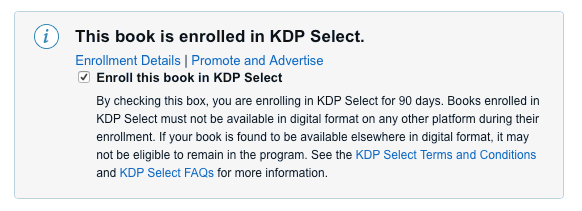
Choose if I wanted to enroll in Kindle Select (90 day exclusive contract with Amazon) or just Kindle Direct (non-exclusive)
Select my markets/royalty options
Click publish
Once I clicked “publish”, the story went into Pending status. After thirty minutes, it was live.
The main decision point was Kindle Select versus Direct. I chose Select (90 day exclusve contract) for the following reasons:
People with Kindle Unlimited can read it for free (more people may see it, and potentially leave a review)
I can choose five promotion days where I can offer the book for free, or at a discount. The days do not need to be consecutive. I planned offering them the first weekend after launch to try and get more people to see it, and potentially leave a review.
I don’t have any other markets yet (iBooks, epub) for the story, so I wasn’t losing anything by limiting myself only to Amazon for 90 days. I can always add other markets after the 90 day contract.
Once the book was live, I was able to create an Author Central account and begin filling in my bio. This is the page people see when they click your name on Amazon. It has options to link your personal website/blog, so I hooked those up to my blog.

Self-Marketing
I made a Facebook author page, invited my friends, and posted updates about the upcoming free download weekend
I’m also an artist, and have an established Facebook page for selling art. It’s taken me years to grow it to 500+ fans. I did a bit of self cross-promotion and announced the upcoming free download weekend along with links to my writing page. Based on demographics I didn’t think there were many sci-fi fans in my art group, but even if I picked up one or two it was helpful.
I added a banner to my website announcing the free download dates, with a direct link to the Amazon page.
Results
I ran a three day free promotion on Friday, Saturday, and Sunday. Amazon doesn't disclose who bought your books, but it does tell you which Amazon regional site sold them. The results were:
Books sold during the free promotion:
- Amazon.com, 7 sales
- Amazon.de, 4 sales
- Amazon.com.au, 1 sale
The first day after the free promotion I had my first paid sale:
- Amazon.com, 1 sale
Sales in the US, Germany and Australia. Cool! Thanks.
Surprisingly, the 12 weekend sales were enough to get me listed at #23 on the Amazon bestseller list for the category Kindle Short Reads->45 minutes(22-32 pages)->Science Fiction & Fantasy. I noticed the list is dynamic and changes hour to hour. Today, for example, with only 1 sale, I'm listed at #911. Doh. But it was fun being at #23!

I still have 2 promotion days left to spend, which I'll use on another weekend after I get some reviews. In the meantime, I'll try to grow my newsletter and Facebook page, so I can let readers know of those promotions.
And, of course, I'll start working on my next story.

Tales of a Rookie - Part 1
When I first started writing stories, there were three choices for getting words on paper: pen and paper, typewriter, word processor. Things have evolved since then, and now there's dedicated writing software.
When I first started writing stories, there were three choices for getting words on paper: pen and paper, typewriter, word processor. Things have evolved since then, and now there's dedicated writing software. I've tried both Ulysses and Scrivener. I can say it's practically impossible to read a modern writing book without tripping over Scrivener raves. It's what I ended up picking.
Here's my impressions:
Ulysses
- Beautiful, clean interface. Really a joy to type in Ulysses. It actually seems designed to encourage you to write.
- Uses Markdown for formatting. Takes a little getting used to if you don't write in Markdown.
- Projects sync easily with the cloud.
- There is an iPad app so you can access your writing on the go.
- Although there's no reason you couldn't write a novel in Ulysses, it seems best suited for writing smaller works. It seems like it'd be awesome for writing articles.
Scrivener
- Scrivener is all about organization. It's project management software for writers. If you want a place to keep all of your notes, research, character/locations details, and book reviews, plus organize all of the chapters and text of your novel, Scrivener is for you.
- Similar to Ulysses, you chose the format of the project when you export it. You can write the entire draft in single-space Times New Roman if you want, then chose an export preset to put it all in standard manuscript submission format.
- The interface is not very intuitive. It's like trying to guess your way through Photoshop.
- It does have distraction-free writing modes, but Ulysses is much nicer for distraction-free writing
- In a way, it's the opposite of Ulysses. It really shines when you're working on a big, complex project.
Scrivener comes with a few templates, but you'll end up configuring it the way you like. Here's the set up for 43 Seconds:

I started with the default Short Story template and added a few folders:
- First Page Header: lists my name, address, phone and story word count in standard submission format. Only included when submitting to magazines. My preset for Kindle excludes this during compile.
- Back Matter: I purposely moved everything to the end of my book to ensure the free Amazon samples include the first few pages of the story. I didn't want those pages to be all copyright notices and table of contents. My back matter section includes the title page with copyright, table of contents, author's message with hyperlinks to my website, about the the author, and dedication. The table of contents was manually created. If I'd used Scrivener's auto-create TOC function, it would end up at the beginning.
- Blurb: The short pitch for the story that appears on Amazon. I just copy/paste from this when uploading my story to Kindle Direct Publishing. I have some brainstormed variants stored here.
- Reviews: Notes from reviews, as well as review text which may be pasted in the Amazon Review section.
- To Do: Things to fix in the next version.
- Front Matter: I've added the image for my cover, and an "Also By" page. Note when you upload the file to Kindle Direct Publishing, Amazon ignores the cover art in the .mobi file. You need to upload it separately in the KDP screen.
I like to write in Georgia twelve-point font, double-spaced. You can set it up however you like, because you'll configure the output font and spacing in the compile screen. I've installed Kindlegen (available free from Amazon) and created a Kindle format preset, so my output is in Kindle's standard .mobi format.
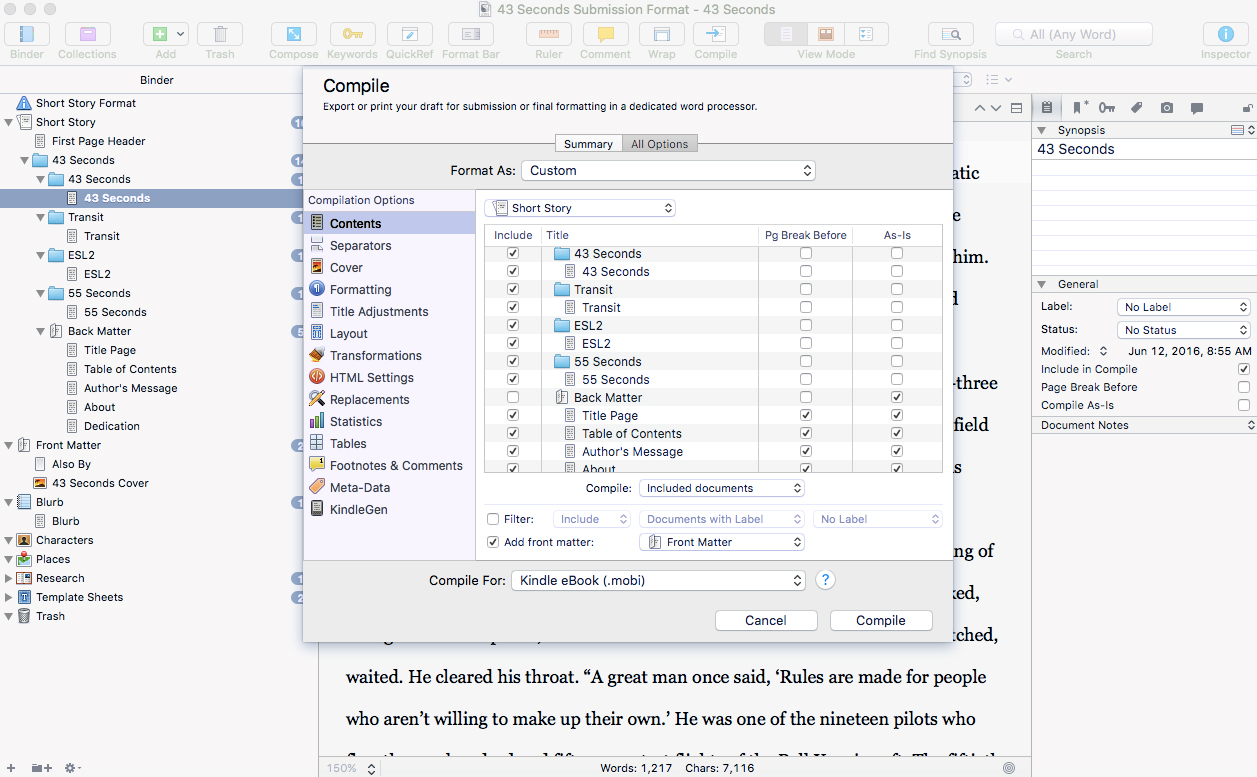
Compiling (Scrivener's lingo for exporting) my story in Kindle .mobi format.
If you own a Kindle, you probably know that you can email documents to your Kindle's email address, and read them on your Kindle. This was great for proofing the .mobi file.
My first readers received pdf versions of the story, and it was simple just to change the compile preset from .mobi to pdf.
That's it! Scrivener is great for organizing your writing. If only they'd finally get around to writing an iPad app for it.
In my next few posts, I'll talk about my experience submitting to Kindle Direct Publishing, enrolling in Kindle Select, and hosting a free promotion.

43 Seconds - Cover Design
As I set about self-publishing my short story, I decided I wanted to do everything myself. This included the cover design. I admit I have a certain fondness for classic 50s, 60s, and 70s paperback science fiction covers, and I thought it would be fun to have a slightly retro, stylized look to the cover.

As I set about self-publishing my short story, I decided I wanted to do everything myself. This included the cover design. I started with stock photos of the Milky Way for the backdrop, but this looked like every other sci-fi book cover on Amazon. I admit I have a certain fondness for classic 50s, 60s, and 70s paperback science fiction covers, and I thought it would be fun to have a slightly retro, stylized look to the cover.
I chose Adobe Illustrator because vector art lined up best with this concept. I wanted to keep the colors and lines clean and simple.

The finished cover design in Illustrator
I've used both Illustrator and Photoshop, and I find Illustrator more intuitive. Maybe it's because, in a world of Microsoft Office and Powerpoint, we're just used to moving around vector graphics. Each element is independent and can have its own set of unique adjustments and effects. For example, the blue lights on the ship have and outer glow effect applied.

Mmmm, glowy.
Text is very easy to lay out. I thought the original design looked fine, until I scaled it to Amazon thumbnail size. The text was illegible. Enlarging all of the text afterwards was easy, and made for a more readable design. As an aside, designing for something which must have a thumbnail view significantly changes some of your classic ideas about proportions in design.
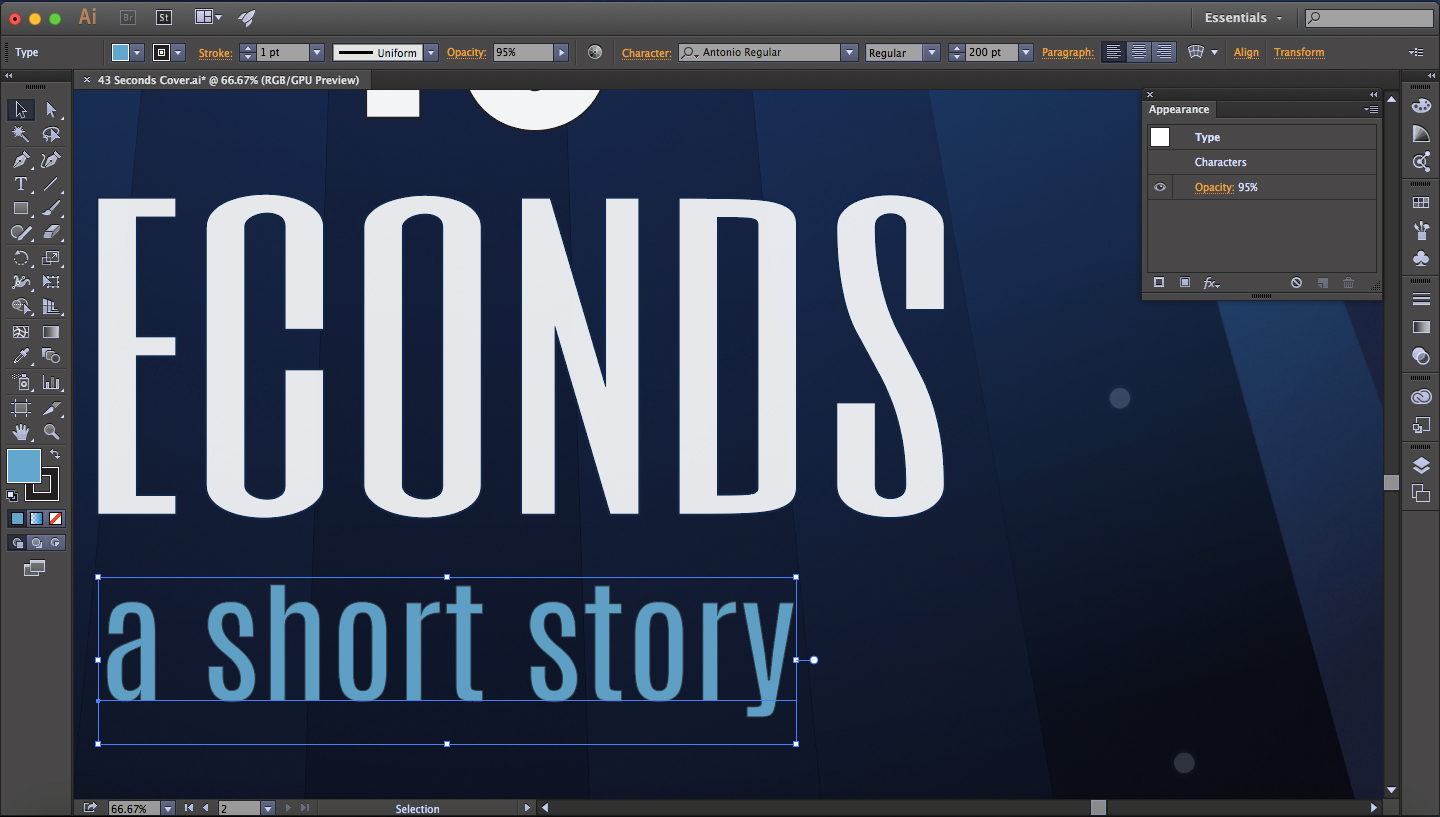
I pushed the opacity down slightly on many of the foreground elements, such as the subtitle, to blend in some of the background color and create better color harmony
Another great feature of Illustrator is artboards. You can create multiple layouts and pin them to different places in your workspace. This was perfect for trying out different versions of the artwork. Here's an example of artboards used for my site's logo design, with different sizes for Facebook banners, avatars, and website headers.

If you save design elements, such as the rocket ship logo, to your library, edits will update each place they appear in an artboard.
The best part about doing the cover design myself: no licensing! I can share the images as much as a want, in any format. Plus, it's just fun to do it yourself.

43 Seconds - Story Ideas and Trivia
I came up with the idea for 43 Seconds while mixing batter for my wife’s birthday cake. The two have nothing to do with each other, except that there’s a certain zen-like meditative span while the beaters churn concentric spirals in the bowl. In my case, this was the perfect time to daydream of space adventures.
I came up with the idea for 43 Seconds while mixing batter for my wife’s birthday cake. The two have nothing to do with each other, except that there’s a certain zen-like meditative span while the beaters churn concentric spirals in the bowl. In my case, this was the perfect time to daydream of space adventures.
Spoiler Alert - if you haven't read 43 Seconds, the next few paragraphs contain random babblings about key plot points.
I’d already had the basic idea of a test flight for an unproven technology, but the question that popped into my head amidst the spattering chocolate was, “What if James has to steal the ship to test it?” That spawned a torrent of follow-up questions. “How would he do that by himself? Does he have accomplices? Why are they helping?” Next thing you know I’ve got Ananke, and Hitoshi, and someone who doesn’t want him to go.
The story evolved quite a bit since the original concept. Here’s a few glimpses into where different aspects originated:
He could see the Skyway3 news filtering across his audience. Feeds were tapped and haptics signaled notifications. Eyes darted to wearables and looked back to him.
The idea of real time social media updates streaming in while James was giving his speech came from a real-life example detailed in Ron Johnson’s So You’ve Been Publicly Shamed. In his example, a person was giving a public apology via press conference while monitors displayed Twitter responses. It didn’t end well.
"I mean, we’re talking disco-era technology, here. It was pricy, and it folded."
James and William’s debate was fun to write, since it was in response to the question, “Why wouldn’t you want an instantaneous near-lightspeed drive?”
The Sandpiper’s strobes pulsed red and green along the pavement while James finished his pre-flight checklist and chatted with the tower.
Sandpiper was the name of the airline in the 90’s TV show Wings. Ah, nostalgia.
“Proceed to whiskey three-five, HPC359.”
All of the air-traffic-control jargon is real, but simplified. It was also an opportunity to see James’s nostalgia for the golden days.
"I remember titanium spirals corkscrewing through cobalt and chromium, the light catching the edges of each turn."
I have a very cool glass paperweight from a trip to the Corning Museum of Glass. It’s clear with blue and white swirls. This formed the inspiration for Ananke’s comments on Earth’s appearance from space.
"Will’s got a vintage Twin Otter that’s a blast to jump out of."
The DeHavilland Twin Otter that James mentions for skydiving is a real plane used by the United States Army Parachute Team.
The speck became an asterisk and bloomed into a proper space station, with a large central dome radiating into six landing pads.
The LEO transit station fuels and stocks vehicles parked there, a bit like loading food and drink onto aircraft at airports. The central hub has a very airport-like waiting area. The original scene was extended and covered all this, but was cut because it didn’t advance the plot.
Earth-Sun Lagrange Two was a popular place. Anything placed there would take one year to circle the sun, the same as the Earth.
Earth-Sun Lagrange Two is a real place. In real life, there are several probes, telescopes, and spacecraft currently at Earth-Sun L1 and L2. ESL2 is somewhat unstable, but I’m assuming the Hayden-Pratt test facility is capable of making its own course corrections.
“Fun fact,” Hitoshi said. “The biggest asteroid that thing’s ever fired on was only twelve meters.”
As I realized ships were routinely achieving fractions of lightspeed, the implications of catastrophic collisions with Earth became a problem. Earth would need to have a “no wake” zone similar to speed boats near shore, and a way to enforce it. The UNSDEF array concept was born.
The Comet looked big from the control room, but as they approached it loomed spectacularly large. Nose to tail it measured fifty-two meters. It was rare to be outside of a spaceship, and easy to forget the true size of one when you were accustomed to the cockpit view.
Once I was at an airshow where a ladder was set up next to an F-14. You could climb up and peer down into the cockpit. I recall just how big the ship was, compared to what I was used to seeing in movies. The Comet is much bigger than an F-14, but the idea of scale is the same.
“Bernard’s Beauty, you are cleared for launch”
Yeager named his Bell X-1 Glamorous Glennis, after his wife. It seemed appropriate for Hitoshi to name the Comet Bernard's Beauty.
The Earth was a brilliant sapphire to his starboard, and Mars was a copper star forward.
I admit that I'm such a nerd that I plugged the story's date into a solar system simulator to determine the distance between Earth and Mars as well as how they would appear from the cockpit of the Comet.
There was no physical sense of speed—with Riggs there wasn’t even acceleration
The Riggs drive is a fictional variant of the Alcubierre drive. It works on a similar concept, but different execution. RF drives received some press last year, although conventional thinking still says reactionless drives are impossible. If you want to approach significant fractions of light speed, you need a way around the rocket equation, however, which limits how fast you can go based on your exhaust velocity.
“Are you crazy? You’ll be dead in less than a minute if you fly that ship.”
As an engineer, I have to say that what James and Ananke are doing is insane, but it wouldn't be a fun story with careful, pragmatic heroes.
“You were thinking in objective time. We would have been dead within the first seven seconds, on our timeline."
I got all the way to end of the story before it occurred to me that forty-three seconds would pass in just a few seconds for the crew due to time dilation. So, if you didn't die nearly instantly you were doing better than the last run.
“We’re in trouble.” Red icons began spilling across the left screen. “Primary and tertiary are already in resonance."
For a famous example of resonance in a mechanical system, watch the video of the Tacoma Narrows bridge ripping itself apart. It's not quite how resonance between Riggs waves works, but it's the general idea.
Hope you enjoyed the story! More posts to come on the process of creating the cover, and self-publishing.