
Red, Blue, Green (1500 words)
In Last Stand, Larson references an organization of radicals. I began fleshing out details of what they're trying to accomplish and how they might operate. Miyu is a character concept for this. This short contains no spoilers and can be read independent of the other works.
AUTHOR'S NOTE: In Last Stand, Larson references an organization of radicals. I began fleshing out details of what they're trying to accomplish and how they might operate. Miyu is a character concept for this. This short contains no spoilers and can be read independent of the other works.
This is a short. It's not a full story, but it is a character and concept study. If you'd like to see more of this storyline, please leave comments.
RED, BLUE, GREEN
Miyu crossed the street, titled her head so her sweatshirt’s hood draped over her face, and stepped inside the bar. An assault of bass and decade old music accompanied the smell of spirits and sweat. She pushed past the crowd, down a crimson hallway, and into the restroom. A click as she locked the door. With both hands she leaned on the sink, glanced up. Brown eyes, twenty-something face, a crescent of color-shifting hair dangling over one cheek.
“Breathe,” she said to her reflection. She reached under the sink, searching, and caught something. A blank, square card. When she pressed the corner a keypad inked itself onto the surface. As she eased the pressure the digits sank back into the card. She pocketed it. The door handle rattled behind her.
She went out the door, down the hall. A man tried to flag her, get her to have a drink, but she pulled her arm away and then was outside, flowing with the crowd, the streets a neon mix of electric blue and carmine red. When she was a few blocks from the bar she ordered a cab, composed herself as she sank into its seat, and stared out the window at the endless rectangles of streaking skyscraper lights. Ten minutes later she was taking the elevator to her apartment on the twenty-sixth floor.
Accent lights awoke as she opened the door. She crossed the room to her balcony, slid open the glass panel, and grabbed a slate off a table. The twinkling spiderweb of city lights and streets greeted her, nearby buildings showing glimpses into people’s lives.
A telescope rested here. Miyu sat beside it. The coordinate screen illuminated as she considered her square card. A press of her thumb revealed the keypad. She tapped in her code and two rows of paired digits raised up beside her thumb. She transcribed the first row’s digits into the telescope’s coordinate screen and servos whined as it adjusted to the destination.
She peered into the eyepiece. Through the lens, a black-haired man sat on a bench, hands in his pockets. Miyu reached up with her right hand, tapped a black cylinder mounted atop the telescope, then clipped a mic onto her right earlobe. A synthetic voice in her ear said, “Tightbeam connection established. Handshaking. Encryption active.”
“Okay,” Miya said, “spotter on comm.”
The man nodded, “Nice night. First time?”
Her hands shook slightly. “No.”
“You sound a bit nervous. Linked up?”
“One second.” She entered the second row of digits from the card into the telescope. It swung off axis and pointed high in the sky. There, barely perceptible against the stars, a black drone hovered in silence. Miyu spliced in the tightbeam link and the synthetic voice said, “AV datafeed. Slate link enabled.”
She tapped the slate and it paired, displaying the drone’s video. From its altitude the city was a spindly lattice of amber and sapphire light. Miyu pushed the man’s coordinates to the drone and the image zoomed onto organic green shapes with circles of light. The figure on the bench was small but in the wide field view she could see all of the adjoining streets and the flow of traffic moving past. “Yeah. We’re good.” She leaned back into the chair, tapped the slate, and patched the telescope feed into a separate window. “What should I call you?”
“Let’s stick with protocol.”
“Sure.” Runners are red, spotters are blue.
Red stood up, began walking. He was maybe thirty, handsome. Looked familiar. He left the park, headed down Wayburn Street. Both the telescope and drone followed him.
“You done many runs?” Miyu said.
Red glanced around at no one in particular. “Green online?”
A hesitation. "Not yet.”
“Not going to get very far without him.”
Miyu’s earpiece chimed from an incoming connection and a young man’s voice joined the channel. “Uh, hey, guys. Sorry. Running late.” A moment of no one talking and the man seemed to take the cue. “Oh, yeah, uh, breacher on comms.”
She resisted the urge to look around, to try and guess where Green was watching her. He’d received a card with her coordinates the same way she’d received one with Red’s. “Welcome to the party, Green.”
Red walked briskly now, crossed a sidewalk, waited at an alley entrance.
Miyu eyed the drone’s feed. “Clear.”
Red entered the alley, went to a dumpster and knelt down beside it, fishing underneath with his right hand, then slid out a black case and opened it. Miyu zoomed. Two silver cylinders, a slate, and a pistol. He gripped the pistol and spoke a passcode. The gun’s safety light cycled to armed.
Miyu placed her hand over her mouth as Red tucked the items inside his jacket.
“Well?” Red asked.
She snapped back to attention. “Sorry. Street’s clear.” A hesitation. “What’s the gun for, Red?”
“What?”
“I thought this was just a data breach.”
Red walked with his hands in his pockets, determined. “You just need to get me into and out of the Onyx building. Let me and Green worry about what happens in there.”
Miyu panned the telescope to the Onyx building. A few office lights scattered in remote patches. “There’s still…there’s still some people there.”
“And Green’s going to keep me away from them.”
Miyu heard Green taking quick breaths on the comm. He said, “Hey, Blue, don’t worry about it.”
“Don’t worry about it? Red’s got a pocket full of binary explosives and a pistol.”
Red’s voice raised, “You should be watching my back, not peeking over my shoulder.” He was one block from the Onyx building.
“It’s fine Blue, we got it,” Green said. “C’mon, c’mon, we need you.”
Red sighed. “We can do this without her.”
Green hesitated. “No, no. We need her. Stay on the line, Blue.” He waited a second for her response. “Blue?”
Miyu furrowed her brow. She watched the top-down view of Red walking, twenty meters to the entrance, then she looked to the side, thinking. A quick tap of coordinates on the slate and the drone swung off axis, panned, zoomed to her location sitting on the balcony. She swung its view down to street level, pulled it back to wide view. Moving in the darkness along the alleys flanking each side of her building were two lines of figures. She tapped the image into daylight mode and saw the agents, the rifles, the government logos. Both groups came to a stop just before the building’s front, waiting.
The air emptied around her and she struggled trying to take breaths. She grabbed her forehead with a handful of hair and tried to think. She knew where Red was. Red didn’t know where anyone was. Green knew where she was and where Red was going.
Green’s voice had an edge, nervous. “Still with us, Blue?”
She panted and swallowed, summoned enough spit to speak. “Uh, Red.” Her voice shook. “Green’s burned us. Run.”
“What?”
Miyu grabbed the slate, saw the agents surging forward towards the main entrance. In her earbud she heard men shouting, Red breathing hard, the sounds of running. She ripped the earbud out and tossed it off the balcony, then she bolted into her apartment, opened the closet, found the go bag. The slate was still in her hand. She swiped it into offline mode, dropped it in the bag, grabbed the duffel, and ran to her door, cracking it open.
Through the slit of the open door she saw the elevator up arrow glowing, floors ticking higher. Fourteen, fifteen, sixteen. She opened the door, stepped out, closed and locked it, then ran to the stairs. She took the steps two and a time, going up one flight and emerging into the hall. Apartment 2704 was three doors down. Leon’s. Sales engineer. Always traveling. She’d hacked his manual entry code a few months ago just for this reason. In a second she had the door open and was inside. It was nearly directly over her apartment one floor below.
She hit the manual switch before the lights turned themselves on, keeping the room in darkness. Quietly she locked the door, crossed to the kitchen, and leaned one hand against the wall, trying to catch her breath. Right about now the agents were overriding her apartment lock and swarming in with rifles drawn, claiming what was once her life. She could never be Miyu again.
A gleam of reflected light caught her eye, and she spied Leon’s liquor stash in the nearby cabinet. She found a nice bourbon, splashed some in a glass, and tried to steady her hand enough to take a sip. As its warmth filtered through her, she held her hand to her mouth, crying without sound.
END
Take My Book, Please
Recently I tested the Facebook Boost Post button, despite the internet telling me never to press it, and, not surprisingly the only effect it generated was vacuuming a ten dollar bill out of my wallet.
I've been trying inexpensive marketing experiments. Recently I tested the Facebook Boost Post button, despite the internet telling me never to press it, and, not surprisingly the only effect it generated was vacuuming a ten dollar bill out of my wallet. Like a gambler watching the dealer scoop up the chips of my losing hand, I slapped another ten on the table, took a swig of my drink, and said, "Deal 'em again, Sam."
I decided to change up the game, however. The past two week experiment has been with Amazon Giveaways. Amazon makes it very easy to set up a Giveaway either for your physical or digital book. Just scroll to the bottom of your reviews, and you will find the Giveaway button after the last review:

Next, you choose your lottery options. I chose Random, 1 in 50 chance, 10 prizes to give away. Amazon informed me this would result in somewhere between 450 - 500 entrants. Note you are purchasing however many copies you plan on giving away at the time that you set up the giveaway, but on the plus side you will get royalties for these purchases (at some point, more about that later):

Next, you set any requirements to enter. You can set no requirements, or require people to follow you on Twitter, or Amazon, view a video, or take a poll. I chose Follow S.D Falchetti on Amazon:

Incidentally, you should follow yourself on Amazon. This way you will see what the button does. As I suspected, followers get notifications of your new releases with links to buy them.
You set the duration (I chose the default 15 days). There's also a legal note that only US residents can enter, which seems to be an Amazon requirement.
On the last screen, you add your win/lose messages, and product details:
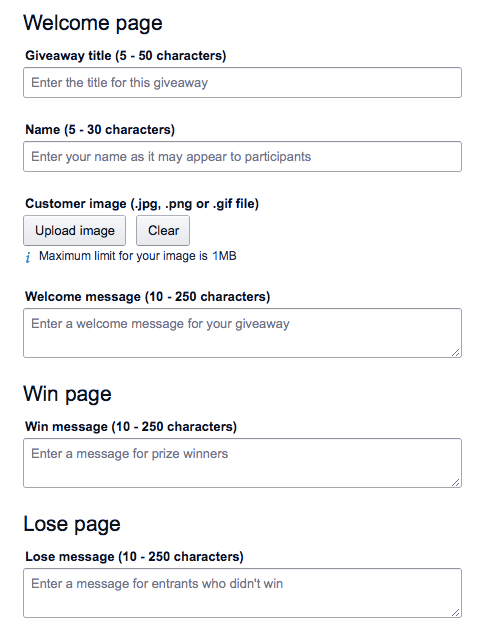
In the win message, I thanked them for entering and asked them to leave a review. In the lose I suggested they download the free sample.
You can also upload a custom image for the giveaway. I suggest doing this, because I left it at the default Amazon product image which resulted in Twitter cropping the book cover to this:

There is no way to edit the Giveaway once you submit it. The only way I was able to fix this was by making a custom graphic and using Twitshot to attach it to the link:

Once you submit it, it will go live probably with an hour. It's up to you how to promote it:
- Share the giveaway link directly with a specific audience (email it just to your newsletter followers, for example)
- Share it with everybody. The easiest way to do this is to use the #AmazonGiveaway hashtag in Twitter, which will be picked up and retweeted. I should mention that many people enter giveaways for fun, and not everyone who wins a copy will read it.
I posted it on my Twitter account with the #AmazonGiveaway hashtag. Within one hour 380 people (out of 500) had entered, winning 7 of the 10 books. Then, it petered to a trickle. I got 1-10 entrants per day for the remaining two weeks. Two more books were won, and I was left with one unclaimed book when the giveaway ended. Amazon allows you to set up a new giveaway for unclaimed books, or simply gift them to people. I gifted it.

How it all panned out:
- 9 out of 10 prizes claimed, most within the first hour
- 460 new Amazon followers
- Zero new sales
Royalties:
- As people won prizes, royalties for those prizes showed up on my royalties report.
Sales Reports:
- The 10 books I purchased as prizes did not show up in my sales report until all 10 books were claimed. Because I had one book left after the giveaway concluded, it was not until I gifted that remnant and the person accepted the gift that all 10 sales showed up in my sales dashboard at once.
Sales Rank:
- The giveaway had zero effect on my Amazon sales rank, even when the 10 books finally showed up in my sales dashboard. I found this odd because if I bought ten copes and simply gifted them, they would show up as both sales and sales rank.
Reviews:
- I'll admit, I didn't expect any reviews. Review-to-purchase ratio on Amazon is between 0.1% - 1%, so you really need to sell more than a hundred copies to have a chance at one review. But, one of the prize winners did leave a 5 star review (thank you! you're awesome!). She wrote:
I won this through a giveaway and very thrilled I read it. Once I started reading it I couldn't stop. Would of definitely bought and looking forward to reading more from the author.
All in all, not a bad experience. I picked up a few hundred Amazon followers, who will get notifications as I publish new releases, and a 5 star review. I might do it again for another book.

Aristarchus Mission Patch
I've enjoyed illustrating the covers for 43 Seconds and Signal Loss, and thought it would be fun to render the Aristarchus's mission patch.
In Signal Loss, Kyan and Harmony wear matching baseball caps with the Aristarchus logo. In the first draft of the story I described the logo having a sunburst pattern above the ship's name, but the description was edited out to pick up the intro pace.
I've enjoyed illustrating the covers for 43 Seconds and Signal Loss, and thought it would be fun to render the Aristarchus's mission patch. In the story, Kyan's cap and flight suit are ocean blue, so this formed the reference for the logo's color scheme.

Fun, huh? It picks up the story element of the Earth being occulted by the Sun while also illustrating the Greek astronomer Aristarchus, who was the first to propose the Earth revolved around the Sun (bet you thought it was Copernicus or Galileo? Aristarchus was a millennia earlier).
Enjoy!

Data Running - Story Extra
In Signal Loss, Kyan Anders is a data runner. I envisioned this as the data equivalent of the Planet Fitness commercial, "I lift things up and put them down." So, what exactly is a data runner, and why would it be necessary in the future?
In Signal Loss, Kyan Anders is a data runner. I envisioned this as the data equivalent of the Planet Fitness commercial, "I lift things up and put them down."
So, what exactly is a data runner, and why would it be necessary in the future?
Consider this: Let's say you live in New York City, and you want to move a terabyte of data to Philadelphia. What's the fastest way to do it?
- Transmit it over the internet
- Pick up the drive with your hands and walk it to Philadelphia
This may require a #2 pencil and a calculator. Show your work:
Let's say you're a residential internet user with Comcast. I ran the Xfinity speed test and got an upload speed result of 11.8 Mbps. That's 1.475 megabytes per second. 1 TB = 1,000,000 MB. Uploading my 1 TB file at 1.475 megabytes per second will take 7.8 days.
On the other hand, Google maps for NYC to PHL shows an Amtrak option (1 hour, 9 minutes) or a driving option (1 hour, 46 minutes). Or you could just walk. Walking 8 hours a day, covering 30 miles per day, it would take 3.2 days. You could enjoy the extra four days wandering around South Street, seeing the Liberty Bell, and running up the Philly Art Museum steps like Rocky.
Other places you can travel to in less than 7.8 days:
- Anyplace on Earth. You can find flights connecting antipodes (diametrically opposite points on the Earth) with 30 hour transit times, and only two stops
- The Moon. The original Apollo Earth to Moon trip took 3 days.
Now, you're probably already ahead of me and you've realized, "Aha! But you've used a terabyte. Can we figure out how small the file would need to be to get to Philly before you do?"
Easy enough. My fastest NYC->PHL option is probably the 1 hour, 9 minute Amtrak option. Upload speed of 1.475 megabytes per second times 1 hour, 9 minutes equals 6.1 gigabytes.
Similarly, for my antipode example, a 30 hour flight equals 159.3 gigabytes.
So, if you're sending things smaller than 6 gigs, the internet will probably win.
But, if you've got to move something big, and do it fast, buy a plane ticket. Or hire Kyan Anders.

Signal Loss - Story Extras Part 2
If you've stumbled upon my blog, then, congrats, you've found bonus story content! If you haven't read Signal Loss yet, stop, get a copy (seriously, it's only 99 cents), then read the rest of this post. Otherwise you'll be exposed to some major plot spoilers Here's a few excerpts and commentary from Signal Loss.
If you've stumbled upon my blog, then, congrats, you've found bonus story content! If you haven't read Signal Loss yet, stop, get a copy (seriously, it's only 99 cents), then read the rest of this post. Otherwise you'll be exposed to some major plot spoilers.
Here's a few excerpts and commentary from Signal Loss:
Thirty-five conversations separated by seven hundred and sixteen minutes.
The edge of the solar system is so far away that even light takes twelve hours to get there.
HELIOS reports M-class flare activity expected 08.02.80 06:48 through 08.02.80 13:21. Expected magnitude M2-M4. Minor communications disruptions expected with inner planet broadcasts
Solar flares are classed A, B, C, M or X. The most powerful flare ever observed was in 1859, and is estimated to be an X45 class.
She flicked her bracelet. Twelve Minutes to Mars. The photo showed James Hayden propped up in a hospital bed, wearing a neck brace, giving a toothy smile and a thumbs up.
James was injured when Bernard's Beauty collided with the boundary in 43 Seconds. He described the impact feeling like his ship had been dropped from a height onto its right nacelle.
I’ve got my final images of Sedna. Today I’ll switch to Eris, then it’s Oort cloud cataloguing and heliopause measurements for the next eight days.
Sedna and Eris are minor planets at the outer edges of the solar system. Sedna has a huge orbit with an aphelion of 936 AU and takes 11,000 years to complete one orbit.
Object one was fifty degrees kelvin with moderate reflectivity. Distance was unknown. Rios guessed it was a scattered disc object, and Kyan confirmed.
Scattered disc objects are outside of Neptune's orbit, but not as far out as the Oort cloud. Sedna and Eris are both scattered disc objects, big enough to be classed as minor planets. Finding things with low luminosity by occultation (seeing them block out the light of something else) is a tried and true astronomical practice.
“I thought at one-fifth gee it would be light enough to lift. I wasn’t thinking.”
The 500 kg drone weighs 275 lbs at 0.25 g. That's similar size and weight as the Atlas Stones used in the real life World's Strongest Man competition. Kyan's right, he wasn't thinking. The mass of the drones will come into play later with Kyan's plan to destroy the impactor.
“The simplest answer is, if you ask an A.I. about its dreams, it will tell you.”
In 43 Seconds, the A.I. Ananke tells James about her desire to see Earth from orbit, in person, and she is awed by it when it happens. She also talks about her desire to fulfill Bernard's dreams, out of loyalty to him. Rios doesn't talk about what he wants until the very last line of the story.
“Salisbury steak and noodles.”
I imagined Kyan eating tv dinners throughout his stay. I remember salisbury steak and noodles being a popular option as a teenager.
“It is a kinetic impactor. These were used for asteroid defense between 2048 and 2062.
Credit goes to NASA for the concept of kinetic impactors used for asteroid defense.
What happens when a 500 kg mass collides with your weapon at three hundred and fifty-nine kilometers per second?
Kinetic energy is just velocity squared times mass divided by two. 359 kps is 803,060 kph, which is ridiculously fast (0.1% of light speed). If you do the math it will give you an answer in joules, which converts indeed to 7 kilotons, roughly half the yield of the Hiroshima nuclear blast.
“Rios, open the fabmod pressure door.”
This was a nod to the famous 2001: A Space Odyssey line, "Open the pod bay doors, Hal." It seems humanity is destined to argue with A.I.s about opening or closing airlock doors.
“If you don’t open that door, I will be killed.”
It was subtle, but this is a variation on a classic moral dilemma, usually phrased as throwing a switch to determine which track a runaway train chooses, where both action and inaction result in someone getting killed. It's really an impossible problem for a computer programmed with an Asimov-like law, which is why Rios is only able to solve it when he makes decisions independent of his programming.
"You know, when we get back, you should take the Turing-Day test again."
The modified Turing-Day test is fiction, although Turing tests are real and well known. The general Turing standard is: if you can't tell the difference between a computer and person, the computer is sentient. I think as expert systems become more competent and convincing, this definition will need to change. This is why Rios defines sentience as having dreams of one's own.

Signal Loss
I've just completed a new short story, Signal Loss, 9600 words. Signal Loss takes place the day after the events in 43 Seconds, following a different set of characters in a very different location.
I've just completed a new short story, Signal Loss, 9600 words. Signal Loss takes place the day after the events in 43 Seconds, following a different set of characters in a very different location. Kyan Anders is a middle-aged data runner piloting the science ship Aristarchus at the edge of the solar system. His daily chats with his daughter are about to be interrupted as the Earth is occulted by the Sun, leaving him only with the ship's computer, Rios. When another runner and a mysterious object appear, things get complicated quickly and life-or-death decisions need to be made thirteen billion kilometers from home.
Solar conjunctions are real, and we usually think of them in terms of Mars slipping behind the sun, causing communications loss with satellites or rovers. At present we don't think of Earth/Sun conjunctions because there's no one to view them, but once people are on Mars or elsewhere in the solar system they'll become a thing.
Solar flares are well-known and affect Earth's communications. These will also be a complication for intrasystem comms.
In my previous story, 43 Seconds, William says "You can literally fly to the end of the solar system in fifteen days." He's talking about how a one gee continuous acceleration gets you to Pluto in fifteen days. But, Pluto is not the end of the solar system. In 2012, Voyager 1 reached the heliopause at 121 AU. Pluto only ranges 30-49 AU. The Aristarchus is somewhere between the two, at 86 AU. So, Kyan is twenty-six travel days from Earth (using the Aristarchus's RF drive). Even at lightspeed his conversations with his daughter have a full 24 hour turn around due to the distance.
Just as an aside, I think it's amazing that, as far out as Kyan is in the story, there's a real life spaceship (Voyager 1) that is much farther. Voyager 1 is nearly 40 AU past Kyan's location. To put this to scale, if Kyan were the Sun, Voyager 1 would be Pluto. That's how far 40 AU is.
I liked the idea that, even with RF drives, someone could be so far out that help was nearly a month away. Throw in Earth comms loss and you're truly on your own dealing with whatever situation develops.
The role of A.I.s and non-A.I. computer intelligences is also explored. If you enjoyed Ananke paired with James in 43 Seconds, you'll like the reluctant roommates of Kyan and Rios in Signal Loss.
There's a few other technological consequences which 43 Seconds mentions that are explored in Signal Loss. I'll keep those under wraps for the time being, though, to avoid spoilers, but I'll write about them once the story is published.

The Golden Age
If you've seen the movie Gentleman Broncos, the opening credits feature a montage of pulp sci-fi covers. You know the type - alien tentacles wrapping around an alarmed female astronaut while a crewman pulls out a blaster. You can actually see the brush strokes in the paint.
If you've seen the movie Gentleman Broncos, the opening credits feature a montage of pulp sci-fi covers. You know the type - alien tentacles wrapping around an alarmed female astronaut while a crewman pulls out a blaster. You can actually see the brush strokes in the paint. I love it!
I started a Pinterest board collecting vintage sci-fi book covers. Although my intent was to find crazy 50s - 80s illustrations, I couldn't help but gravitating to all of the classic books that I loved. Clarke, Asimov, Pournelle, Niven, Pohl, Bester. So, at least the first round of pics are more nostalgia based than art, but I'll keep growing the list.
You can check it out on Pinterest, and follow me for updates.

Tales of a Rookie - Part 3
Last week I posted a book trailer for 43 Seconds on my Facebook page. You may have noticed an enticing "Boost Post" button sits at the bottom of your page posts. I've always ignored it. But there it sat, calling to me like a siren leading a sailor to rocks.
Self-promotion is a necessary evil of indie publishing. I could just hand it over to my agent, except I'm my agent. I feel a bit like Barf from Spaceballs:
Last week I posted a book trailer for 43 Seconds on my Facebook page. You may have noticed an enticing "Boost Post" button sits at the bottom of your page posts. I've always ignored it. But there it sat, calling to me like a siren leading a sailor to rocks.
So I Googled it, and the internet told me never to press that button. Instead, just go light a handful of my own money on fire. It would have the same effect.
Of course I immediately pressed the button. Sure, the wisdom of the internet said it was pointless, but I was willing to conduct a ten dollar experiment. The boost button creates a type of ad which shows up in people's feeds. Just like regular ads, you configure your target audience and create a duration. When the duration and money are used up, the ad ends.
I boosted my video trailer for two days in the United States targeting men 18 - 55 using keywords related to science fiction. I added a link to my Amazon's book page with a teaser "Hop in the pilot's seat with James for 99 cents at http://amzn.to/28TDGpt." As the two days progressed, Facebook sent me cheery updates about all of the extra reach my post achieved. At the end, it gave me a summary:

Fifteen hundred people reached (which means, appeared in their newsfeed) with 364 video views. Facebook autoplays videos, so this was really 364 autoplays. 27 people actually clicked the play button on the video. Zero people clicked on the teaser link. The Likes/Shares were existing Facebook page fans.
Interestingly, demographics are also reported. Twice as many people in the 18-24 year old bracket had the video play in their feed. Because these were autoplays and not actual clicks, I interpreted this as 18-24 year olds were more likely to have the science fiction keywords in their interests, meeting my ad criteria. It's also possible Facebook simply has more users in the 18-24 age bracket than older brackets.

Lastly, the final test: sales. No impact on book sales. Doh! The wisdom of the internet was right.

43 Seconds Trailer
I made a short trailer for 43 Seconds using Adobe Spark. If you haven't used Adobe Spark, it's very easy, and, best of all, free.
I made a short trailer for 43 Seconds using Adobe Spark. If you haven't used Adobe Spark, it's very easy, and, best of all, free.


Tales of a Rookie - Part 2
I decided to self-publish 43 Seconds on Kindle Direct Publishing because I loved the idea of owning the project start to finish. KDP is remakably easy to use. It’s really just a few screens of selections, followed by pushing the “publish” button.
I decided to self-publish 43 Seconds on Kindle Direct Publishing because I loved the idea of owning the project start to finish. KDP is remakably easy to use. It’s really just a few screens of selections, followed by pushing the “publish” button. The steps were:
Create an account
Upload my story (in this case, a .mobi file generated from Scrivener)
Upload my cover art
Enter my product details (title, blurb, author name, etc)
Choose if I wanted to enroll in Kindle Select (90 day exclusive contract with Amazon) or just Kindle Direct (non-exclusive)
Select my markets/royalty options
Click publish
Once I clicked “publish”, the story went into Pending status. After thirty minutes, it was live.
The main decision point was Kindle Select versus Direct. I chose Select (90 day exclusve contract) for the following reasons:
People with Kindle Unlimited can read it for free (more people may see it, and potentially leave a review)
I can choose five promotion days where I can offer the book for free, or at a discount. The days do not need to be consecutive. I planned offering them the first weekend after launch to try and get more people to see it, and potentially leave a review.
I don’t have any other markets yet (iBooks, epub) for the story, so I wasn’t losing anything by limiting myself only to Amazon for 90 days. I can always add other markets after the 90 day contract.

Once the book was live, I was able to create an Author Central account and begin filling in my bio. This is the page people see when they click your name on Amazon. It has options to link your personal website/blog, so I hooked those up to my blog.

Self-Marketing
I made a Facebook author page, invited my friends, and posted updates about the upcoming free download weekend
I’m also an artist, and have an established Facebook page for selling art. It’s taken me years to grow it to 500+ fans. I did a bit of self cross-promotion and announced the upcoming free download weekend along with links to my writing page. Based on demographics I didn’t think there were many sci-fi fans in my art group, but even if I picked up one or two it was helpful.
I added a banner to my website announcing the free download dates, with a direct link to the Amazon page.
Results
I ran a three day free promotion on Friday, Saturday, and Sunday. Amazon doesn't disclose who bought your books, but it does tell you which Amazon regional site sold them. The results were:
Books sold during the free promotion:
- Amazon.com, 7 sales
- Amazon.de, 4 sales
- Amazon.com.au, 1 sale
The first day after the free promotion I had my first paid sale:
- Amazon.com, 1 sale
Sales in the US, Germany and Australia. Cool! Thanks.
Surprisingly, the 12 weekend sales were enough to get me listed at #23 on the Amazon bestseller list for the category Kindle Short Reads->45 minutes(22-32 pages)->Science Fiction & Fantasy. I noticed the list is dynamic and changes hour to hour. Today, for example, with only 1 sale, I'm listed at #911. Doh. But it was fun being at #23!

I still have 2 promotion days left to spend, which I'll use on another weekend after I get some reviews. In the meantime, I'll try to grow my newsletter and Facebook page, so I can let readers know of those promotions.
And, of course, I'll start working on my next story.

Tales of a Rookie - Part 1
When I first started writing stories, there were three choices for getting words on paper: pen and paper, typewriter, word processor. Things have evolved since then, and now there's dedicated writing software.
When I first started writing stories, there were three choices for getting words on paper: pen and paper, typewriter, word processor. Things have evolved since then, and now there's dedicated writing software. I've tried both Ulysses and Scrivener. I can say it's practically impossible to read a modern writing book without tripping over Scrivener raves. It's what I ended up picking.
Here's my impressions:
Ulysses
- Beautiful, clean interface. Really a joy to type in Ulysses. It actually seems designed to encourage you to write.
- Uses Markdown for formatting. Takes a little getting used to if you don't write in Markdown.
- Projects sync easily with the cloud.
- There is an iPad app so you can access your writing on the go.
- Although there's no reason you couldn't write a novel in Ulysses, it seems best suited for writing smaller works. It seems like it'd be awesome for writing articles.
Scrivener
- Scrivener is all about organization. It's project management software for writers. If you want a place to keep all of your notes, research, character/locations details, and book reviews, plus organize all of the chapters and text of your novel, Scrivener is for you.
- Similar to Ulysses, you chose the format of the project when you export it. You can write the entire draft in single-space Times New Roman if you want, then chose an export preset to put it all in standard manuscript submission format.
- The interface is not very intuitive. It's like trying to guess your way through Photoshop.
- It does have distraction-free writing modes, but Ulysses is much nicer for distraction-free writing
- In a way, it's the opposite of Ulysses. It really shines when you're working on a big, complex project.
Scrivener comes with a few templates, but you'll end up configuring it the way you like. Here's the set up for 43 Seconds:

I started with the default Short Story template and added a few folders:
- First Page Header: lists my name, address, phone and story word count in standard submission format. Only included when submitting to magazines. My preset for Kindle excludes this during compile.
- Back Matter: I purposely moved everything to the end of my book to ensure the free Amazon samples include the first few pages of the story. I didn't want those pages to be all copyright notices and table of contents. My back matter section includes the title page with copyright, table of contents, author's message with hyperlinks to my website, about the the author, and dedication. The table of contents was manually created. If I'd used Scrivener's auto-create TOC function, it would end up at the beginning.
- Blurb: The short pitch for the story that appears on Amazon. I just copy/paste from this when uploading my story to Kindle Direct Publishing. I have some brainstormed variants stored here.
- Reviews: Notes from reviews, as well as review text which may be pasted in the Amazon Review section.
- To Do: Things to fix in the next version.
- Front Matter: I've added the image for my cover, and an "Also By" page. Note when you upload the file to Kindle Direct Publishing, Amazon ignores the cover art in the .mobi file. You need to upload it separately in the KDP screen.
I like to write in Georgia twelve-point font, double-spaced. You can set it up however you like, because you'll configure the output font and spacing in the compile screen. I've installed Kindlegen (available free from Amazon) and created a Kindle format preset, so my output is in Kindle's standard .mobi format.
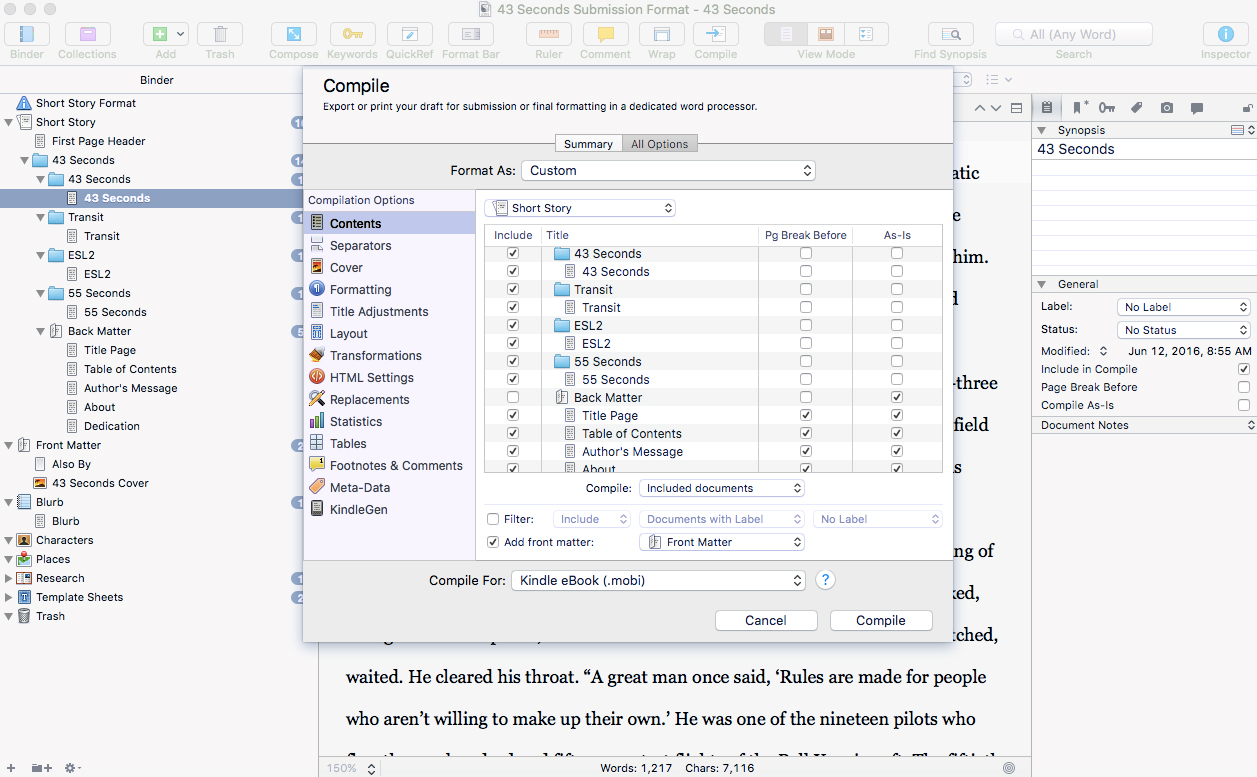
Compiling (Scrivener's lingo for exporting) my story in Kindle .mobi format.
If you own a Kindle, you probably know that you can email documents to your Kindle's email address, and read them on your Kindle. This was great for proofing the .mobi file.
My first readers received pdf versions of the story, and it was simple just to change the compile preset from .mobi to pdf.
That's it! Scrivener is great for organizing your writing. If only they'd finally get around to writing an iPad app for it.
In my next few posts, I'll talk about my experience submitting to Kindle Direct Publishing, enrolling in Kindle Select, and hosting a free promotion.

43 Seconds - Cover Design
As I set about self-publishing my short story, I decided I wanted to do everything myself. This included the cover design. I admit I have a certain fondness for classic 50s, 60s, and 70s paperback science fiction covers, and I thought it would be fun to have a slightly retro, stylized look to the cover.

As I set about self-publishing my short story, I decided I wanted to do everything myself. This included the cover design. I started with stock photos of the Milky Way for the backdrop, but this looked like every other sci-fi book cover on Amazon. I admit I have a certain fondness for classic 50s, 60s, and 70s paperback science fiction covers, and I thought it would be fun to have a slightly retro, stylized look to the cover.
I chose Adobe Illustrator because vector art lined up best with this concept. I wanted to keep the colors and lines clean and simple.

The finished cover design in Illustrator
I've used both Illustrator and Photoshop, and I find Illustrator more intuitive. Maybe it's because, in a world of Microsoft Office and Powerpoint, we're just used to moving around vector graphics. Each element is independent and can have its own set of unique adjustments and effects. For example, the blue lights on the ship have and outer glow effect applied.

Mmmm, glowy.
Text is very easy to lay out. I thought the original design looked fine, until I scaled it to Amazon thumbnail size. The text was illegible. Enlarging all of the text afterwards was easy, and made for a more readable design. As an aside, designing for something which must have a thumbnail view significantly changes some of your classic ideas about proportions in design.
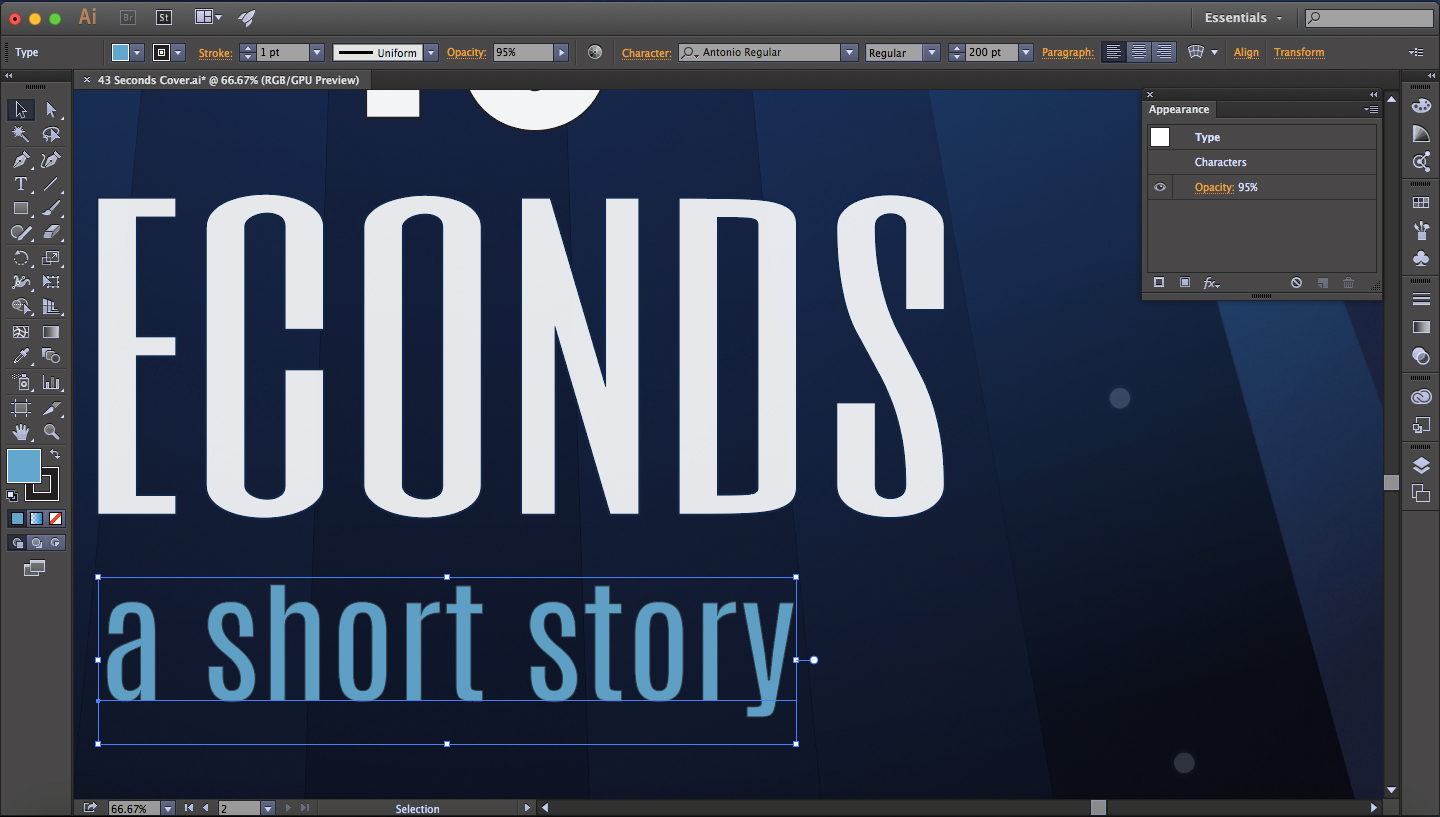
I pushed the opacity down slightly on many of the foreground elements, such as the subtitle, to blend in some of the background color and create better color harmony
Another great feature of Illustrator is artboards. You can create multiple layouts and pin them to different places in your workspace. This was perfect for trying out different versions of the artwork. Here's an example of artboards used for my site's logo design, with different sizes for Facebook banners, avatars, and website headers.

If you save design elements, such as the rocket ship logo, to your library, edits will update each place they appear in an artboard.
The best part about doing the cover design myself: no licensing! I can share the images as much as a want, in any format. Plus, it's just fun to do it yourself.

43 Seconds - Story Ideas and Trivia
I came up with the idea for 43 Seconds while mixing batter for my wife’s birthday cake. The two have nothing to do with each other, except that there’s a certain zen-like meditative span while the beaters churn concentric spirals in the bowl. In my case, this was the perfect time to daydream of space adventures.
I came up with the idea for 43 Seconds while mixing batter for my wife’s birthday cake. The two have nothing to do with each other, except that there’s a certain zen-like meditative span while the beaters churn concentric spirals in the bowl. In my case, this was the perfect time to daydream of space adventures.
Spoiler Alert - if you haven't read 43 Seconds, the next few paragraphs contain random babblings about key plot points.
I’d already had the basic idea of a test flight for an unproven technology, but the question that popped into my head amidst the spattering chocolate was, “What if James has to steal the ship to test it?” That spawned a torrent of follow-up questions. “How would he do that by himself? Does he have accomplices? Why are they helping?” Next thing you know I’ve got Ananke, and Hitoshi, and someone who doesn’t want him to go.
The story evolved quite a bit since the original concept. Here’s a few glimpses into where different aspects originated:
He could see the Skyway3 news filtering across his audience. Feeds were tapped and haptics signaled notifications. Eyes darted to wearables and looked back to him.
The idea of real time social media updates streaming in while James was giving his speech came from a real-life example detailed in Ron Johnson’s So You’ve Been Publicly Shamed. In his example, a person was giving a public apology via press conference while monitors displayed Twitter responses. It didn’t end well.
"I mean, we’re talking disco-era technology, here. It was pricy, and it folded."
James and William’s debate was fun to write, since it was in response to the question, “Why wouldn’t you want an instantaneous near-lightspeed drive?”
The Sandpiper’s strobes pulsed red and green along the pavement while James finished his pre-flight checklist and chatted with the tower.
Sandpiper was the name of the airline in the 90’s TV show Wings. Ah, nostalgia.
“Proceed to whiskey three-five, HPC359.”
All of the air-traffic-control jargon is real, but simplified. It was also an opportunity to see James’s nostalgia for the golden days.
"I remember titanium spirals corkscrewing through cobalt and chromium, the light catching the edges of each turn."
I have a very cool glass paperweight from a trip to the Corning Museum of Glass. It’s clear with blue and white swirls. This formed the inspiration for Ananke’s comments on Earth’s appearance from space.
"Will’s got a vintage Twin Otter that’s a blast to jump out of."
The DeHavilland Twin Otter that James mentions for skydiving is a real plane used by the United States Army Parachute Team.
The speck became an asterisk and bloomed into a proper space station, with a large central dome radiating into six landing pads.
The LEO transit station fuels and stocks vehicles parked there, a bit like loading food and drink onto aircraft at airports. The central hub has a very airport-like waiting area. The original scene was extended and covered all this, but was cut because it didn’t advance the plot.
Earth-Sun Lagrange Two was a popular place. Anything placed there would take one year to circle the sun, the same as the Earth.
Earth-Sun Lagrange Two is a real place. In real life, there are several probes, telescopes, and spacecraft currently at Earth-Sun L1 and L2. ESL2 is somewhat unstable, but I’m assuming the Hayden-Pratt test facility is capable of making its own course corrections.
“Fun fact,” Hitoshi said. “The biggest asteroid that thing’s ever fired on was only twelve meters.”
As I realized ships were routinely achieving fractions of lightspeed, the implications of catastrophic collisions with Earth became a problem. Earth would need to have a “no wake” zone similar to speed boats near shore, and a way to enforce it. The UNSDEF array concept was born.
The Comet looked big from the control room, but as they approached it loomed spectacularly large. Nose to tail it measured fifty-two meters. It was rare to be outside of a spaceship, and easy to forget the true size of one when you were accustomed to the cockpit view.
Once I was at an airshow where a ladder was set up next to an F-14. You could climb up and peer down into the cockpit. I recall just how big the ship was, compared to what I was used to seeing in movies. The Comet is much bigger than an F-14, but the idea of scale is the same.
“Bernard’s Beauty, you are cleared for launch”
Yeager named his Bell X-1 Glamorous Glennis, after his wife. It seemed appropriate for Hitoshi to name the Comet Bernard's Beauty.
The Earth was a brilliant sapphire to his starboard, and Mars was a copper star forward.
I admit that I'm such a nerd that I plugged the story's date into a solar system simulator to determine the distance between Earth and Mars as well as how they would appear from the cockpit of the Comet.
There was no physical sense of speed—with Riggs there wasn’t even acceleration
The Riggs drive is a fictional variant of the Alcubierre drive. It works on a similar concept, but different execution. RF drives received some press last year, although conventional thinking still says reactionless drives are impossible. If you want to approach significant fractions of light speed, you need a way around the rocket equation, however, which limits how fast you can go based on your exhaust velocity.
“Are you crazy? You’ll be dead in less than a minute if you fly that ship.”
As an engineer, I have to say that what James and Ananke are doing is insane, but it wouldn't be a fun story with careful, pragmatic heroes.
“You were thinking in objective time. We would have been dead within the first seven seconds, on our timeline."
I got all the way to end of the story before it occurred to me that forty-three seconds would pass in just a few seconds for the crew due to time dilation. So, if you didn't die nearly instantly you were doing better than the last run.
“We’re in trouble.” Red icons began spilling across the left screen. “Primary and tertiary are already in resonance."
For a famous example of resonance in a mechanical system, watch the video of the Tacoma Narrows bridge ripping itself apart. It's not quite how resonance between Riggs waves works, but it's the general idea.
Hope you enjoyed the story! More posts to come on the process of creating the cover, and self-publishing.