
The Grand Adventure
A pixel plane, two-thousands miles, and a plan.
A few years ago I read Patrick Smith's Cockpit Confidential, a retired pilot's behind-the-scenes look at everything which happens behind the closed doors of aircraft. I was hooked, and, intensely curious. YouTube fueled my fire with channels dedicated to people showing their in-flight videos of pilot's training and first flights. One in particular showed someone being handed the controls of a single-engine prop plane and asked to land it with no flight experience. I remember him panning across the different controls and trying to deduce what each gauge did.
I wanted to know what each gauge did, so I downloaded X Plane and bought the virtual version of the same plane.
I've been virtually flying the past month, learning all of the details about how to start the plane cold, navigate via navaids and gauges, and land at different airports. When I took off from my local county airport, I was amazed at the detail in the simulations. It looked like where I lived, right down to the streets. I could find my house. In the advent of full-world maps like Google Earth, X Plane has a three-dimensional model of the world for you to explore. If you're really into authenticity, you can overlay it with satellite imagery. And, so, I find myself exploring places. Flying over the Golden Gate bridge and doing a circuit past Sausalito to Muir Woods and back, seeing the sights.

Flying the PA28 Piper Warrior II just north of San Jose
After fifty-plus simulator hours, I'm ready for bigger challenges. And, so, I've planned my grand adventure: flying coast-to-coast in my single-engine plane, the PA28 Piper Warrior II, and blogging my trip along the way.
I plan to keep it as authentic as possible. This means:
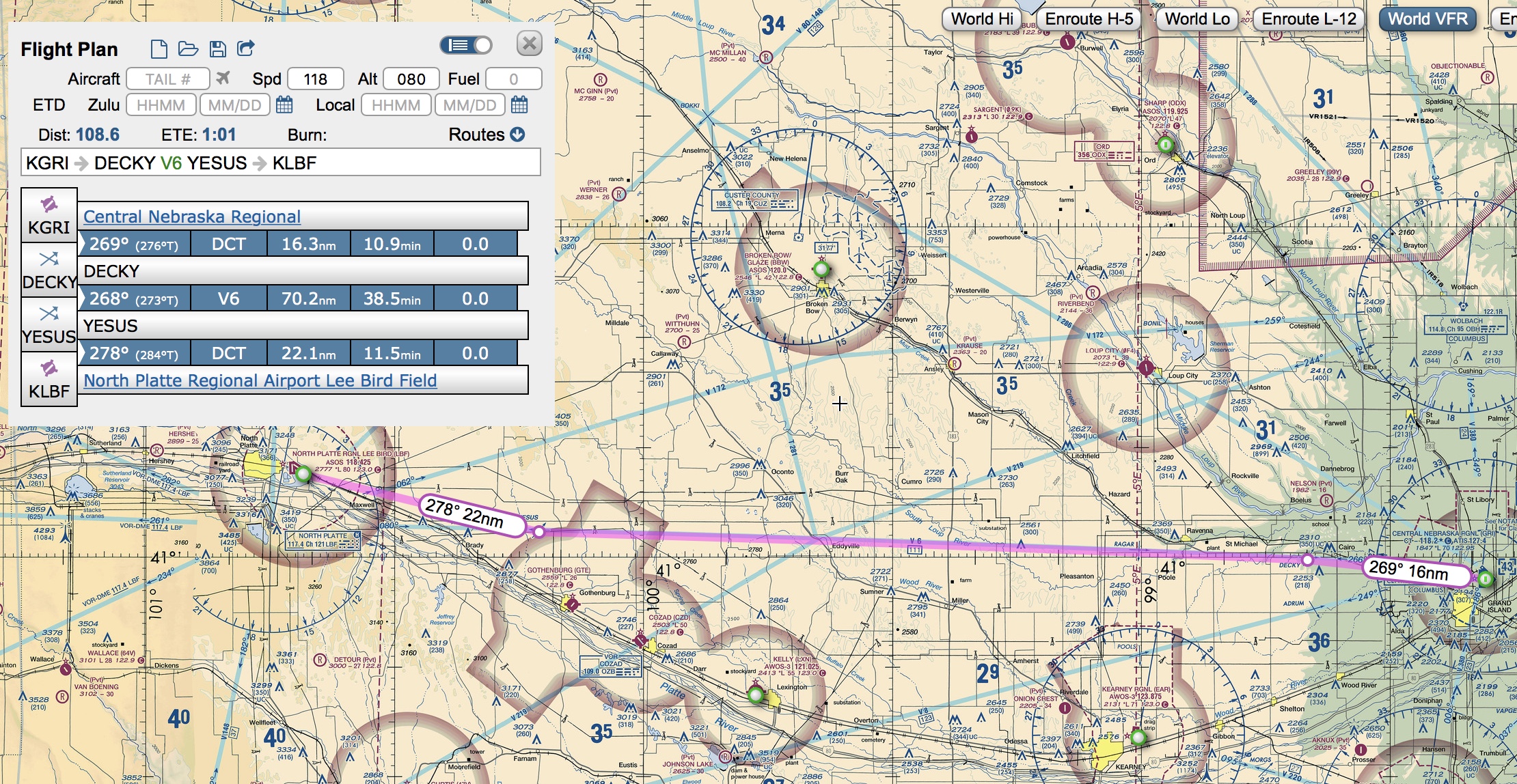
- I'll be following real flight plans created in SkyVector, using actual navaids and sky lanes.
- Real weather will be enabled (X Plane will constantly download real-life weather for where I'm flying). This means some of my flights might get scrubbed for bad weather.
- Ortho (satellite) photos will be used for the entire route, so what you see is what it really looks like.
- I'll fly Just Flight's PA28 Piper Warrior II. Aside from a Garmin 530, its tech is old-school, with standard gauges and a very basic autopilot.

Warrior II cockpit. Top: exhaust gas temperature, indicated airspeed, artificial horizon, altitude, NAV1 course deviation indicator, Garmin GPS; Bottom: ADF indicator, attitude indicator, directional gyro, vertical speed indicator, NAV2 course deviation indicator. Fuel gauges on the bottom. That's about it. There's an autopilot which controls pitch, but doesn't control altitude or vertical speed.
- My flight plan has 31 airports mapped out in SkyVector. Since the Warrior 2 has a range of 500 nautical miles, there will be small hops with overnight stays before moving on to another leg.
That's it! I'm looking forward to the sights, and learning to navigate cross-country.
Stay tuned.

Thoughts on Ready Player One
The first time I read Ernest Cline's Ready Player One, I didn't read it. I was planning a twelve-hour car trip when I stumbled upon the audible version narrated by Wil Wheaton. The book concluded just as I returned home to my garage. I remember sitting there in my car an extra three minutes just to hear the conclusion. I liked it so much that I went and read the Kindle version.
RPO really connected with me. I'm the right age, growing up in the 80s, and loved all the geeky stuff which it loved. I played Zork on my Commodore 64, reveled in computer and video games, played with all the same toys, and cherished all the same tv shows and movies.
When I saw the announcement for the movie version directed by Steven Spielberg, I was excited, and a bit nervous. Would Hollywood squash everything that was great about RPO?
Yesterday I watched the movie version, and I was disappointed.
I knew the key challenges were changed, and this didn't bother me. The originals - playing through a Dungeons and Dragons module to beat a lich at a game of Joust, replicating the dialogue of War Games- were perhaps a bit too geeky for mainstream movie-goers. So, swapping these out with car races and the Shining were understandable.
Like so many movies the past decade, the art direction, visuals, and CGI are fantastic, but the writing at times was fodder for CinemaSins. Which is surprising, because Ernest Cline has a screenwriting credit for the movie.
I know, I'm a cliche with "the book was so much better." But, it's not that the book has more, it's that the movie was a rewrite, with non-sensical plot elements.
For example, in the movie (SPOILER ALERT):
Everyone seems to live in Columbus, Ohio, within a few blocks of each other.
Artemis and Nolan deduce Wade's identity and real-life location nearly down-to-the-second. Literally, seconds after Nolan blows up the stack, Artemis has a goon waiting to kidnap Wade (also…WHAT? Artemis has a goon waiting to kidnap Wade?)
When IOI attacks Artemis's secret location, Artemis shoos Wade into an escape hatch which leads to an alley. Even though it's been seconds since IOI crashed through the window, Aech, Daito and Shoto are waiting for him in a mail truck. I feel like there was some scene cut where Artemis contacts everyone in-game and says "Come here, I've got Wade" and IOI intercepts the message to find out where 'here' is. It's the only way this makes any sense.
Artemis lets herself get captured immediately by IOI to set up an unnecessary damsel-in-distress rescue
Nolan writes his password on a post-it note, and points out the chair with the post-it note to Wade, so Wade can later hack his account and set up the "we're still in the holodeck" trick.
The ending battle with Wade in the truck swaying and affecting his OASIS motion was right out of Inception.
Yes, I know, rants, but I drives me crazy when characters just materialize for no reason to pick up the protagonist, repeatedly.
A few things I liked:
In the book, it always bothered me that Wade was somewhat indifferent to Nolan's threat to blow up the stack, and to some extent almost dared him to do it (because he thought he was bluffing). The movie did a better job of having him try to save his aunt, as well as making the aunt and boyfriend unlikable.
The Shining scene and Aech's reactions to it. It seems unlikely Aech would not have seen the Shining, but still, it was fun.
Artemis has more character development.
A few big themes which got lost in translation:
In the book, the characters meet in person for the first time at Og's, where the climatic online battle occurs. The reveals - Aech's gender, Artemis's appearance, and even Wade's appearance (he's overweight and bald) - are a theme of the OASIS's "be anything" approach. The movie has these, but they're nearly incidental. In the movie, Aech just blurts out it's her in the ally a second before Wade jumps into the mail truck.
The global effort of the egg hunt. All of the main characters are from different places, not neighbors in Columbus, Ohio.
Poverty and classism. Touched upon in the beginning, slightly, but the book was permeated in the fact that Wade was poor, went to the Oasis public school, couldn't afford most of the things in the Oasis, and was generally at a large disadvantage in the egg hunt. It was contrasted nicely with IOI, which had nearly infinite resources. It was a great set up for the little guy winning with a shoestring budget.
Well, that's my rant. Curious what others thought of the movie.
Cutting the Cord
Living the dream of going cable free.
"I've paid twenty-thousand dollars to Comcast over the past ten years," my co-worker said, "and I just can't do it anymore."
Twenty-thousand, I thought, that can't be right.
It turns out that it's not right. My current Comcast bill is $301 per month. Times 12 months equals $3612 annually. Times ten years equals $36,210. You can buy a brand new Audi Q3 for $36,210.
Last year I tried to lower my bill (which is a bundle of phone, internet, and cable) by dropping premium channels, cutting channels, dropping phone service, and lowering internet speed. The result was $1 more expensive per month than my current bundle. This is because seemingly Comcast has a big flowchart which returns all options to the same price point.
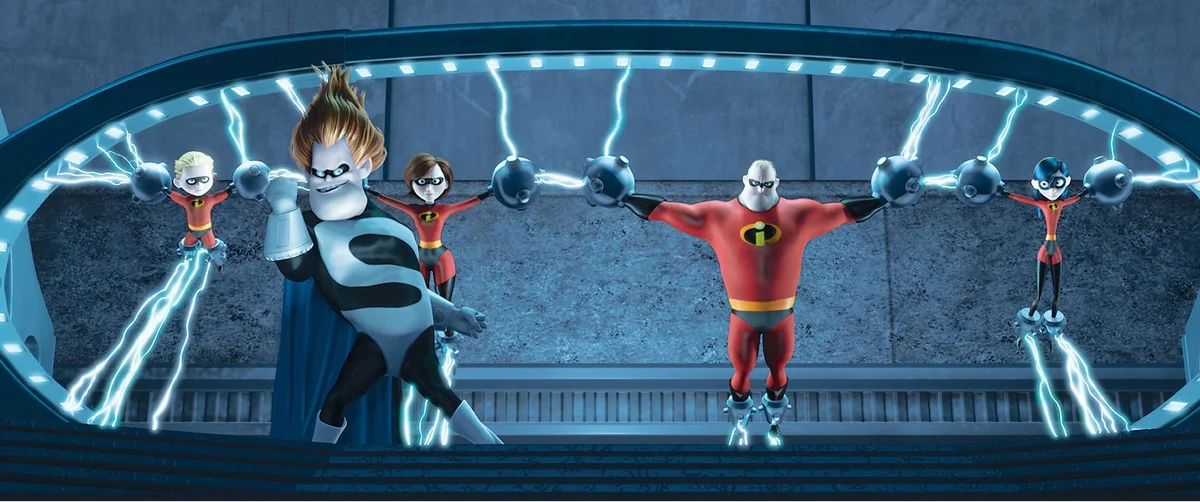
My experience talking to Comcast customer service
So, I've been scheming and dreaming of how to go cable free. This week I started the grand experiment of cutting the cord.
When DirectTvNow offered a promo - subscribe for three months at $35 per month and get a free $179 Apple TV 4K, it seemed like a zero risk proposition. I'd already been thinking of upgrading my 2nd generation Apple TV to a 4K.
First, let me say WOW. The difference in picture quality between the 2nd Gen and 4K is amazing. Second, the addition of the full app store, including games, significantly changes the functionality of my Apple TV. I already have a MiFi controller for playing video games with my daughter.

Playing games like Asphalt 8 with a controller on Apple TV 4K is a surprisingly rewarding console experience
The Apple TV 4k comes with a small touch-surface gesture-swipe remote which has a basic wii-controller-style accelerometer. It has a Siri button, which I'm used to for Comcast voice commands, so that's helpful. It makes me miss my old remote, which had click-buttons instead of a touch-surface. I wish more companies would find the value in physical buttons and stop moving everything to touch gestures (especially for tasks where your eyes are somewhere else).

I don't know how many times I've picked this up upside-down. The top half above the menu is the swipe surface/clicker. The bottom half is for holding.
DirectTVNow works great. The experience is just like the cable guide you're used to. It also includes a basic cloud DVR service at no cost. Best of all, it counts as a cable provider, which means all of the network apps link with it. And, with Apple TV, there are a ridiculous amount of Network apps. You could easily watch all your usual channels without even opening the DirectTVNow app. In general, we just open the network app and stream whatever episodes we want of our favorite shows.
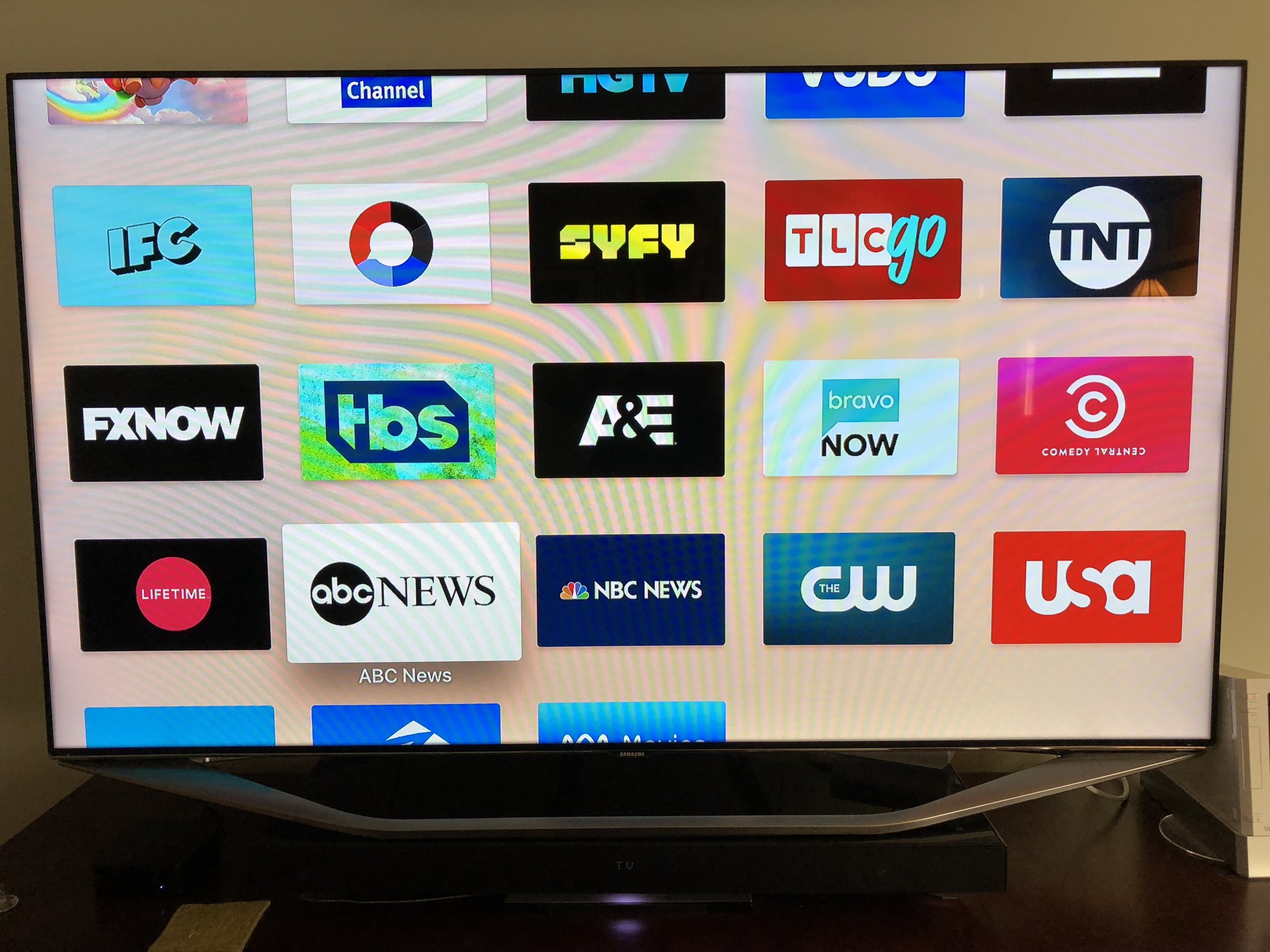
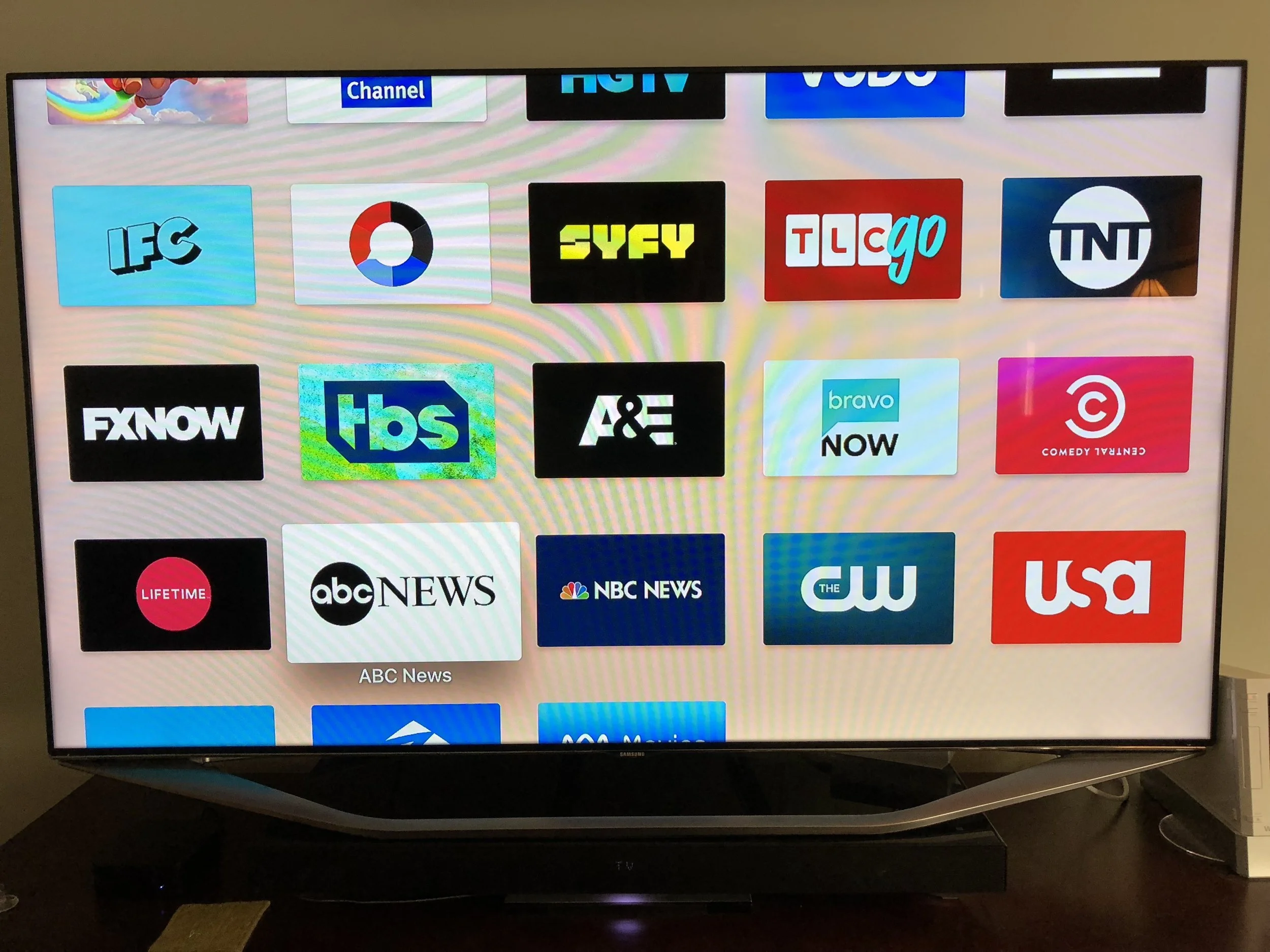
You have to register and activate every single app, then link them to your DirectTVNow account. Once you do, you can stream virtually every show on the network. Some even stream live TV.
Here's where I hit my first hiccup: local channels. Depending upon where you live, your local channels may not be licensed (yet) for streaming via DirectTVNow Where I live, only Fox is licensed.
Of course, the only thing you actually need to watch local channels is an antenna, so I purchased an HD antenna. To my surprise, it receives twenty-six channels over the air. Another surprise is that many of the network apps will stream your local channels. For example, the NBC app will stream your local NBC station live.
Next hiccup: No way to record over-the-air local channels.
Attempted solution: HD Home Run.
HD Home Run is a small box which you plug into your HD antenna and internet router. It then streams the signal to your TV (or other screens, such as iPad). The HD Home Run costs $99 and the Channels app costs $24.99. If you want to add DVR functionality, the subscription is $35 per year.
So, I bought one. And, it sucks.*
First of all, even though the HD Home Run is a wifi streaming device, you cannot wirelessly connect to it. You must use an ethernet cable to physically plug it into your router. This means you must relocate your HD antenna to wherever your router is located. In my case, this was in my basement, which is a bad place to receive antenna signals.
Second, the DVR service isn't a really a service. By "service", they mean that if you stream your content to your Mac or PC, they will enable the record feature in their software on your Mac or PC, which will turn your computer's hard drive into a DVR. The instructions are to keep your computer on 24/7 and disable sleep mode. Also, you probably should not have a notebook computer, like I do.
So, I'm returning it.
There's literally one show I want to record on broadcast tv. I could by a Tivo, but $400 seems overkill for one show. I may just sit tight until DirectTV gets licensing for NBC.
Anyway, otherwise I'm pleasantly surprised and very happy with my cord-cutting experiment. I'm going to run parallel paths - keeping my cable subscription for the month until I'm sure there's no other hiccups, but I can see myself living the cable-free dream.
Edit:
* HD Home Run is actually a very good streaming media device, and integrates nicely with apps like Channels to let you watch live OTA TV through your Apple TV. I just find its DVR software clunky, not well-integrated, and not what I'm looking for as a DVR solution.

Erebus - New Cover Art
Erebus has new cover art.
Erebus has new cover art! The novella is available as a 99 cent standalone or as part of the Haydens World: Volume 1 bundle.


Get Hayden's World: Volume 1 for FREE
Get Hayden’s World: Volume 1 for FREE
Hayden's World: Volume 1 is FREE today (May 3) through Monday (May 7). Get your copy here: http://bit.ly/haydenworld1


Creating the Hayden's Bundle Cover
I give away a few of my secrets for creating retro book covers.
I create all of my own book cover art. Some books, like Titan's Shadow, use licensed Adobe stock photos overlaid with title text. Others, like Aero One, are completely digitally hand-drawn. A few use a mix of 3D modeling and hand-drawn art. Hayden's Bundle fits in that last category.
When I started my self-publishing journey I was at a bit of a loss for how to generate a decent cover, so I thought I'd share some of my tricks.
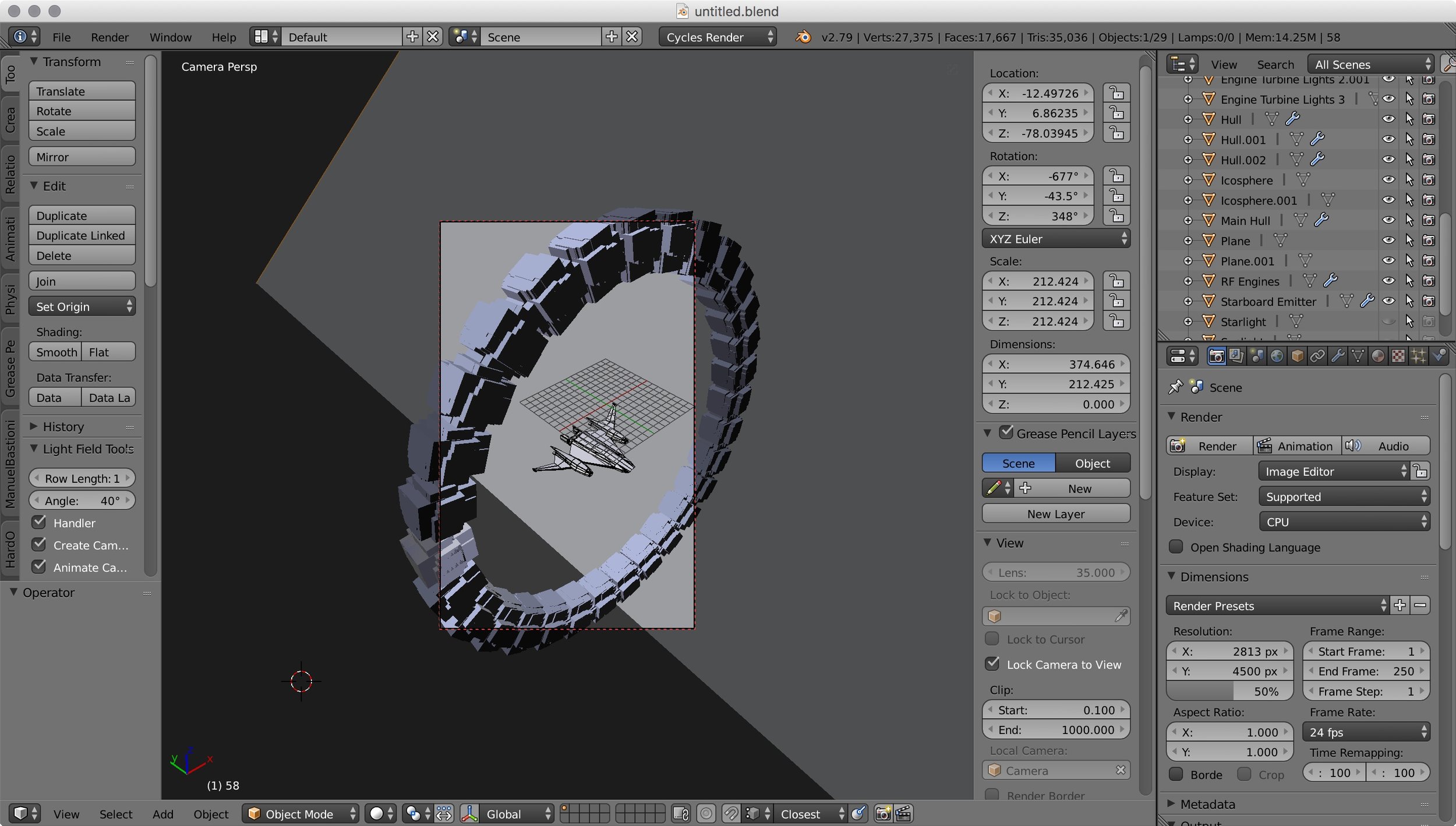
I already had a 3D model of Bernard's Beauty from the 43 Seconds cover, so I reused it. The ring (which is Cassini One in Erebus) was quickly created in Blender just by discombobulating a cube and radially spinning it. I didn't put much effort into materials, textures, or photorealism. The whole intent of the 3D model was to be the pose for the hand-drawn picture. Here it is modeled:
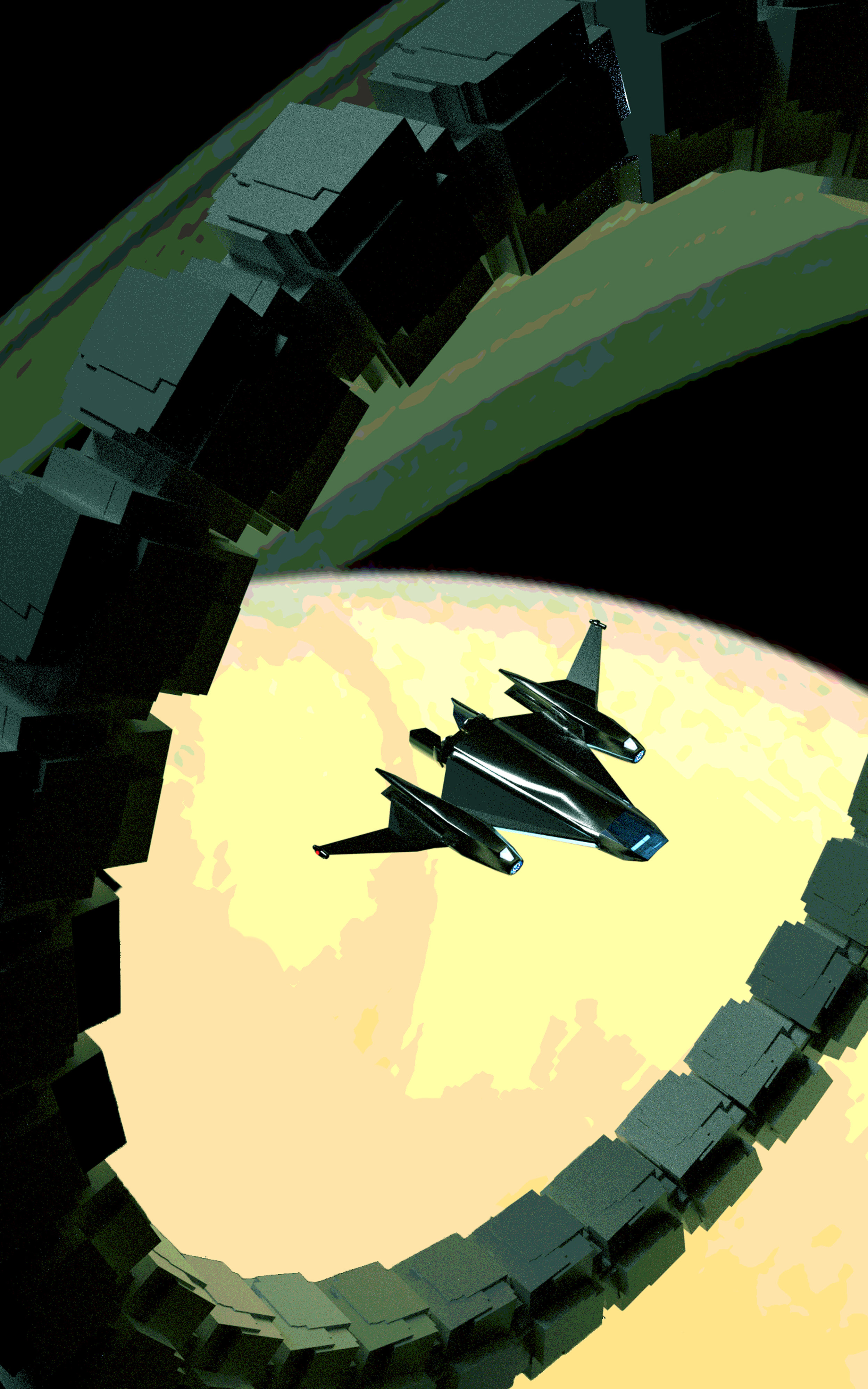
The goal was for the final art to have a retro, stylized look. Because of this, I wanted to have a limited color palette. The next step was to import the render into Photoshop and run it through a posterization filter, reducing the color levels. I tinkered with the color balance at this point, shifting it green:
Now comes the hard part. I masked every detail of the plate and repainted it by hand. Before I started, I worked out the color palette, choosing seven main colors for the picture. I constrained myself to only create new colors by mixing the main colors. This helped give the picture color harmony:

Main colors at top. I started mixing intermediates beneath them.

Masking the plate and hand-painting over it. Aside from assigning new colors, this let me simplify many of the complex shapes and gradients.
This was very labor-intensive. Some details, such as the starry background, needed to be created from scratch using Photoshop brushes. Once it was finished, I used Photoshop's color balance feature to adjust the overall color-scheme, then I moved on to the text. I have some standard fonts and effects I use in the Hayden's World series, so most of the text settings are reapplications from previous covers. The real trick here is working the layout so the text works with the art:
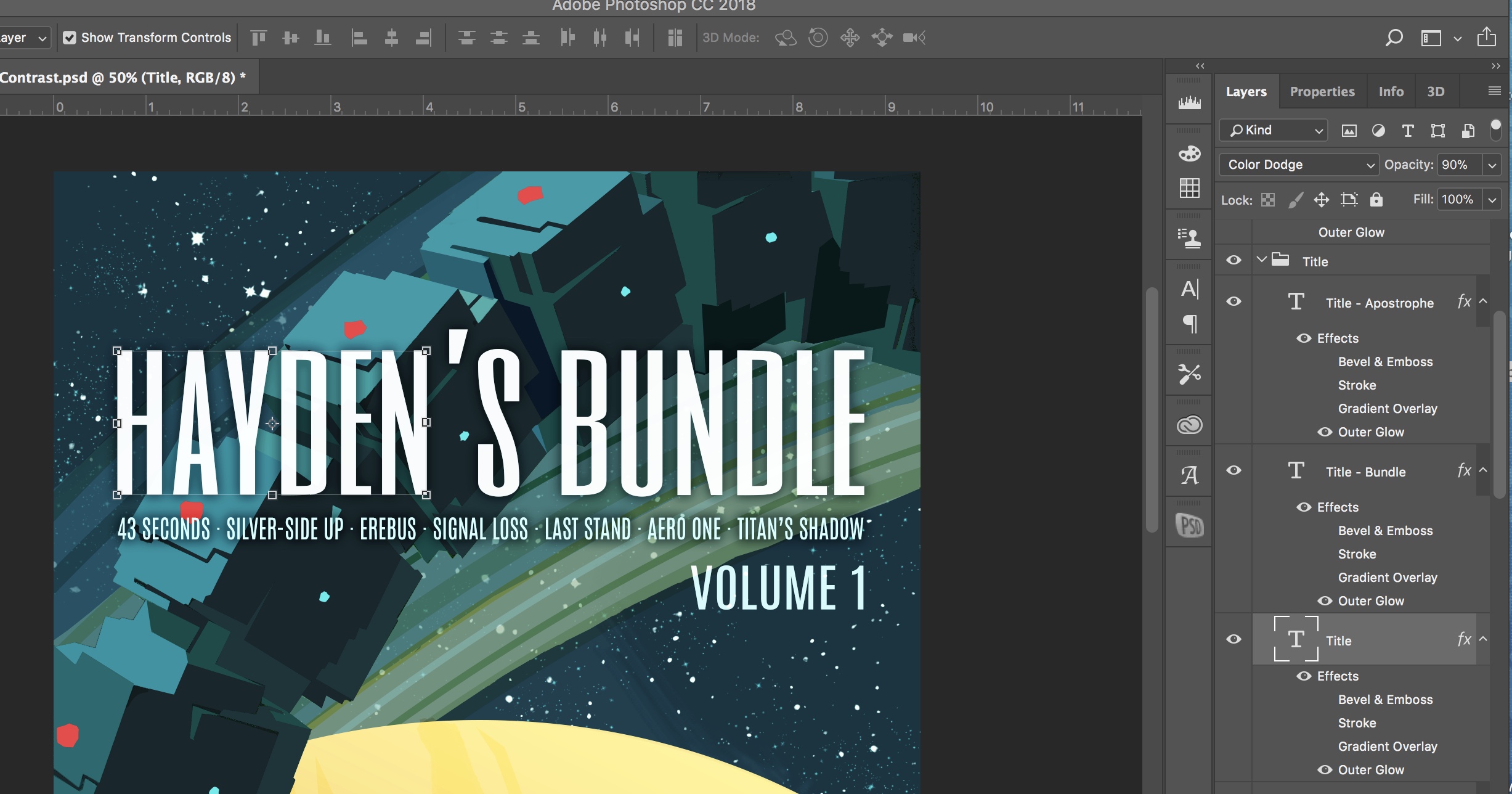
Text layers at right. Outer glow is enabled for the letters, but is set to a dark color, creating a shadow to enhance legibility.
That's it! I save the image in the correct dimensions for Kindle, and I'm good to go.

The last thing I do is make some quick social medial blocks, just by cropping. Here's the title block I use from Twitter promos:

Hope this was helpful. Enjoy!

Hayden's Bundle Now Available
Get all of the Hayden’s World stories in one bundle and save 25%.
Get all of the Hayden's World stories in one bundle and save 25% with Hayden's Bundle: Volume 1. The book includes: 43 Seconds, Silver-Side Up, Erebus, Signal Loss, Last Stand, Aero One, and Titan's Shadow.


Three for Free
Get the first three Hayden's World stories for FREE April 2 - April 6. http://bit.ly/haydensworld
Get the first three Hayden's World stories for FREE this week (April 2 - April 6, 2018) on Kindle: http://bit.ly/haydensworld


A Case for Cases - Update
After a month of use, I give an update on my iPhone X case results.
Last month I bought an iPhone X. I have no regrets - it's an awesome phone. But, it is a glass bar of soap, and this necessitates a case.
As an engineer, I have a knack of overthinking things. This was the case with my case. I wanted the saddle brown leather case, but rationalized myself into the silicone case. In the end, however, heart triumphed over mind and I chose the leather.
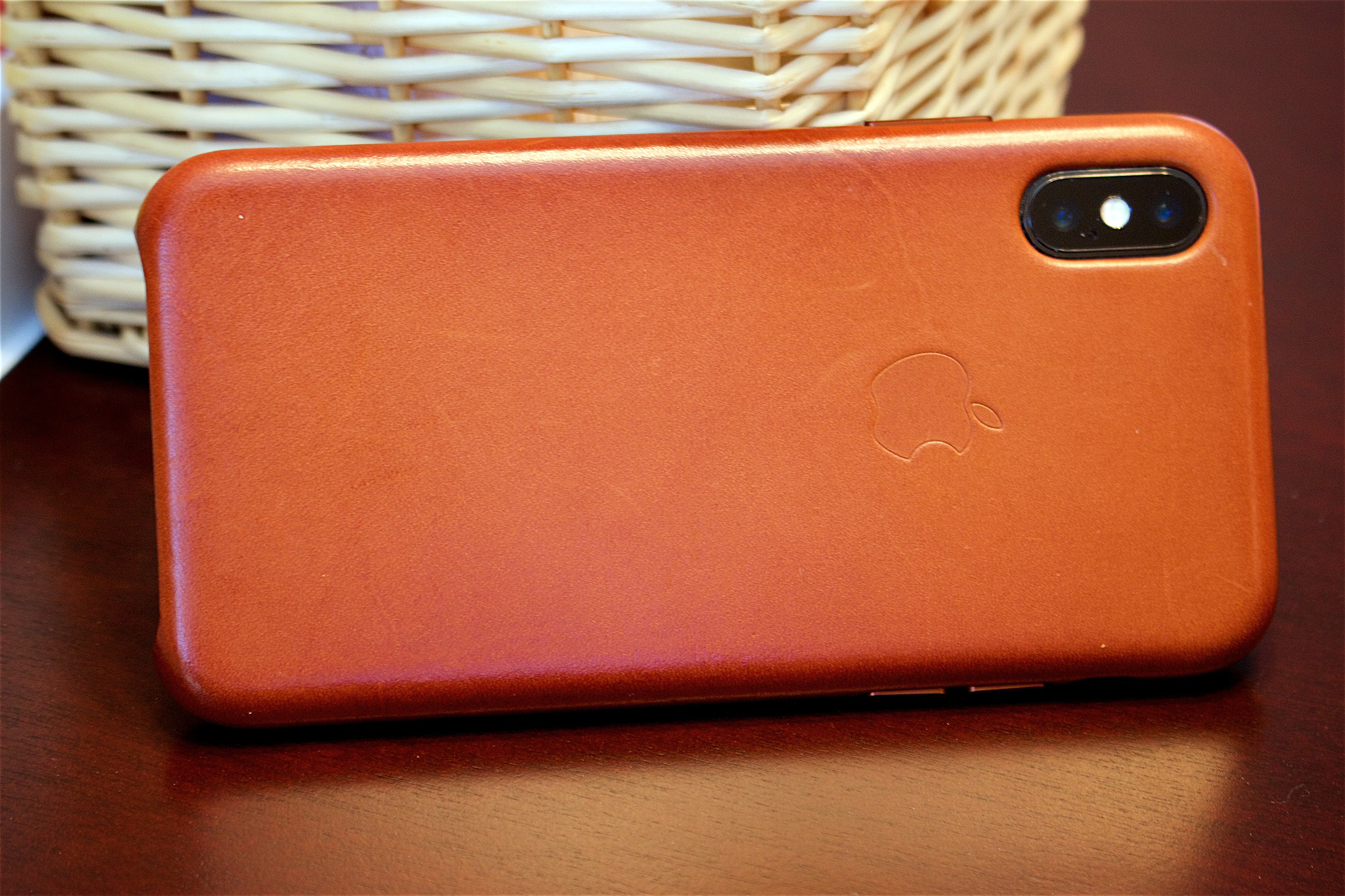
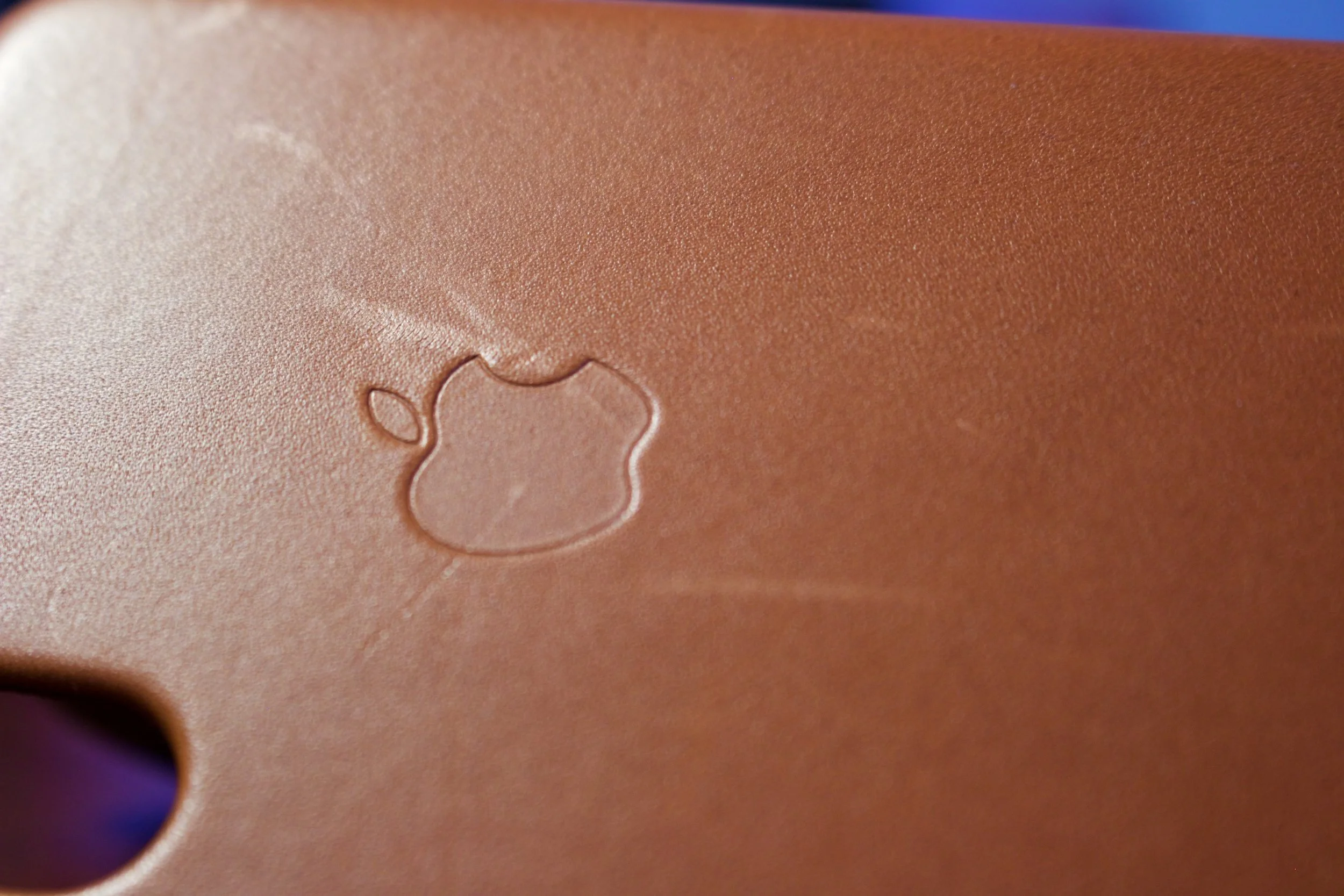
One month later, I've dropped my phone a few times. Never on concrete, but a few times on the hard floor at work. It's unscathed. The leather case itself was initially a scuff magnet. The slightest brush with a fingernail or jean rivet left scratches. But, it self-heals. The more I handled it the more the oils from my skin darkened and smoothed it, and scratches disappeared.
Initially the case was quite rigid and slick. After two weeks it become grippier and soft. I think the amount of grip is just right, now. It's developed a patina, darkening around the edges, and it looks great, like a worn saddle. Originally it was a uniform caramel color, but I prefer the darker brown.
Here's a few pics. If you return to my original post, you can compare them versus new:


Titan's Shadow - Story Extras
A few behind-the-scenes peeks at the writing of Titan's Shadow.
SPOILER ALERT: If you haven't read Titan's Shadow, grab a copy (it's FREE this week!). The rest of this article gives away some major plots points, otherwise.
A few sciencey bits first:
- Jia only wears arctic gear and a full-face breather in Saturn's clouds. Atmospheric pressure is eighty-percent Earth's and the temperature, -99 C, isn't that much colder than the coldest temperature recorded on Earth, -89 C, in Antartica.
- When Jia and Ping attend the eclipse party, Enceladus eclipses the Sun. Janus, Mimas, Enceladus, Tethys, Rhea, Dione and Titan are all capable of causing eclipses on Saturn.
- Despite its thick nitrogen atmosphere, Titan is extremely cold at -179 C, which is why Jia's cryowear is adequate for Saturn but not Titan. If you're wondering why Ping needs a PLEX suit here instead of a regular spacesuit, read the Science of the Story section of Aero One (TLDR: spacesuits are not designed to keep you warm).
- Titan's atmospheric pressure is higher than Earth's. Jia doesn't depressurize Lucky Cricket's airlock before going outside. When she opens the door, Titan's atmosphere blasts in.
- Iapetus is remarkably far from Saturn. At 3,560,851 km, you could fit 279 Earths between Saturn and Iapetus. It's a good place for a smuggler's base.
- The concept of celestial Julian dates is only somewhat fictional. Real Julian dates are popular for astronomy because they are not calendar dependent; instead, they use Jan 1, 4713 BC, as '0' and count up days elapsed. In everyday-life you probably encounter a simplified version of a Julian date which counts days elapsed since Jan 1st of the current year, maxing out at 365. There's no reason that you can't do the same thing for any other planet. For example, Venus has a 225 day year, so it could have its own simplified Julian calendar which spans from zero to 225.
- Although the constellations will appear the same from any planet in our solar system, the morning stars (which are planets) will change. In Park 270 at the end, Jia and Ping see two morning stars - Earth and Venus - low in the horizon.
A few writing bits:
Titan's Shadow has a linear structure, but, like an action movie, has a few big action scenes. If you break the story into normal scenes (S) and action scenes (A) for the nine chapters, it looks like:
S S A S S A A S S
Neat, huh? It's fairly symmetric.
In terms of writing lingo, the inciting incident occurs when Jia spots Flynn, the midpoint is the news of the Hephaestus attack, the climax is the shoot-out with Sulo, and the Hermes's return is the resolution. If you map them out as inciting (I), midpoint (m), climax (c), and resolution (r):
- I - - M - C - R
It works out how you'd expect. The midpoint is exactly in the middle (and is the turning point for the story).
Aero One's story structure was very different. In terms of normal scenes/action scenes, its five chapters map as:
A S S/A S A
Still symmetric, but the opposite of Titan's Shadow. Aero One starts with action and lets you get caught up in the middle.
Okay, a bit technical for writing tidbits, but thought I'd mix it up and give you both the science of the story and also the science of the story. Hope you enjoyed it.

Titan's Shadow - FREE this week
Get Titan's Shadow for FREE this week: http://bit.ly/titansshadow
Get Titan's Shadow for FREE today (March 19) through Friday (March 23): http://bit.ly/titansshadow


Titan's Shadow - Deleted Scenes
I share a few deleted scenes from Titan's Shadow, and why they were cut.
In the Hitchhiker's Guide to the Galaxy, there's an editing joke about how Ford spent the past decade writing about all of Earth's best places, restaurants, and experiences. When his work is submitted for publication, the entire entry for Earth is simply edited down to two words: mostly harmless.

In a 12,000 word story, I tend to edit out 2,000 words. Mostly I delete redundant words and phrases. For example, he set the book down on the table becomes he set the book on the table. Sometimes I cut out entire sentences if they're dragging down the rhythm of a paragraph. Occasionally I'll scrap a scene if it doesn't do anything to move the plot forward. Sometimes it's a bit painful. It reminds me of playing Magic: the Gathering back in the 90s and trying to build a sixty-card deck. Choosing those last few cards to get to sixty was always agonizing because I felt that I needed each one.
There's no sixty-card rule for short stories, but there is pacing. Readers expect to hit certain waypoints at specific times, and the story will feel off if they're missed.
Here's a few of the deleted scenes from Titan's Shadow, and why they were cut:
SPOILER ALERT: If you haven't read Titan's Shadow, grab a copy for 99 cents before proceeding.
Original Chapter One (preceding Cassini): Shanghai
Jia sits in the pristine hallway with her palms folded over her knees. Butterflies dance in her stomach. In the corner of her eye she watches a young administrative assistant swiping icons between translucent displays, the Shanghai skyline spiraling behind her. On the adjoining wall rests the China National Mining Association logo. The assistant becomes aware of Jia’s gaze and stares back. Jia curls her fingers into fists.
A mahogany door creaks open and Ping emerges wearing a dark suit and tie. They lock eyes a moment. Over his shoulder lies an interview room and a single chair. Before she can ask him how it went Ping says, “They’re ready for you.”
She stands and smooths her skirt, her footfalls clacking along the marble. When she reaches the doorway Ping steps aside, but as she is about to pass he places his hand on her arm. A touch of his hand and a smile, then she’s through the threshold. The mahogany door closes behind her.
Two men and one woman sit at a table opposite an empty chair. The lead motions towards the chair. “Please, Miss Xu.”
Jia crosses the room and sits. Chao is the senior and continues to speak, “Thank you for your candor during this week’s interviews.”
Jia breathes in and out, aware of the rise and fall of her chest.
Chao nods to Lei and he speaks next. “Miss Xu, regarding the matter of initial contact with the pirate vessel Maya at the Uranus T2 orbital platform, you are found negligent of following proper disengagement protocols where crew safety or corporate property are at risk. Your actions resulted in the significant injury of Senior Flight Engineer Ping Sun and the complete destruction of the Cormorant-class light carrier Prosperity.”
A flush spreads across her face to her neck.
“Furthermore,” Lei adds, “during the same encounter you brought the ascent vehicle to full power while the platform’s umbilical and clamps were still engaged.”
“I was being shot at,” Jia says, the words more curt than she intended.
Lei sighs. “And then you intentionally destroyed it at a loss of a seven-hundred-and-fifty-million yuan.”
“Respectfully, Chief Lei,” she begins, “it was worth a tenth of what’s on the platform, and I didn’t think the pirates would be able to access the platform without it.”
Lei interlaces his fingers. “But they did, Miss Xu.”
Jia looks away, glancing at nothing. Her expression sours.
“Had you disengaged it is likely both ships would have survived.”
She shakes her head. “You don’t know that. The Maya was clearly aware of us before we saw it. They could have fired on us as soon as we tried to disengage.”
“We’re interested only in facts.”
“Well, Chief Lei, here’s a fact for you. One hundred and twenty-eight seconds. That’s how long it was from initial contact to the battery room exploding. I spent that time dodging slugs, remote-piloting the ascent vehicle, piloting the Prosperity, and generally trying to keep me and Ping alive. I’d like to see what you could do in that situation.” She shakes her head. “The real person responsible for all of that is still out there, and no one’s doing anything about it.”
Lei is silent for a moment. He taps at the screen on the table, then glances back to Jia. “Next, regarding the matter of the one hundred and sixty-three thousand liters of Helium-3 you purged to atmosphere—“
She laughs. “Here we go…”
“—your actions are deemed appropriate by the panel.”
Jia raises her eyebrows. Her lips part, but she says nothing.
Lei continues. “The loss of six-point-eight billion yuan of Helium-3 is regrettable, but purging was appropriate to ensure crew safety. In this case.”
A cautious nod from Jia.
“Your testimony was fully corroborated with Senior Flight Engineer Ping Sun. We find him non-culpable in these matters.”
“As you should. Ping didn’t do anything wrong.” She curls her hands into fists again. “It was my command.”
“We agree.” Lei looks over to Meilin.
“Then you’ve reached your decision,” Jia says.
Meilin says, “We have. Your CNMA contract is terminated, effective immediately.”
Jia shakes her head. “That’s not fair.”
“To be clear, we had an extended discussion about pursuing legal reparations, recommending a pilot’s license suspension—”
Her face burns. “You can’t do that.”
“—but we will not do so, contingent on you not challenging the separation package. Your license will be intact and you can pursue other work.”
“Sure, I’ll just be blacklisted with every carrier.” She looks back to Lei. “You said Ping’s not responsible, right? I want your word that he gets to stay before I agree to anything.”
Lei frowns slightly. “We have not asked Mr. Sun to leave.”
Jia exhales audibly through her nose. “Fine.”
Meilin stands, and the rest of the panel joins her. “My assistant will escort you to your workspace, where you’ll need to clear your belongings.”
Clear your belongings is a gut punch and Jia’s knees are weak as she stands. She turns, crosses the room, and pulls the handle to the heavy door. Ping stands from the bench. In the corner of her eye the assistant in the red blouse moves outside her desk and walk briskly towards her, footsteps echoing rhythmically.
“I’m sorry,” Ping says.
“Miss Xu,” the assistant says, closing.
A lump forms in Jia’s throat as she wraps her arms around Ping’s strong shoulders. She speaks softly in Ping’s ear, “It’s okay, I knew this is how it would be. But Lei gave me his word, you’ll be fine.”
Ping leans back, slides his hands to the tops of her shoulders, and looks her in the eyes.
The assistant arrives. “It’s time to go. I’ll escort you both to your desks.”
Jia’s brow furrows and she ignores the assistant. I’ll escort you both. She questions Ping with a gaze.
Ping rubs her arms. “When they told me they were going to fire you—”
She shakes her head. “No, Ping…”
“—I quit.” He smiles. “Hey, we’re a team. You wouldn’t want me inflicting my bad jokes on another pilot, would you?” He smiles slightly and slides his hand down to hers, intertwining their fingers. “Wherever you go, I’ll be there.”
Jia squeezes the tears from her eyes, leans her head on his shoulder, and just breathes.
WHY IT WAS CUT: The final version of Titan's Shadow doesn't introduce the inciting incident (Jia spotting Flynn during the eclipse party) until midway through the second chapter. This is already a bit late. Pushing it out another chapter by starting with Shanghai caused pacing problems. Ultimately, what happens in Shanghai is a retelling of Aero One which can be summarized as Jia gets fired for her actions in Aero One. It's covered in her dialogue with Galen after she turns in Flynn.
SCENE BETWEEN "IN THE BLIND" AND "PISTACHE"
(DESCRIBING JIA AND PING'S RESCUE FROM TITAN)
Punga Mare station is illuminated like a roadside store on a stretch of desert highway. In the distance, a great black lake spans away from the shore’s edge mirroring the perimeter lights. The station is deserted and feels like an arctic research base. Jia and Ping stand near the main runway. She has her suit heater on, chewing up battery but warding off the chill.
In the sky, a pale patch of light moves beyond the clouds, growing brighter. When the ship emerges, its spotlights carve foggy cones in the night. The craft turns in a wide arc and skims over the lake. It’s large, armored, and both wings sport railguns. Engines hum, crackling the air. It glides to a halt on the runway twenty meters ahead. When the door opens, five men in U.N. PLEX suits emerge, rushing over to meet Jia and Ping, and they’re aboard the ship in an instant.
The gunship blasts back up through the atmosphere like a rocket. Clouds part as a sheath of ethane rain pelts the window, the raindrops looking like a blizzard in the ship’s forward lights, then the storm gives way as darkness surrenders to stars. One of the stars is its own constellation of red, green, and white lights. As they draw nearer, Jia can see structure—decks stacked on each other extending along a trapezoidal axis, docking bays spaced like legs on a centipede, and weapons everywhere. It’s at least three hundred meters long with an asymmetric forward nose. Massive letters read Hermes. It grows impossibly large as their gunship flies along its structure into one of the caterpillar-leg docking bays.
A soldier calls over from the airlock. “You both zero-gee capable or you need an escort?”
“Yeah, we’re good,” Ping says.
When they arrive at sick bay, it’s world-class, pristine white, and has tech Jia hasn’t even seen on Earth. Their doctor programs a nano-cellular repair regimen for her burns, encapsulate the bots under a layer of synthetic skin, and sets them to work. Her palms and knee feel like they’ve been dipped in glue. It could be worse. In a week it’ll peel off and she’ll have new skin.
Their debrief is short with warrant officer Casey Gray from the Criminal Investigations Unit. Whoever deployed the drones did so on the dark side of Titan, out of view. Casey’s reviewing all traffic to Titan during the past few days, but Jia doesn’t need him to tell her that their job was a setup.
“So,” Casey says, buckled into a chair in the interview room. “That was some pretty fancy flying. A couple of our guys can’t believe you kept three raptors at bay in a class-four hauler. Your PLAAF days are showing.”
Jia shrugs. “It’s been a while.”
“You flew TG-32’s. Two combat ribbons. Why’d you leave?”
“Family obligations.” She shifts. “Anyway, it got me my pilot’s license and paid for my degree.”
He nods and looks at Ping. “Quick thinking with the navcon telemetry.”
Ping shakes his head. “No special training. I’m just a nerd.”
Jia curls her fists. “You still have Flynn on board?”
A nod. “We do.”
“Either he somehow passed word about us or his friends figured it out. Either way, pretty sure he’s the reason we’re here. I’d like to have a few words with him.”
Casey appraises her. “I’d advise against that.”
“I don’t—”
“Request denied.” He unclicks his harness and pushes up from his seat. “Why don’t you both get some dinner and rest? Your escort will take you to the galley. We’ll reconnect tomorrow.”
“We’re not going back to Cassini?” Jia asks.
“Need to secure the area first,” Casey says, folding up his slate and tucking it into his belt. The door opens behind him.
Afterwards, Jia holds a tether beside the bed in their quarters. Ping rubs her back while she rubs her neck. Her hands no longer hurt, but they feel odd, like they’ve fallen asleep and she can’t shake feeling back into them. She takes a deep breath. “I don’t know what we’re going to do.”
WHY IT WAS CUT: The scene can be summarized as the Hermes rescues Jia and Ping and returns them to Cassini. Introducing Casey as a second investigator created one too many detectives. Instead, I moved the backstory dialogue about Jia's PLAAF days to Galen's conversation, referenced that she'd been treated by the Hermes medics, and expanded the investigation dialogue into the Pistache and Yin and Yang chapters.

Titan's Shadow (First Chapter, 1200 words)
Saturn’s ammonia clouds stretch into an infinite horizon, the Sun casting long shadows across the platform’s deck. Lucky Cricket rests silhouetted against the sky while shimmering aerostat lights hang suspended in the distance, waiting.
ONE
CASSINI
Saturn’s ammonia clouds stretch into an infinite horizon, the Sun casting long shadows across the platform’s deck. Lucky Cricket rests silhouetted against the sky while shimmering aerostat lights hang suspended in the distance, waiting.
A dull chill seeps into Jia’s arm as she fishes through the toolbox. With her cryowear, she resembles an arctic explorer with a full-face respirator. She finds the logic probe and hands it to Ping.
Ping kneels beside the aerostat. An aura of menace surrounds it, like working underneath a boat in dry dock. Another gust of wind rattles the blimp’s umbilical. Alloy support cables twang like guy wires and the aerostat groans as it shifts in the dock clamps. Ping stumbles and catches the rail, pushing his hood back. He’s tethered, same as her, but it’s still unnerving. It’s a long way down through Saturn’s clouds.
He slips the logic probe into the access panel. “Did you know that the Assyrians named Saturn ‘Oldest of the Old’?”
Jia smiles. She loves Ping’s trivia. “Well, did you know that it’s the least dense of all the planets? If you had a really big ocean, Saturn would float.”
Ping holds up his hands. “You been raiding my trivia files?”
Jia winks.
He examines the probe. “There you are. Open panel forty-two cee.”
A square inset on the aerostat’s surface slides away. Scorch marks mar the control board. She opens the spares compartment and locates a replacement. “I have no idea how Voj makes his numbers with these old J-series stats.”
As if she summoned him, Voj appears in a comms window. “Status?”
“I think we’ve got it,” Jia says. She hands the spare to Ping. “Spectrometry module is fried.”
Voj frowns. “You going to wrap up before sundown? You need to stay on deck overnight, it’s coming out of your commission.”
“Yeah, we’ll make it.”
“Why you wearing cryowear, anyway? You freeze to death on my deck, you’re going to screw my safety numbers.”
“Don’t worry, Voj, your ancient aerostat isn’t worth dying over.” She lifts up the spectrometry module. “Seen this before, you know. You guys should check your clean room procedures. Someone touching parts with ungloved hands cost you fifty thousand.”
“Just fix it,” Voj says. The comms channel closes.
Jia smirks.
“Eh,” says Ping, “become a freelancer, meet exciting people, make new friends.”
Jia touches Ping’s elbow and he stops. “Sooner or later we’ll have enough saved so we don’t have to take these throwaway jobs.”
Ping gazes up. Saturn’s rings are banded specters against an ultramarine sky. “I’ll miss the view, though.”
* * *
Cassini Station is a city in space, habitation decks rotating against the backdrop of Saturn’s F ring. Every day the station grows as construction vehicles ferry in components. It’s like living in a city where new streets and buildings appear each week, a frontier world powered by its own gold rush of Saturn’s sixty-two moons.
From Jia’s approach vector the station’s rings appear stacked and squashed. The comms icon illuminates. “Lucky Cricket, you are cleared for landing at dock four.”
Jia glances at Ping and smiles.
“Oh,” Ping says, “this is my cue.” He taps the screen and accepts the tower instructions. A heads-up flight path overlays the forward view. “Cassini Control, NG-991 Lucky Cricket, acknowledged.”
“You’re sounding like a pilot,” Jia says. She taps the controls and the ship rolls to match the next waypoint.
“Eh, next we should start training you to be an engineer.”
Jia scrunches her nose. “Yeah, math’s not really my thing.”
Ping holds up both his palms. “You gotta be kidding, right?” He motions at the choreographed dance of space traffic. “If there were any more math around here you’d be tripping over it.” He extends the struts.
Jia coasts into dock four and sets Lucky Cricket down.
It takes a moment to adjust to the station’s spin and she staggers to her ship’s locker. Inside rests a brown jacket with silver stripes, red gradated sunglasses, and a pulse pistol. Ping gives her a sidelong glance. He disapproves of the gun, but she won’t get caught flat-footed again. She dons the jacket and glasses, leaves the gun.
They descend the umbilical and catch the elevator to Customs. The main transit hub is a bustle of people with systems engineers, construction specialists, haulers and gas miners. Beyond it lays the Exchange, a dedicated market hub full of shops and services looking a bit like the malls lining Earth’s airports. It’s an assault on the senses with prismatic holo ads and thumping music everywhere.
They slow as they pass the exosuit shop, eyeing the metallic amber PLEX suit. Another job, maybe two, and they’ll have enough saved. With it, they can go places cryowear can’t. They can unlock a tier of jobs which pay real money. With enough real money, they can move back to Earth and take back the life they lost, and she can finally lift her family out of the slums where she grew up. But, for now, they take the lift to their apartment.
Ping heads to the kitchen. “You want some breakfast?”
They’ve been up all night flying back from Saturn and Jia’s not sure if she’s exhausted or hungry. At the sound of him rustling through the pantry her stomach rumbles. “Sure. Would you make me a tea?” She rubs the back of her neck. “I’m going to catch a quick shower, okay?”
“It’ll be ready when you get out.”
She enters the bathroom and leans on the sink, looking in the mirror. Above her left eyebrow is a small v-shaped scar. For a moment, she thinks about the bathroom mirror in the emergency area of the Uranus mining platform, about her ship shredding around her, and the expression which peers back wants to be somewhere else. Somewhere with Ping, for certain, but it’s like she’s on a business trip which never ends, staying in a hotel which is not her home. Everything that was her life burned up in Uranus’s cerulean sky.
After a moment she strips off her clothes and steps in the shower. The hot water is wonderful on her skin. She rubs her neck and the heat relaxes her muscles. For a minute, only the white noise of raining water and steam fill the small space. She closes her eyes.
The shower door slides open and Ping’s hand touches her shoulder. She turns and faces him. They kiss. There’s barely enough room for the two of them, but it’s not the first time they’ve shared the space. They embrace a moment before Ping rubs her shoulders, and she turns as he massages her neck. It’s a very long day, but the heat of Ping’s hands on her shoulders melts it away.
“The tea can wait,” he says. “Thought you’d like company.”
Not everything was lost, she realizes.
She sighs. “Yeah.”
* * * *

New Release - Titan's Shadow
Titan's Shadow is now available on Amazon for 99 cents.
Jia, Ping, and the pirates are back in the sequel to Aero One. Get the 12,500 word novella, Titan's Shadow, for 99 cents on Amazon.


New Story Teasers
Jia, Ping, and the pirates return. Read some teasers from my soon-to-be released novella, Titan's Shadow,
Jia, Ping, and the pirates return in my new story, Titan's Shadow. I'm working on editing and revisions now and will release it this month. Here's a few teasers:
Saturn’s ammonia clouds stretch off into an infinite horizon, the Sun casting long shadows across the platform’s deck. Lucky Cricket rests on the transit ramp silhouetted against the sky. Shimmering aerostat lights hang suspended in the clouds, waiting.
At first it’s a nibble out of the Sun, growing from its left side. It’s not until nearly half of the Sun is blotted out that the glare dims and the party fades to sunset. The kaleidoscopic sea of neon wearables pulses and shimmers with the revelers. Ping’s hair shifts to amber. He slides his hand behind the nape of Jia’s neck and draws her near. Enceladus centers itself perfectly over the Sun, ringed by the corona, and, for a perfect moment, it’s night inside the Panorama. Ping kisses her, his lips warm and tasting of champagne. As they pull apart, the Sun fades in and the party returns to daytime.
Jia’s grunting, fighting with the controls. Fire suppression sprays a white fog which wreathes around the windows.
Ping is groggy, shaking his head. “Are we going to crash?”
Jia glances at the aft camera. The port engine sheathing peels away and spins off into the darkness. “Yes. We are definitely going to crash.”
Galen stands and heads to the airlock. Inside, his EV suit is colored cobalt metallic blue with copper plates. Beside the suit is a rifle and pistol. He checks both before gearing up.
Jia slips into her red EV suit as Ping dons his PLEX suit. Once she’s dressed she checks her pulse pistol. The ammo indicator is full. She slides it into her hip mount.
“Ready?” Galen asks, slinging his rifle onto his back.
Jia’s nervous, shifting her weight. “Yeah.”
Overhead, Saturn is a yellow moon in a speckled sky. A lone white star traverses silently across that sky. It flashes blue and Galen’s ship blossoms into a fireball. Chunks rain down streaming fiery tails, impacting the deck, while the smaller pieces shoot up into the sky like a thousand fireflies. There’s no blast wave in the vacuum, just the low rumble of the explosion’s sound transmitting through their boots. Everyone staggers back into the doorway.
Galen is stunned. He grabs onto the door frame and steadies himself. Ship pieces pulse orange like dying embers, flashing as if gunpowder were sprinkled on them.

A Case for Cases
Well, I should probably put a case on my $1000 glass wet bar of soap.
Yes, I bought a thousand dollar animoji machine. It's sleek, it's beautiful. It's made of glass. It's a wet bar of soap. That's the only way to describe holding an iPhone X. The first day I had it I didn't have a case. Every time I took it gingerly out of my pocket I looked like Jeremy Renner in the Hurt Locker handling live ordinance.
Granted, my past few iPhones have had a case. My 4S had a leather case which looked like old sneakers after a few months. My 6S had a silicone case. The question was which direction to go for the X.
I ended up buying both, getting the Cosmos Blue Apple silicone case and Saddle Brown Apple Leather case. I found a few YouTube videos reviewing each individually, but thought I'd give me own thoughts comparing the two.
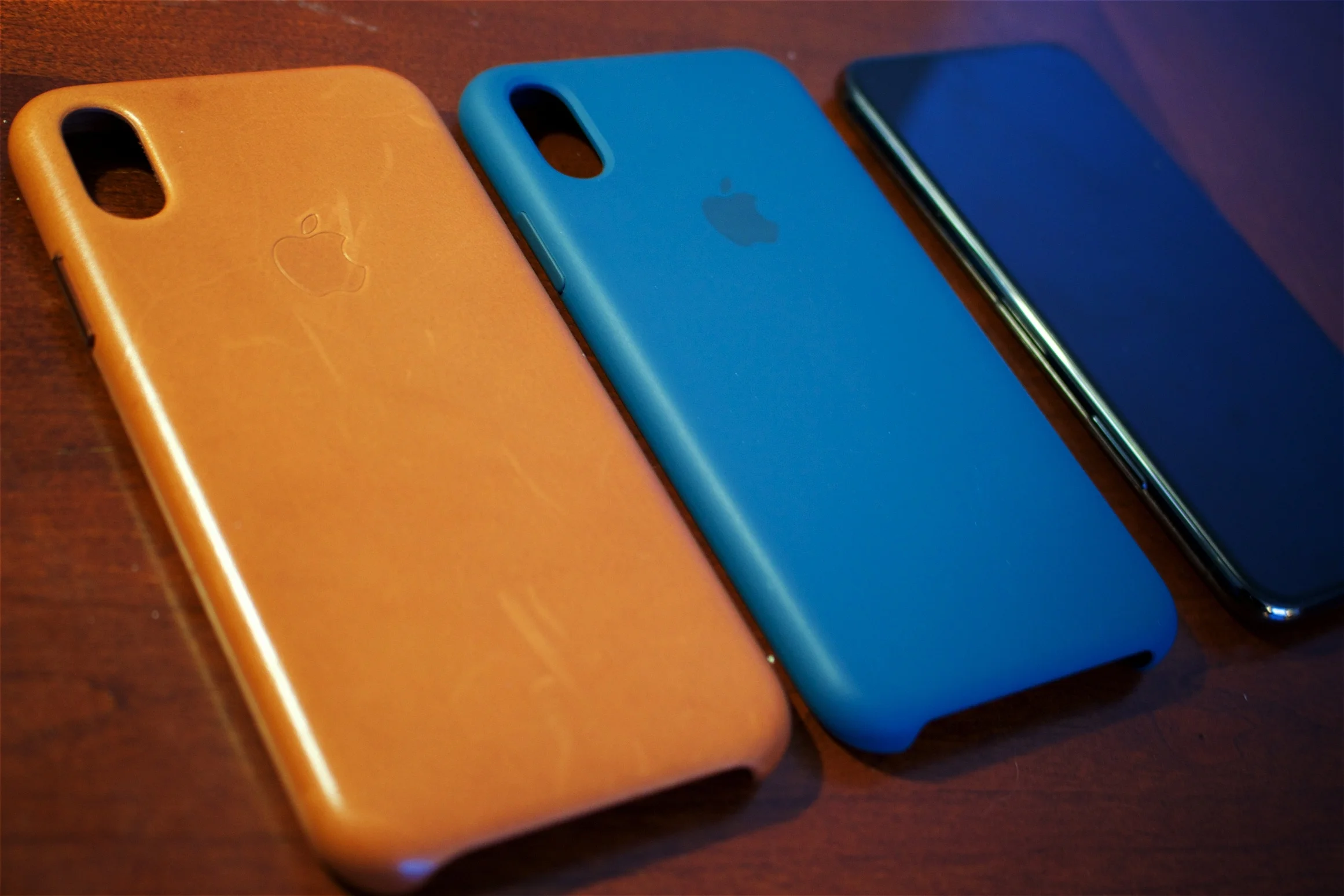
Drop Protection
First, you will not find any drop protection claims anywhere for either of these cases. I can say that I dropped my 6S onto concrete twice with a silicone case without damage. Having both the leather and silicone case, I suspect the silicone one offers better cushioning, just based on the fact that it is soft and the leather case is fairly hard. They seem mainly designed to avoid scuffs and scratches, with a small amount of drop protection.
There are many other heavy-duty cases rated for six or ten-foot drops. I prefer smaller, non-bulky cases with a little bit of padding.
Grip/Feel
The Cosmos Blue silicone case feels slightly powdery and soft. Other than that, it is very grippy.
The Saddle Brown leather case feels very hard and slick. At first it was very slick. After a week it softened slightly, improving its grip.
In terms of touch, I prefer the leather case. Although it is slippery, it just feels great in your hand. Leather also slides out of my pocket easier. Silicone pulls up lint from my pant pocket.
Buttons/Shape/Access
The leather case comes with copper-colored metal power/volume buttons which have a clicky feel. The silicone case has fixed silicone buttons which have a soft feeling.
The access hole for the mute button is smaller on the leather case. It's difficult to fit my thumb into the notch and flick the switch. The silicone case doesn't have this issue.
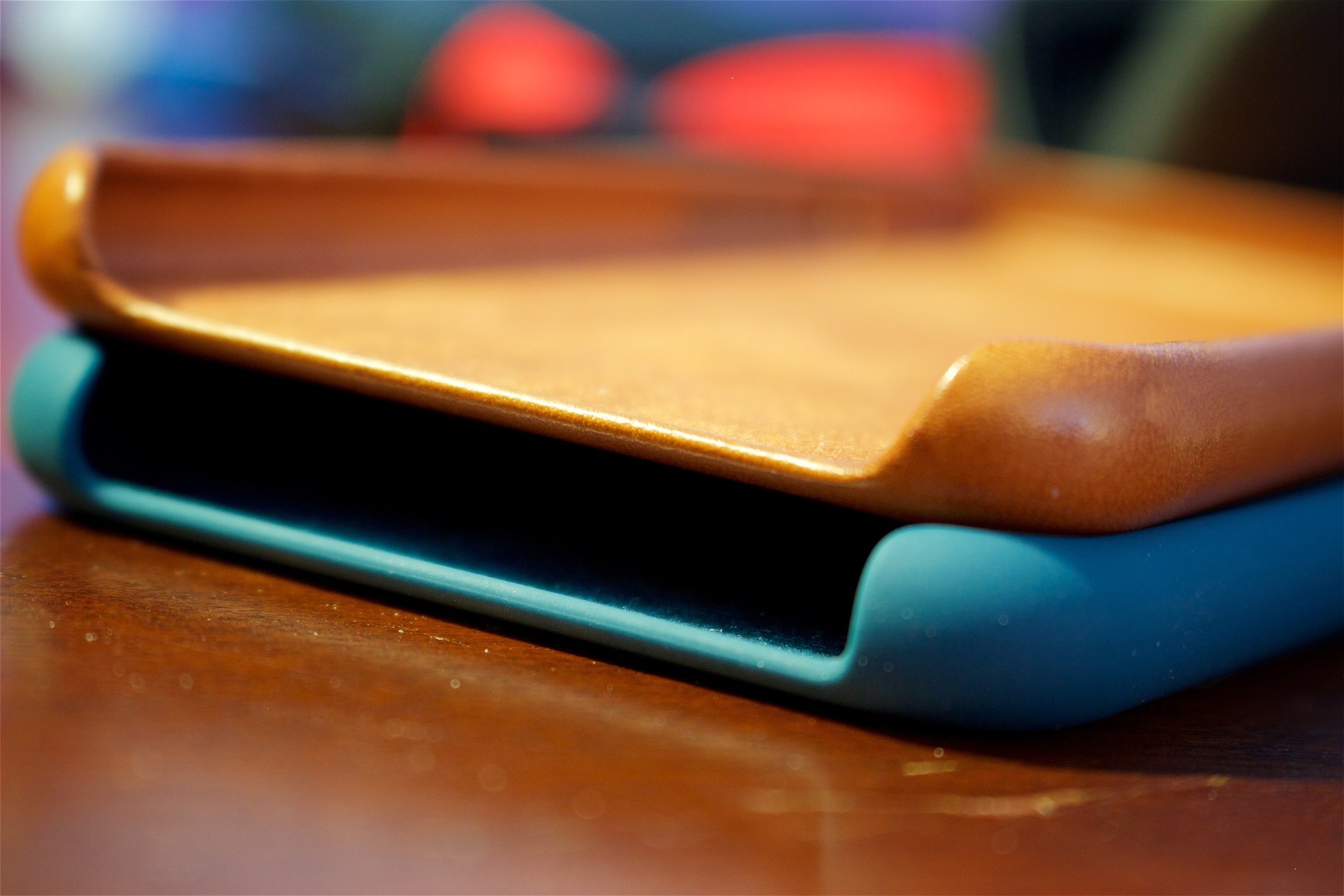
The bottom of the leather case is more open than than the silicone case. I suspect the silicone case offers slightly more bottom protection. As an aside, I like that the bottom is open, because I constantly swipe up (it's the new home key) and it's nice not to hit the case with my thumb.
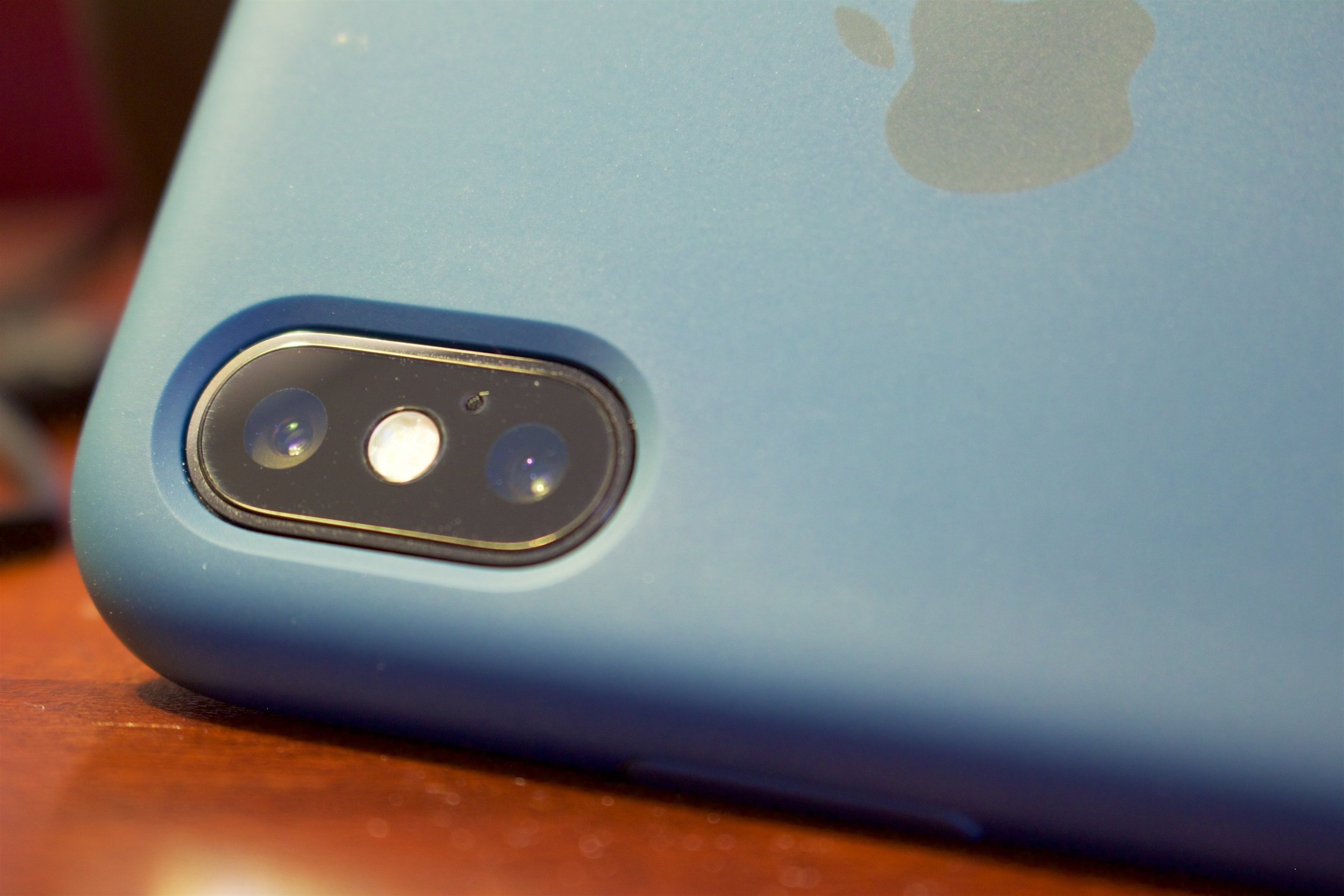
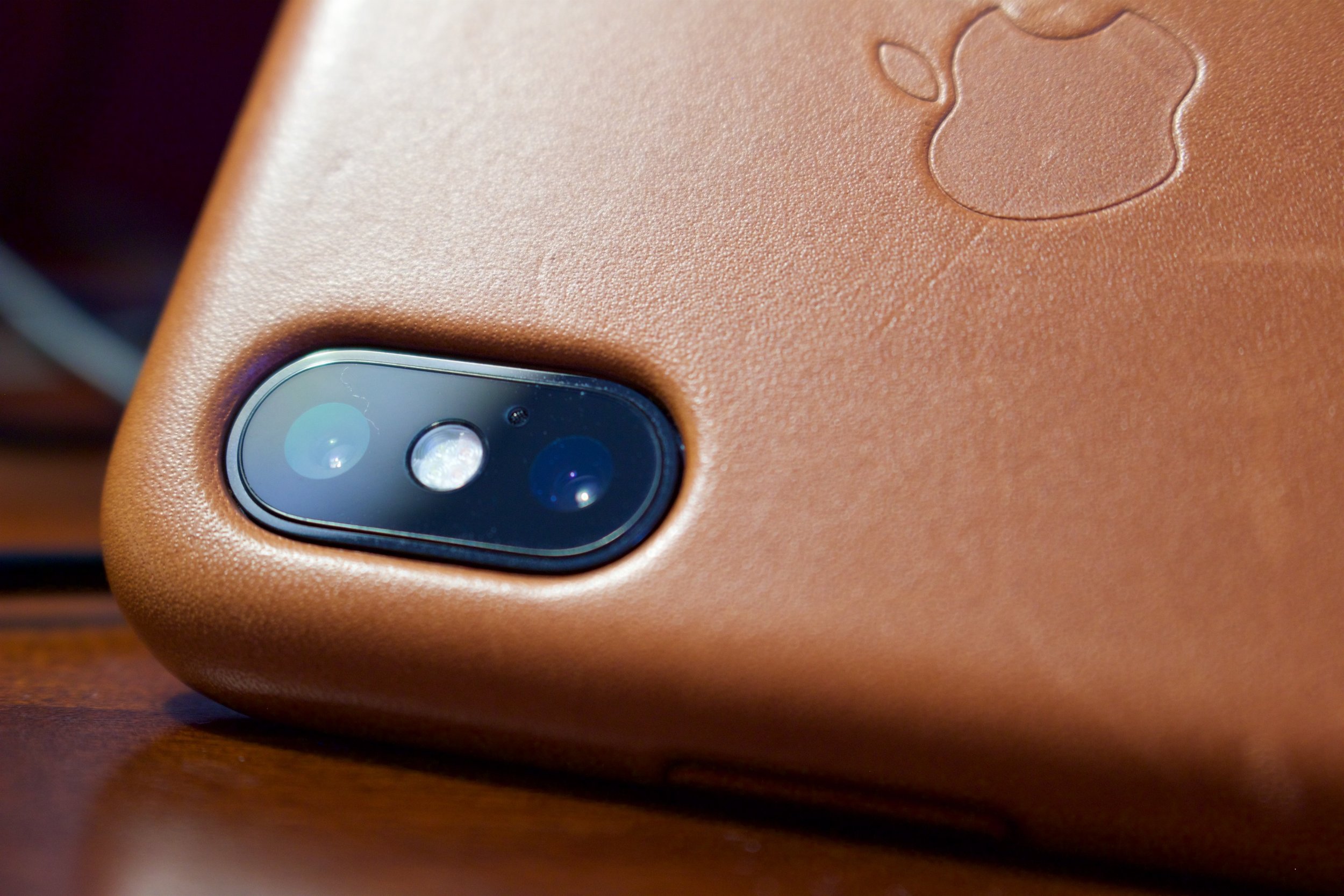
The camera cutout on the blue silicone case has a nice chamfer. The leather case does not, although the leather is raised to protect the camera.
Durability
The silicone case looks the same after time. It's fairly impervious to stains or color change. When it finally wears, it becomes shiny and hard along edges where the underlying plastic is exposed.
The leather case quickly (within a few days) starts to darken. It scratches if you look at it the wrong way. After four days mine had scuffs from fingernails and jean rivets. The case darkens from skin oil, so just touching it will gradually change its color. This isn't necessarily a bad thing for saddle brown, which goes from a caramel color to a leather-bound book appearance. When I set it down on a table at lunch, it picked up a fleck of food with oil, adding a permanent dark spot. Note my experience with other colors of leather cases was different. When I had a blue case, it darkened along all the edges, turning indigo blue. It looked stained, like an old tennis shoe.
Appearance
At two weeks, there is no contest. The leather case looks much more premium than the silicone. I like how the leather is darkening.
Verdict
If I'm going in the field where there's a chance of dropping my phone, I'll put on the silicone case.
For day-to-day use, I'll use the leather case. It looks great and feels nice to hold.


Yes, I bought a $1000 animoji machine
After a week with my iPhone X, I give my random opinions.
I'm a nerd. This should come as no surprise. I bought the first iPhone when it launched in 2007. At first Apple didn't even have an app store - what came with the phone was your only software. There was no front-facing camera and no video capability, It was, however, an awesome mp3 player/internet surfer/phone. And I admit, it was a bit fun when I brought it to work that first time, a crowd of curious co-workers wanting to see the magical gadget.
Ten years later when the iPhone X launched I waffled. It's expensive. It's glass. It swaps out one perfectly fine security feature with another. But that beautiful edge-to-edge OLED screen was compelling, quenching my desire to have an phablet-sized screen in a standard-sized phone. So, last week I reached a tipping point and bought one.
In my mind, I envisioned walking into the AT&T store, saying, "I would like an iPhone X, good sir," handing over my briefcase filled with cash, and watching the clerk slap the box into my eager hand.

The AT&T store's response
Of course, AT&T will not let you buy the phone outright, but instead insists on you signing up for AT&T Next. So, a jillion signatures and forty-minutes later, I finally left with my 64 gb Space Gray iPhone X.
Here's my thoughts after using it for a week:
- First, I love it. Not sure why I waffled so long.

- It's a little taller, wider and heavier than my old 6s. When I hold it with one hand, I hold it differently, resting my pinky underneath the bottom for support. Holding it this way for a while is tiring. It feels much more natural to hold the phone with my left hand while my right does the gestures.
- Those beautiful stainless steel and glass curves simultaneously feel great in your hand and like a wet bar of soap. Sadly, a case is necessary.
- The new gestures are awesome and I do not miss the home button at all. In general, you swipe up instead of clicking the home button, and you swipe up and pause to enter multi-tasking. In multi-tasking you can still fling apps off screen to close them.
- Face ID works so well that I often forget it exists. I'm used to apps prompting me for touch ID when I open them, but now they just unlock without asking for anything.
- The rear camera takes amazing pictures in portrait mode.
- The front camera takes weird pictures in portrait mode. They're fine in regular mode, but the stage/contour lighting produced images which looked like bad Photoshopping.

My first selfie with the iPhone X front portrait camera
- The edge-to-edge screen looks great. You can notice the OLED difference if you set the background to black (in which case, it's pitch black, and icons almost have a 3D effect). In terms of color and clarity, though, it doesn't look much different than a regular iPhone.
- In portrait mode, I ignore the notch. In landscape mode, the notch is a little weird, but not a big deal.
- Although I'm not sure if I'll use animoji, every single person I showed them to was entranced and played with them, laughing.
A few quirks:
- When reading a webpage, it's typical to scroll up with your thumb and pause while you read new content. But this is the same gesture to launch multi-tasking.
- The power-button-that's-sometimes-the-power button is odd. It's now a multi-function button that does everything from opening Siri to using Apple Pay. You can turn the phone on with it, but turning the phone off requires pressing it and the volume button.
- At work, I lay my phone flat beside my computer. To trigger face ID, I need to lean into the phone a bit. By default, all notifications on the lock screen are masked (they just show the app and something like "new message") until the phone sees you. It's kind of cool that it's a "for your eyes only" feature, but I turned it off because I got tired of constantly leaning in to see my emails.
- Although the phone displays a remaining battery graphic, the battery percentage is hidden in the control center. I miss the battery percentage.
- Surprisingly, the phone comes with wired headphones which have a lightning connector, but the headphones no longer include the plastic storage case.
But, overall it's a great phone, and I'm glad I upgraded from my 6S to it.


Books Butterfly Promo Results
My first promotion with Books Butterfly is nearly complete. Here are my results..
Last month I set 43 Seconds perma-free on Amazon. Like many indie authors, I followed the strategy of offering the first-in-series as free to attract new series readers. Since doing that, I've received a trickle of daily downloads for 43 Seconds.

I've read about Books Butterfly guaranteed promos, which guarantee a specific number of downloads, and decided to give them a try. Overall, I'm happy with the results. Here's how it played out:
1/23/18 - I requested the Silver Eagle promotion package ($50) with a guaranteed 500 book download via Books Butterfly online signup form. The site had a Stripe popup which had me pay $50 at the time of signup via credit card. On the form, I could enter my requested ad date. I just entered 'first available' since my book is permafree, and I indicated the book is permafree. I received a confirmation mail the same day from Book Butterfly stating my request was received and someone would get back to me within a few days.
1/26/18 - I noticed a spike in downloads for 43 Seconds. I hadn't heard anything yet from Books Butterfly, but assumed they must have started running the ad.
1/27/18 - I received a confirmation email from Books Butterfly that my ad started running on 1/26 and would continue until 2/6 on Kindle, Nook, Apple, and Kobo. There were many terms and disclaimers in the email including a one-time exception to guarantee downloads for a short story. Books Butterfly offers a prorated refund in the event they don't meet the minimum download promise (the refund is in store credit).
Here's the results of the promo (as of 2/6 @ 6 pm)
Downloads: 473 (Kindle 415 / Apple 49, Nook 9, Kobo 0)
Paid Sales (other titles): 7
New Reviews/Rating during the ad period: 4 (Kindle 2 / Apple 0 Nook 0, Kobo 0, Goodreads 2)
In general, downloads per day were ~60 at the start of the promo and ~30 the second week. Note this download rate was sufficient to keep 43 Seconds in the top ten free books for its category, which was helpful. Its best spot was #4 on the Sci-fi & Fantasy 90 Minute Kindle Short Reads list.
Overall, a good result. I've easily spent $20 on Amazon promos which yielded a single 99 cent sale, so $50 for 500 downloads and 7 sales is a good value. The ad did not pay for itself in terms of sales, but I sell 99 cent short stories and no ad has ever paid for itself (I need to sell higher-priced books before ads become viable). For now, the ads are about building a customer base for the series.
I should note that book totals for the guaranteed download promise should be calculated through 2/7, so I don't have the final tally today as of 2/6. 473 is close to 500, and it's entirely possible I will pass 500 downloads by the end of 2/7. Either way, I'm happy with the promo result.
Lastly, if you were one of the readers who left a review or rating - thank you! You can see that out of the 415 Kindle downloads, 2 left reviews, so this is 0.5%. You are in the top half-of-one percent and you're awesome - thanks again!
EDIT: The final download total (Kindle, Apple, B&N, Kobo) at the end of 2/7 was 506
If you enjoy sci-fi stories about pilots, why not get your free copy of my short story, 43 Seconds, on Amazon Kindle? It’s part of the Hayden’s World series, which is about a pilot willing to risk everything for a shot at the stars.

Some Completely Unnecessary Math
The title says it all. This is what happens when I have a day off.
When I read Andy Weir's The Martian, I realized there was a whole genre of science fiction that took the science part seriously. It's interesting that the original genre of science fiction was just that - fiction extrapolated from science. Sure, I know there's a hard science fiction genre, but Weir started at Bill-Nye-Science-Guy-level and turned it up to eleven.
Even if you're not a hard science fiction fan, there's the puzzle appeal. You'll find it in movies like Apollo 13. Everyone remembers the square-peg-in-a-round-hole brainstorming scene. Or MacGyver, a fellow who literally saved himself and everyone else each episode with science.
Now that it's Christmas, it makes me think of the meme where someone calculates how fast Santa's sleigh would need to go to traverse the world overnight, and what would happen if it did. There's some nerdiness in us all.
I'd read that Weir actually calculated the orbital mechanics of the Hermes in the Martian. I remember thinking he could have just said the NASA guys worked it out in the story and I would've taken his word for it, but, at the same time, it's the sort of thing I do in my stories. If it takes twenty-six days for the Aristarchus to get from the outer system to Earth, I've actually done the math. At times it's been my bane. Simple things like flying from Saturn to Cassini Station (just outside Saturn's rings) in Erebus takes hours of flight time. Space is big. Saturn is really big.
Recently I was watching one of my favorite sci-fi movies of all time, Star Trek II: The Wrath of Khan. I can't say how many times I've seen it. At the end there's the dramatic escape when Khan activates the Genesis device and Kirk says, "Scotty, I need warp speed in three minutes or we're all dead!". Mid-scene we hear that the Enterprise's distance to the Reliant is 4000 km. Sulu says, "We're not going to make it, are we?". David shakes his head. Great stuff.
So, here's where the nerd in me perks up. I know the Enterprise has been shot up and is operating under impulse engines or thrusters. However, it's always struck me that 4000 km is not very far for a starship. If you pay attention, Kirk provides a time and distance in the clip:
Kirk: "Time?"
Saavik: "Three minutes, thirty seconds."
Kirk: "Distance from Reliant?"
Chekov: "Four thousand kilometers."
I'm going to make an assumption the Enterprise was accelerating that entire time. Which would make sense if they're using thrusters. I have no idea how Star Trek's impulse drive works, but if it's a space-bending-continuous-speed thingy, then the math is just distance over time:
4000 km / 3 minutes 30 seconds = 19 kilometers per second
This is fast, but slower than most asteroids. As an aside, not even Star Trek seems to know how its impulse drive works. In some movies they use impulse drive while in space dock, which, you know, seems like a bad idea.
Now if the Enterprise is accelerating at a constant rate from a standstill, the math is a little harder:
distance = 1/2 acceleration * time (squared)
If you solve for acceleration, the Enterprise is accelerating at 18 g
Presumably Star Trek's inertial dampeners keep everyone from getting squished. On the plus side, this is faster than I thought. 18 g acceleration will get you from Earth to the Sun in a speedy 16 hours. Unfortunately the (albeit damaged) impulse drive doesn't work out so well in the long run in this case. Traveling a continuous 19 kps will take 91 days to get from Earth to the Sun. So, stick with the thrusters.
Anyway, this is what happens when I have a day off. Enjoy the geekiness.
Pulp Fiction
Serial fiction is an itch I needed to scratch with my keyboard.
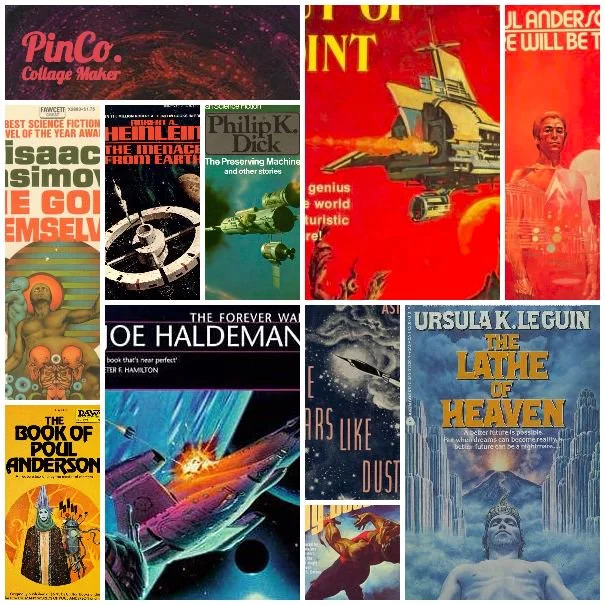
If you've read 43 Seconds or Erebus, you'll know James has nostalgia for the golden days. His dreams are an extension of my own. Instead of the golden days of aviation, however, I dream about the pulpy days of science fiction. Book covers painted in gauche with paint-streaked rocket ships bisecting star fields, like these:

Like 'em? Check out my collection on Pinterest.
I also love the concept of the serial, tuning in next week or getting the next issue to see what befalls our hero. It's really the structure for most modern sci-fi television, whether you're watching Dr. Who or Star Trek. Bite-sized stories consumed sequentially, starring the same characters, focusing sometimes on the star, sometimes on the co-stars.
When I conceived Hayden's World, it was a full-fledged book. I thought the voyage to get to that point, however, was its own exciting story. I'd been searching for Kindle short reads to consume each night in bed - ninety-nine cent stories I could read in under an hour. To my surprise, there was a shortage of them. It was an itch which needed to be scratched, and I decided to tackle it with my keyboard.
Publishing sci-fi shorts on Kindle is surprisingly difficult. I think people are more likely to try a novel from an unknown author than a short story. It's nearly impossible to advertise ninety-nine cent fiction without losing money. I've found the most effective paid promotion is simply to buy the books from Amazon and give them away (via Amazon's Giveaway program). Kindle Select allows me to set the price to free for up to five days every three months. and this moves two hundred copies if I pay for basic advertising. Recently I had a friend ask if there was good money in my Kindle sales. I told him I could buy one nice dinner-for-two yearly from them.
This quote from author Palessa on Nicolas C. Rossis blog sums it up perfectly:
On the author side, I decided to go more for brand awareness than book sales, because if I’ve learned anything in this whole independent author journey, it’s that obscurity is the force we are all fighting against.
The main challenge hasn't been one star reviews. It's publishing to the abyss. It takes money and effort to keep your needle in the haystack from sifting to the bottom of the pile. And, you've got company there. You can deduce this fairly quickly from your Kindle stats. When your book bottoms out in sales, it moves to a sales rank of around three million (meaning, there are three million books in the pool, and you are at the bottom). When you sell just one copy, your rank jumps to one hundred thousand. This means those 2.9 million other souls are selling no copies.
I'll admit, it's daunting. I was an artist before I was a writer. Both are creative endeavors. Art is easier, though. It's visual. When you post a newly completed piece online, you immediately get feedback. People can assess its merit in the few seconds it takes to glance at it, and respond. They can share the image socially. Writing, though, is different. There's a commitment to read a story, and then it takes more than a Facebook like to give feedback.
I'm four stories deep now in the Hayden's World series and excited about the subplots developing. There's plenty to explore, especially with James's discovery in Erebus, or the lack of closure with the pirates in Aero One. Looking forward to seeing what happens next with our heroes.
As always, you can help with your feedback. Leaving a rating on Amazon or Goodreads really helps, or just a comment on this blog if you like a story or have questions about what's next. I love to hear from readers, so drop me a line.
Thanks!