Thoughts on Star Trek: Strange New Worlds Season 4
We’re five episodes into Season 4 of Star Trek: Strange New Worlds. As someone who grew up watching 60s Trek, hear my thoughts on how it’s going.
When the pilot of Strange New Worlds launched, I was cautiously optimistic that after years of Trek turning into something unrecognizable we had returned to the roots of exploration and adventure. Season One, like most shows, had some missteps, devolving into Star Trek: Discovery-ish nonsense at times where non-stop action and plot twists were used as sauce to mask the undercooked plot.
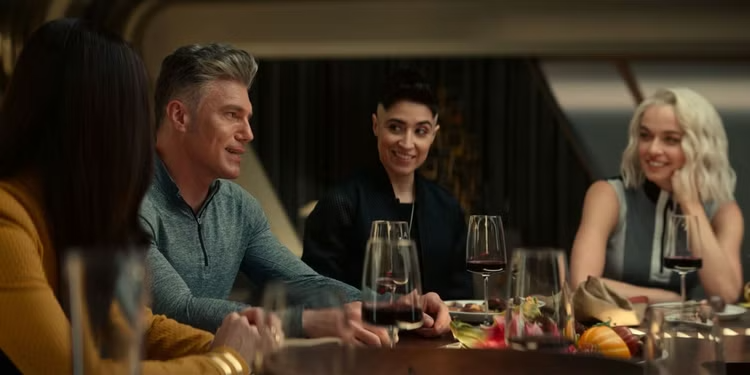
At other times, though, it took a refreshing breath, having entire scenes where the crew ate dinner with the captain, discussing their careers, or adventures where they beamed down to a planet with a strange and wondrous environment. It seemed to live up to its name of Strange New Worlds.
My main critique of Season One was that it lost the rhythm of classic Trek, in particular Next Generation Trek, which had an A/B plot structure. The A plot was the main problem to solve, while the B plot was usually a lesser character-driven crisis. Ideally, resolving the B plot helped the character contribute to the A plot solution. In short, it was just the right amount of plot for one hour. Season One (and most modern Trek) often devolved into multiple character and plot crisis in the same episode, not trusting the viewer to maintain focus for more than five minutes. Main characters have karate battles in front of pending warp core breaches while each reveals some deep dark secret about their history, while simultaneously another group of character have their own life-and-death drama unfolding in a shuttle bay. My lesser tinge was that the plots were immediately identifiable as a repurpose of other plots from classic Trek, often with one element flipped. For example, when I first watched “Children of the Comet” (ST: SNW S1E2), I immediately thought, “Oh, it’s ‘For the World is Hollow and I Have Touched the Sky’ from ST:TOS’, except the people aren’t inside the comet. Same set up, though.”
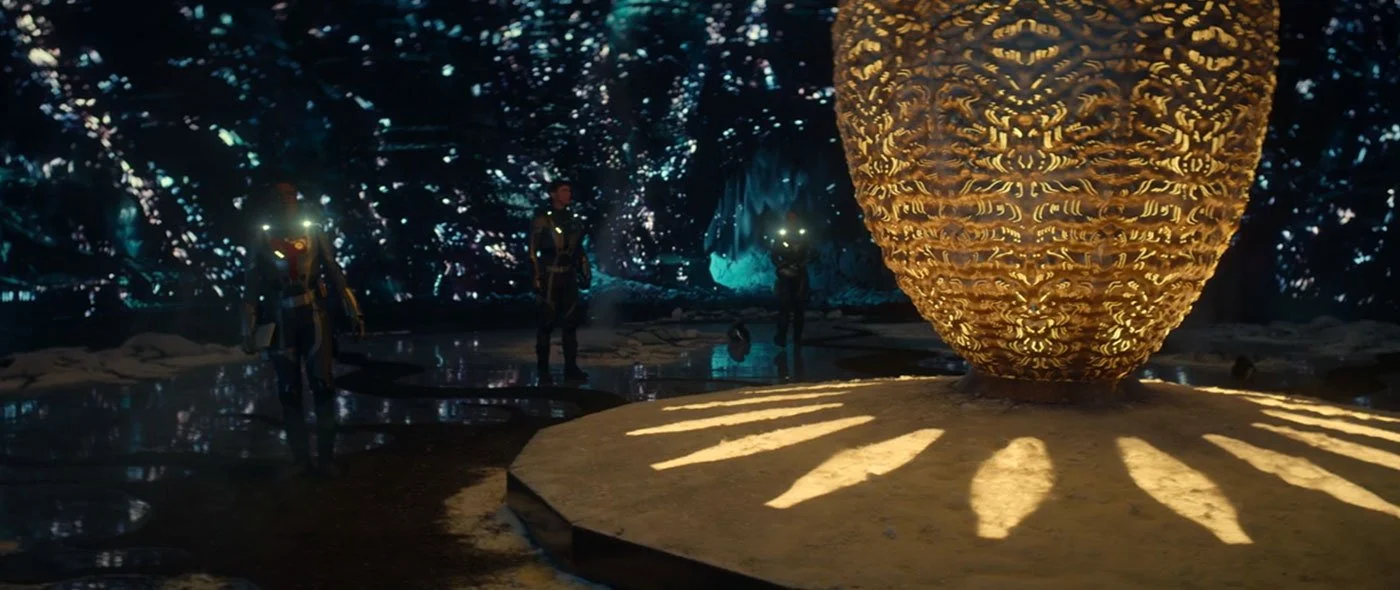
ST:SNW “Children of the Comet”
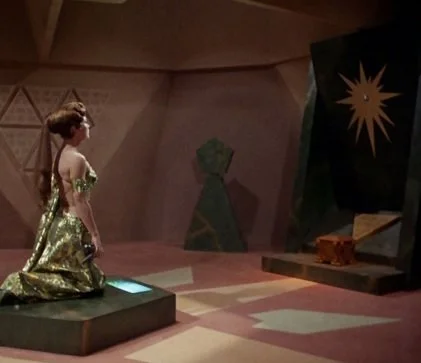
ST: TOS “For the World is Hollow and I Have Touched the Sky”
At first I thought this was to reinforce nostalgia, but as this became the norm I suspected it was lazy writing. I envisioned the writer’s room having a wheel of classic Trek episodes they spun during brainstorming, then said “but” and spun it again. “The crew beams down to find a missing Starfleet captain has used his knowledge to rule the technologically inferior locals” (ST:TOS “Patterns of Force”) BUT “The crew develops amnesia and can’t remember who they are” (ST:TNG “Conundrum”).
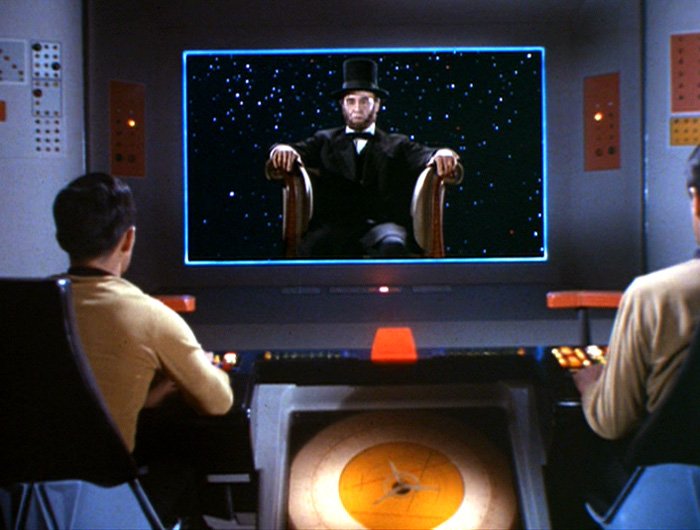
In later seasons, the idea mining has expanded to other shows and genres. Many people criticized the musical episode as stealing the idea from Buffy the Vampire Slayer, but I enjoyed the musical episode. It was character-driven, showed me something I hadn’t seen before, and plenty of other series have done musical episodes. Despite it being “not serious”, I actually thought it was very Star Trek, in the same way that I thought the Lower Decks cross-over was very Star Trek. Both celebrated the Trek universe and characters. I think sometimes people forget just how campy the 60s series could be, with giant glowing green hands grabbing the Enterprise, Spock losing his brain with his body being directed by McCoy’s 4-button remote control, or Abraham Lincoln floating on his chair in space.
Season Four telegraphed its campiness with the teaser of Pike as a Muppet and fans have been waiting to pounce. Pounce time is upon us with the release of the much-maligned Muppet Trek. We’re five episodes in and, like previous seasons, at best it’s mixed. Shows like The Next Generation went through one or two bumpy seasons before finding their stride, then consistently delivered. Strange New Worlds just wanders all over the place, constantly trying a new gimmick. It’s not even a throw-spaghetti-on-the-wall-and-see-what-sticks approach, as they don’t wait around to see what sticks. They just move onto a new goopy food. I wish it would just settle and be a Star Trek show. The episodes so far:
"Valles Marineris"
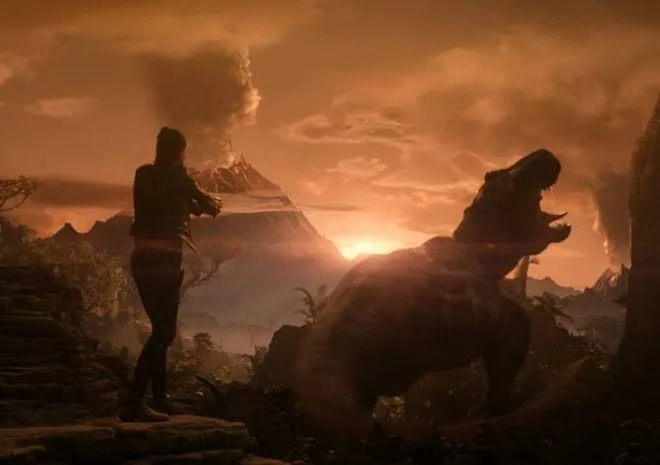
The plot: The Enterprise gets pulled into an anomaly and time travels to Earth during the dinosaur era. They discover Mars has a technological civilization that is at war with another unknown planet in the solar system. In resolving the conflict, the Enterprise creates both the comet that killed the dinosaurs and the anomaly that brought it there.
The plot it appears to be repurposing: “All Good Things” from ST:TNG, where the Enterprise creates the anomaly that extends into the past and future, interfering with the formation of life on Earth.
The verdict: The resolution, where Pike simply allows the Martians to genocidally destroy an entire populated planet, is very un-Trek, regardless of his realization it is necessary for the timeline.
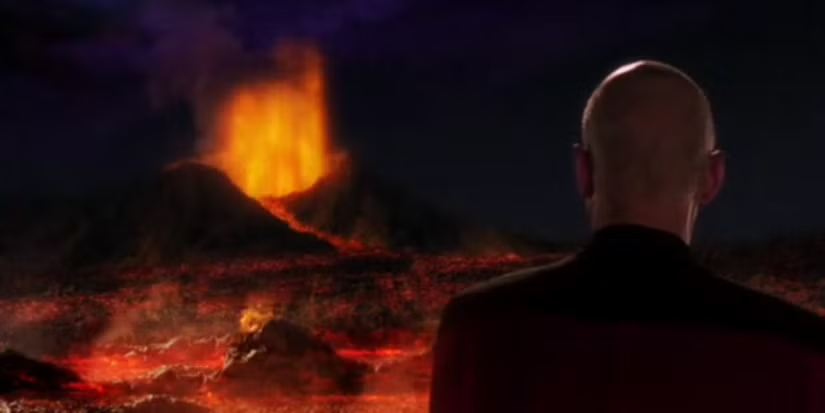
ST:TNG “All Good Things”. Q brings Picard to Earth’s distant past to see how the Enterprise has upset the formation of life on Earth
"The Griffin Incident"
The plot: The Enterprise discovers a ghost ship. Several crew members are trapped aboard and experience terrors, each terror an amplification of some aspect of their anxieties.
The plot it appears to be repurposing: The movie “Event Horizon”. Ghost ships certainly are a staple of scifi, however, so I’ll cut them a little slack.
The verdict: The episode delves into gory gross-out scares, with Kirk’s brother graphically having his intestines pulled out into a hull breach, Pike dicing his own fingers with a chef’s knife, and Spock cutting off his ears with scissors. TNG occassionally had some gore, such as the infamous head-phasering-exploding of “Conspiracy”, but this was too much. I’d be okay with a ghost-ship-crew-is-going-mad episode, but the deliberate push into R-rated horror was jarring.
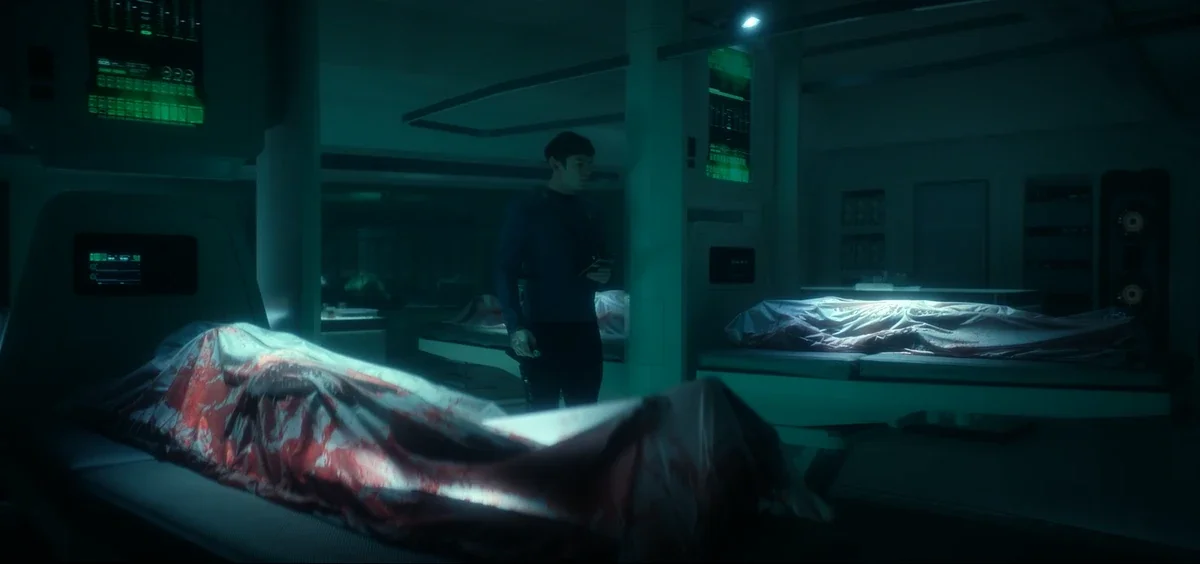
ST:SNW “The Griffin Incident”. Of course you know one of those body bags is going to sit up behind Spock when he isn’t looking
"Human Best Friend"
The plot: The crew takes shore leave on a Risa-like recreation planet where you get drunk just by breathing the atmosphere. They wake up, hungover, unable to remember where they left the shuttle and must backtrack the night’s events to solve the mystery.
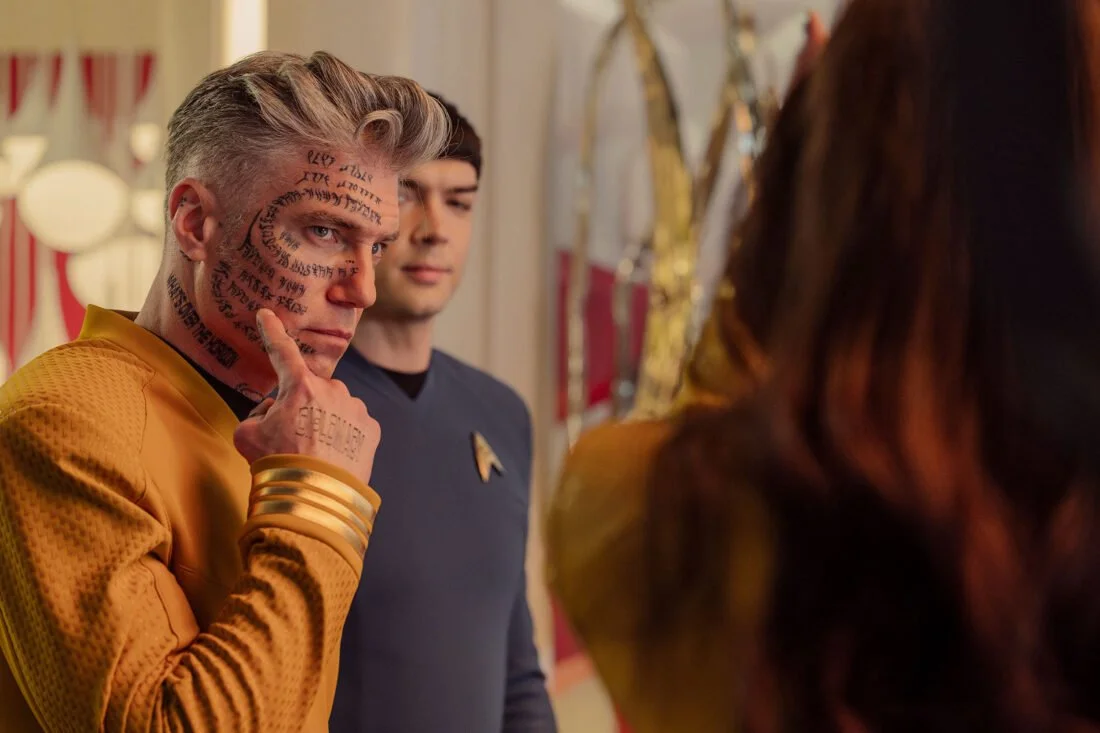
The plot it appears to be repurposing: The movie “The Hangover”, right down to Pike’s face tattoo.
The verdict: I frowned at them simply doing The Hangover in space, but the episode itself was light and silly and at times genuinely funny. TOS had its fill of light and funny episodes as well, so I have no problem with a funny episode. I just wish it were an original funny episode.
"A Case of Chiaroscuro"
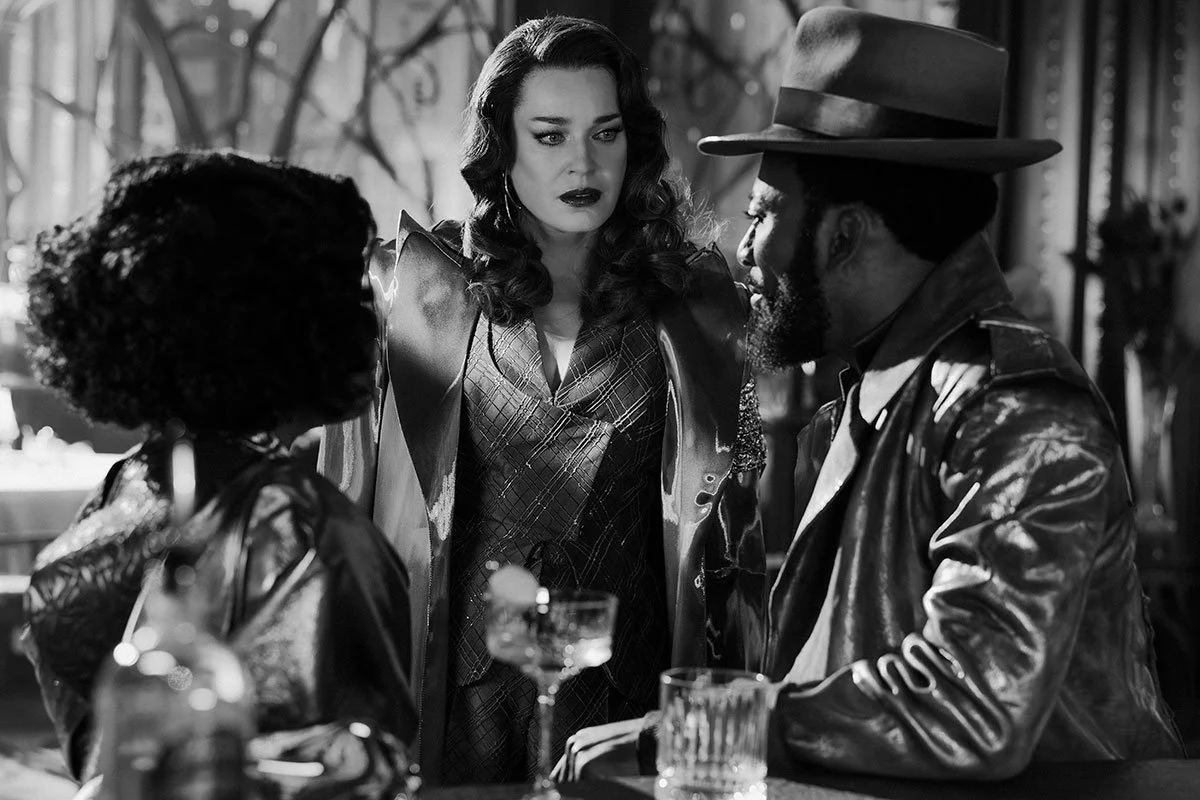
The plot: Several crew members are trapped on a Klingon-occupied world after their shuttle is disabled, and must help the resistance oppose the Klingons. The world is in a unique solar system where everything is in black and white, and the technology of the world is 1920s retro-futurism.
The plot it appears to be repurposing: The movie, “Casablanca” and the Star Trek: Continues episode, “What Ships Ae For”
The verdict: I’m not sure if permission was asked, but the mechanism for everyone seeing in black and white seems like it was taken directly from the Star Trek: Continues episode “What Ships are For”, where radiation from the system’s sun interferes with the eye’s color receptors, causing people to see in black and white. That ST: Continues episode was excellent in that the black and white component was crucial to the plot. The plot of the Strange New Worlds episode itself is quite obviously Casablanca, right down to the recreation of certain scenes; however, I could absolutely see this as a Deep Space Nine episode, with Sisko and Dax in black and white and the Klingons replaced by Cardassians and Bajorans. I liked it. It was experimental but visually stunning, and it felt like something Deep Space Nine would do.
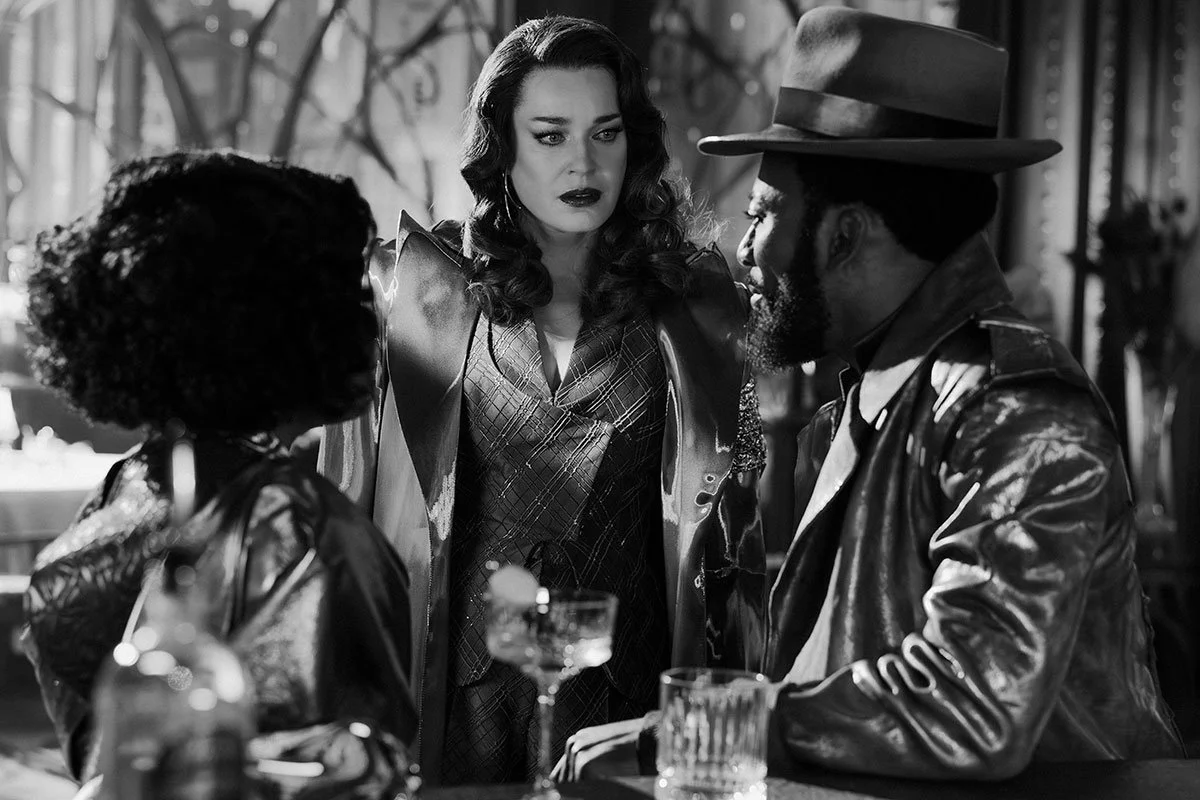
ST:SNW “A Case of Chiaroscuro”
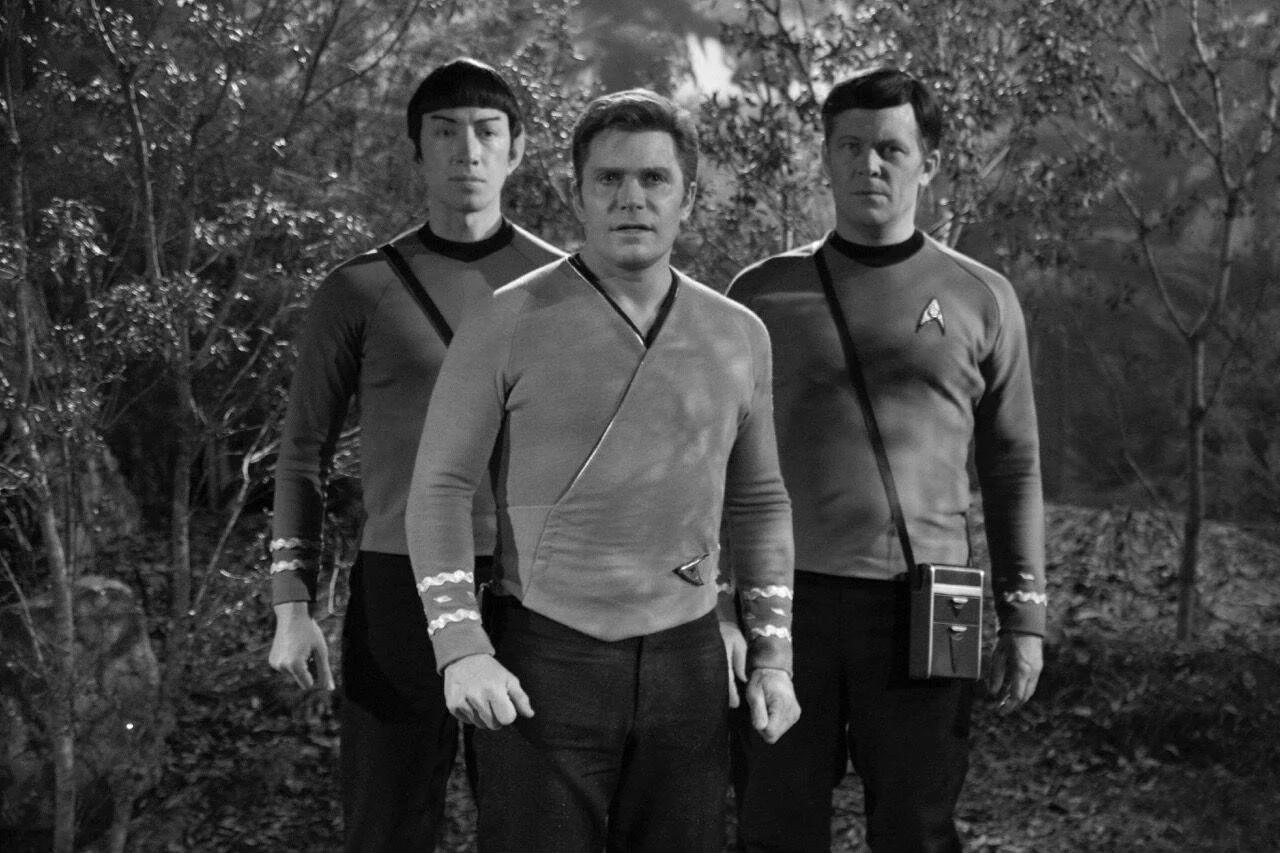
ST: Continues “What Ships are For”
"Level Five Transporter Accident"
The plot: Scotty pushes the transporter too far and through a strange malfunction transforms the entire crew, except Spock, into Muppets. Orion pirates take advantage of the situation to capture Enterprise.
The plot it appears to be repurposing: The Scrubs episode, “My ABCs”.
The verdict: Just not funny. It could have been funny. For example, I recently watched the Muppets reboot and had a silly grin on my face the entire time. For this Star Trek episode, I was deadpanned. There were a few glimmers of hope, such as the crew simply enjoying being in space without suits because they were puppets. When the crew realized they needed to stop thinking and acting like humans and instead use Muppet logic to defeat the Orions, I perked up, thinking it would take a clever turn, but their actual plan of just storming the bridge and Miss-Piggy-karate-chopping everyone wasn’t clever. It wasn’t helped by the Orion captain simply acting like she was oblivious to Spock actively walking around the bridge conspiring with the Muppets. The “it was all a dream” resolution was both a relief (that this didn’t seriously happen) and a let down (the lamest way to resolve a story).
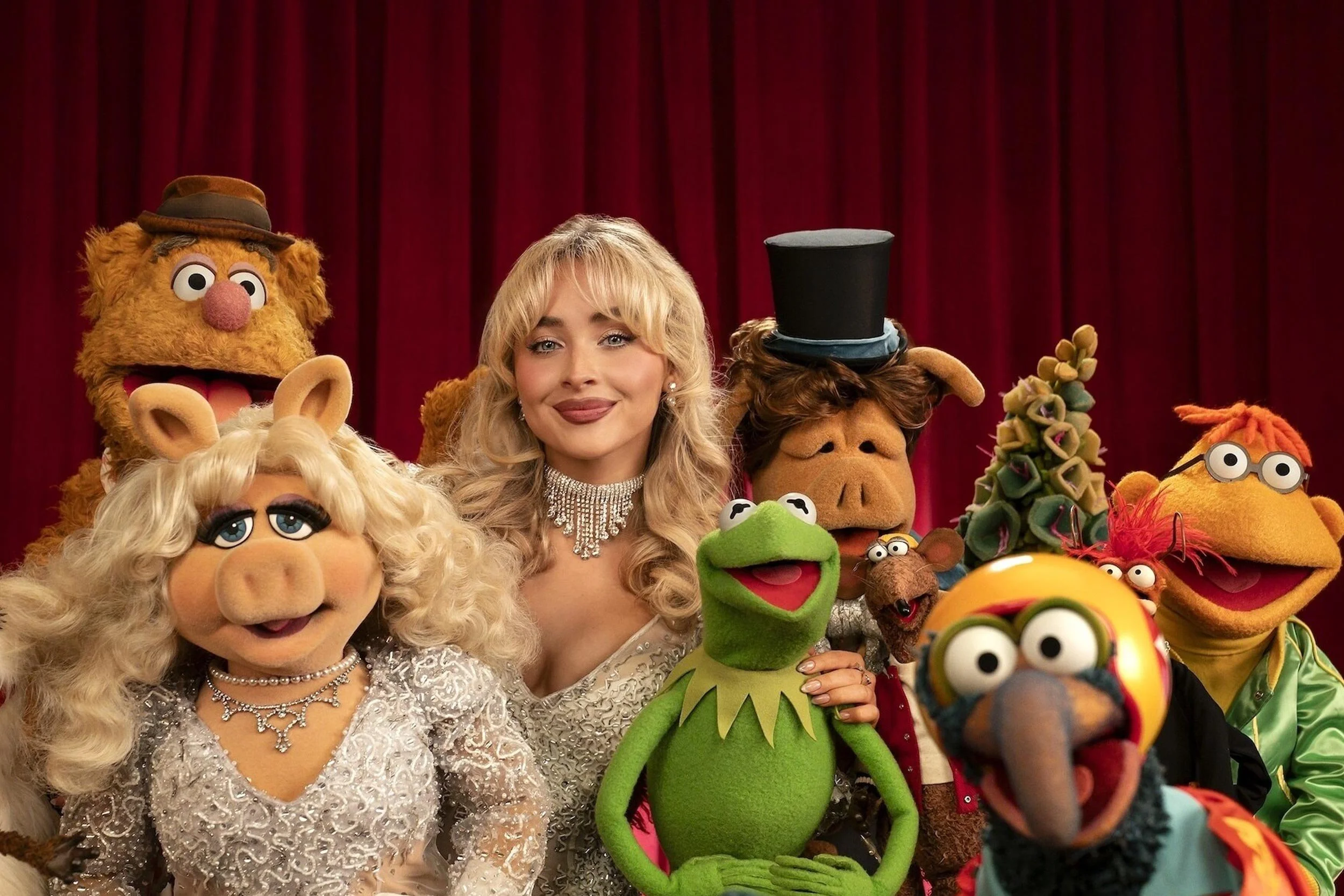
The Muppets reboot
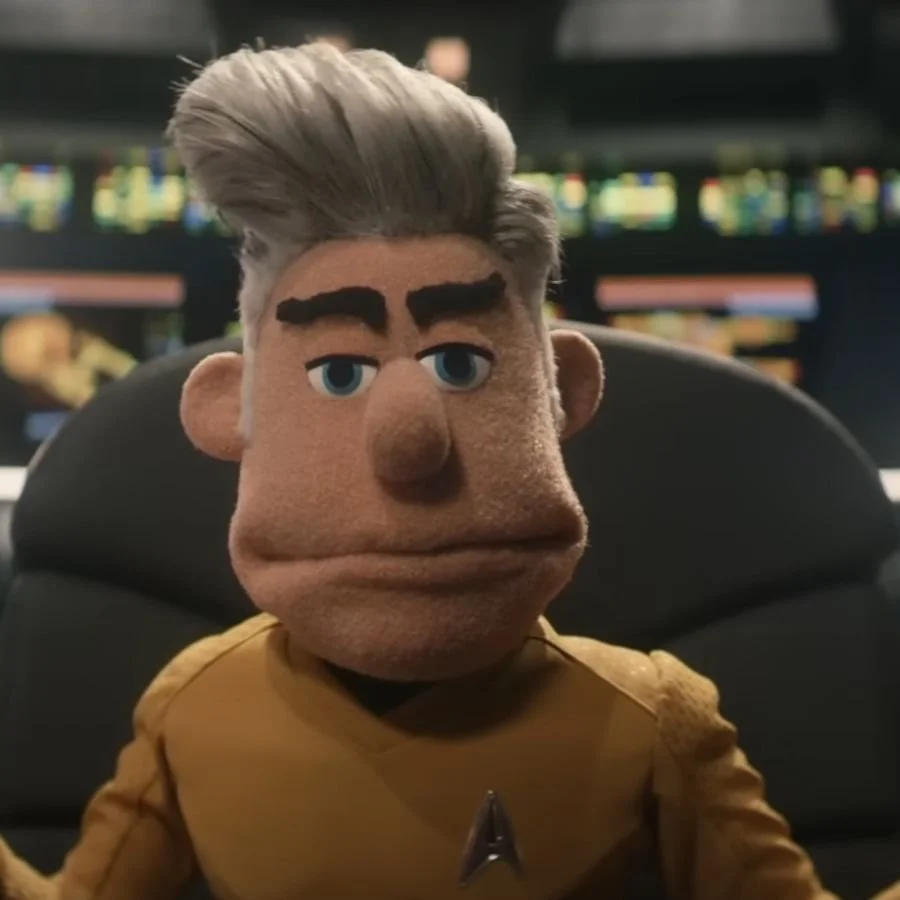
(sigh)
In summary, and please hear me Star Trek writers, enough with the gimmicks. I follow Red Letter Media on YouTube and they often have conversations about what they want from Trek. I’m with them: I want the classic TNG setup of a professional crew of good people who consistently do the right thing to solve space problems and mysteries. Red Letter Media framed it well with a hypothetical series based on a smaller Federation starship with a crew of new characters that solves some mystery weekly. The plots don’t need to involve saving the universe and the characters don’t need to have convoluted back stories. Good people doing good things to make the galaxy a little better is classic Trek.
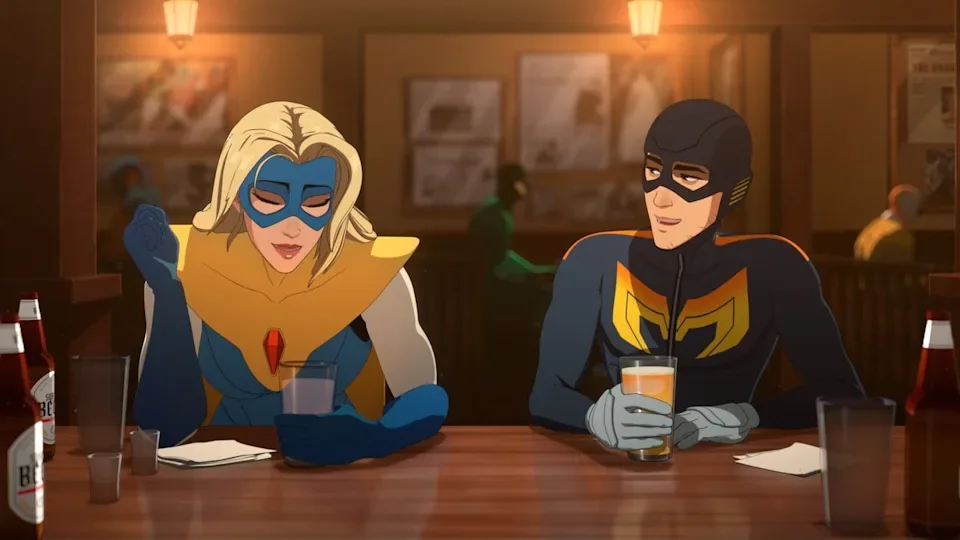
Thoughts on Dispatch
What’s not to love about a choose-your-own-adventure superhero story?
I am a sucker for narrative adventures. As I get older, I want video games that are less about fast-twitch mechanics and more about characters who make me feel something. I loved Detroit: Become Human and Baldurs Gate 3 for just these reasons. Detroit: Become Human has radically different acts based upon previous choices, and bad choices can get main characters killed off mid-story only to have the story evolve around their deaths. For example, Alice and Kara can spend the third act attempting to cross the Canadian border or attempting to escape from an android death camp. Or, perhaps neither because they both got killed escaping the freighter in act two.
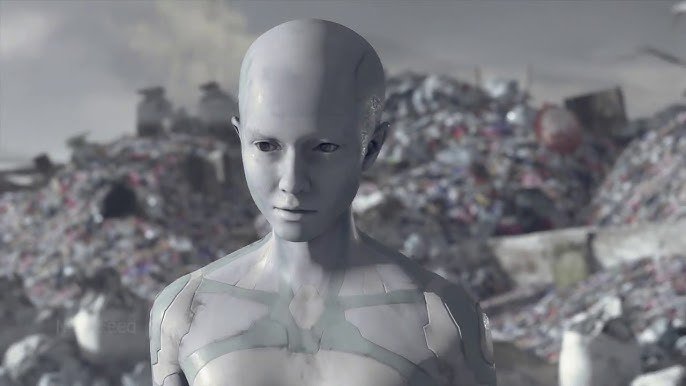
Kara in the android death camp
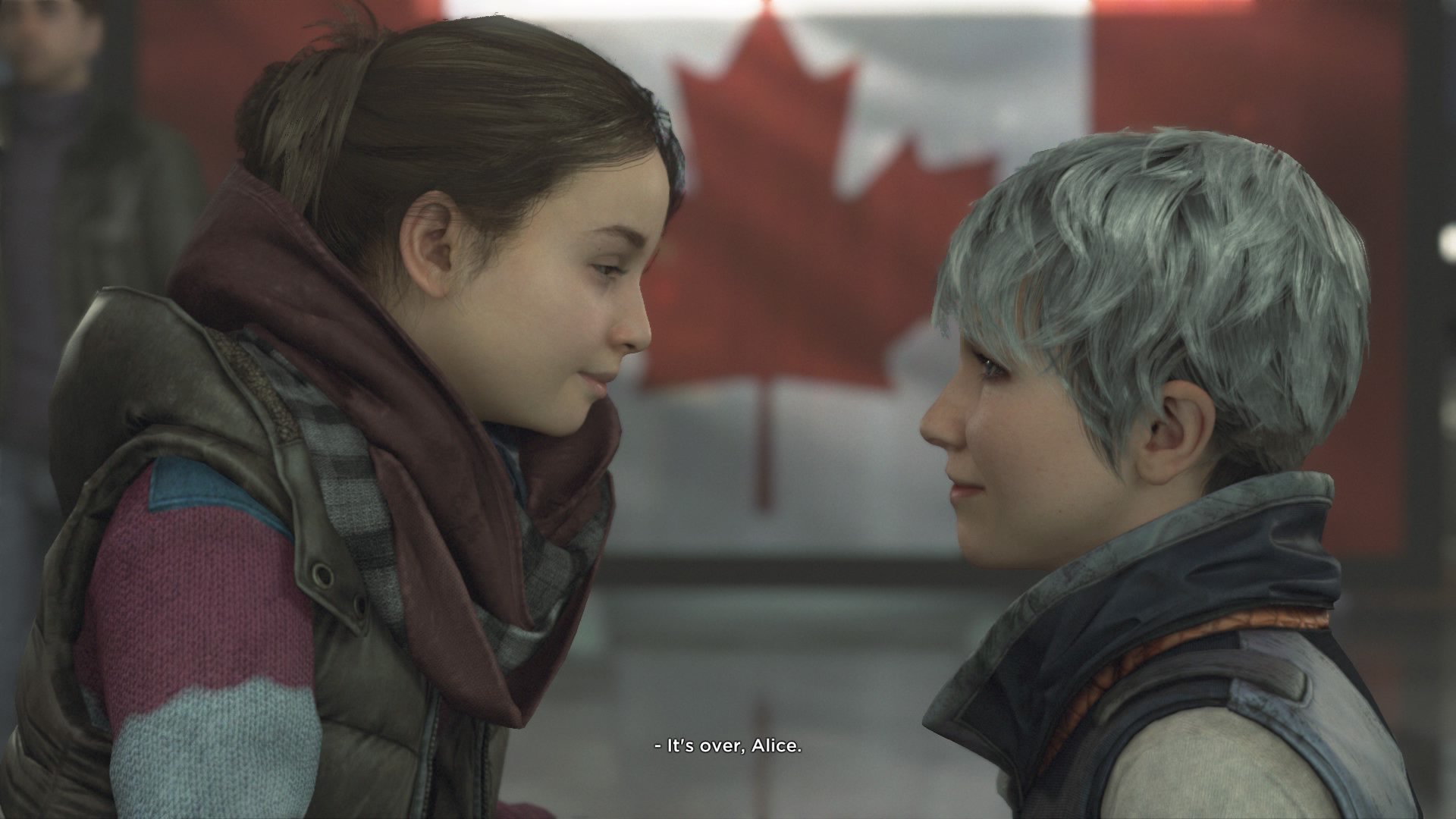
Kara and Alice at the Canadian border
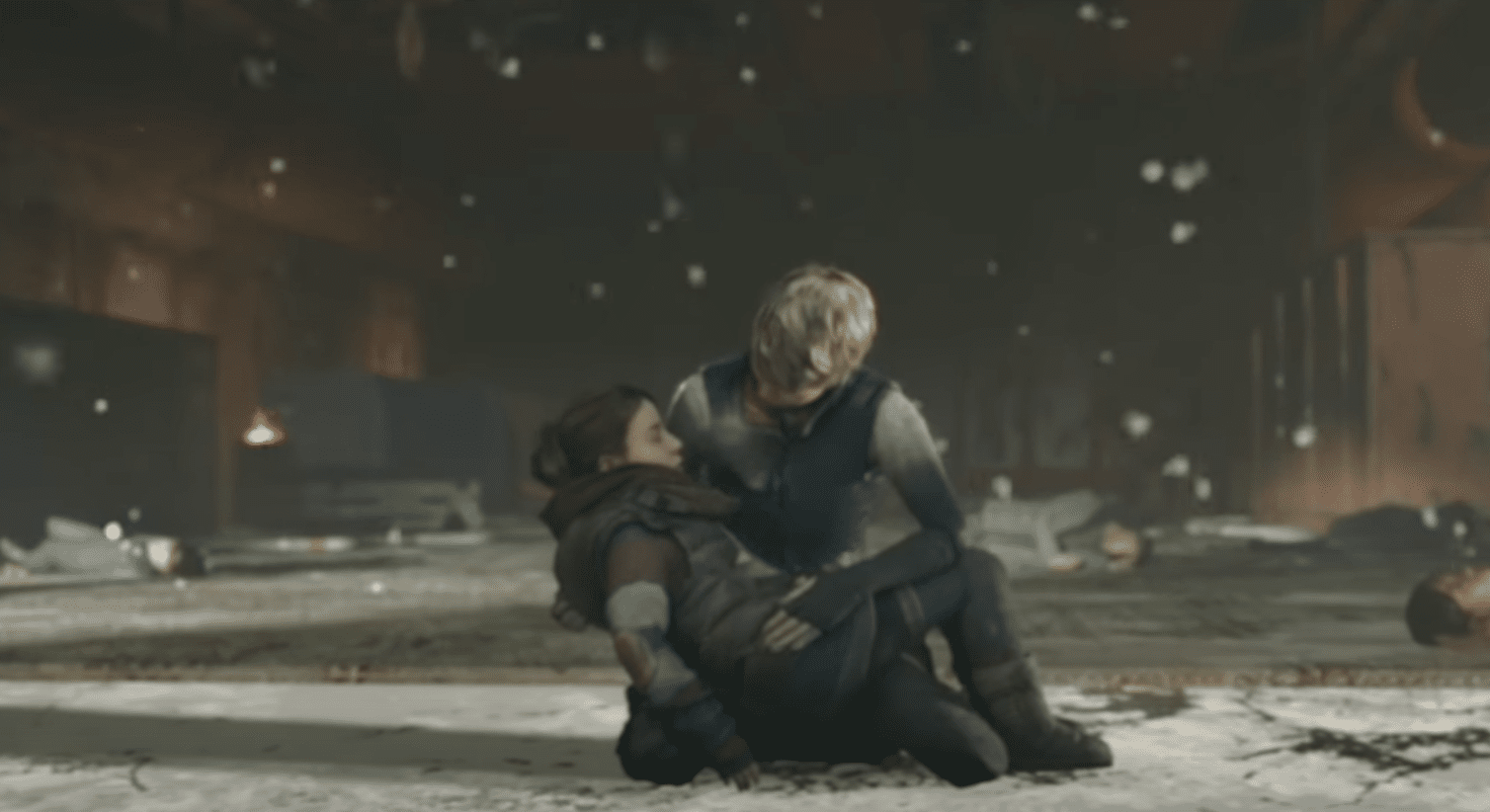
Kara and Alice are killed escaping the freighter
I’d seen Dispatch on Steam showing a normal looking guy standing at a urinal flanked by superheroes, and pondered what it was about, but it took a while for me to realize it was a choose-your-own-adventure animated series.
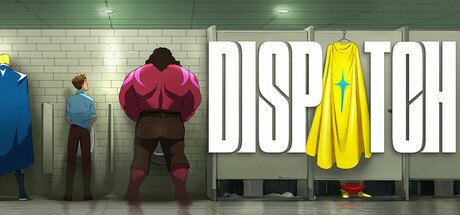
Dispatch is structured like a Netflix 8-episode mini-series, complete with credits and music at the end of each episode. There is a free demo, but it doesn’t do the game justice as the demo focuses mostly on the dispatching game play. Personally I think they should just have released Episode 1 as the demo. Nearly all of Episode 1 is narrative, with the exception of a short tutorial on dispatching and hacking.
Like any great series, Episode 1 starts with a strong hook and sets the stage: Your character, Robert Robertson, is the third-generation owner of an Ironman-like supersuit. When he dons it, he becomes Mecha Man. The story picks up in the middle of the action as Mecha Man is hunting down the supervillain, Shroud, who killed his father (the former Mecha Man). Shroud is one step ahead of him, and after an epic battle the Mecha Man suit is destroyed. An injured Robert Robertson, still in superhero costume, gives a defeated press conference where he admits he is unable to repair the suit and his superhero days may be over. A short time later, Robert attempts to stop some looters, sans powers, and gets stomped, before a flying superhero named Blonde Blazer comes to his rescue.
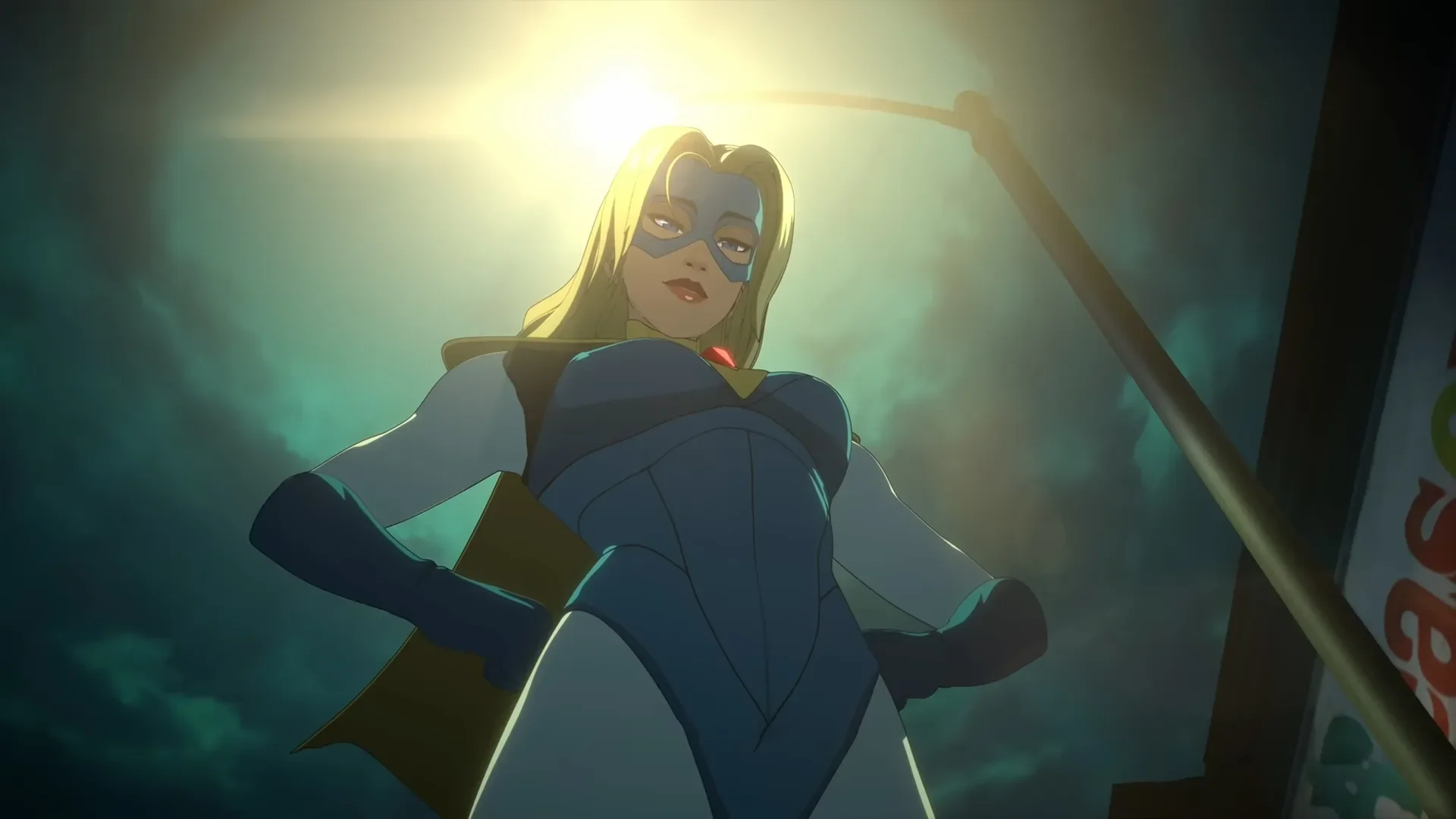
She invites him to a superhero bar before taking him on a Lois-and-Clark-like flight over the city.
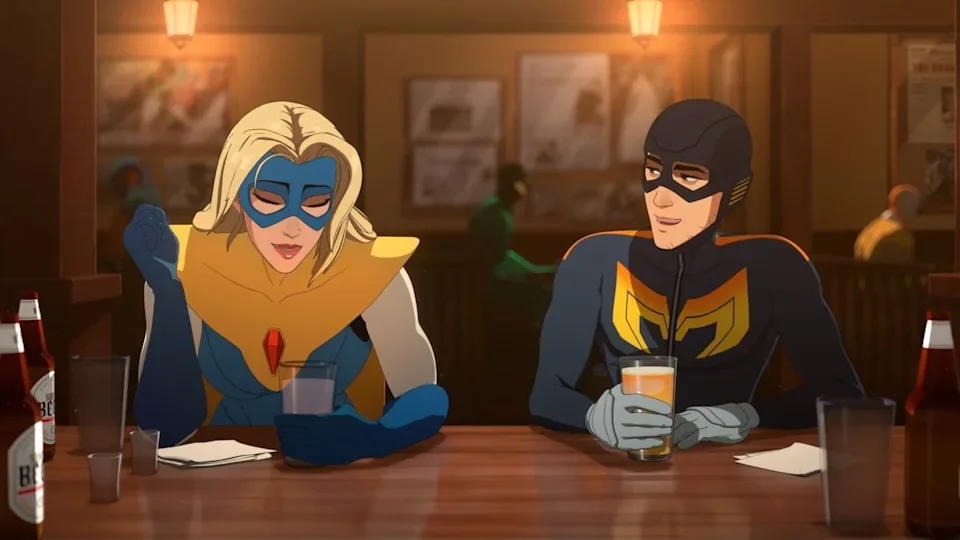
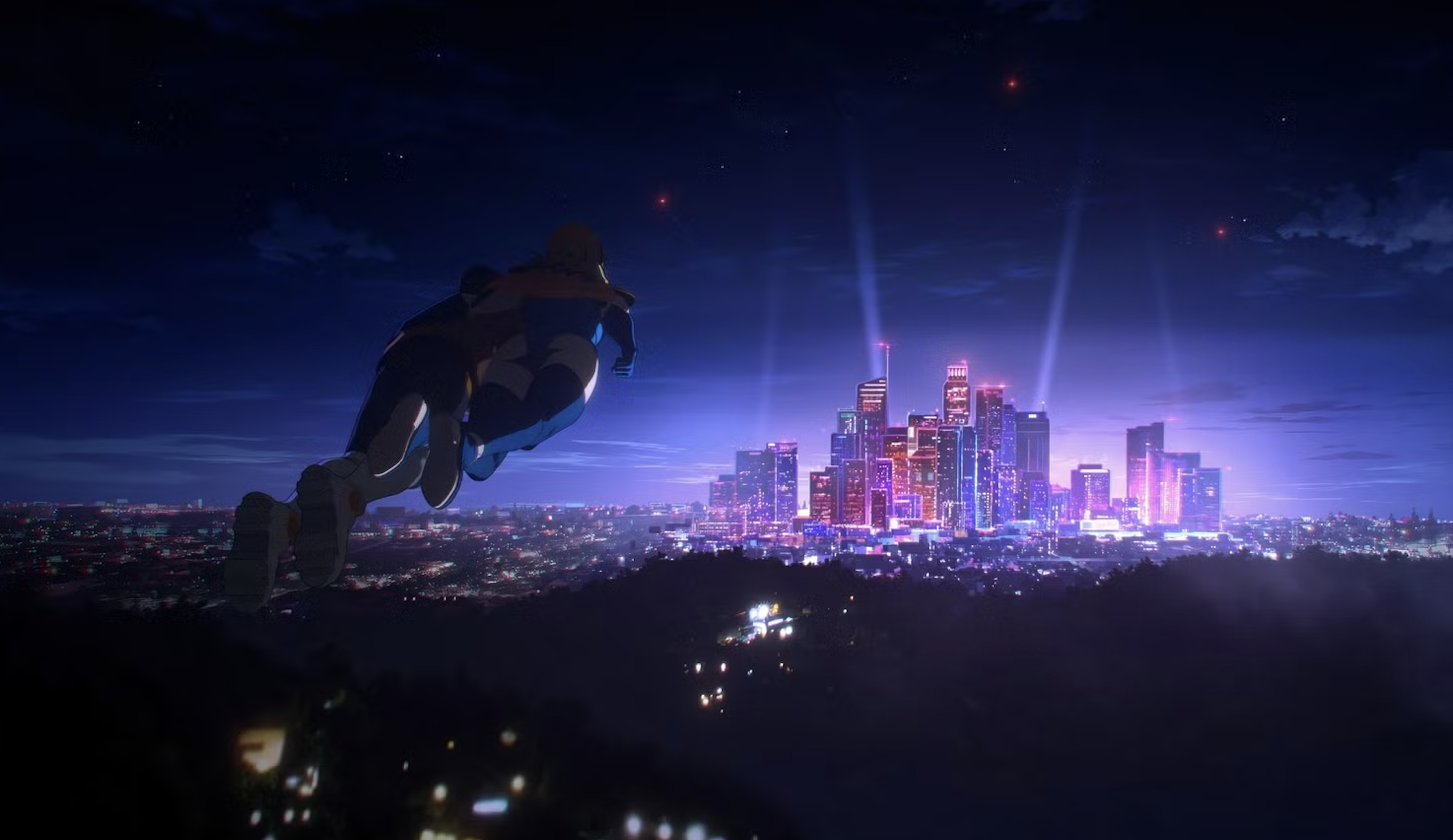
As the two sit on a billboard, she makes him an offer he can’t refuse: come and work for the Superhero Dispatch Network as a dispatcher (a 911 operator for superheroes) and SDN will repair his Mecha Man suit. What she doesn’t initially tell him is that he will be managing the Bad News Bears of superheroes - a group of former supervillains who were given second chances via the Phoenix program. His entire team is at rock bottom of the leaderboards. Much like Ted Lasso, his job will be to turn a team of I’s into a team of We’s.
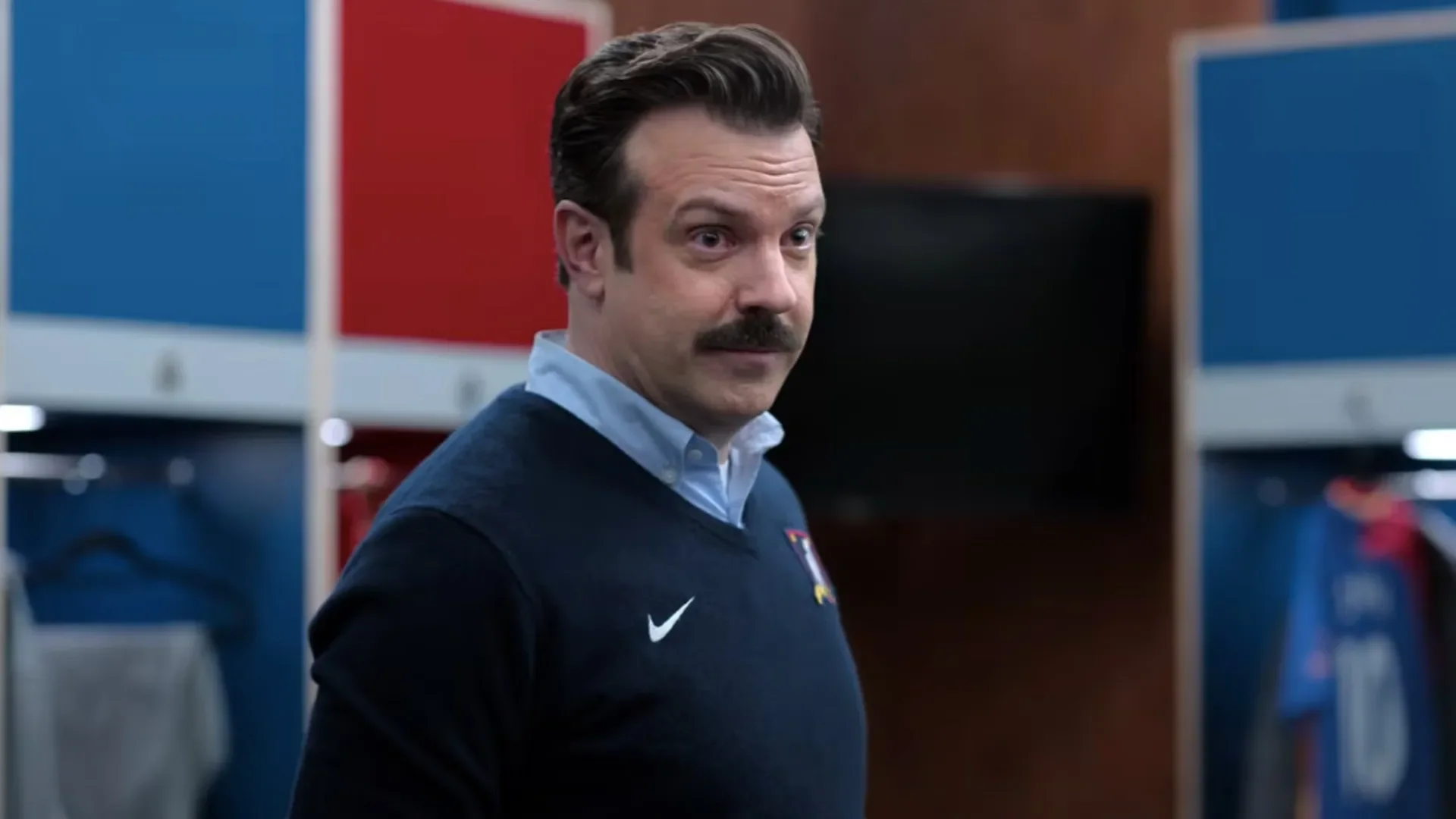
Ted Lasso will make you Believe, and so will Robert Robertson by the end of Dispatch
What ensues are eight episodes following Robert on his hero’s journey to get his supersuit back. Along the way he will unite his team, possibly find romance, and in the end confront the supervillain Shroud. The middle of each episode is filled with dispatching, which is a fairly easy mini game where calls come in and you choose the best hero for the job. There’s some crew resource management since heroes may be tied up with other calls and if you send too many to ensure success you may not have anyone left. Some calls and cutscenes require you to hack systems. The hacking mini game is fun and intuitive, solving easy logic puzzles as you move through nodes with the arrow keys.
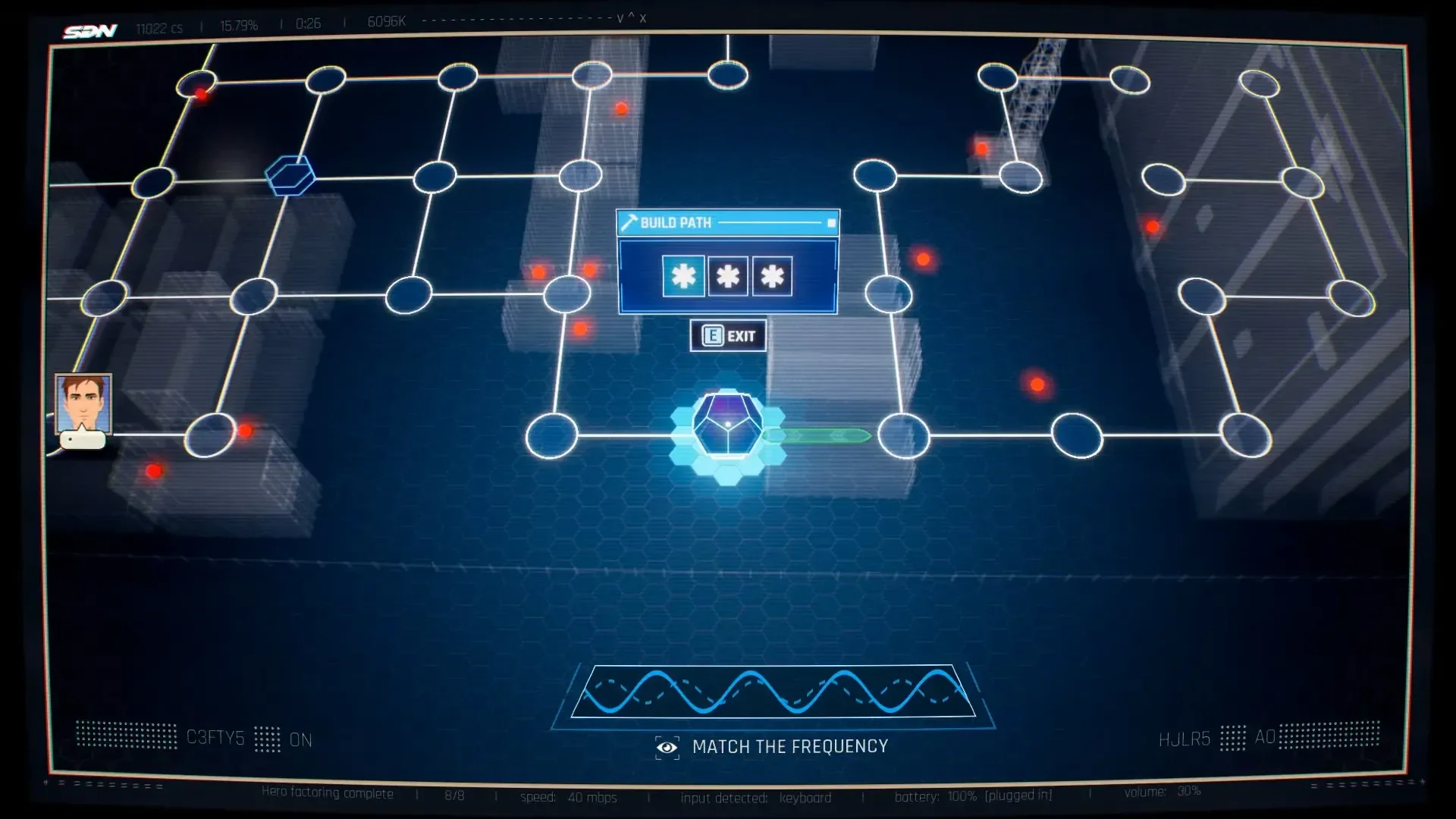
The meat of the game is the interactive cut scenes, however, where you are given choices at junctures.
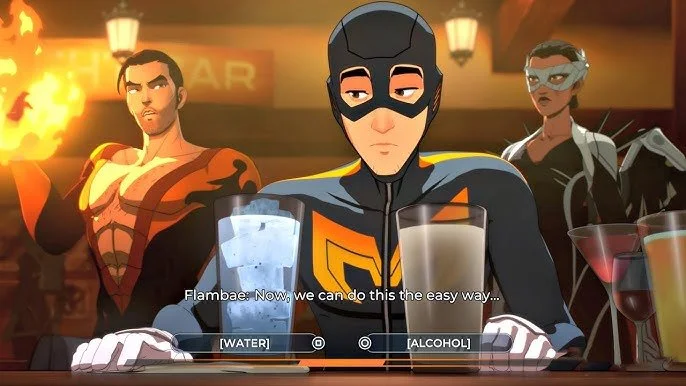
Occasionally there are quick time events that require you to click or move the mouse a certain way at key moments. Unfortunately neither the dispatching nor the hacking nor the QTEs affect the outcome of anything other than achievements. You can fail every dispatch and hack and the plot continues on the same.
The story is exceptional. The characters, writing, dialogue, and voice acting are all S-tier, with Robert voiced by Breaking Bad’s Aaron Paul. You really become attached to the characters. The humor is pervasive and well done, and you look forward to the clever quips. The writing is so good that there is a mid-series scene where a key character sacrifices themselves in a truly heroic way that literally brought a tear to me eye. Here I am, watching a superhero cartoon, getting choked up. When you do make choices in the game, the writing always makes you feel like it was the right choice. For example, at one point you must choose whether to reveal you are Mecha Man to your team. If you chose no, Robert gives an inspirational speech about it not mattering who we were, but it’s about who we are now. If you chose yes, your team defends you when one of them becomes enraged. Both options show your team coming around to viewing you as one of them.
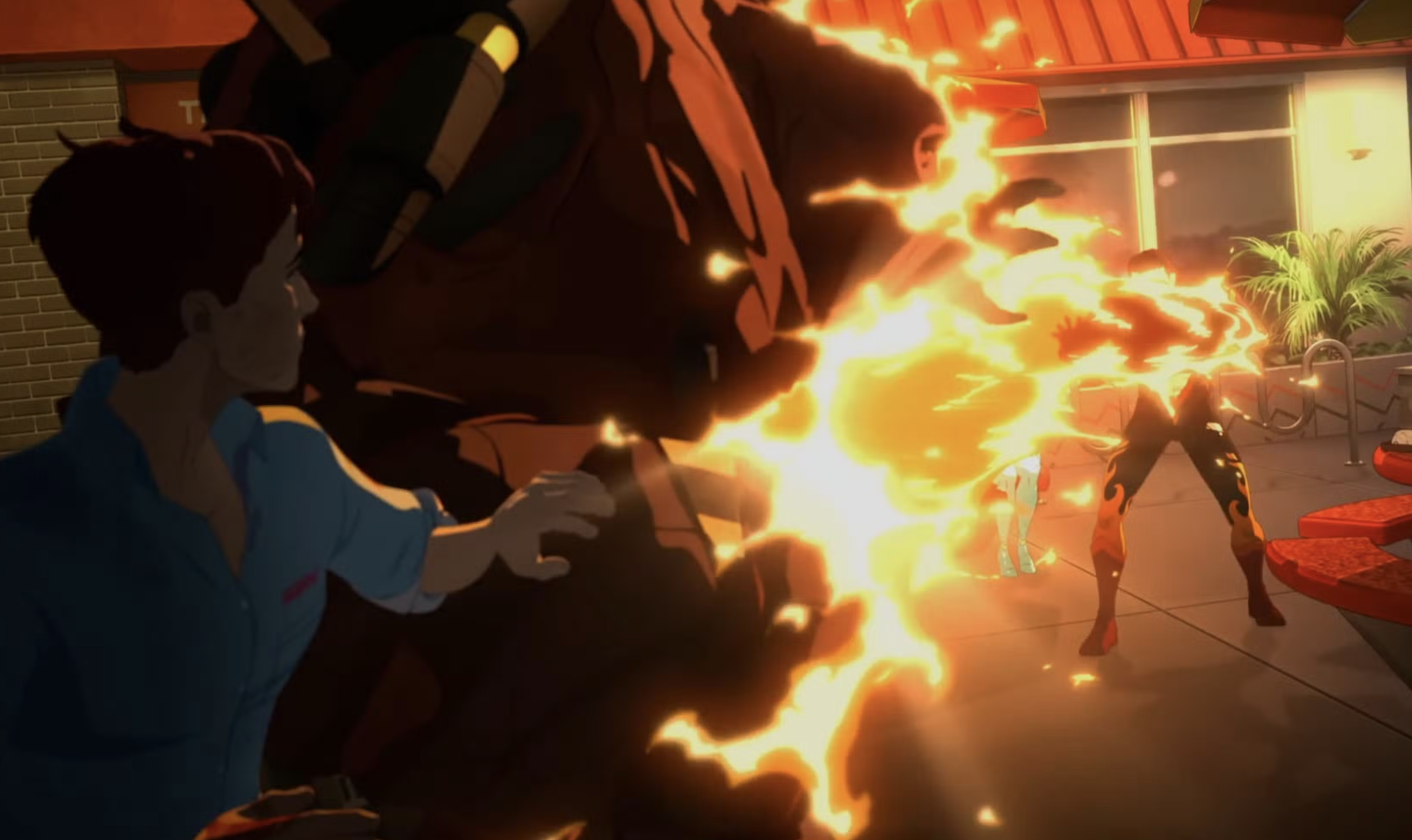
The downside is that both options show your team coming around. The only real consequence is that the enraged team member sits out the next dispatch. Your team ends up finding out anyway when another character outs you. This is the main weakness with Dispatch. Like Telltale games, all choices often result in the same outcome, just with slight differences in dialogue. There is no way to fail Dispatch. You can’t lose the game, you will always get to the confrontation with Shroud at the end, and your choices only really affect a few things:
Your romance choice
Whether a key team member redeems themselves
Some minor ending variations about which villains go to jail
Your post-credit achievement as Hero, Everyman, or Anti-Hero, reflecting if you took good, neutral, or bad options
Where the choices have the most impact is what cut scenes or dialogue you may see. So, choices are mainly about the game experience. Romancing Blonde Blazer doesn’t change anything in the game, but it does give you a truly epic dinner date kiss scene with eighties synth music raging, which was one of the most memorable scenes in the game for me.
That being said, I absolutely loved Dispatch. For all eight episodes, I had a goofy smile as I played. At the end, I hoped it would be an actual tv series (and I still hope there will be a Dispatch season two). Even though the illusion of choice was high, it never felt like that, and I always felt like I was in Robert’s shoes picking the path forward. The final episode delivered on the setup with an epic battle that was simply perfect.
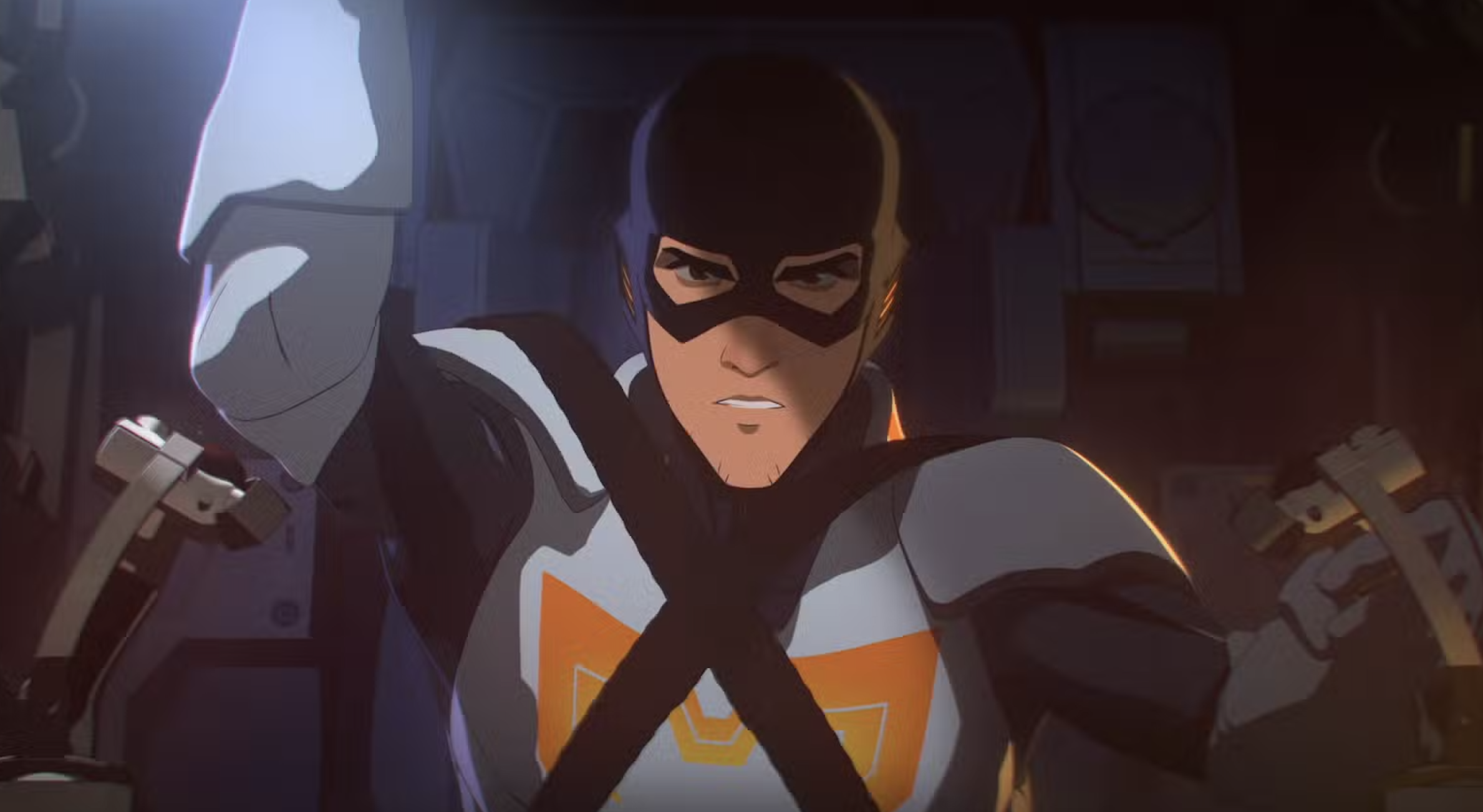
I should note that Dispatch is a very solid R-rated game, much like watching the Boys or Watchmen. Profanity and sexual innuendo is pervasive and a few episodes have both male and female nudity. The very first episode has a male villain who is completely naked, Dr. Manhattan style, who has a prolonged fight with Mecha Man. There is an option to beep profanity and censor (with black rectangles) nudity, but even with it on there are still lower-tiered uncensored swear words and relentless sexual talk. As an adult this doesn’t bother me, but if you’re planning on playing the game with or getting it for a child, keep in mind that even the censored version has graphic sex talk.

Superhero wardrobe malfunction, with the game’s nudity censor turned on, which puts black boxes over images
So, if you’re an adult (or at least a 16+ teenager) who loves story-driven games, I highly recommend Dispatch.
Hollywood Route Flight Plan
Fly virtually with me on my YouTube channel then come here for the flight brief (or do it the other way around!)
In my most recent Microsoft Flight Simulator 2024 video, I departed Burbank in a Piper Tomahawk, flew past the Hollywood sign, and navigated to KCCB Cable. Check out the video if you haven’t seen it.
FOR FLIGHT SIMULATOR USE ONLY. NOT FOR REAL WORLD INSTRUCTION
Our flight plan relies on easy-to-see visual waypoints, most of which are called out as VFR reporting points on the sectional (VFR reporting points have a flag icon next to them. They’re usually landmarks and if you tell ATC you’re near one, they’ll know where you’re at). We do have some airspaces to contend with, including the LA Bravo that we’d like to avoid, but a little carefully planning will let us fly over or around them. Because we’re flying east, I’ve selected our cruise altitude to be 3,500 MSL (when flying VFR easterly greater than 3000 feet above ground, pilots should chose an odd altitude in thousands plus 500 feet).
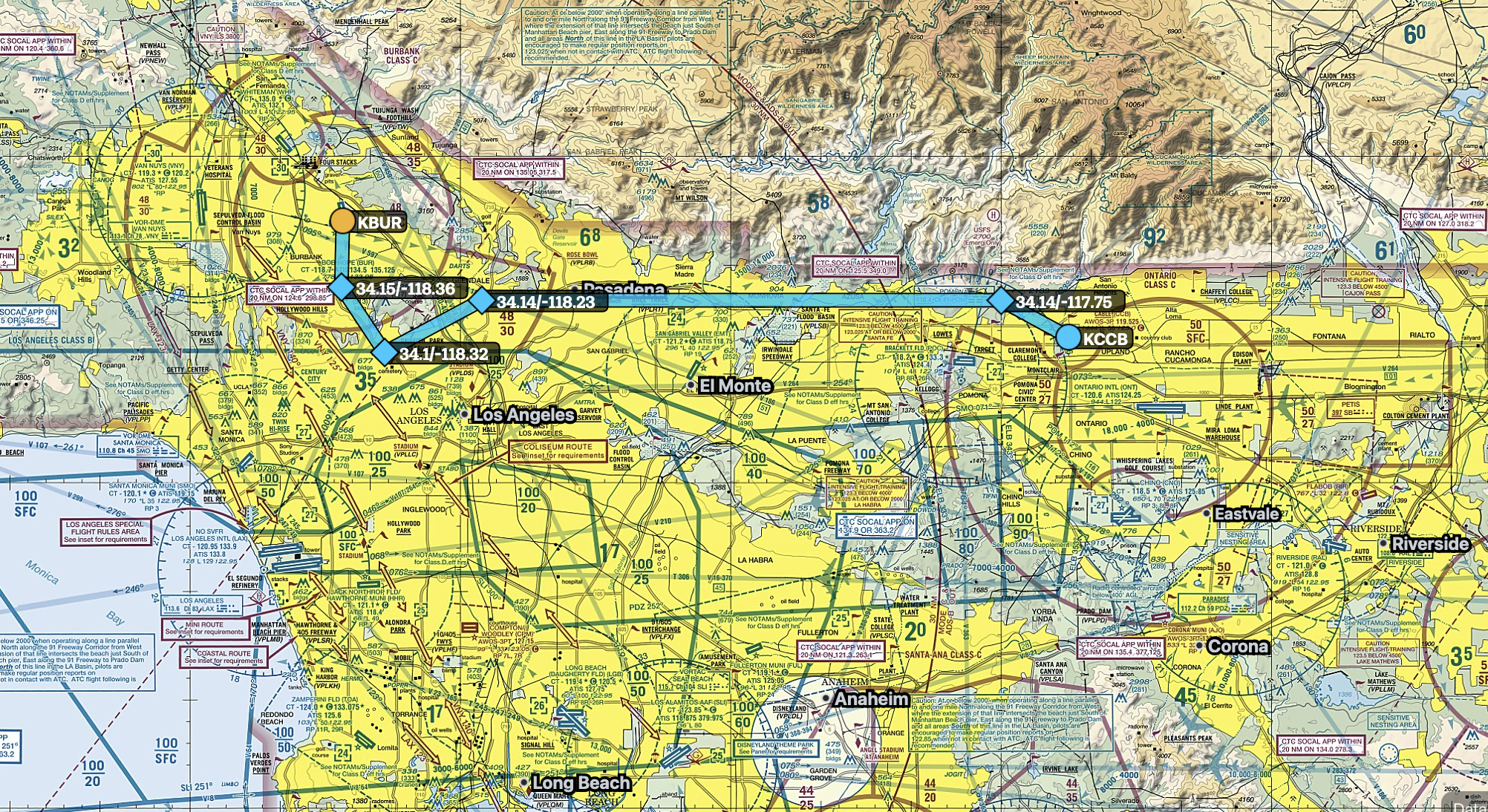
We’ll be departing from KBUR Burbank’s Class Charlie, remaining north of the LA Class Bravo, flying above the Class D airspace of San Gabriel and Brackett Field, and skirting north of KONT Ontario’s Class Charlie to arrive at KCCB Cable, a non-towered field
On the ground at Burbank, we’ll pick up flight following because it’s a busy airspace and it’ll be nice to have help from ATC. Burbank is a Class Charlie so the sequence of ATC calls will be:
Tune in the ATIS to get the current weather information
Call Burbank Clearance Delivery and request flight following to KCCB at 3,500 feet
Call Burbank Ground and request taxi for a south departure
Call Burbank Tower when holding short of the runway and request take off clearance
Call SOCAL Departure when tower hands us off to them to continue flying through the approach ring of Burbank’s Class Charlie, and then to continue with flight following
Switch to KCCB CTAF when SOCAL tells us
Self-announce position calls on KCCB CTAF until we’ve landed and taxied to the ramp
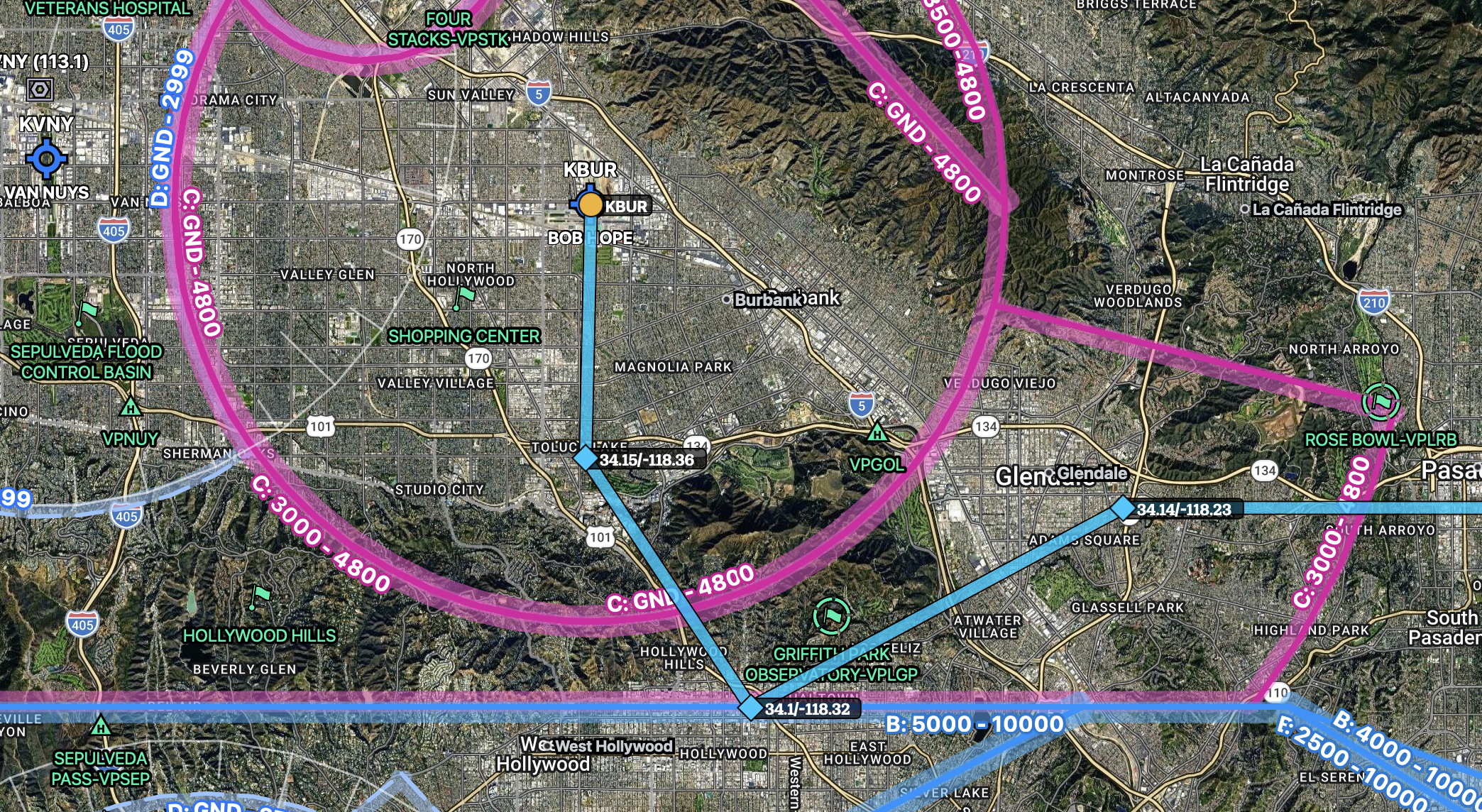
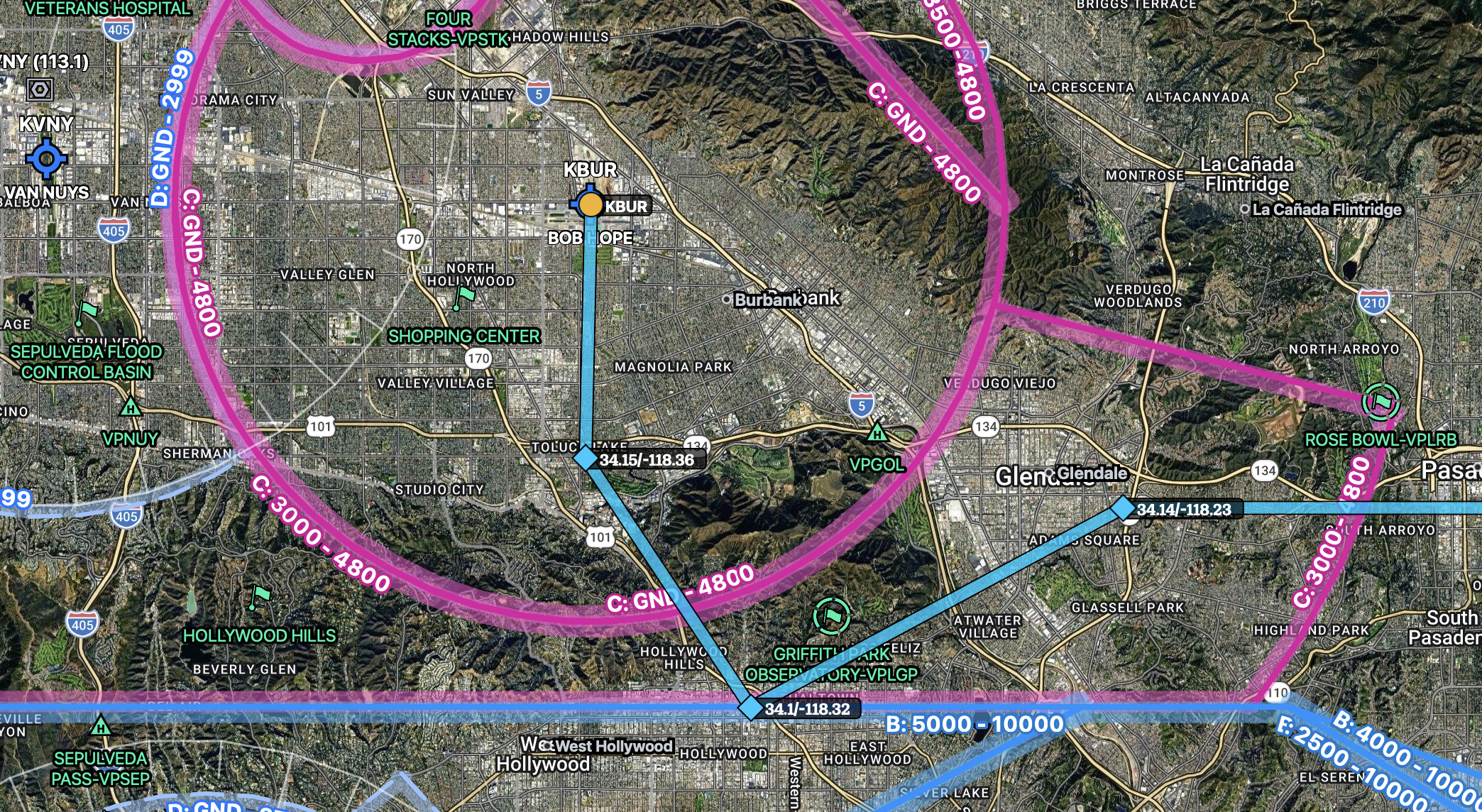
On departure we’ll fly south until we intercept Highway 101. You can see it drawn on the sectional southwest of Burbank. We’ll follow Highway 101 through the Hollywood mountain pass, looking to our left to see the famous Hollywood sign.

In Foreflight, I like to switch to satellite view when picking out visual waypoints. If you do that for the Hollywood mountain pass, you can see Highway 101 and also our next visual waypoint, Griffith Observatory, which is a VFR reporting point We’ll turn east when abeam Griffith and hug the mountain, keeping Griffith on our left. Just to our south, you can see the blue line of the LA Bravo with a starting height of 5,000 MSL. We’ll be cruising at 3,500, so this won’t be an issue, but as we proceed east the next Bravo shelf starts at 2,500. By hugging the mountain and staying north, we’ll avoid entering the 2,500 shelf. At 3,500 we’ll still be in KBUR Burbank’s Class Charlie, which is marked in magenta on the pic below, and we’ll exit it when we’re abeam the Rose Bowl.
Our next waypoint is Glendale, at the intersection of Route 2 and Route 134. This is a nice big x where the routes intersect and will be easy to spot. We’ll turn east and follow Route 134 until it merges with Interstate 210 East. Be sure to spot the Rose Bowl on our left, which as I mentioned marks the end of Burbank’s airspace. Our flight path continues east following Interstate 210 and we’ll overfly KEMT San Gabriel’s Class D airspace; however, its airspace only goes up to 2,400 MSL. We’ll be flying at 3,500 MSL and will not be in it.
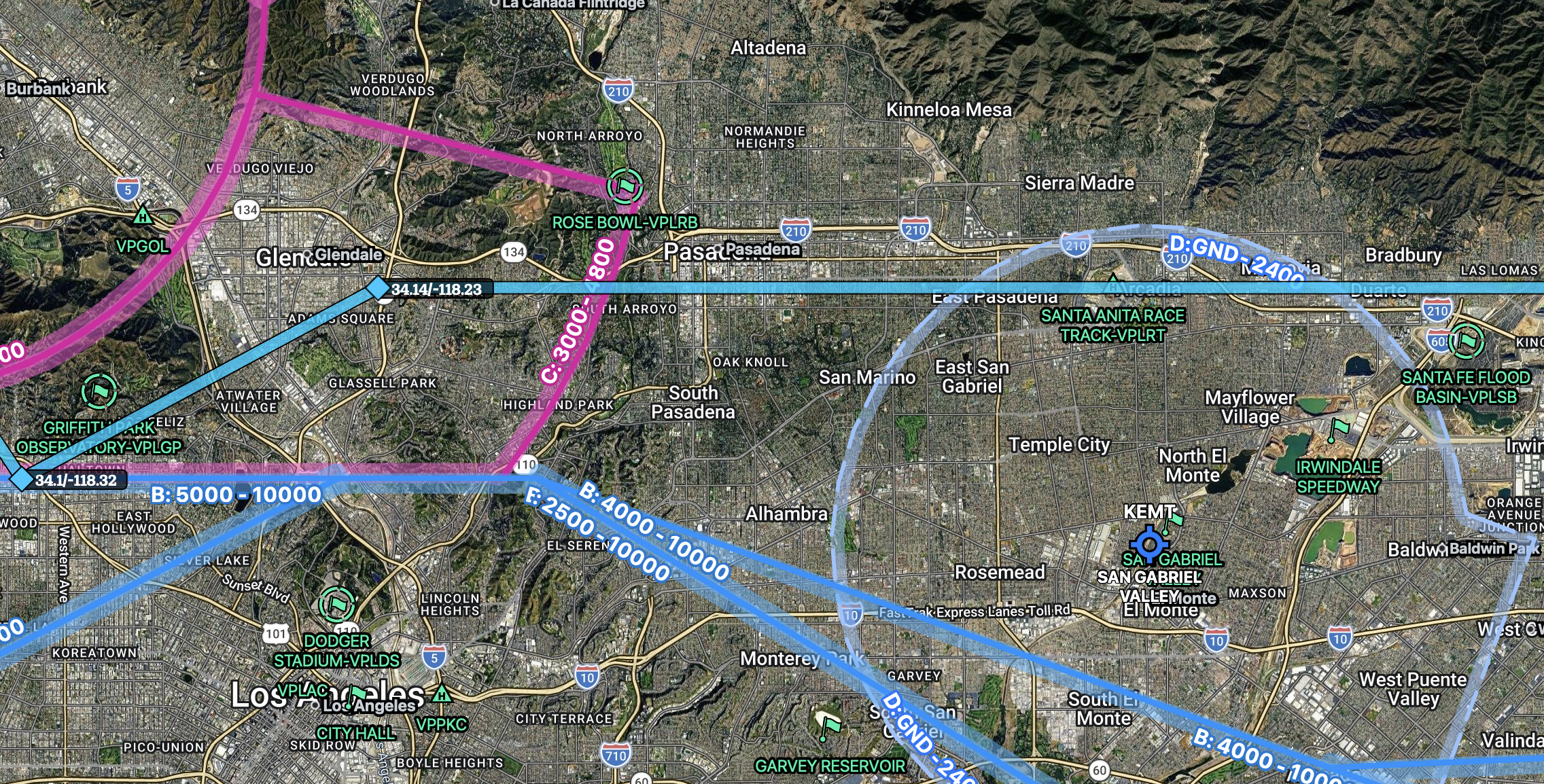
As we overfly San Gabriel, Santa Anita Racetrack is a nice visual waypoint on the northern end of its airspace. We’ll know exactly where we are when we see it.
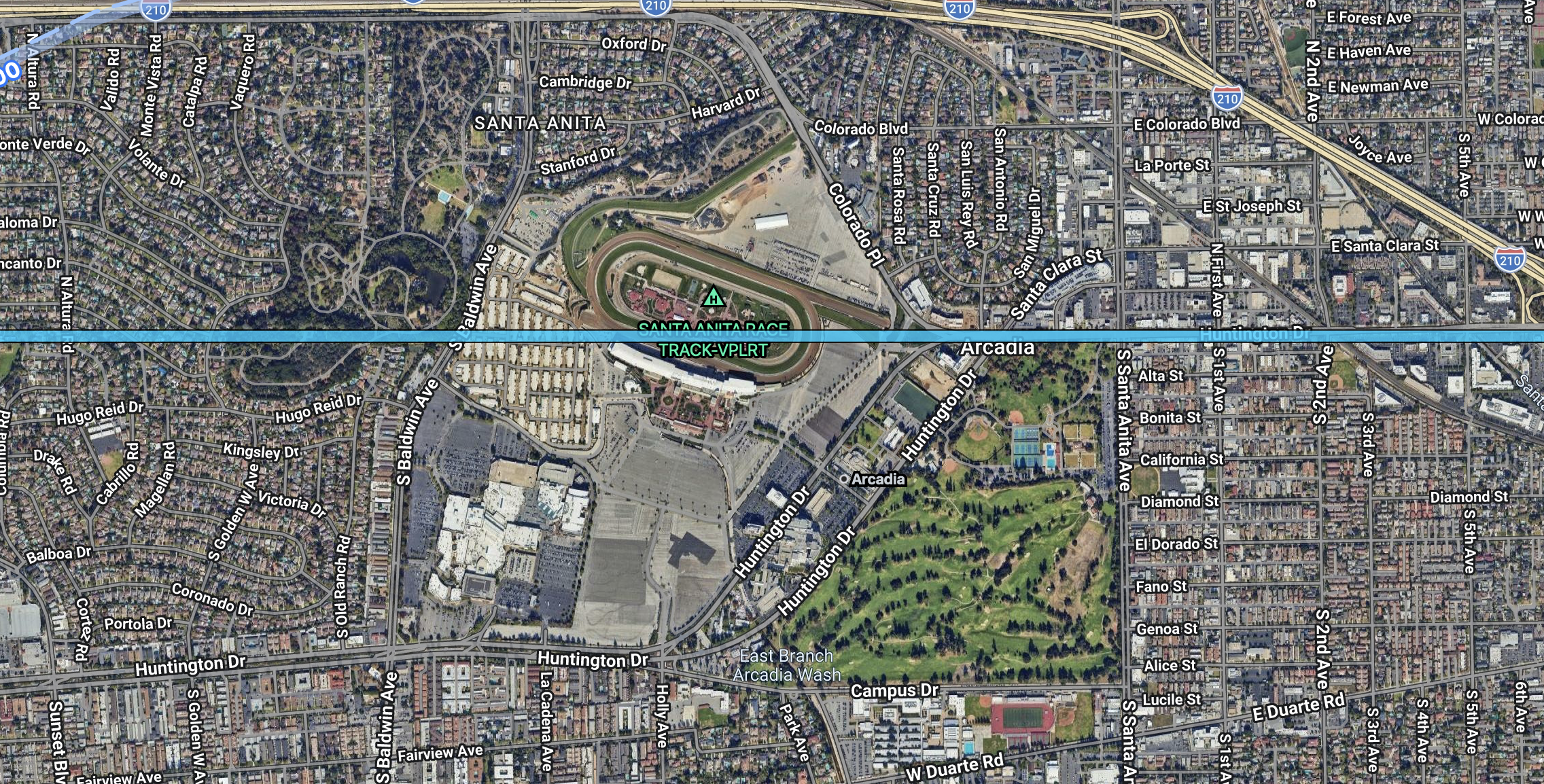
Our next visual waypoints are the Sante Fe Flood Basin and Irwindale Speedway, on the eastern side of San Gabriel’s airspace.
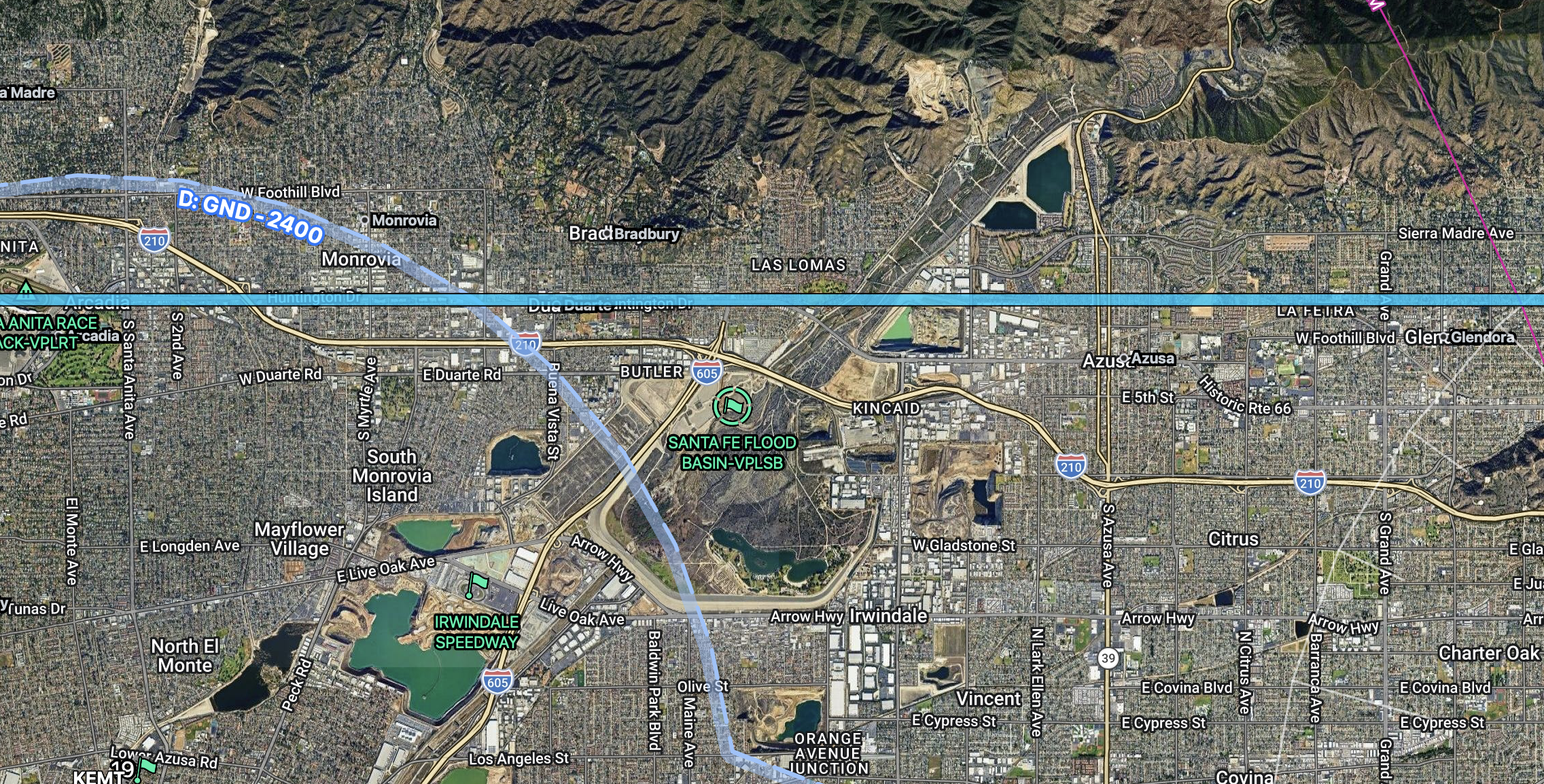
We’ll continue following Interstate 210 andl overfly KPOC Brackett Field’s Class D airspace, heading for the Live Oak Reservoir. By overflying the reservoir at 3,500 MSL, we’ll avoid KONT Ontario’s Class C, which is to the south of the reservoir. The Reservoir will be our cue to start our descent. Our plan is to approach KCCB Cable from the north.
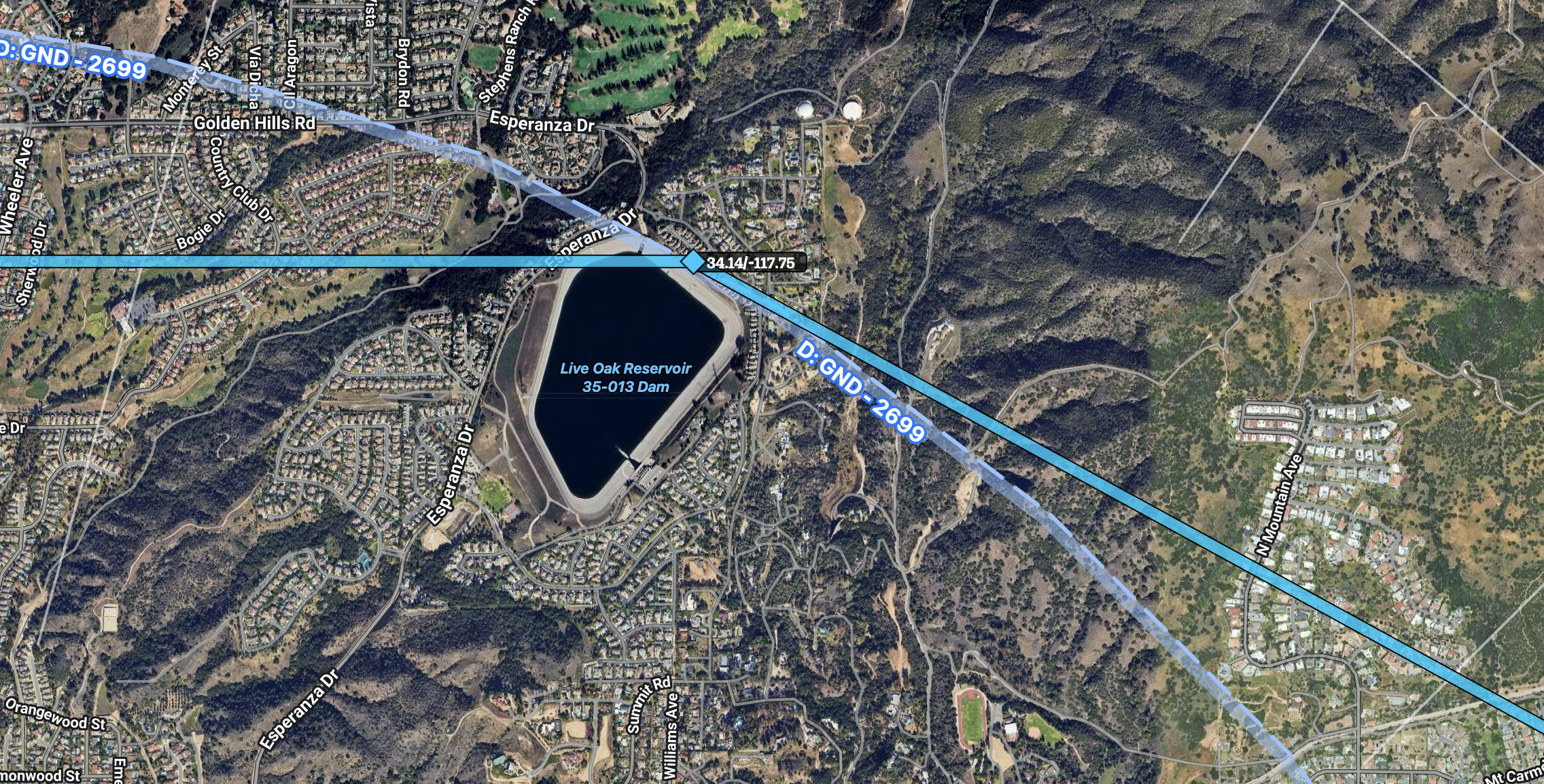
KCCB Cable has published pattern entry procedures for noise abatement. You can find them on KCCB’s website, but for our north arrival to runway 24 we should overfly the numbers of runway 6 and break left directly into the left downwind for runway 24. Coming in from the north lets us avoid overflying the residential areas by approaching over the unpopulated water treatment areas.
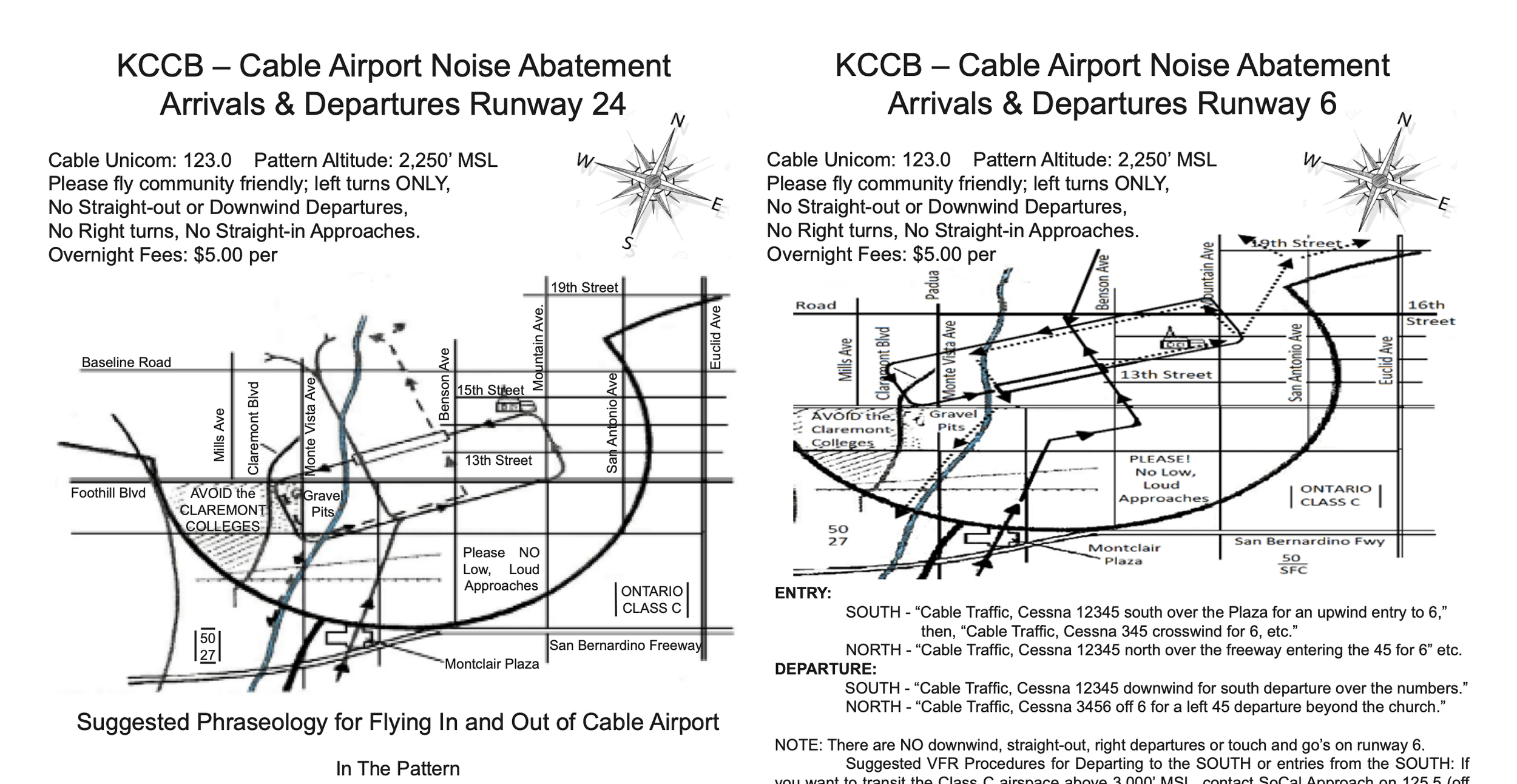

North approach to Cable from the top center of the map avoids all the houses
KCCB is non-towered, so we’ll need to make CTAF calls self-announcing our position. The CTAF frequency is the 123.0 number next to the C that looks like a copyright symbol that’s listed in the magenta airport text to the right of KCCB below.
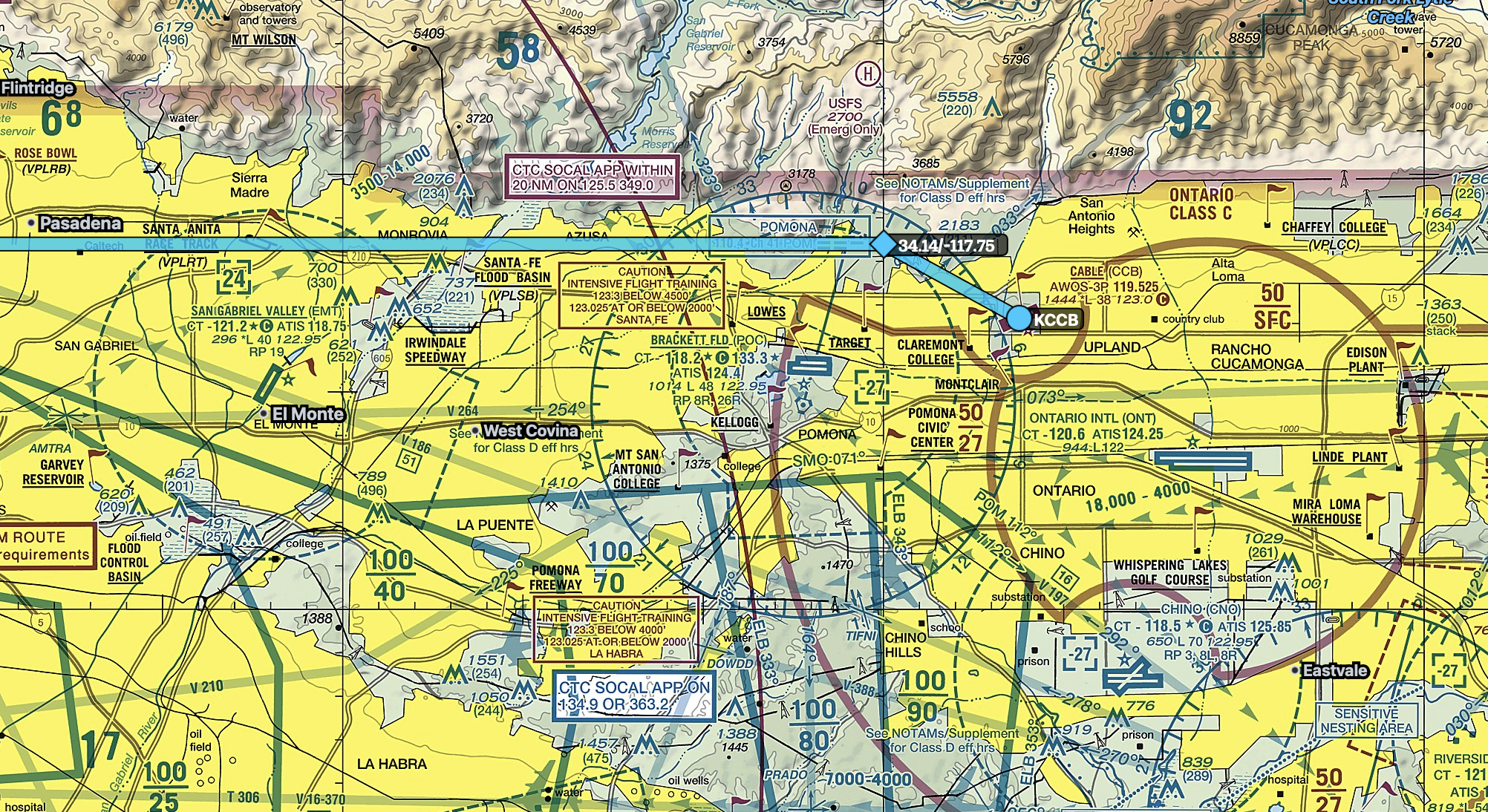
That’s it! Short and scenic. Give it a try - it’s great fun. For bonus points, hand fly it using visual references only.
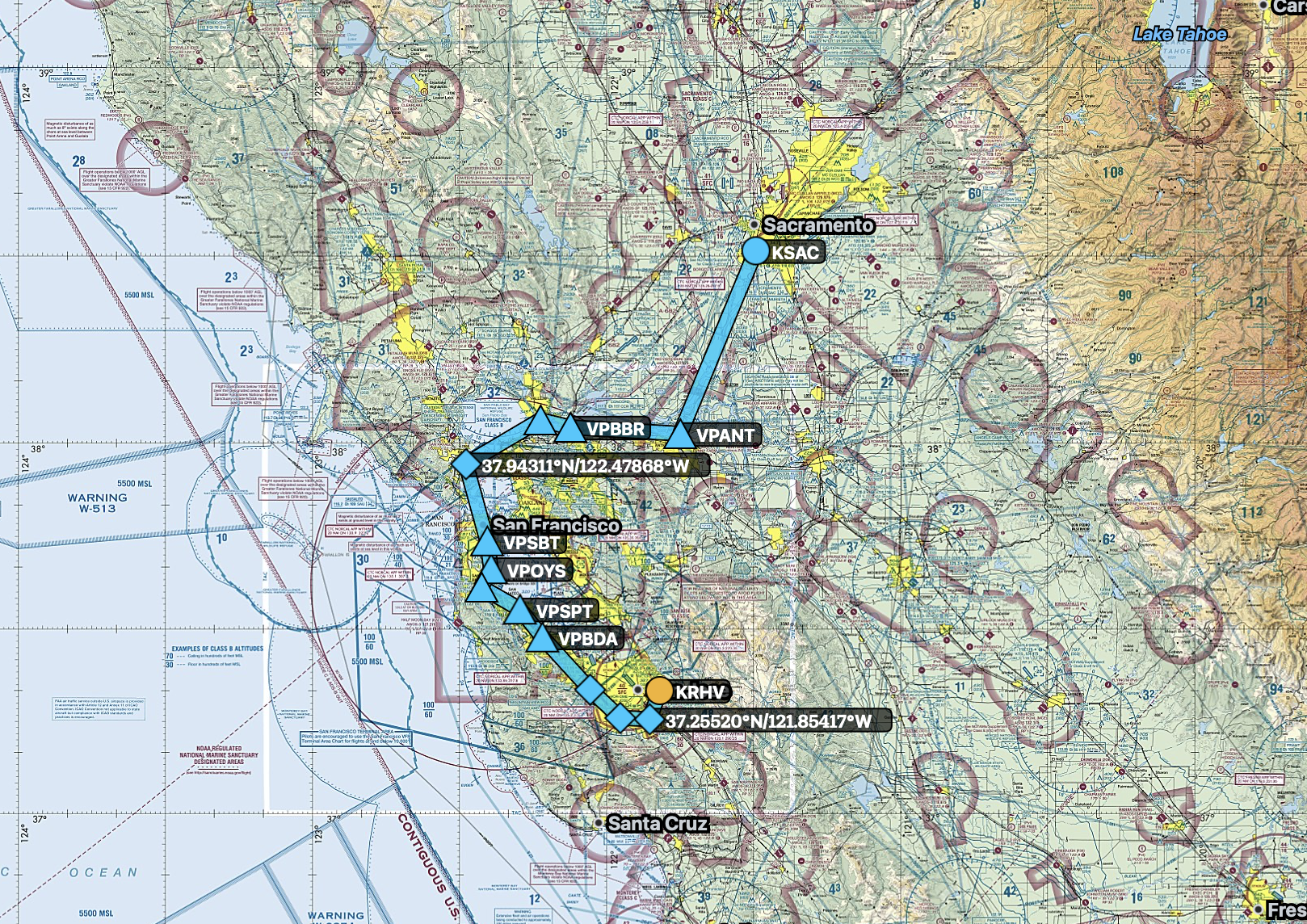
Bay Shore Route Break Down
Watch my latest Microsoft Flight Simulator 2024 video and then do a deep dive on how the complex airspaces work in its flight plan
In my latest Microsoft Flight Simulator 2024 video, I navigated the Baron B58TC through the complex San Francisco airspace via the Bay Shore route. I breezed through the flight plan in the video because it would have taken all the time to explain the different airspaces. The nice thing about a blog post is that it does have all the time, so if you’re a flight simmer who’s curious what the route was and how to read the airspaces, this is for you.
I know I shouldn’t need to say this, but if you’re a real pilot looking for a primer on flying the real life Bay Shore route, this post isn’t for you. This flight plan was created to showcase the recent City Update 13 photogrammetry improvements in Microsoft Flight Simulator 2024.
NOT FOR REAL LIFE FLIGHT INSTRUCTION. FOR SIMULATOR USE ONLY
The flight plan:
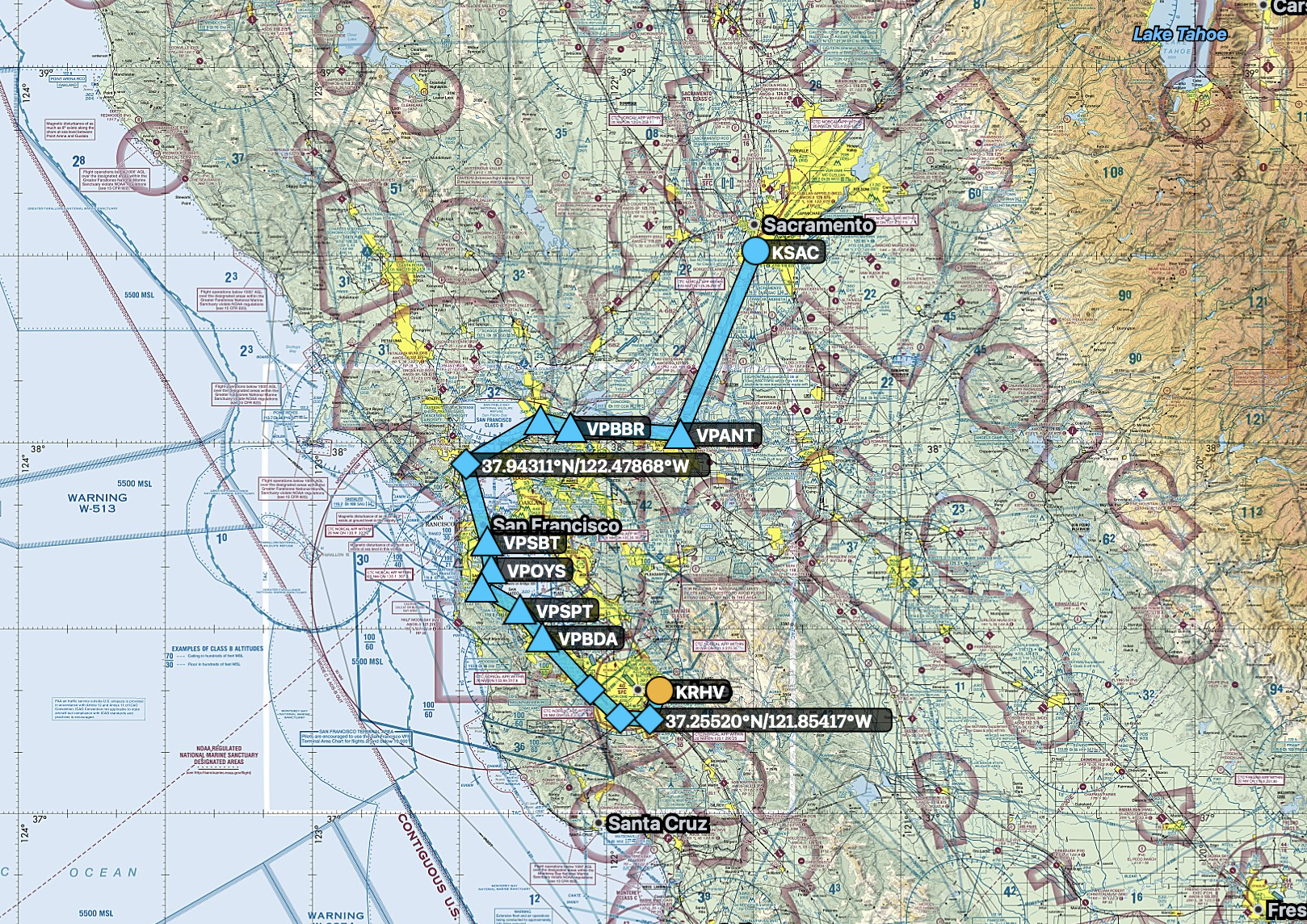
You can see we could just fly direct from KRHV to KSAC and avoid everything, but we’d miss out on the great views
A few primers:
Class D airspace is shown by a dashed blue line. The airspace starts at the ground and extends up to the blue number indicated in the bracketed box, in hundreds of feet
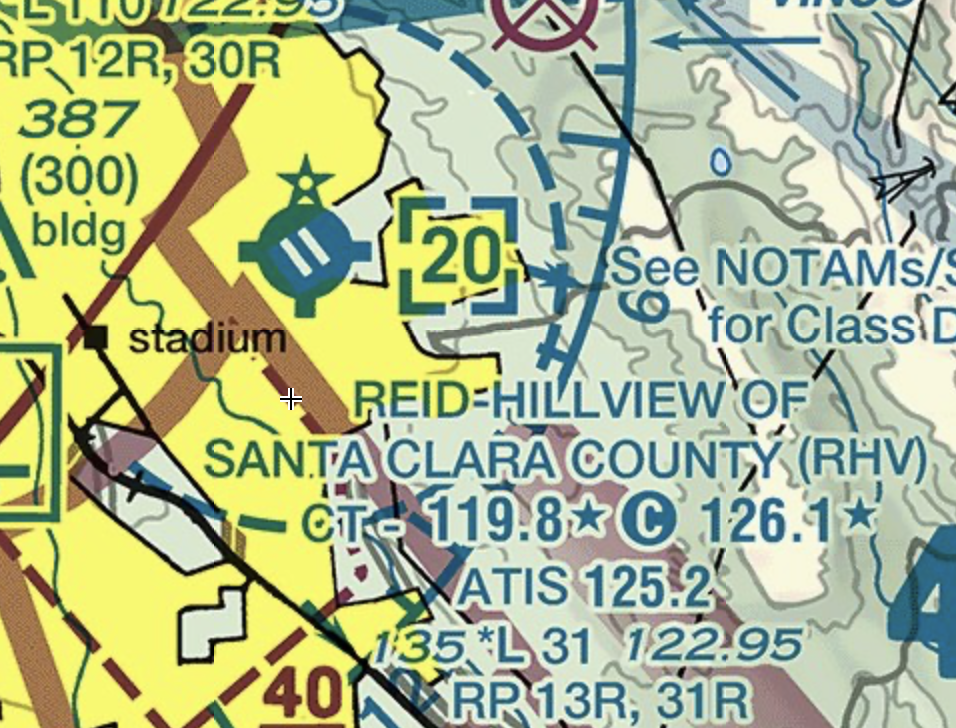
Our departing field, RHV Reid-Hillview, is in Class D airspace indicated by the dashed blue semi-circle. The 20 in the blue box brackets indicates the airspace extends from the surface to 2,000 feet
Class C airspace is shown by a solid magenta line. It usually has an inner and an outer ring, and the outer ring may be subdivided into segments. Each segment or ring has its own beginning and ending altitude, indicated by a magenta fraction. The fraction is the starting altitude and ending altitude in hundreds of feet represented by the bottom and the top number.
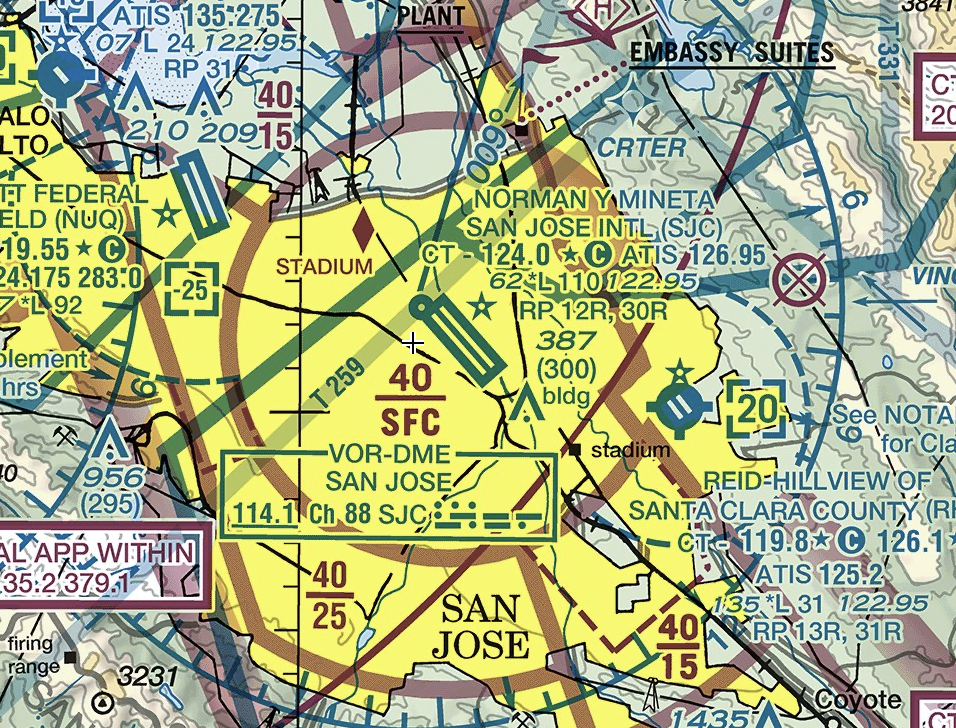
San Jose’s Class C airspace has an inner tower ring (40/SFC) which indicates it starts at the surface and goes up to 4,000 feet. The outer Approach ring has several segments, each having their own starting and ending altitude, such as 40/15 to indicate start at 1,500 feet and end at 4,000 feet
Class B airspace is shown in solid blue lines. Like Class C, it has an inner tower surface area and multiple Approach segments that list their starting and ending altitudes as a blue fraction. Unlike the other airspaces, you explicitly need a clearance to enter Class B airspace.
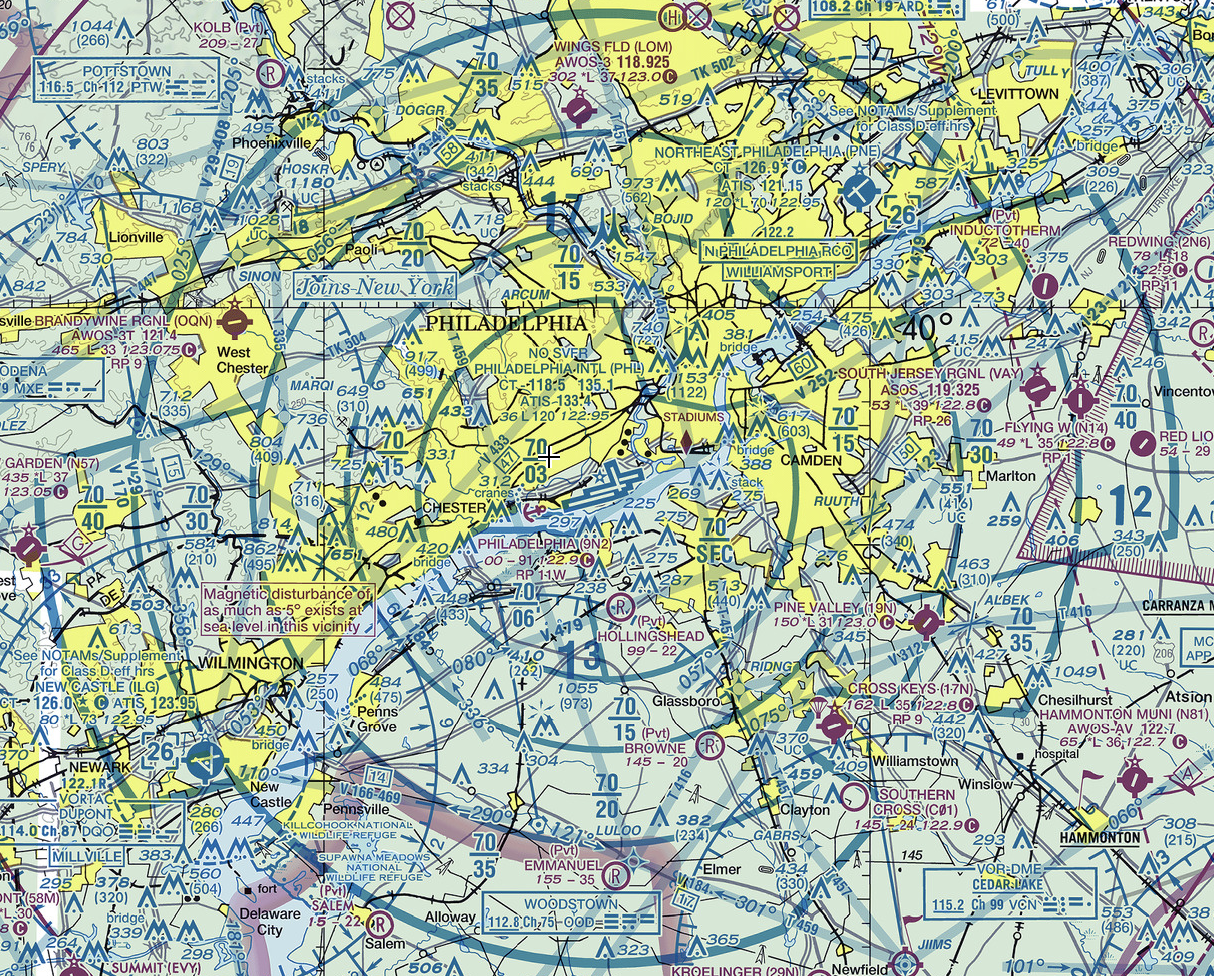
Here I’ve used Philadelphia’s Class B as an example because it’s easier to read. It’s a series of rings, each broken into segments, with each segment having its own blue fraction listed.
Class E airspace, or “everywhere airspace”, is what most of the sky is made of, usually starting at 1,200 feet above ground and extending up to 18,000 above sea level. Think of it as the airspace between airports. Some people call it uncontrolled airspace, but that’s not true. What they really mean is that you don’t need to talk to ATC when flying VFR in it. It’s still controlled airspace, meaning ATC is available for things like IFR flight or flight following.
The only true uncontrolled airspace is Class G, where ATC is not available, usually because it’s too low for radar or it’s in an extremely remote area. In general (with a few exceptions), neither Class E nor Class G are drawn on sectionals. Instead, pilots know that (unless otherwise specified), Class G covers the first 1,200 feet of altitude, then Class E takes over and covers the rest up to 18,000 MSL. Once you get above 18,000 MSL, you’re in the realm of IFR only in Class A.
Fun Trivia: Class A ends at 60,000 MSL and then reverts back to Class E. If you could somehow get this high, you technically wouldn’t need to talk to ATC anymore.
KRHV Reid-Hillview is in Class D airspace that goes from the surface to 2,000 feet. It’s next to KSJC San Jose’s Class C airspace, which is shown with a solid magenta line. We want to depart KRHV and fly through the KSJC southern segments. The first segment starts at 1,500 feet and extends to 4,000 feet. Because of that, we’ll fly at 1,000 feet until ATC gives us permission to enter it. Once they do, we’ll climb to 2,500 feet.
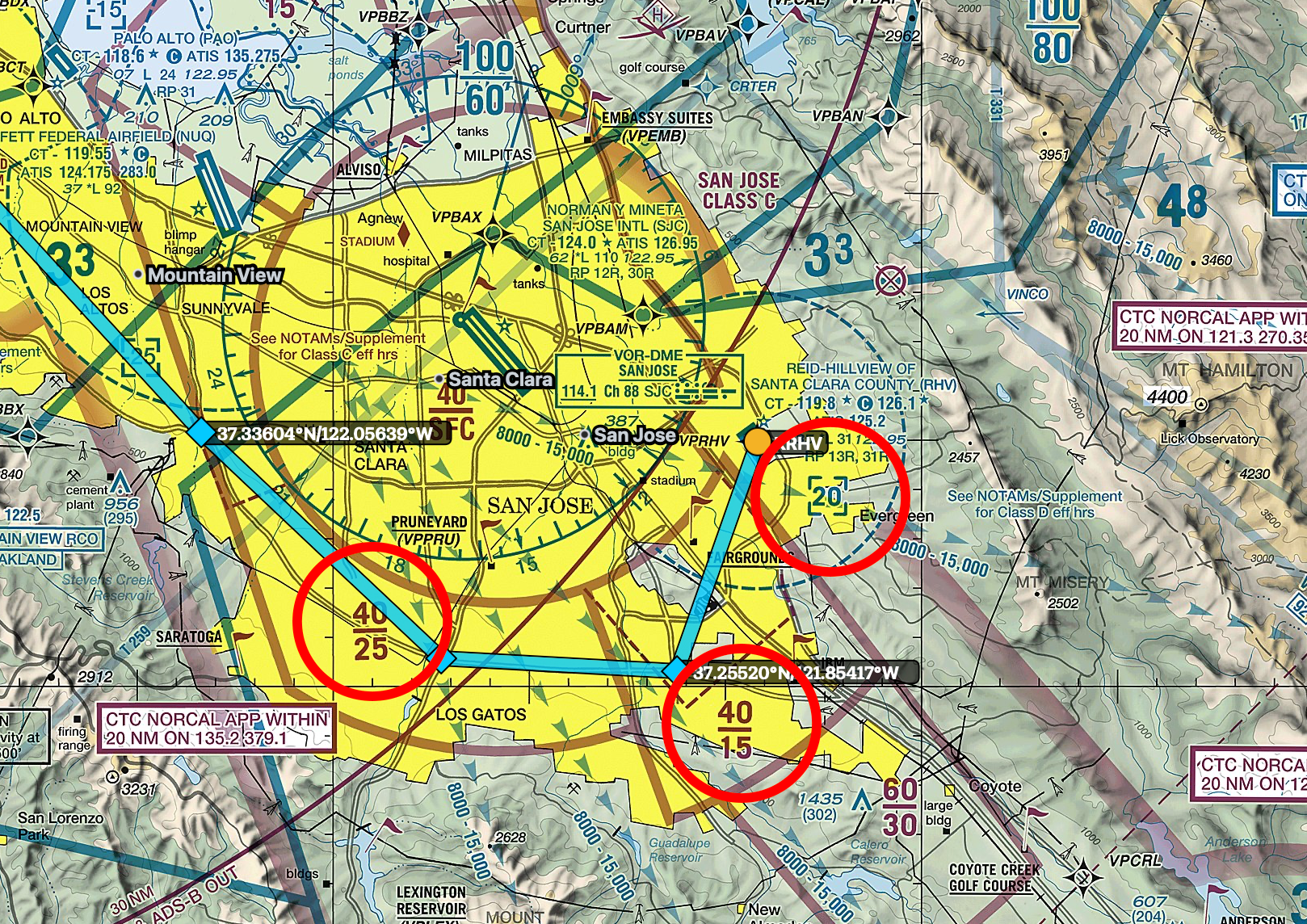
Solid magenta lines indicate KSJC San Jose’s Class C airspace. The dotted blue circle indicates KRHV’s Class D airspace. The fractions are top/bottom of airspace shelves in 100s, such as 40/25 = top of airspace at 4,000 feet and bottom at 2,500 feet.
Because we’re flying VFR, I’ve picked things I can easily see for waypoints, such as major road intersections. You can see the roads drawn on the sectional, above.
To the north of San Jose, the flight path passes under one of the solid blue lines indicating a KSFO Class Bravo shelf. The shelf numbers are the blue 100/60 north of KSJC, indicating the Bravo starts at 6,000 and goes up to 10,000 feet. We’re okay to fly under it at 2,500 feet and don’t need any special permissions.
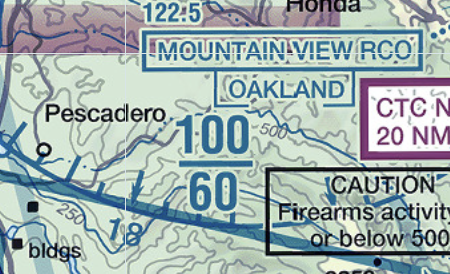
We’ll also pass over KNUQ Mofffet’s Class D airspace. It’s hard to see in the screenshot below, but their airspace is listed as “-25” in a blue bracket, which means it extends from surface up to but not including 2,500 feet. So we’re just barely above it flying at 2,500 feet.
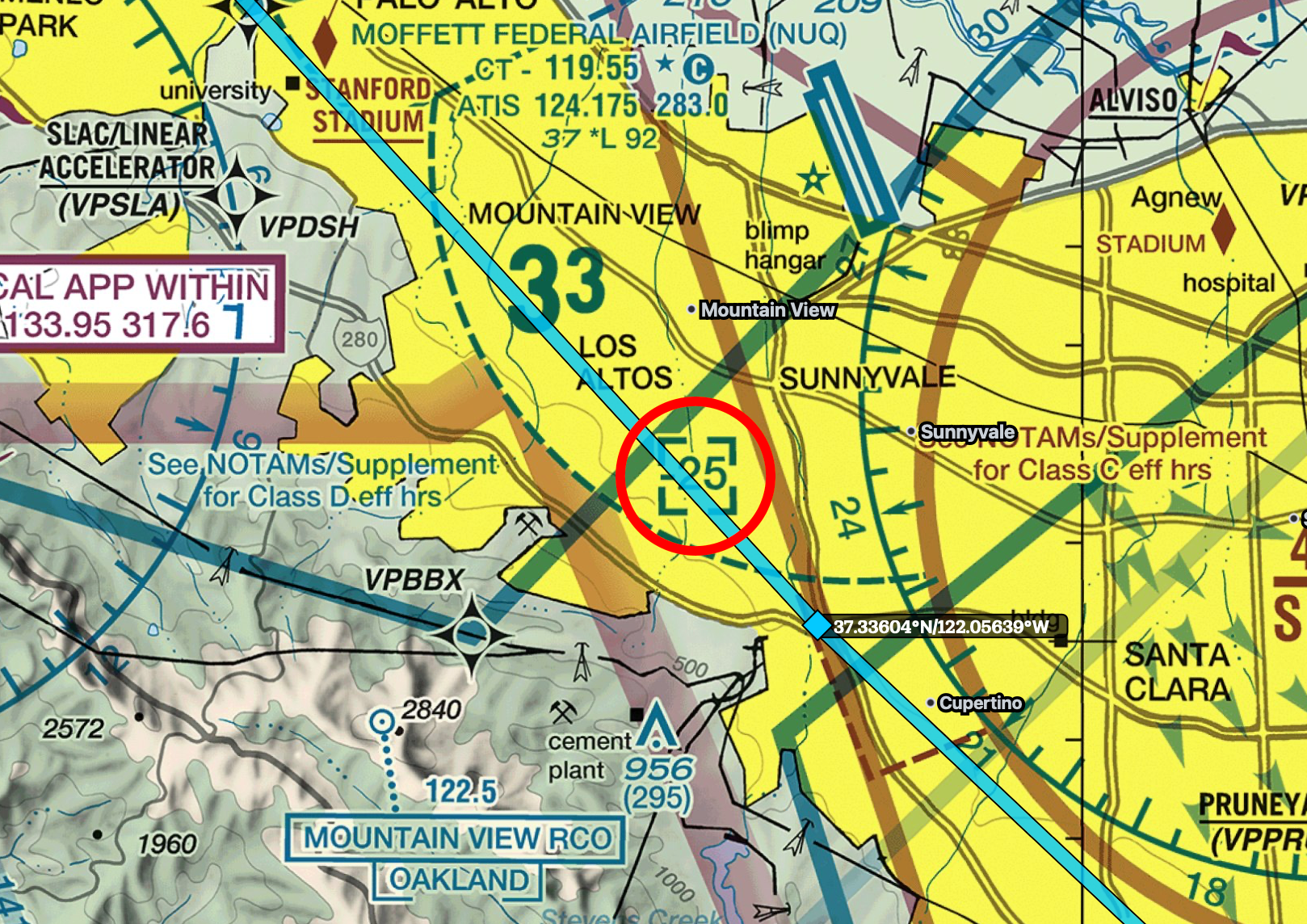
The bold blue 33 under Mountain View looks like a Bravo airspace altitude, but it’s something different. It’s the MEF (Maximum Elevation Figure) that lists the highest terrain or obstacle (in hundreds of feet) in this sectional tile. To clear the tallest thing in the tile, you must fly at least 3,300 feet. Note we’re flying at 2,500, which we can do but must be careful to review the terrain and obstruction elevations along our flight path.
We’ll continue northwest, overflying Stanford Stadium and heading to Highway 101. We’ll overfly Palo Alto and San Carlos Class Deltas, both extending from surface to 2,000 feet. Since we’re at 2,500, we don’t need to talk to them. The Bravo shelf we are under at this point starts at 3,000 feet, so we are still not in Bravo. Before reaching San Mateo, which is the start of the surface area of the Bravo, we will have requested a Bravo transition via Bay Shore Route and we need explicit clearance to enter the Bravo to proceed beyond San Mateo.
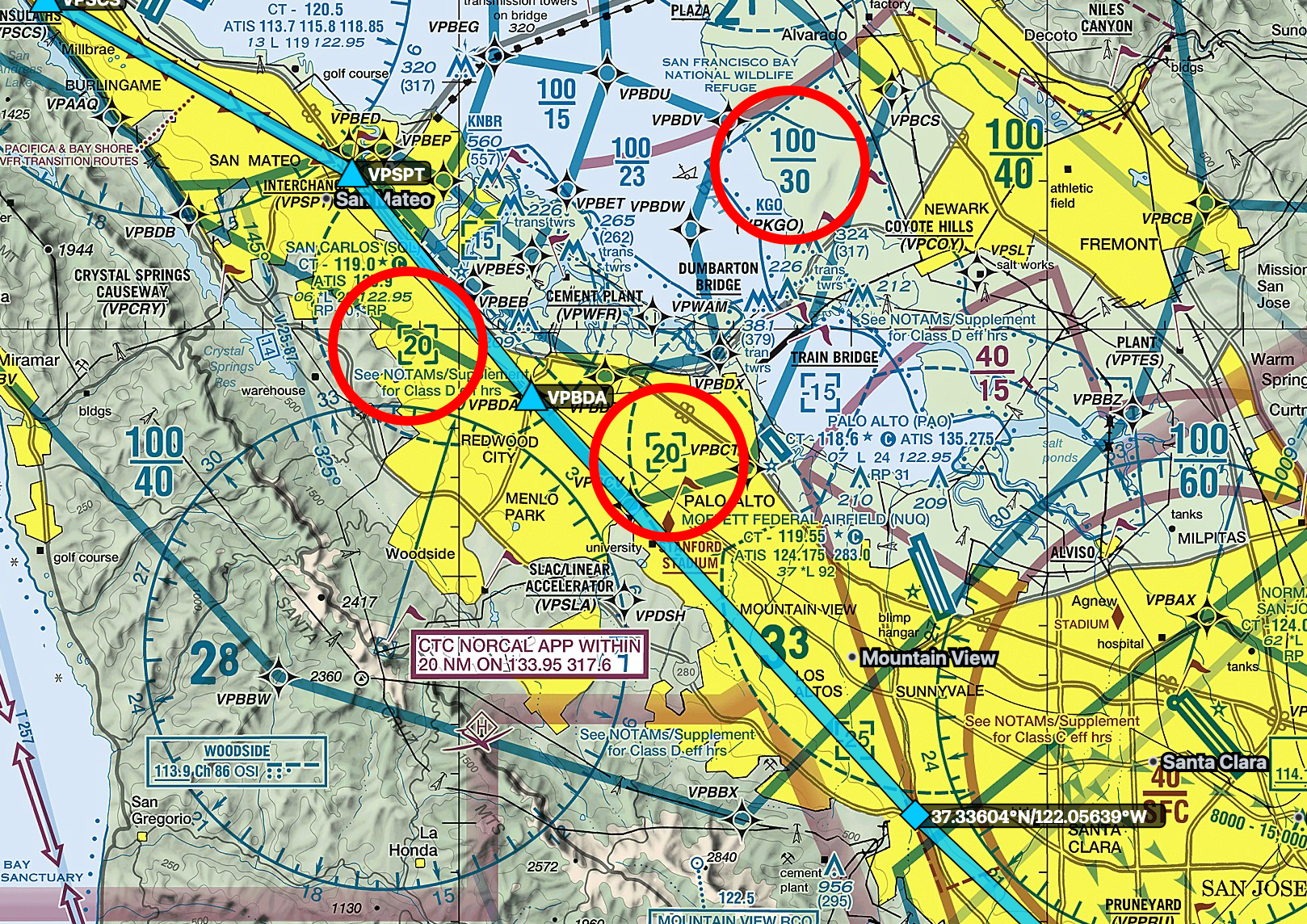
What to do if ATC says no? We’ll turn due west over the mountains and follow the western shore remaining clear of the Bravo. We’ll miss out on the KSFO flyby, but still get to see the Golden Gate Bridge and Saulsalito.
When ATC clears us for the Bay Shore transition, we’ll follow the red arrows marked on the VFR sectional. ATC will assign our altitude, and we’re expecting anywhere from 1,500 feet to 2,500 feet. We’ve chosen to stay at 2,500 feet in anticipation of the restriction. In the video, Say Intentions ATC gave me at or below 3,500, so I chose to remain at 2,500.
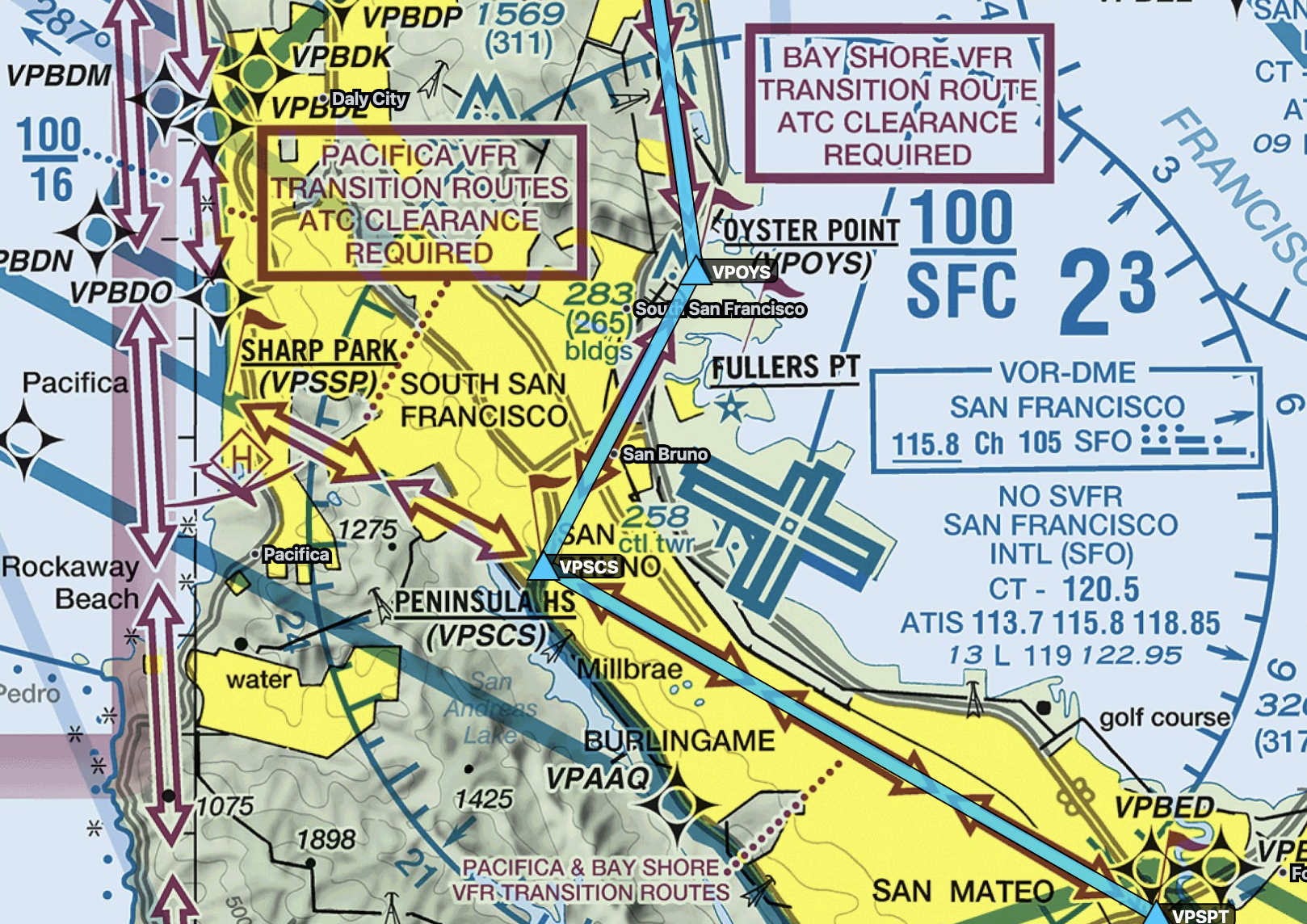
The red arrows are VFR Transition Routes. The red boxed texts indicates that you need ATC clearance to fly them. This isn’t always true. There are other Class Bravos in the US that have VFR transitions that do not require ATC clearance. It’s important to read the text and any insets.
On the north side of KSFO, the Bay Shore Route concludes at Farmer’s Market. The Bravo shelf here is 2,100, increasing to 3,000 as we head north. Although it appears that we’re in the Oakland Class Charlie airspace based on the magenta T/15, this indicates the bottom of Oakland starts at 1,500 feet and ends at the start of the KSFO Class Bravo, wherever that may be. It’s written like that because there are two Bravo shelves overlaying this one Charlie segment, and each Bravo shelf has a different starting altitude.. It is worth noting that with us flying at 2,500, there is a short span after Farmer’s Market where the first 2,100 foot Bravo shelf ends and becomes the second 3,000 foot Bravo shelf. At that point, with us flying at 2,500 feet we have exited the Bravo and we are in the Oakland Charlie airspace that starts at 1,500 feet. Both Oakland and San Francisco use NORCAL Approach, so I’d guess the Approach controller would give me instructions, since they are the controlling authority.
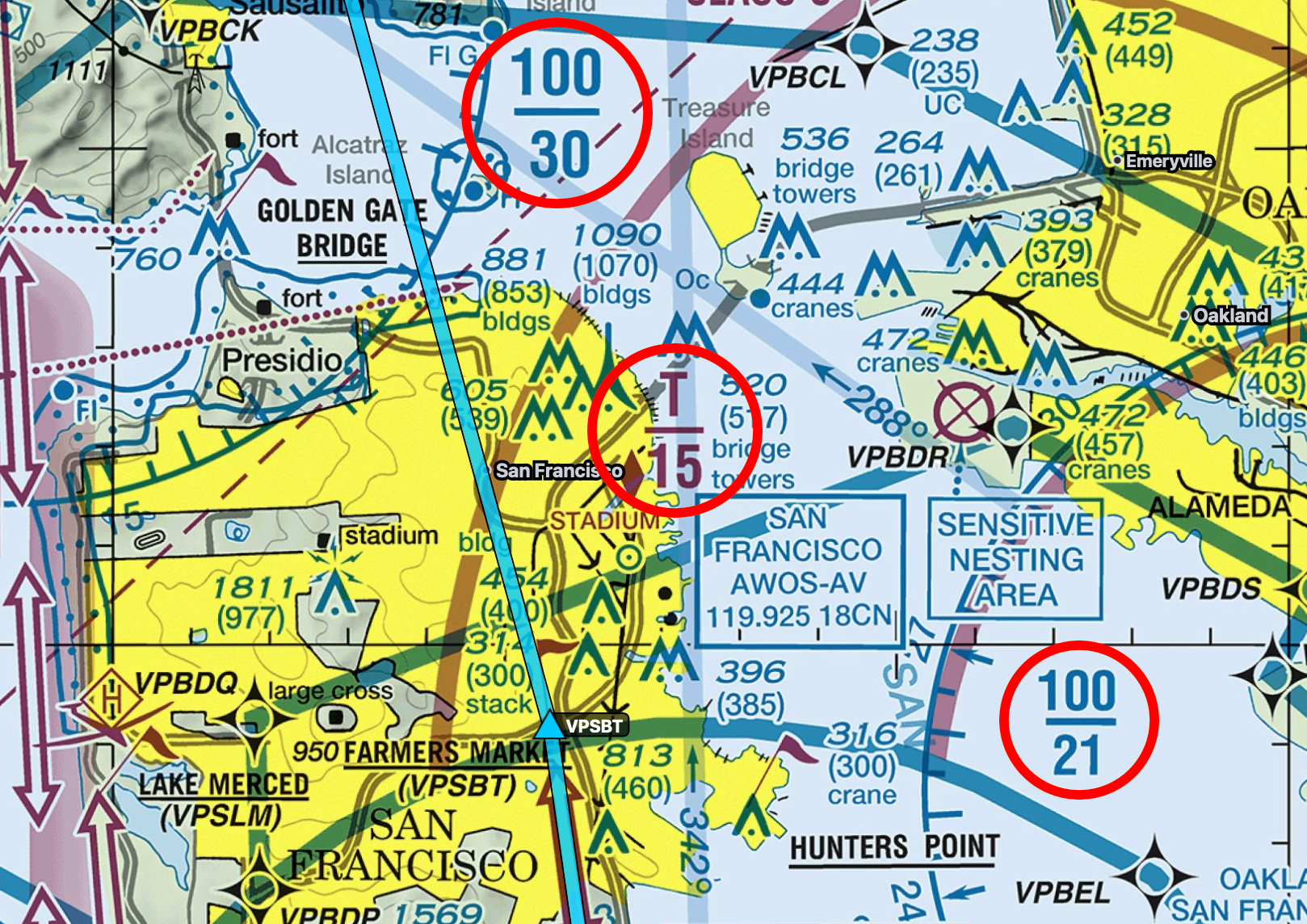
Complicated
As we make our way abeam the Golden Gate Bridge, we’ll exit Oakland’s Class C airspace while still under the Bravo airspace that starts at 3,000 feet. Note we’re flying at 2,500 feet, which means we aren’t in anyone’s airspace anymore and are in good ole’ Class E (“everywhere”) airspace. As such, we don’t need to talk with ATC anymore, if we don’t want to, but we’ll stick with flight following because it’s helpful in busy airspaces.
Things are getting easier. We’ll turn east at the San Rafael bridge, and here the Class Bravo starts at 5000 feet and goes up to 10,000 feet. Flying low is nice for scenery but not terribly safe if we have a problem, so I’d like to get some altitude, so we’ll climb to 3,500 feet. I’ve picked this altitude because we are flying VFR east and need to fly an odd altitude plus 500 feet.
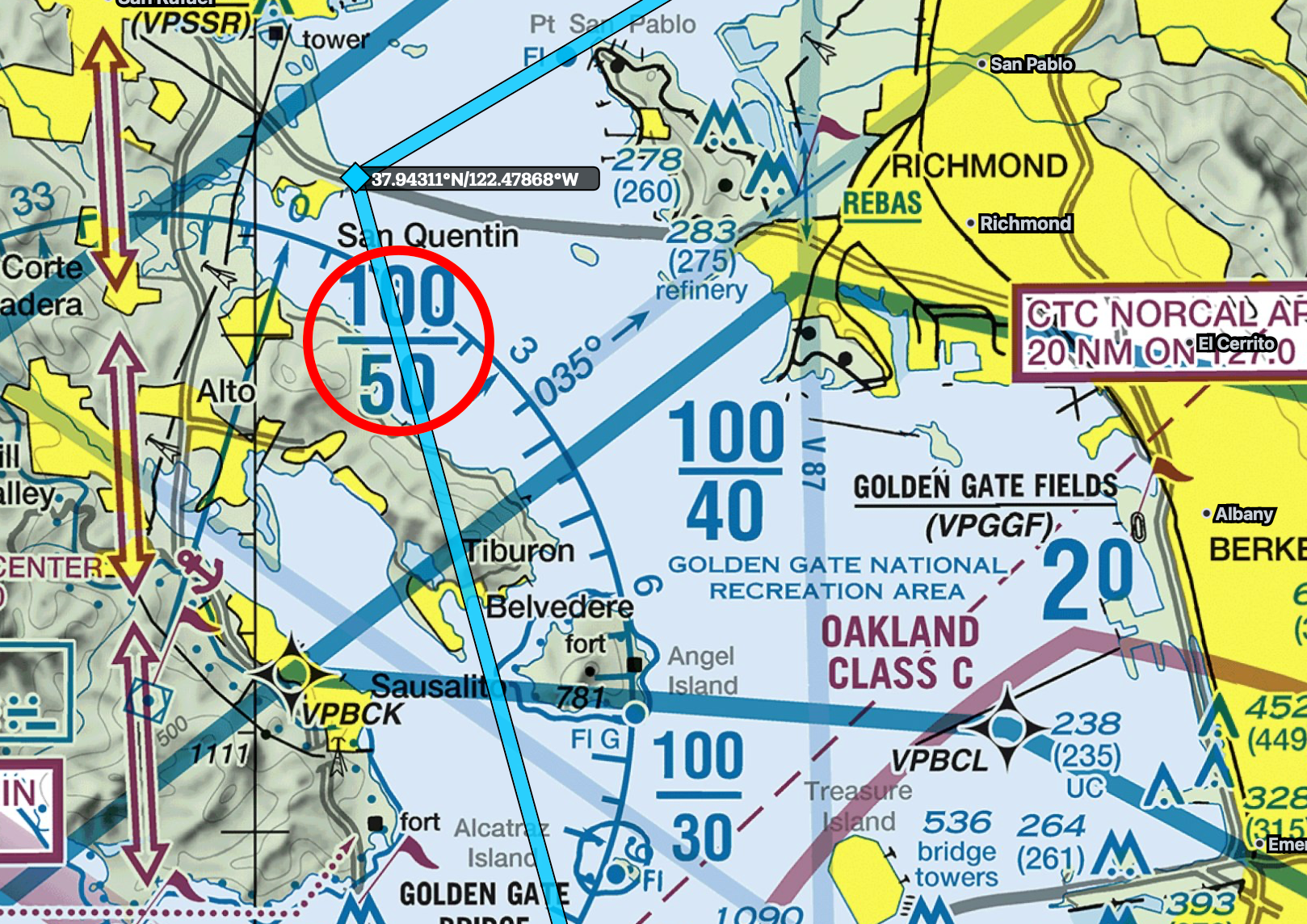
Flying under the last Bravo shelf
As we approach the Carquinez Bridge, the Bravo ends and we’re free to climb to 5,500 feet, which will give us a little more of an altitude if we have any problems. There’s a bunch of other airspace symbols as we approach this area, including a red hashed polygon with big red letters and numbers:
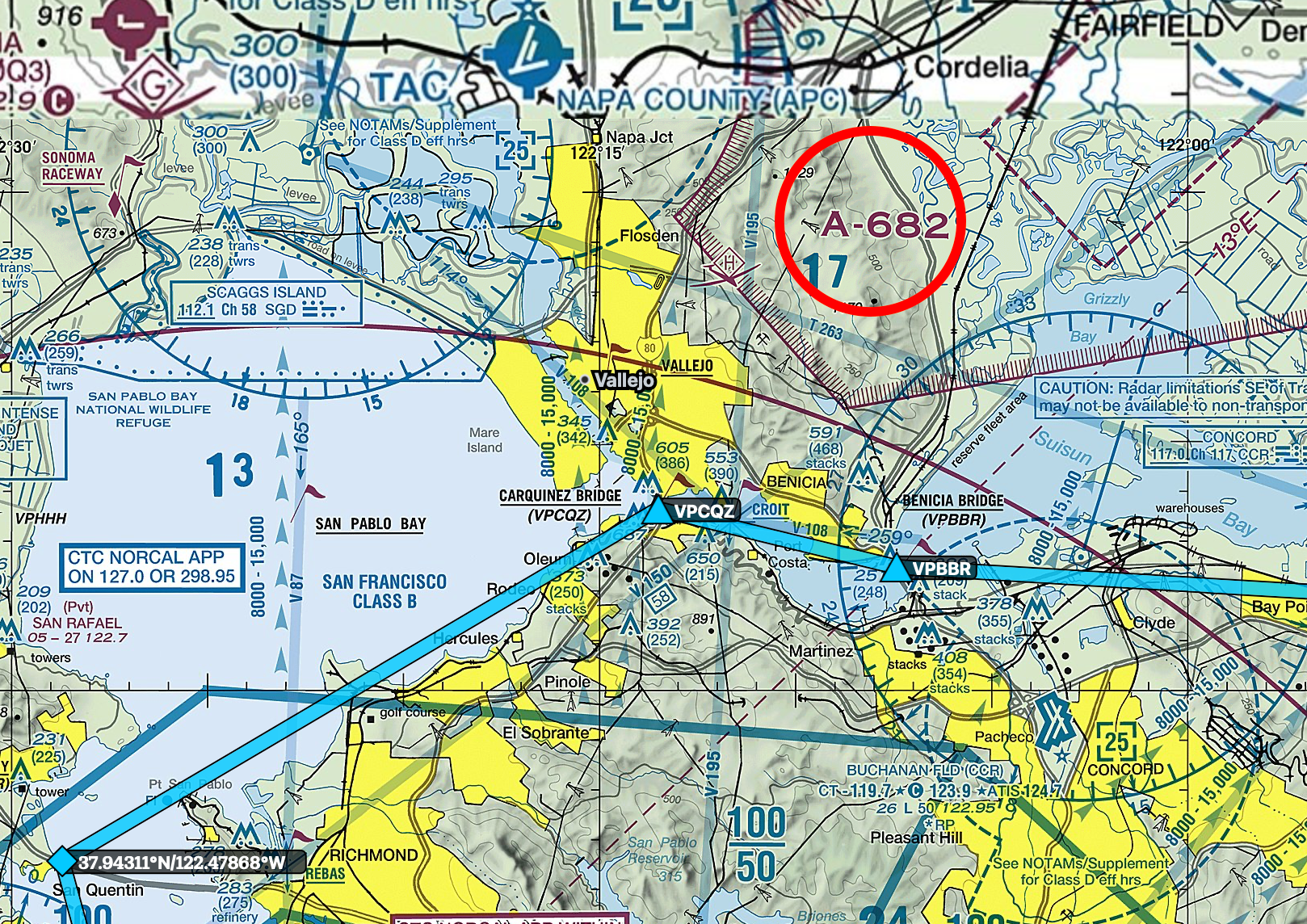
The hashed red polygon labeled A-682 is an Alert Area for Travis Air Force Base. We are free to fly in it without permission, but we should be, well, alert. It’s a warning that something like a high volume of flight training may be happening.
Now, we’ll just follow the bay bridges until the Antioch bridge, where we’ll follow the Sacramento River. This will be our cue to get the weather for KSAC San Francisco Executive, because Exec Tower will ask us for the ATIS code when we request landing. KSAC itself is a Class D, just south of the Class C of Sacramento and west of the Class D of Mather. From an awareness standpoint, if we end up on the north side of KSAC we’ll need to mind the 41/16 Class C shelf, which shouldn’t be a problem if we’re at traffic pattern altitude of 1,000 feet.
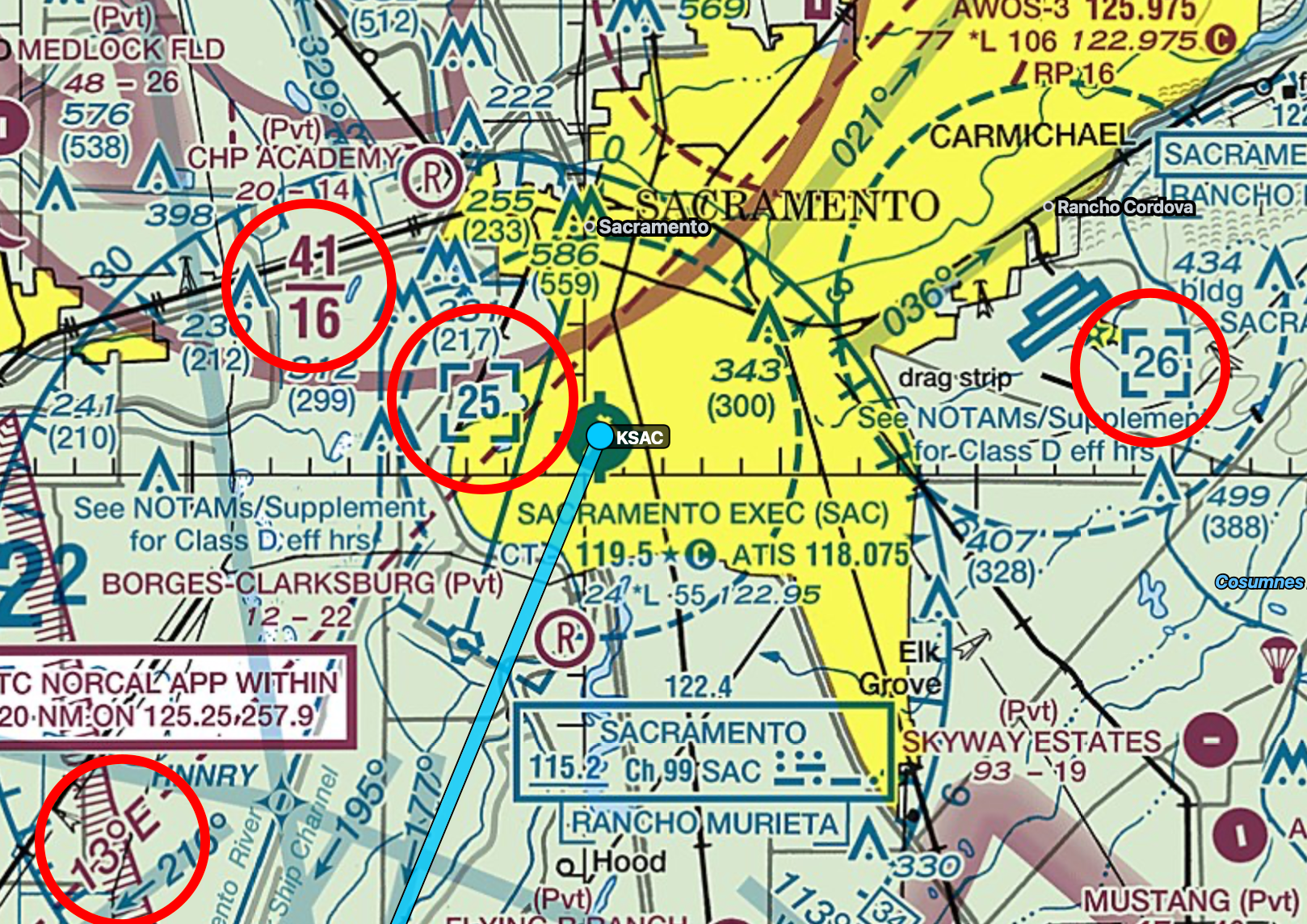
Bonus topic! See that 13 degrees E in the lower left? You probably know that if you hold a compass, it doesn’t point to the Earth’s North Pole, but instead points to magnetic north. This changes based on where you are on the planet because the Earth’s magnetic field is not uniform. The map is telling you that at this spot on the planet, magnetic north is 13 degrees east of true north . If you know how to read the VOR compass rose, it’s easy to see that the north arrow on the compass rose is tilted to the right of the North-South longitude line that passes through KSAC. VORs use magnetic north while sectional maps use true north.
One other bit of trivia is that magnetic north changes over time. Runway numbers, for example, use the magnetic heading of the runway when the runway was created. So runway 24 aligns with 240 magnetic degrees. Over time, magnetic north changes, for example runway 24 might now align with 250 magnetic degrees. Because of this, sometimes an airport will re-number the runway to fix the offset. VORs are the same. Magnetic north on a VOR might be different than what magnetic north is now because time has elapsed since it was created. If you were to look up Sacramento’s VOR, SAC, listed on the sectional above, its magnetic north is 17 degrees east of true north. This is off by 4 degrees versus what is listed on the sectional for magnetic north as 13 degrees E. Confusing, huh? When I first started flight simming and plotting out courses in SkyVector, I could never understand why the numbers didn’t match up, or why up and down on the map wasn’t north and south on my compass.
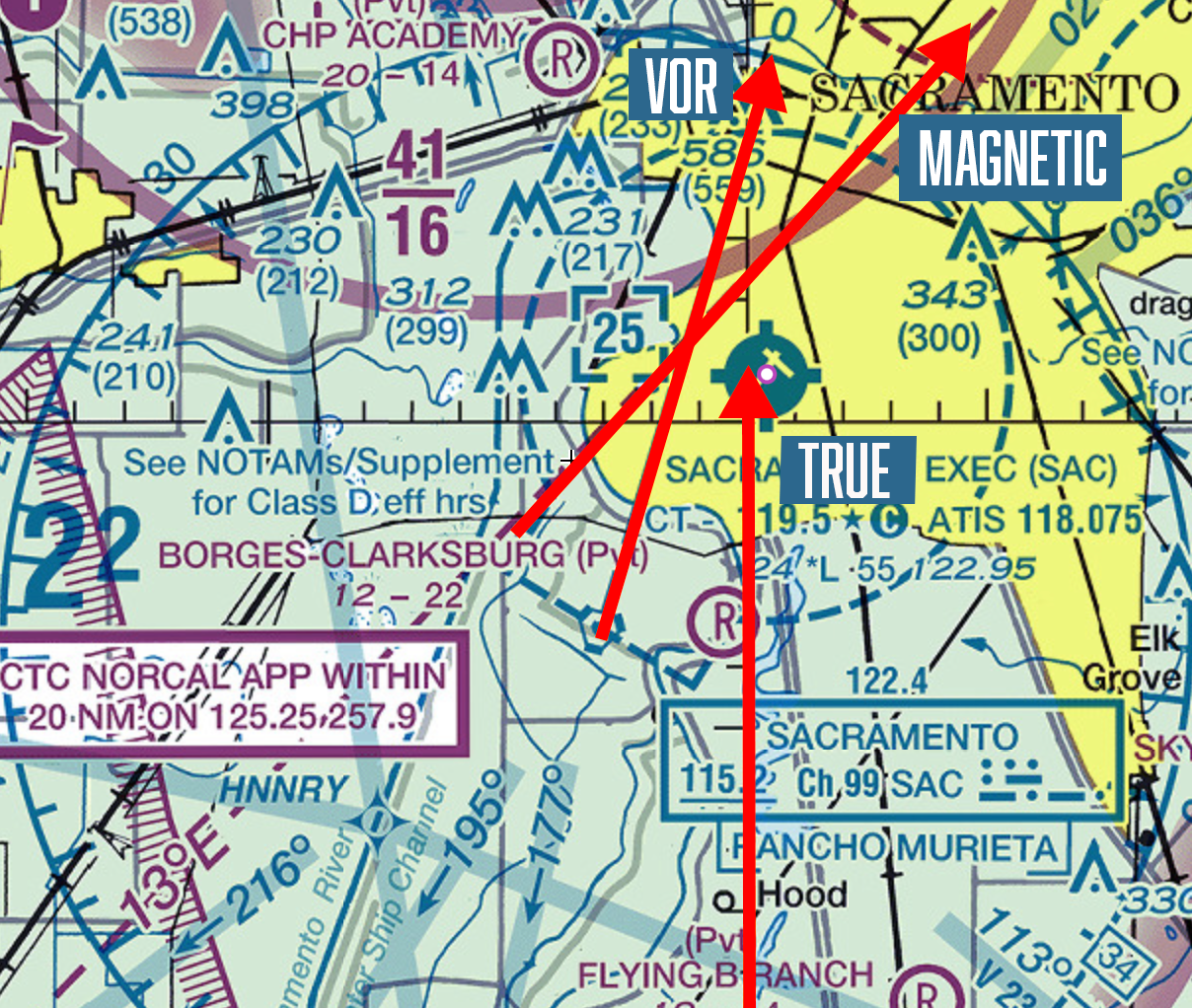
Three different Norths

United States magnetic declination diagram. Your compass will point along the line, wherever you are located in the US
Thoughts on Love, Death and Robots Season 4
Love, Death and Robots returns for Season 4. How does Netflix’s adult sci-fi anthology fare this year?
Season four of Netflix’s sci-fi anthology Love, Death, and Robots dropped May 15, bringing ten new bingable stories to 2025. In previous years, stories needed to have one of the title elements and this was typically supplied with plenty of R-rated mayhem, often with gore and nudity. The series often reminds me of a modernization of 1981’s Heavy Metal, stringing together imaginative sci-fi animations with adult themes.

Like most anthologies, there is a mix of good and bad stories, but over time the series has shifted towards more solid offerings. with Season Three serving up a several excellent episodes. Although I hoped Netflix would continue this trajectory, Season Four fell a bit flat and felt a bit rushed, although there were still a few standouts. The episodes:
Can’t Stop
The first episode has nothing to do with Love, Death, or Robots, unless you count loving the Red Hot Chili Peppers as love, or perhaps consider marionettes robots. The episode is a CGI animated Red Hot Chili Peppers concert performance, except everyone is a marionette, a la Team America style. Although well-done from a computer animation standpoint, after watching it, my only question was why?

Close Encounters of the Mini Kind
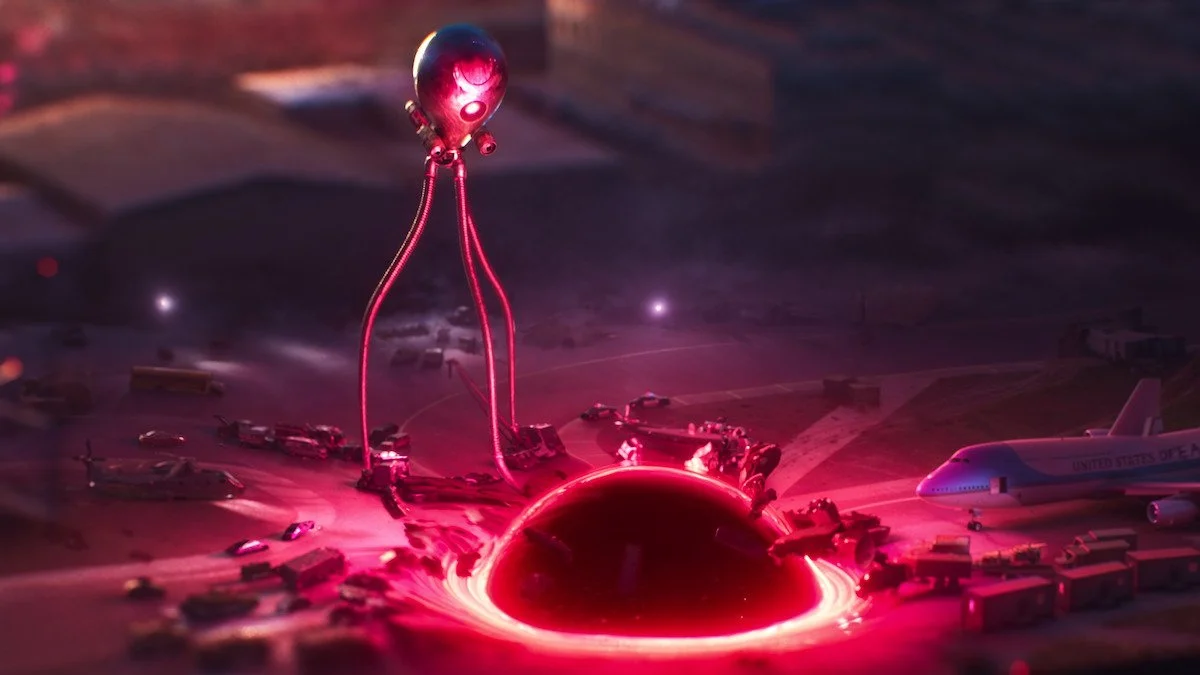
Season 3’s Love, Death, and Robots included Night of the Mini Dead, a fun fast-forward zombie outbreak rendered as a tilt-shift diorama. Season 4 brings us the same approach with aliens. After an alien first contact goes disastrously wrong due to humans, well, being humans, an all-out alien invasion and human resistance unfolds at breakneck speed. A proper Love, Death and Robots episode that’s just as fun as its Season 3 predecessor. Recommended.
Close Encounter of the Mini Kind, Season 4

Night of the Mini Dead, Season 3
Spider Rose
Another proper Love, Death, and Robots sci-fi episode, this story centers on a solitary female cyborg who mans a trading station, seeking to trade for a weapon to extract retribution upon the group that killed her husband. When an alien trader arrives but refuses to trade weapons, it instead offers her a pet. The pet has a certain Lilo and Stitch quality to it, both melting the woman’s hardened heart but also containing a danger. My favorite parts were her bonding with her pet by doing things like playing zero gee fetch. The story didn’t quite stick the landing, but visually and tonally it fit right in with what I expect from the anthology, which is a good thing.

400 Boys
400 Boys is all style. I can’t explain the story itself. It’s something like “a bunch of humans with electrical telekinetic powers in a dark apocalyptic future fight giant naked evil babies that wield massive chains”. That’s pretty much it. It looks cool in the way that stylized anime fights have an intense kinetic energy, but I can’t really explain what I was watching. I will say that it’s generated a lot of discussion as to what it represents, with theories ranging to racial inequity, gang violence, or plutocracy. so I give the story credit for inviting the viewer to interpret its meaning.
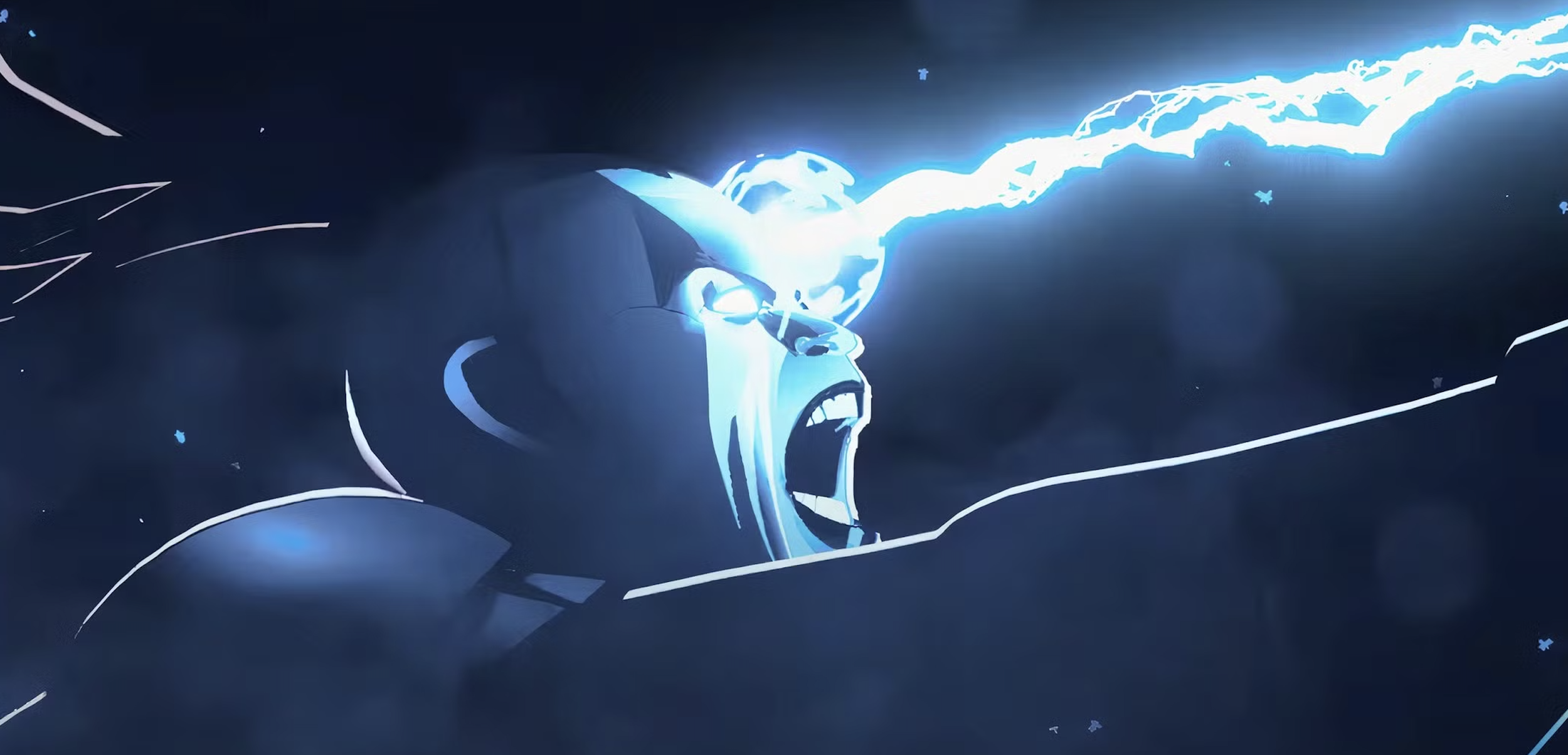
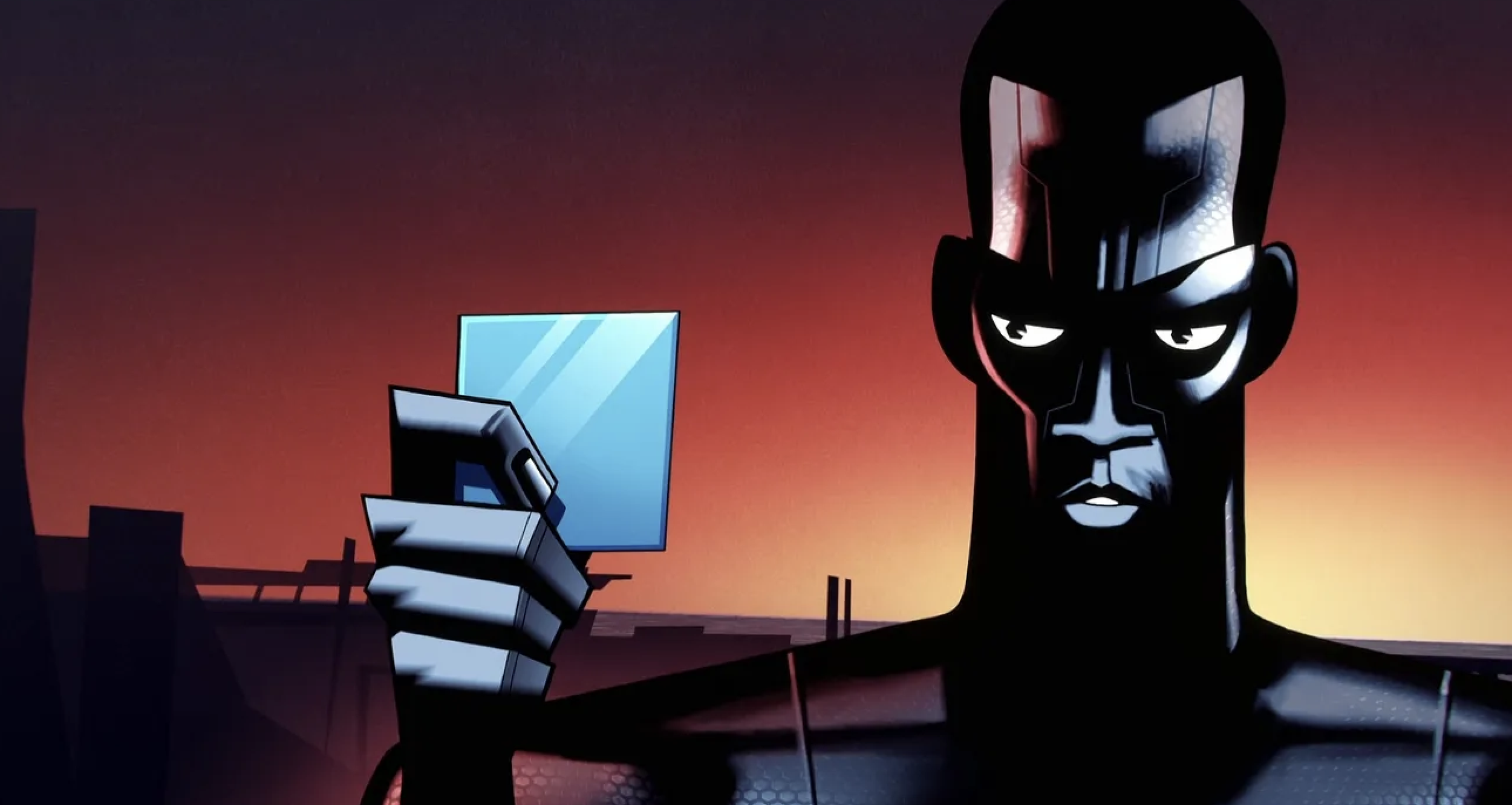
From a stylization standpoint, the art reminds me a bit of Season One’s superb Zima Blue:
The Other Large Thing
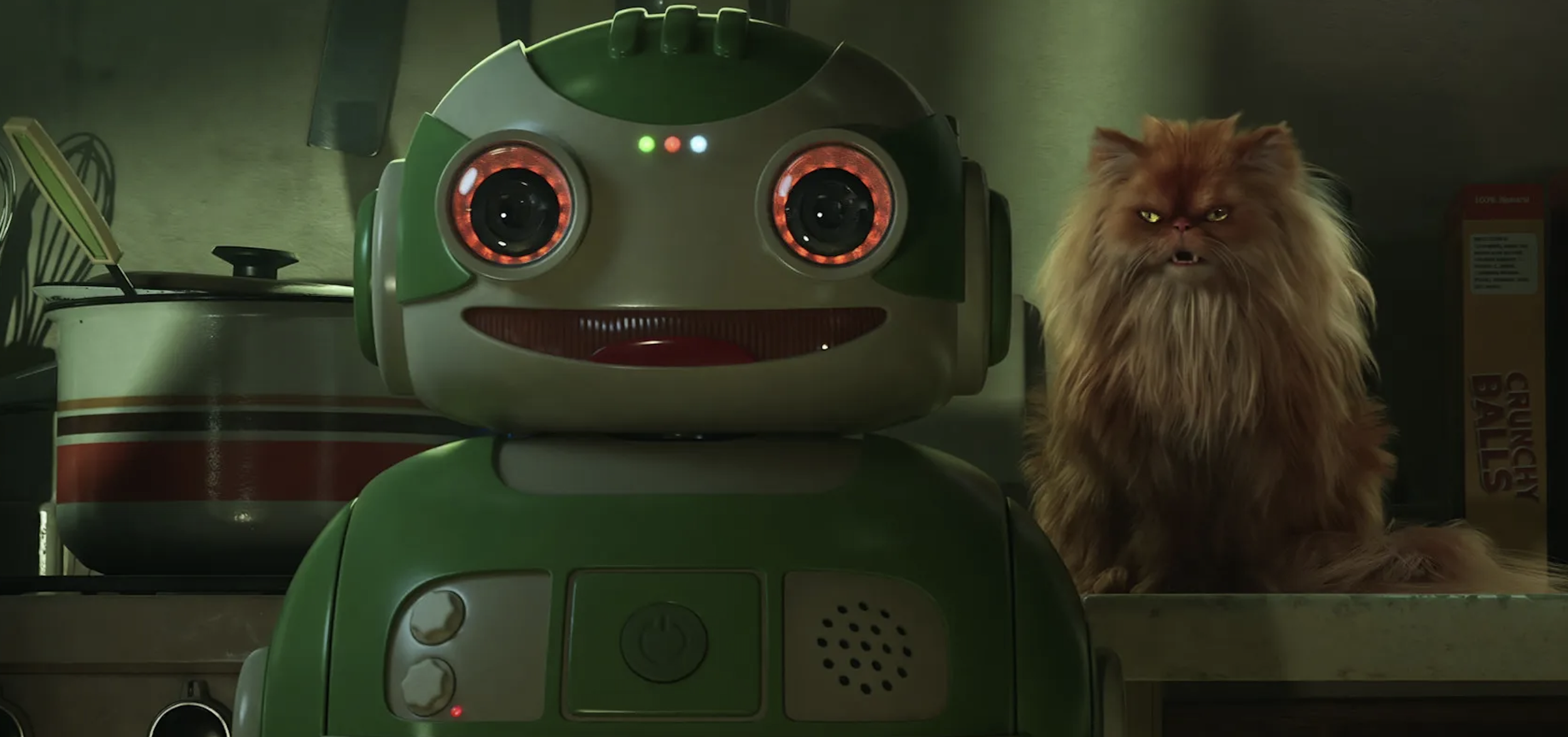
“Cats are evil and plotting to take over the world” isn’t quite an original idea. The story, from the perspective of one of the evil cats, adds a twist when its human owners buy a robot to do house chores, and the robot learns the cat’s language. Soon the cat is using all of the robot’s abilities to exact its plans, including connecting to the internet to coordinate with other robots . The animation is well-done, with characters having a cartoonish look that fits the story’s tone well, and overall the episode is a good middle-of-the-road offering for a Love, Death and Robots season.
Golgotha
Golgotha is the first live-action episode in Love, Death and Robots. It’s interesting that many of the series CGI fairings have become so photorealistic that you find yourself questioning whether people are real or rendered. An example from Season 3’s Jibaro:

I had the reverse experience with Golgotha, where I greatly admired the sweating human facial animation during the first minute until I realized it was actually real. Golgotha has an Arthur Dent from Hitchhiker’s Guide to Galaxy vibe to it, with a bumbling priest chosen as the emissary to a first contact with an alien race of priests. He and the alien stroll along the beach talking about religion. The aliens themselves have a bit of a Star Trek IV: The Voyage Home setup. Overall I liked the change of seeing a live action piece. I wish there were a bit more meat to this one, as the alien conversation is over after just a few sentences, but it was enjoyable.

The Screaming of the Tyrannosaur
The Screaming of the Tyrannosaur screams of Love, Death, and Robots, with spectacular and gory action sequences. There’s also a bit of a Jupiter Ascending vibe to it.

Jupiter Ascending, 2015
To celebrate a royal union, gladiatorial games unfold with humans and dinosaurs, but one of the gladiators has her own plans to bring down the royalty. This is one of those stories that you do disservice by simply describing it as “a bunch of body-painted naked people ride triceratops to battle each other and t-rexes” because it’s wildly inventive and visually kinetic, with a satisfying ending that feels like a short story you’d read in the yearly sci-fi anthologies.

How Zeke Got His Religion
I’d mentioned how the anthology reminded me of Heavy Metal, but How Zeke Got His Religion is practically an episode from the 1981 movie, except where the 80s movie had zombies in a bomber, this has something else entirely. There’s a splash of Indiana Jones with WWII Nazis conjuring supernatural forces, but the episode is a solid and very gory hand-drawn horror. A WWII bomber, led by a mysterious occult expert, must bomb a church in the middle of the night before a horror is unleashed. When the horror is unleashed and gets inside the bomber, well, it’s horrible. The animation is beautiful and the directing flawless. It reminds me a bit of last season’s Kill Team Kill, another hand-drawn horror, in that as the monster catches up with each of the men you know that once it’s got a hold of one, the next moments will be terrible, and that just builds the anxiety as more men fall. Add in that it all takes place inside a bomber high in the nighttime sky and it’s truly the stuff of nightmares. I also admired that the supernatural monster was unlike anything you’ve seen before. At one point the men shoot it with a ship’s machine gun only to have the bullet holes rip open into dozens of mouths, like something out of The Thing. Highly recommended.

How Zeke Got His Religion, Season 4
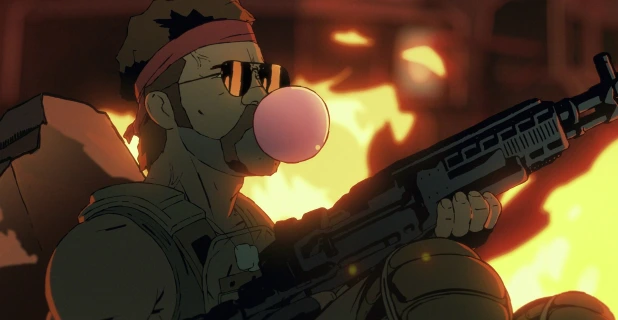
Kill Team Kill, Season 3
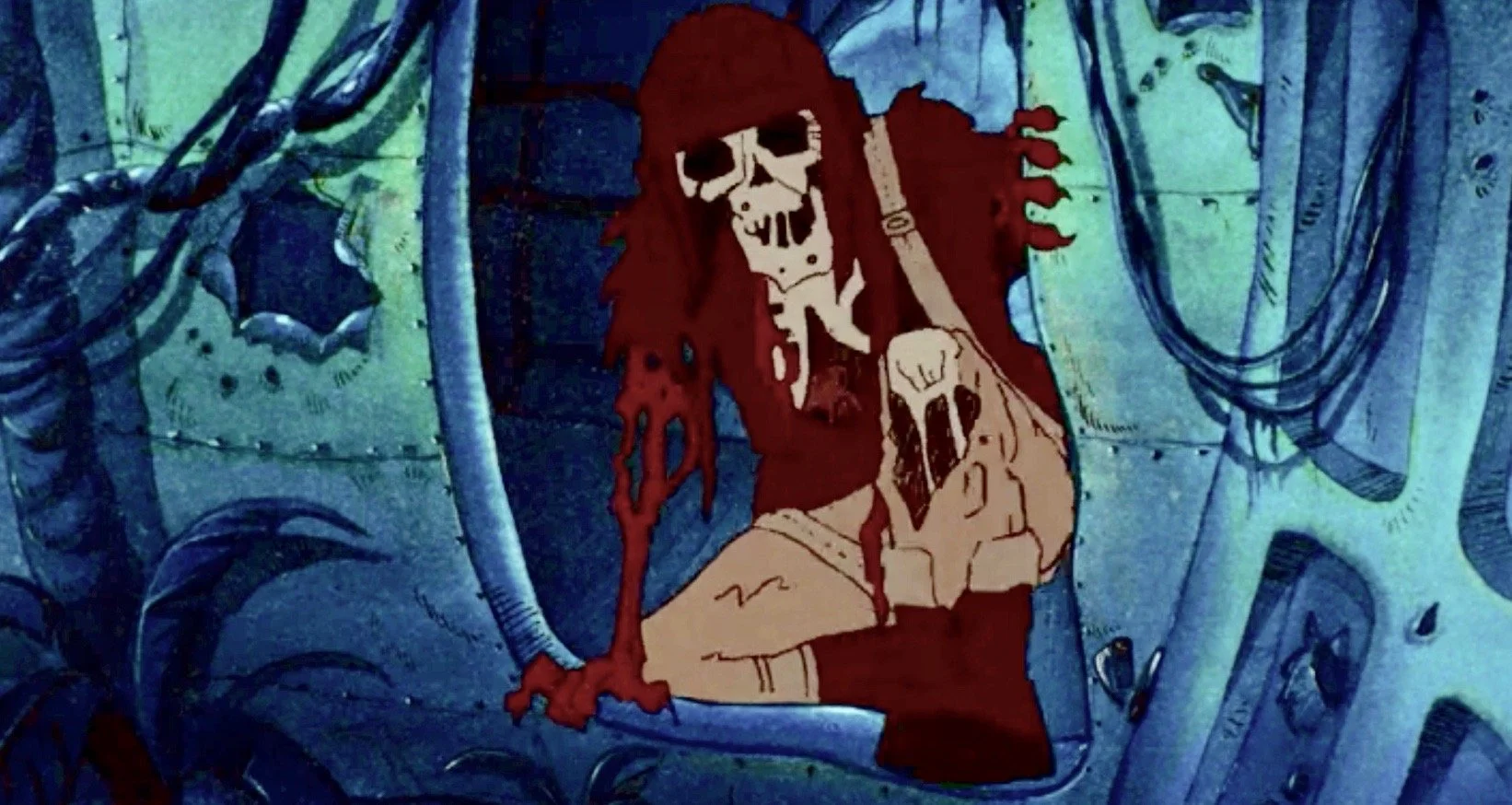
Heavy Metal, 1981
Smart Appliances, Stupid Owners
Told as a series of The Office style interviews with smart appliances, this episode is a fun commentary on human behavior, with each appliance offering a bit of snark. The animation style has a claymation look, a bit like Wallace and Grommet, which fits nicely with the tone. None of the jokes are laugh-out-loud funny, but several elicited chuckles. Cheeky and fun.

For He Can Creep
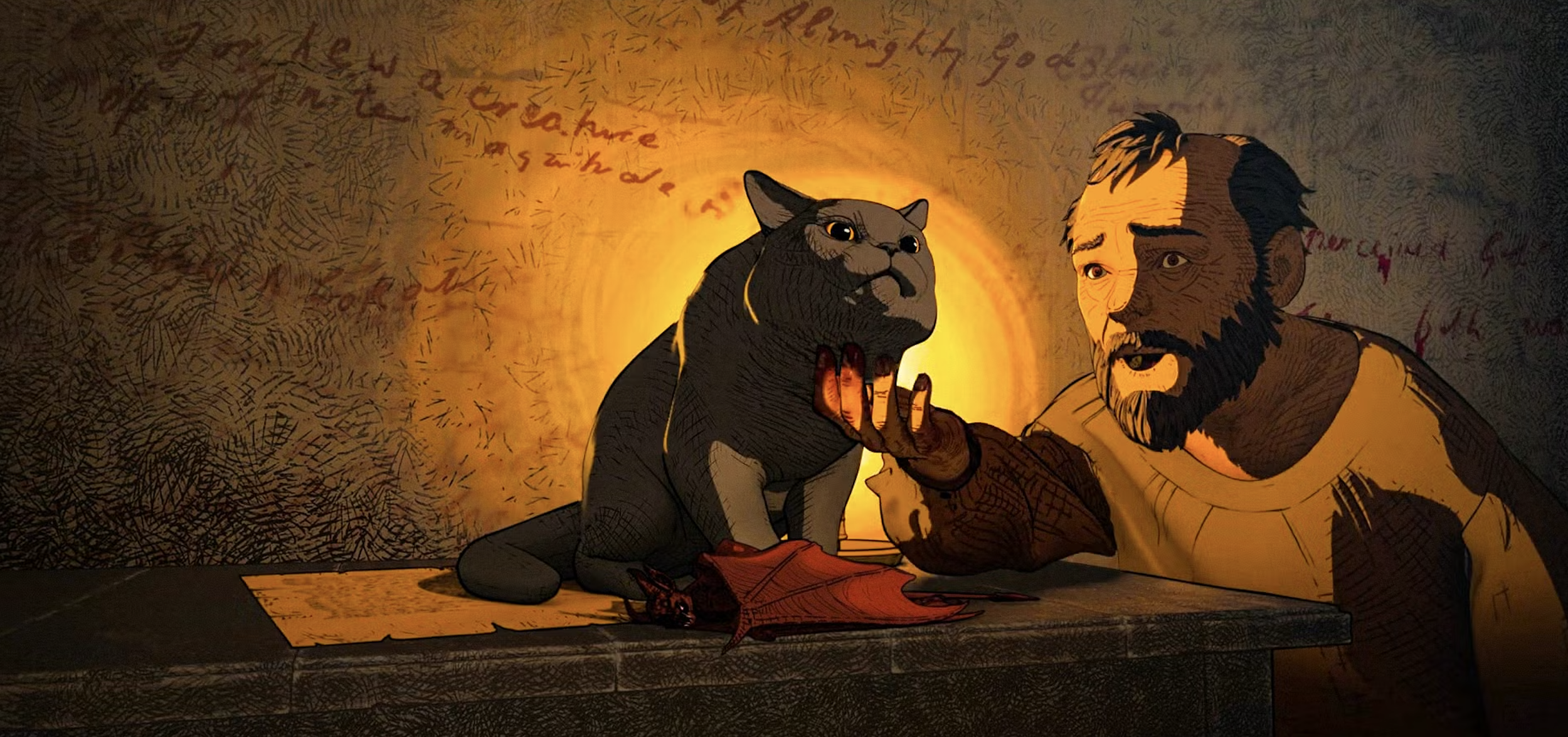
Told from the perspective of the cat, the story revolves around an imprisoned poet in a medieval asylum whose only friend is a cat. When the devil becomes interested in the poet and attempts to enlist the cat to realize his nefarious plans, the cat recruits his feline friends to thwart him. Wonderfully atmospheric, illustrated, and directed, For He Can Creep is a strong choice to end the season.
Mostly-Good Airports
As many know, I blame the hero of my stories, James Hayden, for exposing me to the bite of the aviation bug. In the Hayden’s World series, he’s an awesome pilot, and during my quest to learn what the assorted gauges and switches actually did on an airplane I downloaded a copy of X-Plane. You know, for research purposes. My research turned into a full-fledged hobby and I became part of the sim community, flying myself virtually out of my local field on literal flights of fantasy. Eventually I migrated to Microsoft Flight Simulator and was wowed to find the entire world modeled in my PC. Now, the thing is that after thousands of virtual flight hours all simmers develop the same fantasy. In it, a worried flight attendent steps in front of the closed curtains to the cockpit, asking if anyone onboard knows how to land a plane. You crack your knuckles. I’ve got this.

With that swagger, I booked a discovery flight at my local flight school and sauntered into the FBO. When the CFI asked “What do you want from today’s lesson?” and I replied. “I want to fly the plane as much as humanely possible,” I was bristling with confidence. This is where Morgan Freeman’s voice says, “He did not, in fact, have this.” Fast forward one hour where the CFI, who I’d lulled into a false sense of security from my amazing pre-knowledge, allowed me to actually attempt to land the plane. I cannot stress enough how different an experience it is from looking at a 2D monitor while landing munching Doritos with one hand versus hurtling face-down at eighty miles-per-hour towards an unflinching planet. Our aircraft was a non-stabilized mess careening towards an ever-enlarging patch of grass and I was thinking we’re going to die here but all I could utter was “Ground. Ground. Ground is coming up.” The CFI took the controls and bailed us out, wisely deciding it would be a few lessons before we would try that again. It turns out that landing a real plane is, in fact, really difficult. That didn’t dissuade me though. After countless crappy, bone-jarring landings, I eventually figured it out and through enough training and persistence convinced the FAA that it was somehow a good idea to give me a pilot’s license, so here we are.

I still flight sim. Maybe even more than before I started real flying. There’s an expectations curve where you learn how the sim is different and in what ways it’s the same, and how to translate between the two. It’s interesting that there’s a bell-curve of opinions, ranging from die-hard simmers who get angry at the slightest implication that they couldn’t land a real 747 on the first try to real-life pilots who have never tried a sim and discount them as useless video games. The truth is in the middle. I had zero chance of landing a real plane on my first try, even with an F-18 pilot talking me through it (yes, really), but, I actively use Microsoft Flight Simulator as a supplement for real life flying. I’ll practice procedures in it and rehearse actual routes I intend to fly.
One of the nice things about virtual simming is that I can practice flying between my local fields whenever I want. The sim does a decent job of generating Lego versions of them, but I wanted more, so I learned how to work the Scenery Editor and create 3D models in Blender. To date, I’ve created KWBW Wyoming Valley and KSEG Penn Valley, which are both posted for free on Flightsim.to. This past week, I created KHZL Hazleton, but MSFS2024 is full of bugs and one of those bugs ate my airport. When you make an airport, you compile it in the editor and export it. Fortunately I have the compiled version, but the editor devoured the raw code. As such, it’s a mostly-good airport that I can’t further improve. Still, I enjoy flying out of it and like to share what I make, so here’s a link if you want to use it (unzip and copy to your Community folder). It only works for MSFS2024, and as I said, it’s as-is, but I think it’s not too bad:
KHZL Hazleton (Microsoft Flight Simulator 2024 version only)

There’s a few objects that required third-party libraries. The airport will still work without these. They just add a little flavor. To install these libraries, download and copy to your Community folder:
Ethnicfs Military Library (required for tank in front of FBO)]
EDHK Lights (night lighting)
I you haven’t seen my YouTube channel, please check it out and subscribe if simming is your passion. Thanks for coming along on this journey.
You can see the virtual flight from KHZL here:
Watch the real-life flight between KWBW and KHZL here;
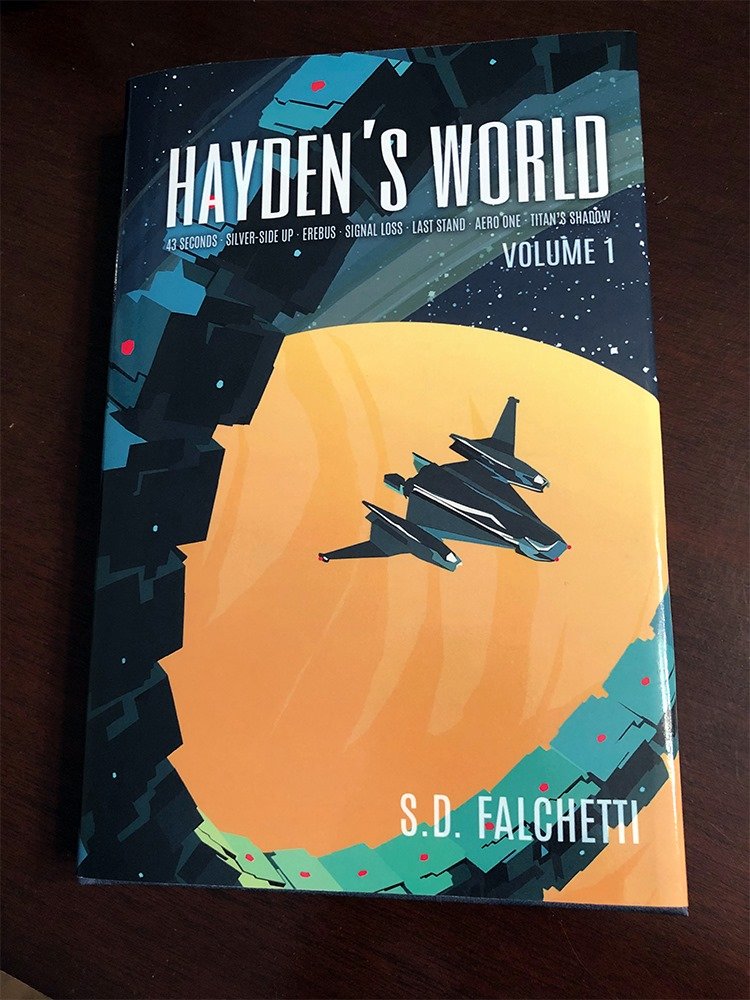
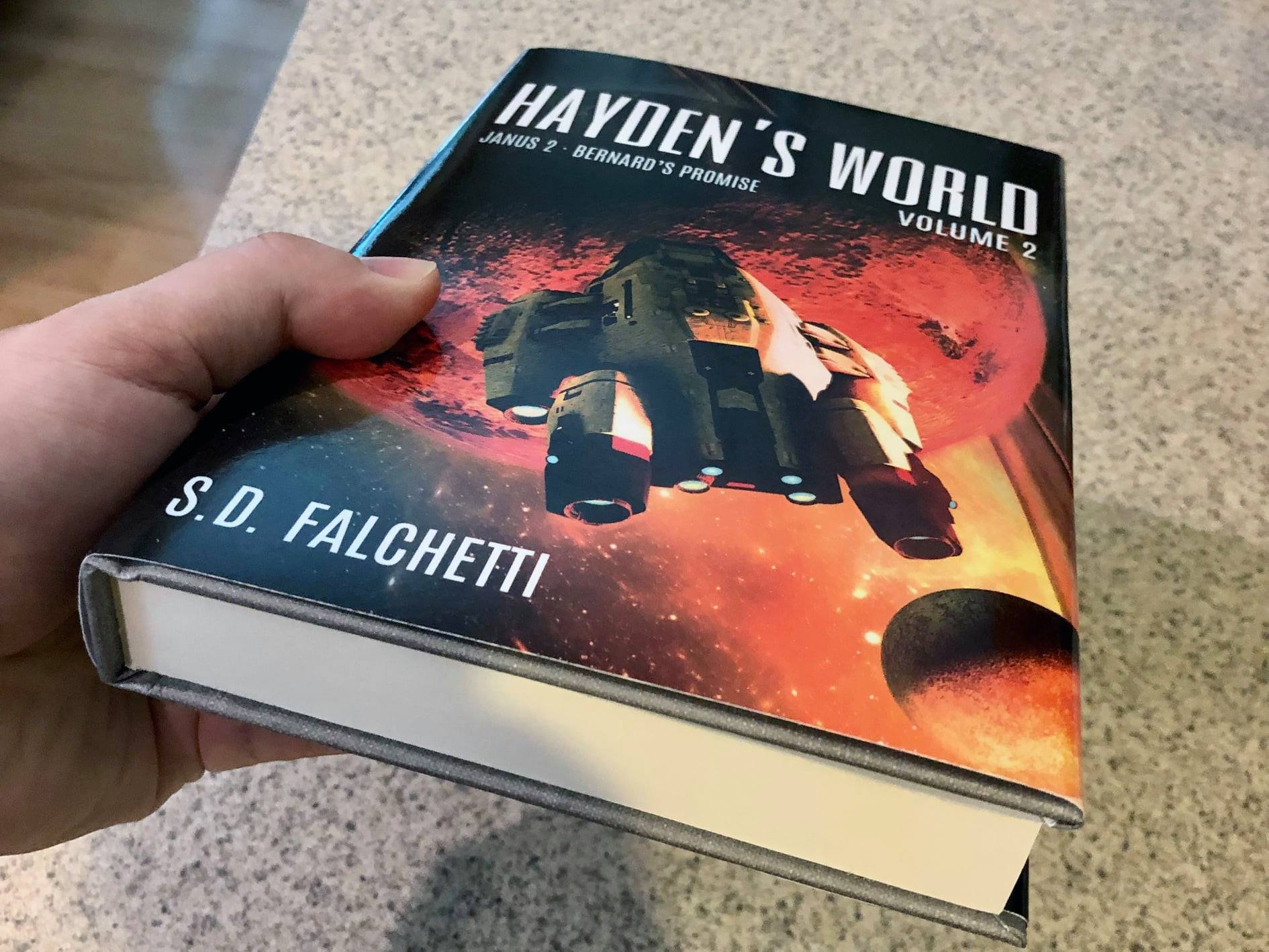
Hayden's World: Volume 2 now available on Audible
I’ve collaborated once again with the very talented Shamaan Casey to produce the audiobook version of Hayden’s World: Volume 2. Find it on Amazon or Audible.


Hats off, with admiration
Season 2 of Star Trek: Strange New Worlds isn’t over yet, but the writers are already knocking it out of the park
Last year I wrote a critical post about the first season of Star Trek: Strange New Worlds. My post was driven, in many ways, by a culmination of years of disappointment that started after Next Generation’s conclusion. I felt that modern Trek writers had lost their bearings, sacrificing the classic magic in favor of sensory overload. Star Trek: Discovery was the prime example, not trusting the viewer to stay engaged for more than three minutes without a new revelation or battle. When Strange New Worlds launched, I was hopeful about the return to the original series’ timeline. While the first season did rekindle the sense of exploration promised in its title, my complaint was that, like its contemporary peers, it was often afraid to let its episodes breathe and for its characters to stand on their own merits.
In hindsight, even Star Trek: The Next Generation needed two or three seasons to find its way. Simply ask yourself which NextGen S1 episodes you recall. There’s the pilot, “Encounter at Farpoint”, and “The Naked Now”, where the crew gets drunk on the same virus from the 60s series episode. What else? The other memorable episodes include the Binars stealing the Enterprise in “11001001”, Wesley getting sentenced to death for trampling flowers in “Justice”, Tasha Yar getting killed in “Skin of Evil”, and the Starfleet commander face-phasering of “Conspiracy”. Those aren’t necessarily good episodes, but you do remember them. The other two dozen episodes are a blur. Just two seasons later, however, the writers were dunking with stories like “Yesterday’s Enterprise” and “Best of Both Worlds”.

Encounter at Farpoint

The Naked Now

Skin of Evil

Justice

11001001

Yesterday’s Enterprise

The Best of Both Worlds
Season 2’s first episode of Star Trek: Strange New Worlds, simply titled “Episode One”, had a worrisome kickoff. When Pike is off the ship, Spock steals the Enterprise to help La’an. Along the way, Chapel and the doctor turn themselves into super-soldiers after injecting themselves with a mystery green goo. Right about here, as Chapel is single-handedly Matrix-fighting a squad of Klingons, is where I sighed and considered calling it quits for yet another modern Star Trek series. Can we just have a Star Trek series where not every crew member is a secret super-soldier with a dark twisted past?
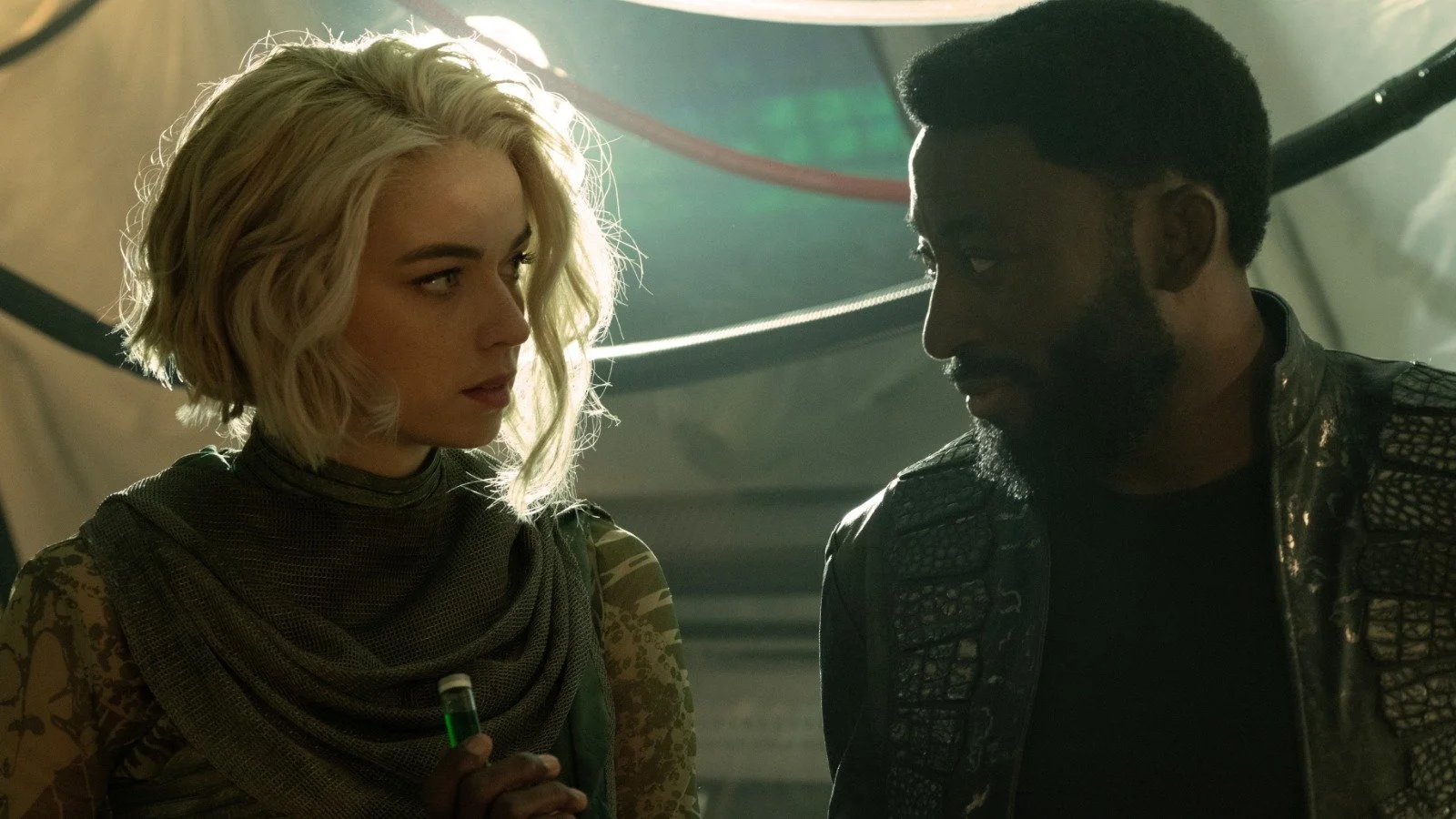
Fortunately, I stuck around. The second episode, “Ad Astra per Aspera”, is a classic court martial plot with Number One on trial for a fundamental right. It evokes ST:TNG’s “The Measure of Man”, where Data must prove his right to have free will. There are principled arguments to be made and the crew pulls together to support their besieged commander. Principles and camaraderie. It feels like Star Trek.
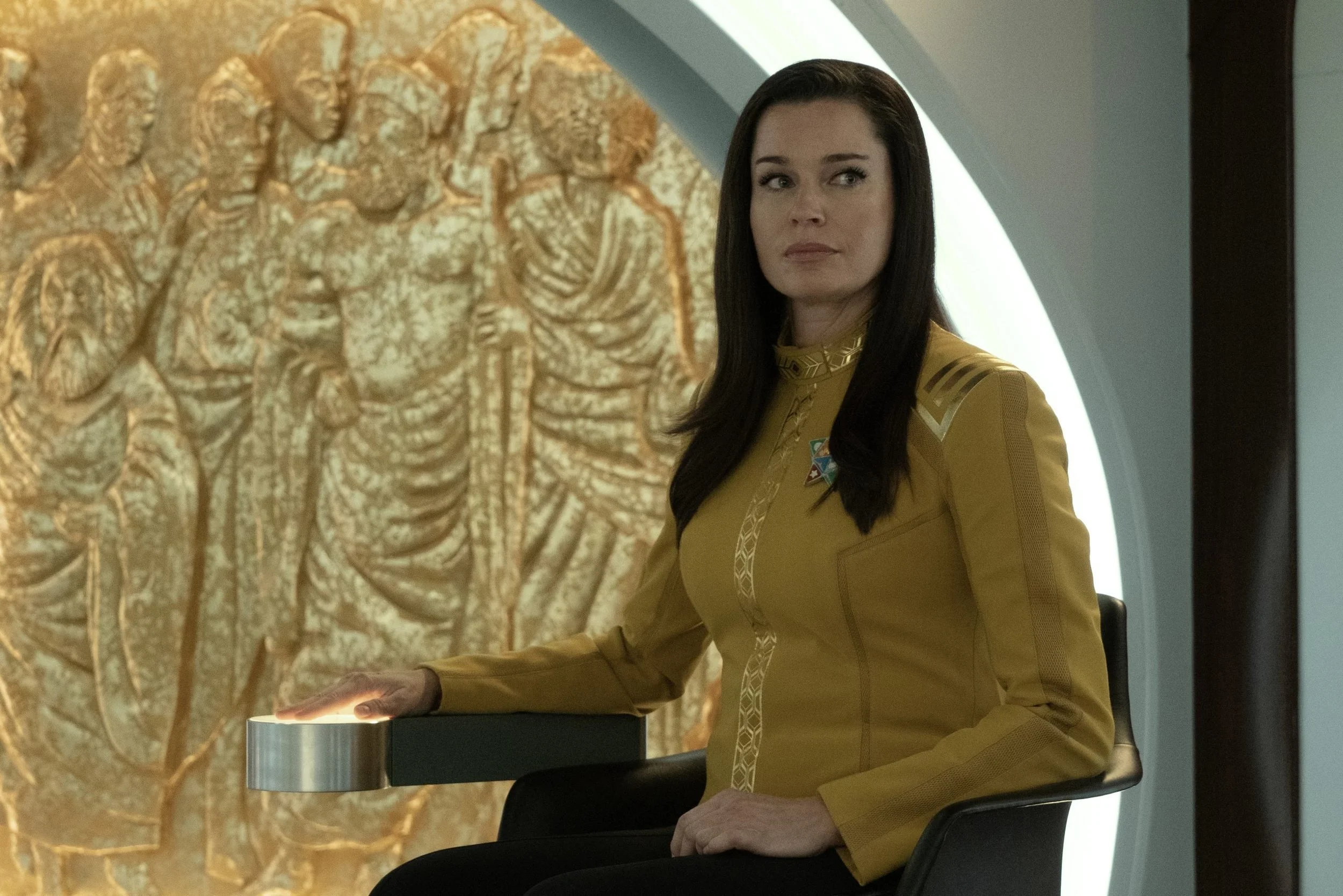
Ad Astra per Aspera

The Measure of a Man
Episode three, “Tomorrow and Tomorrow and Tomorrow” pairs an alternate timeline Captain Kirk with La’An in a time travel episode to the 21st century. It’s a restrained plot that explores La’An’s struggle with her family name while also giving her a chance for some romance. It plays a few Star Trek IV beats with Star Trek characters out of place in contemporary times, but overall it’s La’an’s story, and I appreciate that despite the writer’s perplexing S1 choice to make her related to Khan, she’s allowed to explore the stigma. I also like that her feelings for Kirk translate back into her home timeline, where Lieutenant Kirk has not had a relationship with her, setting her up for an Eternal Sunshine of the Spotless Mind situation where your lover no longer remembers you.

Episode four, “Among the Lotus Eaters”, is an away team mission where the planet slowly erases everyone’s memories. The villain is a rogue Starfleet officer who uses his superior technology to rule a primitive planet. It evokes classic TOS episodes such as “Patterns of Force” where a Starfleet captain models a planet after Nazi Germany for efficiency, and perhaps a little of “Court Martial”, where a crew member, Benjamin Finney, who Kirk believes is dead, extracts revenge upon Kirk for abandoning him.

Among the Lotus Eaters

Patterns of Force

Court Martial
The next episode, “Charades”, is where season two hits its stride. When a shuttle accident seriously injures Spock, extra-dimensional aliens repair him using his DNA, mistakingly choosing the human component and making him entirely human. He awakens as a round-earred human, complete with uncontrolled emotions, at a critical time where he is to undergo a stern approval ceremony with T’Pring’s parents. This easily could have devolved into a Three’s Company episode, but instead it is delightful and laugh-out-loud funny. Spock’s one liners through the episode are comedic gold, such as “I believe my facial spasms are returning” as he struggles to keep a poker face under his mother-in-law’s demeaning onslaught. There’s a subtext that Chapel finds him easier to talk to about their relationship, since he’s not suppressing any emotions, but she also realizes he’s no longer himself. In a non-Star Trek reference, this reminds me of the Office episode where Dwight has a concussion, transforming into a normal human being for the episode before Pam somewhat reluctantly forces him to get medical help.

The idea of advanced aliens trying to fix a crew member but not having the correct blueprint evokes TOS’s “The Menagerie”, which tells the story of Christoper Pike being held by mind-manipulating aliens who also hold a human woman captive. The woman was the victim of a crash, who they tried to repair, but assembled poorly.

The Menagerie
I’d originally had some problems with Strange New World’s Spock relationship with Nurse Chapel, until I’d realized that Chapel admitted having secret feelings for Spock in the 60s series episode “The Naked Time”, where the crew becomes drunk on an alien virus, losing all inhibitions.

Uhura is the star of episode six, “Lost in Translation”, where only she can see terrifying messages from an alien race. It reminds me of ST:TNG’s “Night Terrors” where Counselor Troi keeps having nightmares that turn out to be a subconscious message from a trapped alien crew.

Lost in Translation

Night Terrors
I wasn’t originally sure how to feel about Strange New World’s version of Kirk, but in the original series whenever Kirk bumps into someone who knew him at the Academy or in his pre-captain days, he’s always described as a hard worker who was a “stack of books with legs”. I appreciate seeing a Lieutenant Kirk who is not yet Captain Kirk, but is an up-and-coming focused leader who will earn his future rank. It’s refreshing not to see the J.J. Abrams frat-boy version of post-Academy Kirk.
If season 2 had hit its stride a few episodes ago, episode seven is where it pulls way ahead of the pack. “Those Old Scientists” is a crossover episode with the animated Star Trek series, Lower Decks. It starts out animated in the Lower Decks timeline, with Ensign Boimler stepping into an alien portal that transports him back in time to Strange New Worlds’ setting. There, he is live-action, just like everyone else. As a time traveler, his presence is disruptive and the Enterprise crew wants to find a way to send him back to his home timeline. Matters complicate when a second Lower Decks crewmate, Mariner, emerges. It was so much fun, I watched this episode more than once. What makes this work so brilliantly is that Boimler is the ultimate Star Trek TOS fan, idolizing the characters and ships of the past. He is us, if we were transported to the Enterprise, and we live vicariously through him. Most importantly, this episode gives itself complete permission to be as Star Trek as possible while having unfettered fun. I loved every minute of it. It ends with an animated scene of Strange New World’s crew, explained as a weird side-effect or drinking too much Orion alcohol.


After the last episode, “Under the Cloak of War” will give you whiplash for its tonal shift. A dark, grueling episode about the trauma or war, with Chapel and M’Benga flashbacks as field medics treating an endless stream of casualties during a Federation-Klingon war. The plot cuts between the flashbacks and current time where a Klingon defector from that war now has a message of peace as an ambassador. Those who were brutalized by him, however, cannot forgive him. This reminds me of the TOS’s “The Conscience of a King” where the lead actor of a Shakespearean acting troupe is suspected of being Kodos the Executioner, a leader who killed thousands of people during a food shortage and is now trying to live a life of peace as an actor. The episode is about trauma and war, and makes a point that those looking in from the outside can’t understand its impact.

Under the Cloak of War

The Conscience of a King
This episode has a callback to Worf’s Klingon version of Tai Chi, Mok’bara:


Under the Cloak of War
The somewhat-reluctant dinner with old Klingon adversaries reminds me of the Star Trek 6: Undiscovered Country dinner:

Star Trek VI: The Undiscovered Country

Under the Cloak of War
This leads us to episode nine, “Subspace Rhapsody”. Much like “Those Old Scientists” took risk with an animated/live-action crossover, “Subspace Rhapsody” pushes the chips all in for a musical episode. Let me say, this was the most fun I’ve had watching a Star Trek episode. When the Enterprise encounters a naturally-occurring subspace fold, an improbability field emerges, forcing the crew to break into song and dance whenever emotions are strong. The result is a theme-park of fun and character exploration, with characters revealing their inner-most feelings. Indeed - that is the conflict - characters share too much publicly, and the improbability field is growing, pulling other ships into its wake.
What I loved about this episode is that it was all about the characters. Spock’s “I’m the X” is as perfect a Spock song as it gets, with industrial, mechanical beats juxtaposed against Spock’s deeply-rooted emotions. Anyone who’s ever tried to think themselves through a breakup will relate.
Chapel’s “I’m Ready” is the same song recast as a glamorous cabernet-style tune, evoking her joy at breaking her bonds to pursue her dreams. Uhura searches for her place in the world, belting out the notes in “Keep Us Connected”. La’An explores the theme of unrequited love introduced in the time travel episode with “How Would That Feel?”. Although it doesn’t have a title, there’s a bring-down-the-house moment where even the Klingons get involved in the singing. The whole episode, complete with singing Klingons, could easily ruffle the feathers of any Star Trek purist, but, like the animated cross-over episode, it does just the opposite, serving up an homage of all things Star Trek.
So, to the writers of Star Trek: Strange New Worlds Season 2, I tip my hat, with great admiration. Keep doing what you’re doing. You’ve hit your stride and, like Usain Bolt smiling to the cameramen as he leaves the competition in the dust, you make it look easy. You’ve made me excited about Star Trek once again, and, like Kirk at the end of Star Trek II, I feel young, like when it was all new.


Thoughts on Black Mirror Season 6
It’s hard to believe Black Mirror has been producing content since 2011. After bingeing Season 6, I offer a few thoughts.
Like your favorite sci-fi series, Black Mirror has evolved and matured since its fledgling Season 1 days. That first season debuted in 2011 and contained three episodes. What I recall about the early seasons is that the stories focused on technology’s dehumanizing impact on society and were often unbalanced. Where a traditional short story would have beats and a tidy wrap-up, Black Mirror’s narratives bounced off plot pegs like a Plinko chip, zig-zagging their way to an ending where all momentum abruptly stopped. I felt the writers had simply run out of time and typed “The End”. With Season 3, however, we were treated to more focused and fun narratives such as “Nosedive”, where everyone socially rates their interactions with others, causing a woman to have a true Trading Places experience when her rating plummets due to a series of ever-worsening events. Moving on to Season 4, we are rewarded with the gem of “U.S.S. Callister”, where a programmer creates a virtual Star Trek-like universe and imprisons sentient AI copies of his co-workers as the ship’s crew. We also get the memorable “Metalhead”, where a Terminator-like robotic dog relentlessly pursues the protagonists. Next, Season 5 starred Miley Cyrus in the fun “Rachel, Jack and Ashley Too”, where a teen’s Alexa-like toy robot is an AI copy of the pop star it is emulating, and the actual pop star needs rescuing. The progression of stories becomes more traditional, with popular actors guest-starring, runtimes approaching movie lengths, bigger budgets for sets and special effects, and solid writing.
Much like the Outer Limits had a theme of mankind’s hubris leading to its downfall, Black Mirror has nearly always been about the perils of technology (and in particular screens, hence the series name). What’s interesting revisiting Season 1 is the consistency of the underlying message. Both Season 1 and 6 contain an indictment of the consumer as being complicit in whatever unethical thing the content provider is creating. In Season 1, it’s “Fifteen Million Merits”, where people earn merits by riding stationary bikes while watching a roomful of screens. Merits buy or skip content, and the characters in the episode end up becoming the content they were consuming, which itself is a type of jail. Compare that to the latest Season 6, where three of the five episodes are indeed mirrors for the viewer, showing his complicity (and in one episode making the content viewer the content).
The Season 6 episodes, in order:
JOAN IS AWFUL

A woman comes home to watch a new trending series on Streamberry (a fictional version of Netflix, in a nice bit of meta) only to discover that the series is all about her and that she is the villain everyone loves to hate. It’s quite a brilliant piece of writing that lands on multiple fronts. It takes series like “The Tiger King”, where a real person’s life is served up as entertainment to the masses, and flips it on the consumer, inviting them to see how they would feel if their life were served up as entertainment for others. It also shines the light on Netflix’s content creation machine, AI content creation, deep fakes, personal control over one’s image and likeness, and even a Matrix-like examination of what is real. Thoroughly enjoyable, and, well, awful.
LOCH HENRY

A film student and his girlfriend return to his home town to visit his mother. While there, he decides to make a documentary about a local serial killer who was responsible for the death of the film student’s policeman father. The technological aspect of the story revolves around an old stack of VHS tapes. I can’t say much more without divulging the plot. Similar to “Joan is Awful”, the story focuses on the intrusiveness of creating content based upon real-life tragedies, and asks the viewer to consider how he would feel if that content included him. Loch Henry was the weakest of the five episodes. Although there was some nice cinematography and terrific acting, I found my attention drifting, even after the big reveal.
BEYOND THE SEA
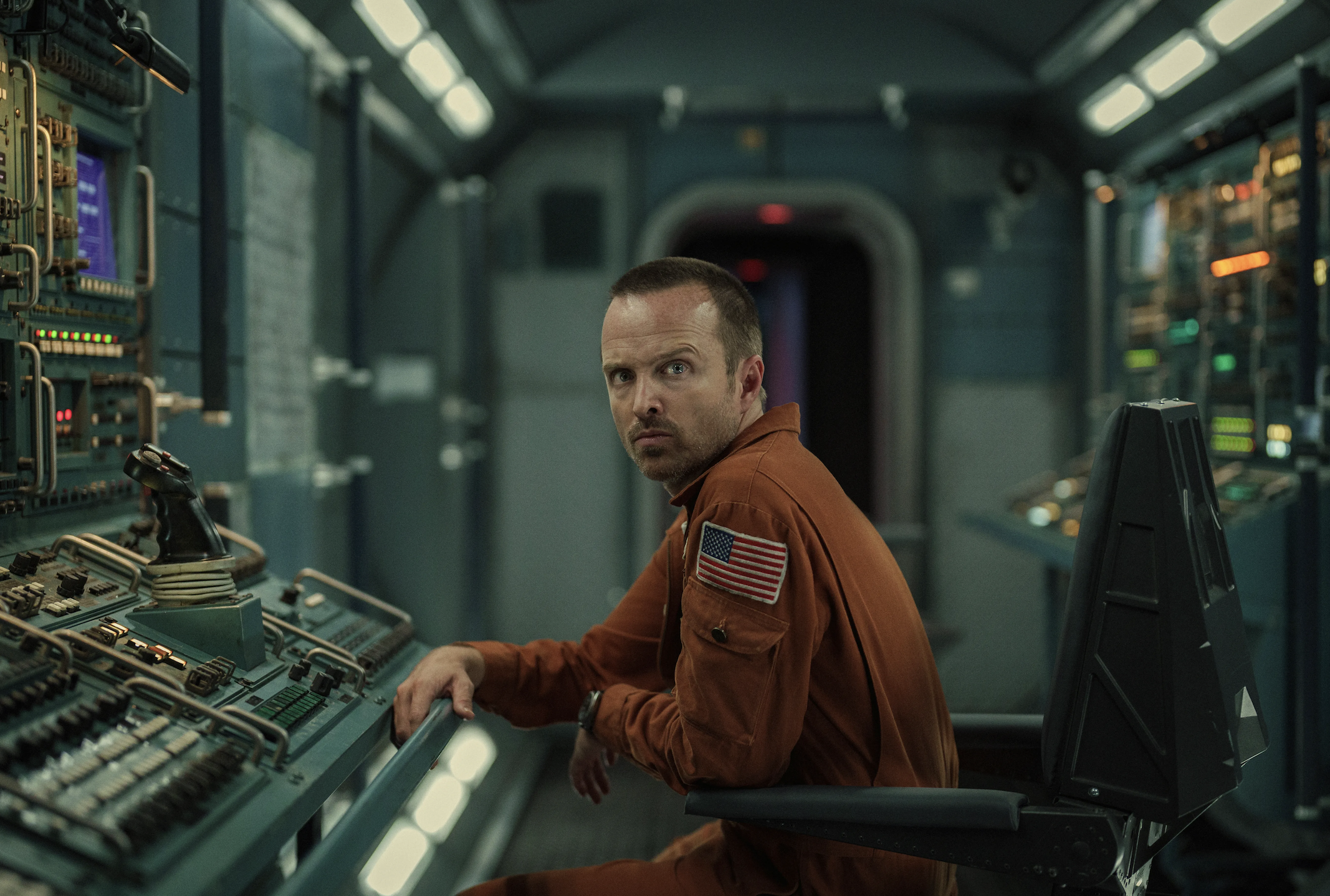
Breaking Bad’s Aaron Paul, 40 Days and 40 Nights Josh Hartnett, and House of Cards Kate Mara round out an all-star cast in this sci-fi flick set in an alternate 1969 where two astronauts are on a six-year manned space mission. To keep sane, they both have Avatar-like android replicas back on Earth that they can jack into, allowing them to spend time with their families. When one of the astronaut’s family is murdered and his avatar destroyed, he sinks into a deep depression. The other astronaut allows him to use his avatar as a form of therapy, but this involves inhabiting the body and family life of another man. This episode is slow, cerebral sci-fi with a small cast and just a few set pieces. One has an idea that all is not going to end well. It’s a bit like a reverse-Avatar, where instead of controlling an avatar to interact with Pandora’s aliens, you are interacting with humans back on Earth. One of the things I admired about the writing is that there was no attempt to explain the technology. The characters simply accept it, and so does the viewer. There’s also a subtext of 60s-era masculinity driving the problems, where neither man can talk about his emotions and both view women as possessions.
MAZEY DAY

A financially-strapped photographer has a crisis-of-conscience and quits her paparazzi job, only to take one last lucrative assignment to snap photos of a starlet-in-hiding named Mazey Day. The episode starts as a somewhat-standard the paparazzi are awful plot, showing the horde of photographers going through every devious trick to score their prize and, in general, acting like terrible people. In that way, it’s very much on theme with the other episodes’ indictment of content consumers. After all, they are getting rewarded by the consumer for their intrusiveness. About two-thirds of the way through the story the plot takes a very unexpected and delightfully bloody twist with the remainder of the episode transforming into a rollercoaster of horror. The twist itself is nothing new from a cinema standpoint, but it is nonetheless fun, and I watched it twice.
DEMON 79

The standout episode from the season is also the least Black Mirror-ish. In fact, instead of the shattered Black Mirror title logo, Demon 79, opens with a Red Mirror logo. Set in 1979 and shot beautifully in a film style that emulates 70s-era slasher films, the sets, costumes, background television clips, and color palettes are aglow in Kodachrome hues. The plot follows a mild-mannered department store worker who faces racial discrimination, retreating into dark fantasies, Ally McBeal-style, where she strangles her co-workers. When she is exiled to eat her lunch in the department store basement, she accidentally summons a demon after bleeding upon a strange talisman she finds in an old desk. The demon tells her she must kill three people in three days to prevent the end of the world. To help her, the demon (hilariously) assumes the form of the lead singer of Boney M based upon a television show the woman had recently watched, and offers to show her the sins of her potential victims to ease her own moral qualms. There is no real technology component to this episode. Instead, it is a solid horror-comedy short with a traditional story structure, great momentum, and wonderful 70s homage. It’s its own mini Breaking Bad, following the woman’s transformation from victim to predator. Worth a second watch.
All five episodes this season were excellent, and the order they were presented makes perfect sense, with the strongest two (Joan is Awful and Demon 79) at both ends, and the middle-of-the-pack (Beyond the Sea) in the middle. It’s high praise that I went back and watched both Mazey Day and Demon 79 again. It’s awesome that Black Mirror has been churning out content now for twelve years, and I hope to see a Season 7.

Hayden's World: Volume 1 - Now on Audible!
Hear Hayden’s World for the first time
It’s here! Shamaan Casey is the voice of the Hayden’s World series, and I’ve partnered with him to produce the full version of Hayden’s World: Volume 1. Hear the stress in James’s voice as he pushes Bernard’s to near lightspeed and the desperation of Jia and Ping as they crash through Titan’s murk, all brought alive via Shamaan’s expert narration. You can find HW:V1 here on Audible.


Reality versus Simulation
How closely does a flight simulator match reality? I found out last week when I flew both a real and virtual plane to the same airport.
Just how much does Microsoft Flight Simulator 2020 look like the real thing? I got a chance to find out last week, when I piloted a real Cessna 172 Skyhawk into a landing at KRDG Reading and then, the next day, repeated the same flight in Microsoft Flight Simulator 2020. Curious, I set the in-flight video side-by-side with the MSFS 2020 video. The result:
I have to say, my jaw dropped a bit at home closely the two matched up, right down to the touchdown point. That’s not to say that MSFS 2020 is just like flying the real thing - I actually wrote a Quora answer to the question of whether someone with flight sim experience could land a real airplane on the first try (what do you think? I found out that answer for real in April 2022) - but wow…it’s much closer than I guessed. You can watch the MSFS 2020 recreation of the entire 158 mile flight (thankfully condensed to 17 minutes) here:
Thoughts on Love, Death and Robots Season 3
Netflix’s R-rated sci-fi anthology returns for Season 3. How does it stack up versus previous seasons?
Each year, I eagerly awaited the release of Neil Clarke’s The Best Science Fiction of the Year. It was a cornucopia of sci-fi short stories that, hopefully, reflected the best of what was out there. It was easy to knock out a story a night before falling asleep.
Very few movies have attempted the anthology format. The 80s flicks Heavy Metal, Creepshow, and Cat’s Eye come to mind. Now, however, in the age of streaming entertainment, the anthology format marries up well with on-demand bingable content. Like my Neil Clarke book, I could knock off a story each night before going to bed.
Netflix’s Season 1 of Love, Death, and Robots was eighteen short episodes featuring love, death and/or robots. Many of the short stories were recognizable, previously published by well-known sci-fi authors. Season 1 was, however, excessive in its nudity and gore, and it seemed the point of some episodes was simply to titilate. Season 2 dialed it down to eight longer character-driven stories. Indeed, one episode of Season 2 was simply about a scientist observing how townspeople reacted to a dead giant man who washed up on their beach (and it was strong episode, not relying on machine guns or explosions to keep the viewer’s attention). So, when Netflix announced Season 3’s release, the million dollar question was: what format would they follow?
Fortunately, Netflix paid attention to their Season 2 reviews and followed suit with Season 3, releasing nine episodes on May 20, 2022. Similar to Season 2, there is almost no nudity, although they did dial the gore setting up several ticks. Nearly every episode has graphic violence, and I will admit that I became a bit numb to it by the end of my binge-fest. Like previous seasons, there are a variety of visual styles ranging from hand-drawn cel-shaded traditional animation to photorealistic CGI real enough that you’ll wonder if they subbed in live-action actors. You will immediately recognize several of the shorts as classic sci-fi stories by names such as Asher, Swanwick and Scalzi. There are no bad episodes (although there is one episode that isn’t my cup-of-tea, but that doesn’t make it bad), and all of them are memorable in their own way. Similar to Season 2, I have no best/worst list because the quality of all of them is excellent; instead, I’ll give my thoughts on each.
Three Robots: Exit Strategies

There is always a Scalzi story in Love, Death and Robots. This one is a sequel to the Season 1 episode featuring three robots touring a post-humanity wasteland. It’s classic Scalzi humor: a bit political, snarky, and dry. I was ambivalent about the Season 1 version of this episode, and Season 3 felt like more of the same, so for me I was tempted to skip to more interesting episodes about half-way through this one. Not bad, but I personally have never found the three robots very funny.
Bad Travelling

Based upon a Neil Asher story, this a fantasy flick set nearly entirely upon a sailing vessel. When a sea monster occupies the ship’s lower decks and demands human meat, the crew faces some bloody and savage decisions about how to proceed. Everything happens by torchlit-night and the vibe is gothic horror. A morality play drenched in blood.
The Very Pulse of the Machine

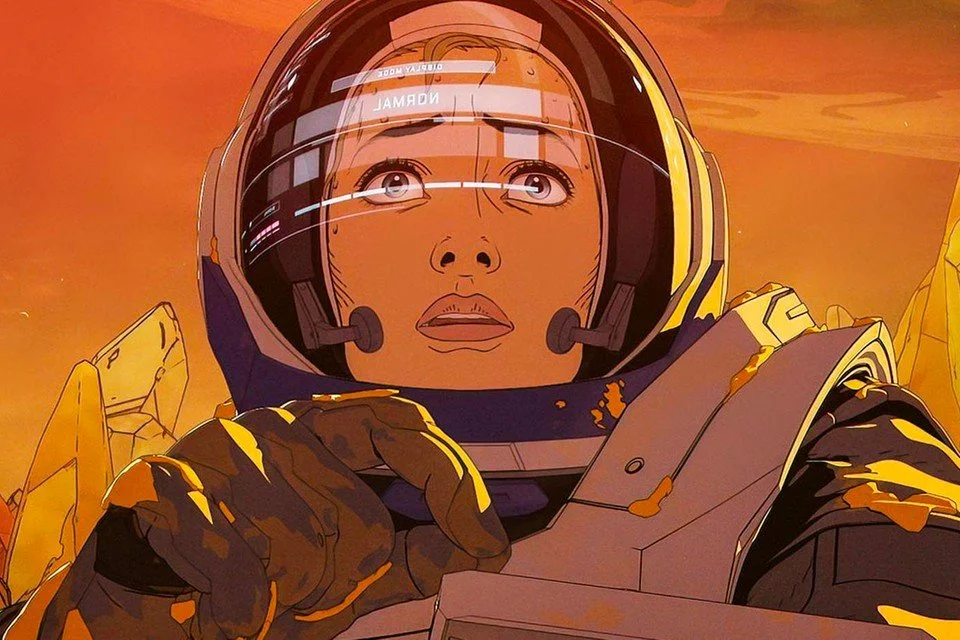
There always is a breathtakingly-cel-shaded episode in Love, Death, and Robots, and The Very Pulse of the Machine is gorgeous, set on Jupiter’s moon Io. After a rover wreck kills her companion, a woman must drag her companion’s body kilometers across Io’s landscape to rendezvous with a shuttle. When she starts hearing the slain woman’s voice, she’s unsure if it’s drug-induced hallucinations or something else. Surreal and trippy, this episode is a winner worth watching more than once.
Night of the Mini Dead

If you’ve ever played a 4X computer strategy game, you’ll recognize the bird’s eye view as you watch hordes of tiny soldiers class with enemies. Night of the Mini Dead is just that: the zombie apocalypse on fast-forward shot with a tilt-lens effect as if you were looking down on a diorama. It’s fun and zippy, a little snarky, and something that will leave you with a smirk on your face.
Kill Team Kill

Based upon a story by Justin Coates, this episode is hand-animated in a style and tone reminiscent of Heavy Metal. The opening of the episode features a man urinating directly on the camera’s view, the man relishing in what he’s doing, complete with visible cartoon-drawn genitals. That’s pretty much the tone of the entire episode. The story is about a special ops unit that encounters a “honey badger” - a cybernetic grizzly bear killing machine. It reminds me a bit of the grizzly bear scene in Annihilation, if the grizzly bear were a T1000. The violence and gore is dialed up to eleven, and the F-word is used like breathing. It’s intended to be so overly-macho that it slips into parody, spewing out lines like, “Sarge, can we have permission to die now?” On the plus side, though, I was impressed by the directing of the action. It’s difficult to portray chaotic action clearly in a way that the viewer knows exactly where everyone is and what is happening, but Kill Team Bill does a great job at this. When a character scampers back on all fours, dodging snapping jaws and claws, it has a realistic chess-like logic to it with the viewer anticipating when he’ll run out of moves. The ending credits song features a death-metal verse “F-you, honey badger” shouted over and over, which, once again, emphasizes unapologetically that this episode is just what it is.
Swarm

Based on a story by Bruce Sterling, Swarm is classic sci-fi with weird aliens, future humans, and humanity’s tendency to exploit others. There’s a slight shade of Avatar with a woman who has been studying an alien swarm that lives inside an asteroid and a man who arrives to try and exploit them. The story is interesting for both its visual beauty and its tonal shifts. It starts out magical and wondrous as they two humans swim through the alien environment, discovering its amazing workings. It shifts to a brief romance, providing one of the fleeting nudity scenes in Season 3, before plummeting into a dark abyss of horror. It reminds me of an Outer Limits episode, where mankind’s arrogance always leads to its downfall. It’s worth watching more than once (although the ending horror scene is the stuff of nightmares).
Mason’s Rats

I’d read this story before by Neal Asher. A farmer with a rat problem notices his issues have escalated when the rats evolve to use crossbows and weapons. When he turns to a technological pest-control solution of mechanized rat killing machines, an all-out war breaks out in his barn. The result is The Secret of NiMH meets Saving Private Ryan, and the graphic violence is of the rat variety but is still nonetheless bloody and gory. It’s an excellent episode with a satisfying ending.
In Vaulted Halls Entombed

I’d describe this military story by Alan Baxter as Seal Team Six meets Call of Cthulu. When a military unit is tasked with rescuing a hostage from insurgents in Afghanistan’s caves, they find a brutal and otherworldly horror. Where Kill Team Kill was an over-the-top Kill Bill approach to marines versus monsters, In Vaulted Halls Entombed is a serious take. I appreciated that the military team moved and talked like a military team, and the photorealism of the the CGI was superb. The violence is very Starship Troopers: graphic, bloody, and dismembering, and the story’s resolution was unsettling.
Jibaro

Last year, Netflix stuck the landing on Season 2 by ending with the Drowned Giant. This year they chose well once again, concluding with Alberto Mielgo’s Jibaro. A fantasy piece, the story features knights in plate mail catastrophically encountering a bejeweled siren in the river. The main character, Jibaro, is deaf and consequently immune to the siren’s power, but he is also greedy, coveting the siren’s jewels. The photorealism of this story is simply unbelievable and had me questioning whether live-action actors had been subbed in. Even the best CGI often has characters with lifeless eyes or skin that doesn’t quite reflect all of the subtle muscle movements of the human body. The siren in Jibaro, though, has eyes that look completely real, filled with intelligence and emotion. I recognized the frantic style of the director immediately, as he had done Season 1’s The Witness.

Season 1’s The Witness
The Witness was a gratuitous nudity romp where a mostly-naked woman runs through the entire story pursued by another man. It was one of my least favorite Season 1 episodes. Jibaro, even though it also is a bit of a pursuit story, reels it in. There is no nudity, although there is a fair amount of violence. What’s interesting is that there is no spoken dialogue. The story conveys everything through the actions and expressions of its characters. The directing is manic and jarring, but when it settles down it is quite impactful. Memorable (in a good way) is the way I’d describe Jibaro. It’s on my “watch again” list.
So that’s it! Season 3 is solid and easily bingable in one setting. It’s a mark of quality that I intended to watch a few of the episodes a second time. Well done, Netflix.

Thoughts on Star Trek: Strange New Worlds
Paramount+ released Star Trek: Strange New Worlds, taking us back to Pike’s Enterprise. As a fan who grew up watching the classic series, what do I think?
Star Trek peaked in the early nineties. Trek fans could feast on their pick of golden-age shows: Star Trek: The Next Generation. Star Trek: Deep Space Nine. Star Trek: Voyager. After a bit of a lull, Star Trek: Enterprise attempted to revitalize the franchise in the early two-thousands. Enterprise was perhaps the first flat-footed attempt in what would become a series of misfires to ride the Star Trek coat tails. I liked Enterprise, but it was off, in the way that watching fan fiction is often off. The problem is that the heart of Star Trek is not warp nacelles, phasers and transporters. If there’s one thing I wish I could convince the writers of 2022, it’s just that. It’s not about the gadgets. If you think back to the Next Generation, you’ll instantly envision Captain Picard giving a principle-based speech to either his crew or aliens at a critical decision. If you think of Voyager, you’ll see Janeway wrestling with doing the right thing while trying to get her crew home. In each case, the crews are good, professional people trying their best to help others. Star Trek, for all of its high tech gadgetry, is fundamentally about its characters and the trials they face in their quest to do good.
The J.J.Abrams reboots somewhat exasperated the flat-footed problem by falling into the sugar-rush hyper activeness of the CGI special effects trap, a trend that would continue to modern day. His plots often used hand-waves to ignore non-sensical elements, scooting the viewer along with the next glitzy explosion to keep him from thinking too much. The first movie was, admittedly, enjoyable, however, because it tapped into a bit of the goofy sense of adventure that permeated the original series. Sure, the characters were in life-and-death situations, but they were having fun, and their fun extended to the viewer.
In the past few years, Star Trek has returned with Star Trek: Discovery and Star Trek: Picard. I made it through about three episodes of each. These illustrate my point that gluing warp nacelles onto your ship is not enough to make it Star Trek. Fortunately, you can imagine that the executives at Paramount read the tea leaves and said, “You know, there’s probably a whole segment out there that we can market to that just wants plain old Star Trek.” And so, Star Trek: Strange New Worlds was born.
I’m two episodes into Strange New Worlds and I like it. It’s not perfect, and it is, indeed, plain old Star Trek (perhaps to a fault). The opening credits encapsulate the show nicely. It’s a mix of classic elements and glitzy CGI. It’s not a nineties Star Trek series, but it’s not a Star Trek: Discovery series either. It’s somewhere in between.
The original 1960s Star Trek pilot had the Enterprise commanded by Christopher Pike, with Spock as his science officer and Majel Barrett as Number One. Star Trek: Strange New Worlds returns to this Pike-captained Enterprise. Spock is here, and the show takes some liberties by introducing Uhura as a cadet. Pike, played by Anson Mount, is charismatic and kind. He’s instantly likable and seems like the type of captain you’d like to work for. He has some crazy graying hair (sometimes upstaging him) which Anson jokes about as being “the best hair in sci-fi”.

Rebecca Romijn plays Number One. She’s serious and professional, in much the same way that Majel Barrett was in the pilot.

Spock is played by Ethan Peck. The writers have tried, once again for some reason, to coolify Spock. To all of the current and future Star Trek writers: please stop. Spock does not need to be made cooler. Strange New Worlds Spock is certainly likable, but the viewer being introduced to a shirtless Spock about to have a love scene, talking with Pike on a viewer while his scantily-clad partner reclines on the bed just seems very J.J. Abrams. Spock is not James Bond. Spock is Spock. That being said, the actor, like the entire cast, is excellent and brings a warmth to his character.

Other notable officers include:
Melissa Navia as Erica Ortegas. Warm and interesting, like the other characters, but I kept expecting her to speak Belter and to hail to Rocinante. Christian Chong as the security officer La’an Noonien Singh. Yes…same last name as Khan Noonien Singh. That Khan. I’m not sure where the writers are going with that, but I ask them: wherever it is, is it necessary? Can’t we just have a bridge crew that are their own interesting people without each person needing to have some monumental dark past? I mean, do you remember Scotty’s dark past? Chekov’s? No you don’t. Were they interesting and fun characters nonetheless? Yes they were. For the record, if we end up with a scene where Pike yells “La’an!” into a communicator, I will be quite disappointed.

In sick bay we go a little off the rails with Nurse Chapel, played by Jess Bush. For some reason the writers have given Nurse Chapel a borderline personality disorder where she likes to surprise-inject people with painful hyposprays because it’s “more fun that way”. I imagine they were shooting for quirky but ended up with someone you’d probably get a restraining order against. By they way, none of these comments are critiques on the actors. I think they are all superb. It’s critiques on the writing.

Uhura appears as a cadet who is not sure she wants to be in Starfleet, played by Celia Rose Gooding. Although she doesn’t seem like the cool professional portrayed in 1960s Trek, she does a great job of fulfilling the role of a fresh-out-of-school talented cadet with a bright future. One could imagine how she would mature into the Uhura on Kirk’s Enterprise.

I had to think a bit about how to describe the sets, and the best description is that the series has its own look. I think, overall, I like it. There are elements of the original 1960s concepts extrapolated to the hyper-modern look of more recent Star Trek series. The result is something that’s neither over-the-top nor overly retro. It works.


And now, the plots. I was pleasantly surprised to see straight-forward plots that even took breathers for character development. Case in point: Episode Two starts with Uhura nervously attending a dinner with the Captain and other officers. A good five minutes of nothing but dialogue exchanges occurs over dinner, and we learn something about both Uhura and Pike. A lesser series would get about one minute into the scene before there was an attempted mutiny or surprise attack, but Strange New Worlds lets the characters breathe. The dinner ends not with a “Shields Up! Red Alert!”, but with Spock walking Uhura back while chatting with her about her Starfleet uncertainty.

The first episode is a Prime Directive/First Contact plot where a pre-warp civilization (think Earth 21st century) has somehow created a warp signature. Contact was lost with the Starfleet ship sent there to investigate. When Pike and crew arrive, they must beam down to the plant disguised as locals to find the missing crew members and determine what’s happened. The resolution involves a classic captain’s soliloquy to the alien leaders. It feels like Star Trek. This could easily be a Captain Picard speech, and you feel like you’ve seen this setup before. In fact, it’s a basic plot from classic episodes that has one element spun (how they created the warp signature and what it will be used for).
Episode two has a comet on a collision course for a planet that houses a primitive civilization. When Enterprise attempts to nudge the comet away from the planet, they discover it is actually a technological device. If this plot sounds familiar, it is, essentially, a spin on the 1960s episode, “For the World is Hollow and I Have Touched the Sky”. In that episode, Enterprise is sent to divert an asteroid on a collision course with an inhabited planet. The asteroid is technological, and contains an entire world within it. The world’s inhabitants are oblivious to the fact that they live in an asteroid, and they are kept that way by a central computer. Similar to Strange New World’s episode one, episode two is a mash-up of classic episodes with one element flipped. Pike and the Enterprise crew resolve the situation not with force but by being clever, which, once again, is a good thing.
So, what to make of it? I like it. It feels like its own show, which actually says a lot considering it is using several pre-established characters and events. The environments are a bit magical, in the same way that the Lost in Space Netflix series does an excellent job of evoking a sense of adventure and wonder with its strange locations, and I hope there are many actual strange new worlds ahead of us in the series.

The crew is very likable and every now and then the shows pauses to let them be people - which is something that’s been lacking in so many recent Star Trek attempts - and they do have the classic Star Trek vibe of good people trying to do good things. The plots feel a little lazy so far, dusting off classic episodes and swapping out one thing for another to call it something new, but the execution of the episodes is done well and both have been enjoyable. I’m cautiously optimistic about where the journey is heading, and looking forward to the next episodes to find out.

EDIT: Just watched episode three and…it’s Star Trek: Discovery pastiche. SPOILER ALERT: In the span of one episode, Number One and the Security Chief have a karate battle in front of an imminent warp core breach while revealing that they are both augmented humans. The doctor reveals that he has his terminally ill daughter suspended in the transporter, hidden from crew. Number One resigns from Starfleet due to being from a forbidden genetically manipulated race that was eradicated, but Pike agrees to overlook it. Note none of these are the primary plot of the episode, which was about a pathogen that travels via light. To the writers: this is such weak, insecure writing. This is like cooking a steak but believing that your cooking skills are so inadequate that you need to dump an entire bottle of A1 sauce on it to save it.
From a writing standpoint, here’s the problem in a nutshell for shows like Star Trek: Discovery or Strange New Worlds E3: If you think of classic Next Generation episodes, the one hour episode structure always had an A and a B plot. The A plot was usually the main situation the crew was dealing with, while the B plot was some smaller crisis that one or two characters faced. Ideally, the two were related. The characters learned something from the B plot that helped resolve the A plot. The problem with recent Star Treks and Strange New Worlds: Episode 3 is that there is an A, B, C, D, E, F, G, H, I, J, K plot. It’s the writing equivalent of going overboard with CGI special effects. Calm down. Less is more. As a viewer, I find it a bit insulting that I’m not trusted to continue watching unless something new and shiny is dangled in front of my face every sixty seconds. I started out this review specifically commenting how nice it was to have an episode start with Pike’s dinner party where people spent five minutes talking and eating dinner. No one grabbed a steak knife and lunged at Pike, secretly revealing themselves as an assassin. We got to know the characters, and they had normal human problems (Uhura has doubts about her role in Starfleet). It was actual writing. Please do more of this.
POST EDIT: After watching a few more episodes, my opinion has improved. The most recent episodes, “The Serene Squall” and “The Elysian Kingdom” were more traditional Star Trek plots. I still have the vague complaint that they are recycling ST:TOS and ST:TNG episodes by swapping out one element for another. I also find that the writers aren’t quite sure what to do with the crew, so they either find a way to remove the non-primary plot characters (by having them spend the episode injured in sick bay) or they go the other route and give every character a story. But, other than those gripes, the crew is personable and interesting, and I like them as characters. This is something that some of the other Star Trek series, such as Star Trek: Enterprise, never quite achieved.

Getting Real
What happens when a sim pilot flies a real Cessna?
From my view in the pilot’s seat, the runway streaked underneath me as the airspeed indicator crept up, the rumble of the full-throttle engine muffled by my headset. As I pulled back on the yoke, the Cessna’s nose lifted and the yoke pulled back, as if I were holding the plane up with my own strength. The jolting vibration of the wheels jostling upon runway subsided as my weight shifted back and down into the seat. Now, nothing but air supported the plane. Blue sky crept down, displacing the ground in my vision, and the C172 climbed into the sky.
This could be a scene from one of my books with James at the controls, but it was real, and I was actually flying that Cessna. I’d been thinking about flying lessons for a while now, and the first step in that journey was a discovery flight to see if real flying was for me. I’d been an enthusiastic fan of simulated flying - I have a YouTube channel where I post Microsoft Flight Simulator and X-Plane flights. Would those countless hours of simulated flight help me at all when I got behind the controls of a real airplane?
I planned on writing a long blog post about it, but the day after my flight I made a YouTube video where I described the experience. I don’t think any words that I write on a blog can capture the emotion in my voice, so I’ll just direct you to it. Check it out here:
Some photos from my flight. (The in-flight photos were taken while my instructor had the controls)

Tractoring out our plane, N80471, a C172 Cessna Skhyawk. The hangar was filled with different models of planes and it was fun just to plane spot while we were getting set up.
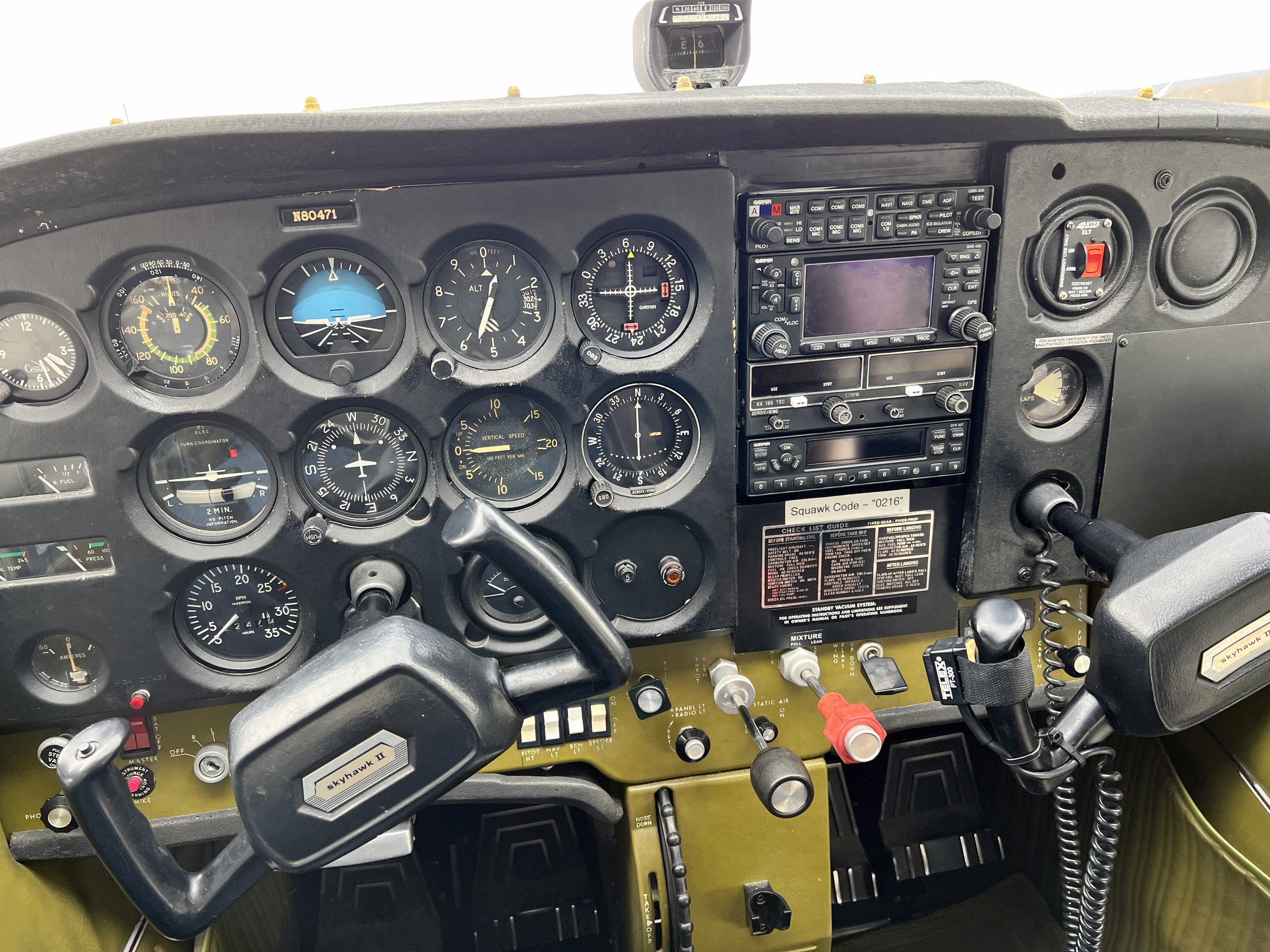
My view from the left seat of the Cessna. It looks intimidating, but it nearly perfectly matched the model I’d used in the flight simulator.

My view from the left seat. Our altitude is around 3500 feet.

My view over my left shoulder. There were lakes and reservoirs in the area, and this made it easy to get my bearings.

View while making a left turn, with the left wing dipped towards the ground. Turns are one of the plane handling items that matched the simulation experience fairly well, and I think the simulator helped me execute them better.

Look at that smile! I’m having the time of my life.

It was a bit overcast during my flight, but the clouds parted just after landing, and I got this sunset shot in front of the plane I’d just flown.
Thoughts on the Matrix Resurrections
It’s been twenty-two years since the first Matrix blew our minds. How does the Matrix Resurrections measure up?
In 1999, I recall sitting on a couch watching television when a movie ad appeared. “What is the Matrix?” asked a sunglass-clad actor. Keanu Reeves stood on a rooftop as the actor jumped impossibly high and landed on the next skyscraper, Keanu uttering, “Woah.” It looked vaguely sci-fi, or perhaps superhero-ish, and I was mildly interested. When it released to movie theaters, I went to see it, and…my mind was blown. Here was Bill & Ted’s Keanu opening up a serious can of whoop-ass, dodging bullets in bullet-time, with a sidekick who could run up walls, wrapped up in a mind-bending plot about escaping from reality. There are very few movies that I’ve seen in the theaters more than once, but I returned with some of my karate school friends (and we mimicked the movie’s moves for quite some time), and a few months later when I was on a business trip and the local IMAX theatre had it, I went to see it by myself in IMAX. I bought the soundtrack, and listened to it on my daily work commute.

In 2003, I recall flipping through an entertainment magazine that had an article about the upcoming sequel, the Matrix Reloaded. It featured a clip from the first big fight scene, the Chateau battle:

I wondered, after the ending of the first movie, what could possibly be a challenge for Neo? After all, he ended the movie essentially as a god able to completely reshape the Matrix to whatever he wanted. When I went to see Reloaded, there were parts of it I really liked - the freeway battle in particular - but there was something a bit numb already filtering into the series. During the Chateau battle, for example, you could almost see Keanu going through his memorized movies like a karate student executing a kata. The whole battle was spectacular and precise, but its outcome seemed inevitable, and even Neo seemed like he would have preferred to hit the fast forward button to the spot where all of the bodies were sprawled on the ground and he was the last man standing. Still, for a series that introduced bullet-time, the freeway chase managed to show us once again something we hadn’t seen before, in a way that was exciting and unpredictable.
When the Matrix Revolutions was released later in the same year, the series took its nosedive. All of the glitzy costumes and superhuman powers of the Matrix were traded for normal humans in drab tattered sacks plotting war in an underground city. When Neo and Smith finally clash in their concluding battle, they are both so omnipotent and indestructible that it’s a bore.
Let’s face it: the Matrix should have ended after the first movie. Don’t get me wrong - the second movie had plenty of Matrix fun (although not nearly as much as the first) - but the first movie was a complete story with the Matrix defeated and our hero able to remake it however he wanted (or not at all). The subsequent movies, which tried to explain where the Matrix and Neo came from, were entirely unnecessary. It would be like making a prequel to the Planet of the Apes to show exactly how the Statue of Liberty got buried. While you could spell it all out in a ninety-minute flick, people were like, “Oh yeah. We blew it all up. Got it.”
The Matrix’s reality-is-not-real concept wasn’t new. Dark City had a similar plot with a person trapped in a false reality (and Dark City is a brilliant movie to watch all on its own. Its final reveal is equally mind-bending), but the Matrix turned anime comics into amazing live action. We’ve all seen endless martial arts flicks, but somehow the martial arts in the Matrix were like nothing we’ve seen before.

1998’s Dark City - What if your entire city and everyone in it changed every night, and you were the only one who remained the same?
There were several video games and spinoffs, such as the Animatrix, between now and then, but fast-forward to December 2021 for the release of the fourth movie in the series, the Matrix Resurrections. I watched it today, streaming on HBO Max.
There was a point in the movie’s two-and-a-half-hour runtime where my brain had enough and started distracting itself with memories of better movies, and I know exactly where that point was. It’s when two of the characters ride flying manta ray/dolphin mechs, straddling them like World of Warcraft mounts, soaring semi-seriously through the red goo pods of the human harvester fields. Right about here was where I’d realized I was in Jupiter Ascending territory. In case you rightfully forgot Jupiter Ascending, it was also a Wachowski film, featuring a hover-skating Chanum Tatum elf pew-pewing it with evil aliens.
Without getting too spoilery, the plot of the Matrix Resurrections is that Neo and Trinity must get together, for…reasons. Yes, yes…they died at the end of movie three, but like Spock’s noble sacrifice in Wrath of Khan easily being undone by the studio’s desire to have more sequels (and indeed, Spock did live long and prosper after his death, thriving well into the Next Generation), Neo and Trinity are resurrected. Other dead characters, such as Agent Smith, are also resurrected, while some (without naming them to avoid spoilers) are digitally rebranded.

In some ways, the Neo/Trinity portion of the plot reminds me very loosely of 2011’s The Adjustment Bureau. In it, Matt Damon’s character needs to interact with Emily Blunt’s character, but not too much. Forces in the movie are trying to ensure the two walk the fine line between just enough and not too much. Similarly, Neo and Trinity are linked but must be kept apart.
The Adjustment Bureau, based on the Phillip K. Dick story. Phillip K. Dick also wrote A Scanner Darkly, which starred Keanu Reeves.
The best thing about Resurrections is the performance of its villains. Jonathan Groff (Mindhunters, Hamilton), is excellent as Agent Smith. I’m sure you’ve seen the trailer with him yelling, “Mister Anderson!”

Neil Patrick Harris plays Neo’s therapist, who works very hard to convince Neo that his delusions of being trapped in an alternate reality are just that - delusions. He’s at his best when the script lets him be manipulative during the first half of the movie.

Much of the movie is about getting an emotionally-scarred and somewhat-powerless Neo out of the Matrix, and then an Oceans Eleven style caper to break Trinity out. Neo’s sole remaining power is a Witcher-like Aard telekinetic blast. If you’ve played the Witcher games, that’s a minor power that you mash the A button on your controller periodically to buy you a few seconds. Neo uses it mostly the same way here. It does fit in the plot that he’s been in the Matrix for so long that he’s forgotten who he is and how to use his powers, but I was expecting a “he’s starting to believe” moment. There’s a slight escalation of his telekinetic blast to stop bullets, but everything you saw in the trailer is it.

The action sequences are…straight forward. During the fights, at first I thought that everything was slowed down and mushy because the main actors are a bit older - but this style extended to the 20-something actors as well. Unlike the government building battle of the first movie, where Neo and Trinity run between marble pillars as bullets zing and crack into rock, characters in Resurrections simply stand still in the middle of hallways as dozens of soldiers shoot automatic weapons at them, somehow missing as if they were firing blanks

The ending battle morphs into a World War Z zombie hoard and truly feels like a video game, with helicopters shooting missiles and characters dodging explosions. There’s no memorable Matrix Reloaded freeway chase or Neo with the chain gun in a helicopter freeing Morpheus. Well, actually there is the helicopter chain gun scene, complete with the same exact camera shot looking up as the shells rain down. This is certainly meant to pay homage, but so much of the movie either recycles the first movie (in some cases doing a split screen with footage of the first movie beside the current in case you somehow miss it), or does on-the-nose references, like Neil Patrick Harris’s black cat named Deja Vu, complete with a food bowl with giant white Deja Vu letters. The only thing it’s missing is a blinking arrow pointing at the cat. My other complaint about the action scenes is that they simply decide that they are done at some point. During an early battle with Agent Smith, Neo telekinetic blasts him through a wall and then switches gears to calmly chat with his team in the same location, as if Agent Smith won’t just dart back in through the hole and continue the fight. Fortunately for Neo, Smith just gave up, I presume.
So, with all of this negatively, what is it that I liked? I liked the clever self-awareness. Neo is trapped in the Matrix believing he is a computer programmer who created an insanely popular trilogy of computer games called the Matrix that featured all of the characters and plot of the Matrix movies. On his desk, he has a Trinity action figure falling backwards shooting both guns, and a Sentinel figurine. Whenever he believes anything from his previous life was real, his therapist redirects him to acknowledge this is the fantasy world he’s built for himself. Neil Patrick Harris, as his therapist and gatekeeper, is quite a brilliant touch to keep someone in the Matrix. The rebooted Agent Smith has a different personality than the original, but it works. He’s confident, cocky, and in control. The seething disdain of the original Smith is gone.
Overall, however, we didn’t need a fourth movie. I’d place the quality of the fourth movie on par with the third, which is to say…not great. It’s hard to be negative because I really like Keanu Reeves and all of the actors in the movie, but there wasn’t much point to the movie other than to give Neo and Trinity the happy ending they were denied at the end of the third movie. I get the feeling that the Wachowskis are more into the Neo/Trinity love story than the rest of us. Even in the first Matrix movie, Neo and Trinity’s relationship was incidental. When I excitedly recruited my karate school to go see the original movie, it wasn’t, “Hey guys, you have to see this romance!” So, in my mind, I think I’ll just remember Neo flying off at the end of the first movie, with the sky as the limit for what he’ll do next.
Thoughts on Squid Game
Once again I’m the last person in the world to watch something popular. What did I think of Netflix’s Squid Game?
Continuing on my theme of being the last person in the world to watch something trendy, this week I binged Netflix’s Squid Game. If you, like me, are the last person to see it, I’ll summarize it as a group of contestants play a series of deadly games in pursuit of a giant cash prize. The series follows Seong Gi-hun, a down-and-out gambler pursued by ruthless loan sharks, who seeks to get out of debt and maintain custody of his daughter. One day, he meets a well-dressed man who carries a briefcase full of money. The man invites him to play a simple game, promising the money if Seong wins. When Seong loses and admits he doesn’t have the money to cover his wager, the man suggests Seong can pay with his body, slapping him in the face. Seong catches on and they continue - lose, slap, lose, slap - until finally Seong wins. When the man hands him his small cash prize, he invites Seong to play a different game where there is real money to be won. It turns out that Seong is one of 456 players to accept this invitation, and soon he is ferried (literally) off to an unknown island that houses a Bond-villain type of lair. The 456 players all dorm together and are dressed in identical green tracksuits. The only thing that differentiates them is the player number printed on their tracksuit.

Seong Gi-hun, played by Lee Jung-jam
Perhaps the first hint that something is terribly wrong is the appearance of the facility’s staff, who all wear pink jump suits with black fencing masks obscuring their faces. Each mask has a symbol - a square or circle - that looks like something printed on a Playstation controller.

The facility looks like something from a video game, and there’s a playful camaraderie as the 456 players head off to their first content, the children’s game Red Light, Green Light. If the pink faceless jumpsuits didn’t tip them off that something was wrong, then the guns that open fire on all the contestants that fail to freeze for Red Light certainly does. The first game is panicked blood bath, killing off half of the players. There are several more games to come.
What follows is a Breaking Bad-like spiral for the remaining players. People quickly realize that the cash pot increases by a million for each player’s death, and it doesn’t matter if that death occurs in game or in the darkness of their dormitory’s night.

People who are already ruthless continue to be ruthless, but people who were kind find themselves in a dog-eat-dog world where their morals are gradually compromised as they do what it takes to survive. Clans form, Survivor-style, and Seong’s clan is composed mostly of the good guys. To the writer’s credit, the episodes spend time with each of the characters, and when the inventible betrayals occur, the viewer feels them. One of the games near the end is especially brutal when it pits allies against each other, and some of the good guys do awful things to be the one left still breathing.
The facility’s overseer, the Frontman, has an interesting line mid-season where he comments that the game is an equalizer. Every person comes from different disadvantaged backgrounds, he says, but in the game they are identical and for once in their lives have an equal chance at the money. Note his assessment isn't quite true - some of the games rely on physical strength and the physically stronger are at an advantage in these - but it is a theme for the show. The series is about inequality and desperation, and the choices you make when you’re desperate.

The Frontman. If your host is dressed like this, this also is not a good sign.
If the idea of contestants playing to the death to win a fabulous cash prize sounds familiar, there’s a long history of this in cinema.
The Hunger Games is the most recent similar story about a contest to the death, although its contestants were picked by lottery.

1987’s The Running Man even had a game show host for its lethal contest
1985’s Gymkata had a mountain obstacle course of doom
In a way, the set up reminds me of a murderous version of Willy Wonka and the Chocolate Factory. After each mishap, pink jumpsuit guys come out like Oompa Loompas to clean up the mess, but all of the players continue on nonetheless for the promise of the final prize.

It also reminds me of Most Extreme Elimination Challenge (which itself was a repurposing of the original gameshow Takeshi’s Castle). Granted, people weren’t playing to death in it, but I can imagine that falling face-first into a giant roller would leave a mark.

The other obvious comparison is to 1999’s Eyes Wide Shut (in particular in Squid Game’s third act when wealthy, golden-masked benefactors show up to watch the games).

Tom Cruise in Eyes Wide Shut.
The Netflix version of Squid Game that I watched was dubbed, but I think there’s also an option to watch in the original language with subtitles. I think I would prefer subtitles, to hear the actors’ performance.
What to make of Squid Game? The fact that I’m writing a blog post means it succeeded in getting me to think about it after it concluded. I enjoyed the later parts of the series more than the earlier, because they became very character-focused. Even the story’s hero didn’t always act very heroic. There was a message that, even if you think you’re the good guy, you may be one dire situation away from tabling your morals and principles.
The story’s wrap up concludes with a final game and a winner, and is both expected and satisfying. The plot that follows, however, flops flat and feels like it missed on an opportunity to show exactly what the money did for the winner. There’s a standard writer’s element for character-building called “the lie that the protagonist believes”, and often it is what the protagonist seeks through much of the plot. The wrap-up flirted with the idea of having the money but not wanting it anymore, but then pivoted for a big character twist right at the end. I won’t spoil it, but it seemed tacked on, and didn’t quite work out as a twist for me.
Do I recommend Squid Game? Yes. Keep in mind it’s very violent - hundreds of people are executed or murdered and there are side plots involving organ harvesting that are gory, so be aware of what you’re signing up for when you watch it. But, the series will leave you thinking a bit about its themes, and the character conflict and macabre curiosity for what the next game is will keep you hooked.

Thoughts on Amazon's The Wheel of Time
As a long-time Robert Jordan fan, how do I think Amazon is doing with their newly-released Wheel of Time series?
As a writer, I was a surprisingly late bloomer as a reader. Growing up, I loved movies, and it wasn’t until I ventured into Dungeons and Dragons and other tabletop RPGs that I delved into my first novels, all D&D adventures by R.A. Salvatore. In the early 90s, physical bookstores reigned, and I remember perusing all of the colorful paperback covers until one caught my eye. In it, a man reached up for a glowing gold sword. The bold blue title text read, “The Dragon Reborn”. I had a habit, then, and still do until this day, of picking a random page from the book’s interior and reading it. If I like the author’s style and handle on prose, I’ll buy it. Such was the case with The Dragon Reborn.

I actually met Robert Jordan in person. One morning, while I was brushing my teeth, a friends texted Robert Jordan will be signing books at the King of Prussia Mall today. We’re going. You in? King of Prussia was a bit of a road trip from where I lived, and I was supposed to be at work in two hours. Tooth brush hanging out of my mouth, I stared at the message, wheels churning in my head. I had two personal days to use for whatever I wanted this year. This seemed like a good whatever. Hours later, I sat with my friends en route to King of Prussia. The event was a book signing, and, when we arrived, the line was at least a hundred people deep. I patiently waited my turn, handed Robert Jordan my hardcover, and he signed it with a flourish. I, of course, still have it.

We hung around the mall until closing time, shopping, and when we returned to the book store, there was Robert Jordan and his agent, sitting at the same table, alone except for one chatting fan. My friends looked unbelievingly at each other. Robert Jordan, just chilling out, by himself, looking for someone to talk to. We made a beeline for the table. What resulted was a remarkably casual discussion between us and Robert Jordan. He told us about all of the things that didn’t make it into the books. For example, that the Aes Sedai weren’t sterile, but used an herbal birth control tea that every Wisdom knew how to brew. The chatting fan whipped out a camera and asked if he could take a photo with Robert Jordan. When he agreed, the fan leaned in, smiled next to him, and snapped a group shot. Our mouths dropped open. This was, of course, before everyone had cameras in their phones and taking photos actually required film. All of us flipped around and began search the mall for a store that sold disposable cameras. Simultaneously, an announcement over the mall intercom said, “The mall is closing in ten minutes. Please make your final purchases.”. Robert Jordan reacted to the announcement by closing up his books and starting to tidy his table. We learned a lesson that day. The lone fan got his prized photo because he didn’t assume he couldn’t get one.
What I loved about the Wheel of Time series is that it was mature. Where my previous sword and sorcery books were fun flights of fantasy, the Wheel of Time was an epic, complex series full of politics, factions, character building, and endless detail. To some extent, it rivaled Tolkien for complexity of world building. I encountered it at the perfect age - my early twenties - when I was looking for stories with more.
If you haven’t read the series, it’s about small-town folk from a place called Two Rivers that are whisked away on a grand adventure involving a prophecy in which one of them is the Dragon Reborn, a male spell caster of immense power who can either save or break the world. In the story, women are the only ones who can safely wield magic. The occasional, rare men who can wield it go insane. There is a very Tolkein-esque array of dark forces, ranging from Trollocs to Fades and Forsaken, and the theme of a small-town young man becoming an epic hero is one that works both for Hobbits and Jedis.
The novel series spans fourteen books, some of which approach a thousand pages each. The breadth of the story is massive, and certainly a challenge for any movie or television adaption. After the success of HBO’s Game of Thrones, however, you can see how a network may be up for the challenge. The network, in this case, is Amazon Prime, and the series launched in November 2021. I admit, my first reaction upon seeing the trailer wasn’t great:
Part of my reaction is based upon my love of the Wheel of Time books. It’s a cliche, but it’s always hard for a movie or show to live up to what your imagination has conjured. My other reaction was based on the look. Much like my habit of flipping open a book to a random page to get a flavor of the author’s style, the trailer’s flavor had a certain Dungeons & Dragons costume campiness to it (more on that later), and the swirling white magic looked like the type of mid-tier visualizations that something with more budget than a television episode but less budget than a movie could afford.
The first three episodes are available for viewing now. If you haven’t read the books, the story starts with an Aes Sedai spellcaster, Moraine Damodred, and her magically-bonded Warder, Lan Mandragoran, arriving at the small town of The Two Rivers, in search of the Dragon Reborn (a male spellcaster capable of immense power). They encounter Rand al’Thor, Matt Cauthon, Perrin Albara, and Nynaeve al’Maera. The Dark Lord is also searching for the Dragon Reborn, and the orc-like Trollocs descend upon Two Rivers, forcing Matt and party to flee with Moraine and Lan. This sets up a very Tolkienesque pursuit where everyone, good and bad, wants to get their hands on the Dragon Reborn.
It’s easiest to break my reaction down into categories:
Casting: The casting is excellent. All of the actors look like how I envisioned them and project their character’s personalities well. Rand (Josha Stradowski) looks similar to Hayden Christensen’s Anakin Skywalker, but fortunately channels strength and warmth in his performance.

Moraine (Rosamund Pike) is regal and guarded, and has the ageless look that Aes Sedai are known for.

Lan (Daniel Henney) is superb. He’s an actor like The Man in High Castle’s Rufus Sewell who excels at showing the viewer the wheels turning in his head. Lan is a character of few words, yet his silences have their own unspoken dialogue.

Perrin (Marcus Rutherford) isn’t given a lot of material to work with in the first few episodes other than being traumatized by his wife’s death, so we’ll have to see how he develops.

Mat (Barney Harris) is cocky and stubborn, and a good foil for Rand. The third episode, in particular, gives him a chance to both grate on and win over the viewer.

Thom Merrillin (Alexandre Willaume) is all of the rogue you expect him to be, and has real presence.
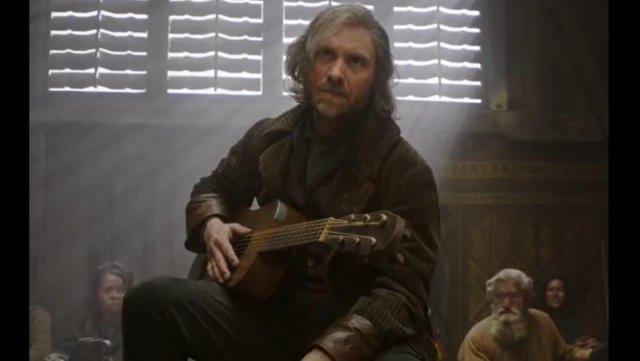
Nynaeve (Zoe Robins) is a spitfire.

So, overall, great job with the casting. My first reaction was that everyone looked young, but, then again, in the books they are. And as I get older, young people tend to look even younger.
Sets/Landscape: Throughout the first three episodes, the camera will pause to pan across a town set against a fantastic mountain backdrop. These appear to be a mix of on-location and special effects, but they really looked good. Shots have the larger-than-life, epic structures that fantasy book cover art favors. Towns, like the water-wheel powered town in the third episode, look functional and well-thought out. You feel that people could live here and that it’s not just a few set pieces plopped down as a backdrop for the characters. Nicely done.

Costumes: Here is the first stumbling point, for me. I’d describe it as “Wheel of Time by J. Crew”. All of the characters look just too hip, with modern fabrics, trendy patterns, and clothes that look like they are brand-new Christmas presents freshly donned. I found myself unconsciously looking for the size tags that you forget to remove in new clothing. Mat, in particular, looks like he’s one pair of Brooks Brothers glasses and a fall day away from being in a J.Crew catalog.

Comparisons to Game of Thrones are unavoidable, but GoT’s costumes looked functional, like the type of things one would need to wear on a winter battlefield.

Not that I want everything to be as dire as Game of Thrones, but armored warriors, like the White Cloaks, look a bit silly to me in the series:

It doesn’t quite delve into Richard Gere/First Knight territory for non-functional armor design, but it is a neighbor at times.

1995’s Arthurian mess, First Knight. If your armor is made of felt and has a turtleneck, you’re doing it wrong. Like the White Cloaks, Arthur is also a fan of the tiny shoulder shield.
Note there are some Wheel of Time townspeople shots where I appreciated that their garb reminded me a bit of the book covers. Fantasy book covers also do not usually have functional armor or dress, so emulating them in moderation, I think, is fine.
Special Effects: This one is a mixed bag. There are no bad effects, but the ghostly white tendrils of the spell weaving looks a bit cheesy.

On the other hand, the mix of practical and CGI effects for things like the Trollocs and Fade are superb. The Trolloc battle scenes in the first two episodes are terrifying.

Plot/Pacing: Lastly, although quite a bit happens in the first three episodes, the pacing is a bit slow. This isn’t a complaint. If anything, I’ve grown weary of series that need an explosion every three minutes to keep your attention, so having one that just follows Mat and Rand around as they try to earn a stay at an inn is actually great, because it’s all about character. The show does like to flip from calm to crisis in an instant, so any stretch of mundane-seeming tasks is probably going to end in someone holding someone else at sword point, but it works.
Violence/Gore/Nudity: Because this will inevitably be compared to Game of Thrones, I feel I need to comment on this. GoT dialed nudity to eleven, and episodes often contained gruesome violence. Wheel of Time has no sexual nudity so far. In fact, the only nudity I can recall is Lan’s butt as he gets into a bathtub with Moraine (the water is cloudy and Moraine is obscured). Their bath isn’t sexual - it’s just matter of fact. They’re bonded and have been through life and death together, and being naked in a bathtub is trivial to them. Wheel of Time does have a fair amount of violence and gore. Trollocs get sliced in half by the One Power, spilling intestines, and people take axes to the ribs, vomiting blood. The violence is intended to be jarring. I think the violence in GoT was matter-of-fact: in this world, people are barbaric to each other; deal with it. In Wheel of Time it’s meant to be horrific. Robert Jordan served two tours in Vietnam, and I think his experience of the horrors of battle flipping the switch from serenity to terror come across in his writing, and also in the Amazon series.
So, my verdict? I like it, and it’s growing on me. I wasn’t wowed by the first episode, but I was curious to see where it was going. The more I watch, and the more I see the character building, the more I’m appreciating it. Looking forward to episode four this Friday.

MSFS 2020 IFR Warrior II Flight: Syracuse to Teterboro
Want to go old school and navigate a 70s-era Piper Warrior IFR using nothing but nav radios and maps? Follow along in this step-by-step instruction for Microsoft Flight Simulator 2020.
When I started flight simming, VFR and IFR maps were an incomprehensible jumble of numbers, lines and colors. Still, there was something alluring about them, like a mariner on a ship unrolling an old nautical map and plotting his waypoints across it. Indeed, VFR pilots learn to do much of the same thing, using a ruler and a pencil to plot out courses and estimate distances. IFR maps, on the other hand, are almost like looking at computer code.
Modern avionics like Garmin GTN750s or even Foreflight make it easy to know the position of your aircraft at all times, and plinking away an IFR flight plan on the GTN’s touch sensitive screen coupled with an autopilot that controls all of your plane’s axis is nice. In the sim, you can engage the autopilot and let the GPS handle the flying while you sit back and enjoy the scenery. But, it wasn’t always that way. Pilots used to fly IFR using nothing more than charts, VORs, and math. Vintage aircraft may have only a single navigation radio to work with, making frequency juggling an art. IFR flight was a dance of distances, times, and tuning in radio frequencies.

In the soup! Flying the Piper Warrior in IMC (Instrument Meteorological Conditions), where you can’t see a thing. Hopefully you’re flying IFR (using Instrument Flight Rules). If you’re flying VFR (using Visual Flight Rules), statistics say you’ll quickly get disoriented, have a fatal loss of control and be dead within 178 seconds.
I love flying the Piper Warrior II in MSFS. It’s a 1970s-era aircraft with a configurable panel that ranges from modern GPSs to simple nav radios. I’ve been flying modern airliners lately in MSFS, creating complex IFR flight plans, and I thought it would be a fun challenge to fly the Warrior IFR using no GPS with only the two navigation radios and a DME. A pilot, a map, and a radio. You know, old school.
MOSTLY UNNECESSARY DISCLAIMER: This tutorial is for flight simulator use only. I’m not an IFR-rated pilot, or even a pilot (although I do hope to change that). As my video says, I’m just some guy playing a video game.
You can watch the flight here on my YouTube channel.
If you want to try it yourself, here are the instructions:
Flight Plan: KSYR Syracuse Hancock to KTEB Teteboro
KSYR TEBOR V483 FILPS V489 HUO KTEB

STRAD SKUBY NIPIE UNVIL are part of the ILS RWY 19 approach, and are added to the screenshot so you can see the approach
Flight Duration: 184 NM, 1:44 flight time
Cruise Altitude: 7000 feet
Weather: I recommend the Scattered Clouds preset, since it will give a nice mix of being in clouds and sun. I set my departure time 2.5 hours before sunset.
Airports: In my video, I used payware airports, but they are not necessary. The airports were SierraSim’s KSYR Syracuse Hancock and Flightbeam Studio’s KTEB Teterboro.
Aircraft: JustFlight’s Piper Warrior II. You can use any aircraft that has two course deviation indicators and a DME
To do this flight, you’ll need to already understand the basics of how to dial in headings using a CDI, operate your NAV radios, operate a DME, and operate your autopilot.

Left: Course Deviation Indicator 1 (CDI1), Course Deviation Indicator 2 (CDI2)
Center: COM1/NAV1, COM2/NAV2
Right, Center: Distance Measuring Equipment (DME)
Right, Top: DME source switch (NAV1 or NAV2)
A short guide to reading IFR charts:
We’ll be using Enroute Low-altitude IFR charts. These are used for IFR flights up to 18,000 feet MSL. The charts show airways, which are much like interstates for cars. In general, pilots get an on airway at a certain point, fly along the airways to their destination, then exit the airway. Airways exist to give pilots safe routes to fly where they won’t hit terrain and are guaranteed navaid radio reception.
There are two types of low-altitude airways:
Victor Airways - drawn in black, these use VOR radio signals to navigate
T-Routes - drawn in blue, use RNAV(GNSS) to navigate
For our flight, our Piper Warrior II does not have any RNAV equipment, so we cannot use any of the T-Routes. We do have two nav radios coupled to course deviation indicators, however, so we can use Victor Airways.

Victor routes in black and T routes in Blue
Airways provide a few key pieces of information:
The minimum safe altitude for a segment
The minimum altitude that guarantees you can receive VOR signals for the entire segment
The length of each segment in nautical miles
Whether the airway is legally flyable (the airway line is bold) or for reference only (the airway line is thin)

Airway examples, above:
The 4000 over V433-483 means that the Minimum Enroute Altitude (MEA) for this segment is 4000 feet. If you fly at or above 4000 feet, you are guaranteed VOR radio reception. Because this is the only number listed, it is also the Minimum Obstacle Clearance Altitude (MOCA), which is the altitude that guarantees that you will not hit terrain or obstacles such as towers.
The 23 under V433-483 means that the length of this segment is 23 nautical miles.
The 6 to the left of the word SHERB means the length of the segment connecting EATEN and SHERB is 6 nautical miles.
The round-boxed 29 next to the 6 means the cumulative distance from EATEN to Rockdale VOR (lower right of the map) is 29 nautical miles. The airway is broken up into smaller segments defined by waypoints, and each segment has a distance. Round-boxed numbers report the cumulative distance of all the segments up to this point. For example, you can see a 5 under EATEN, which means the EATEN/DINNO segment is 5 nautical miles long, and a round-boxed 34 after that, which means the cumulative distance is 34 (the last rounded boxed number of 29 plus the EATEN/DINNO 5).
The V433-483 airway is bolded black, which means it is legally flyable. The arrow pointing to DINNO with 047 written over it is thin. This line is not flyable. It’s for reference only. It gives you another way to identify DINNO when you are flying on V433-483. In this case, the reference tells you DINNO is on the 047 radial from Georgetown VOR. What would happen if you tried to fly the 047 radial line, anyway? No one knows. That’s the point. There’s no MOCA or MEA written on this reference line. For all you know, there’s a mountain sticking up or no radio reception, which would be bad to discover when you’re deep in clouds. The reason bolded airways exist is that someone has flown them and confirmed that they are safe to fly when you stick by their numbers.
In our simulated flight, there’s a point where I lost VOR reception despite flying by the numbers (because the simulator is not a perfect recreation of reality). I was in a cloud at the time. At that instant, I was flying blind.

Examples of airway altitudes: The 4000 above V29 is the MEA (Minimum Enroute Altitude) and the *3600 is the MOCA (Minimum Obstacle Clearance Altitude). When picking your altitude for this segment, it should be above 4000 if you want to have VOR reception and not crash into any obstacles.
Steps:
The flight follows the V483, V429 and V489 airways, and uses the following VORS and waypoints:
Syracuse SYR 109.9
Rockdale RKA 112.6
TEBOR, located on V433 at 38 DME from RKA
Delancey DNY 112.1
FILPS, located on V249 at 29 DME from DNY
Albany ALB 115.3
WEARD, located on V489 at 67 DME from ALB. Note you will lose the ALB signal in the simulator before reaching 67 DME (even though the IFR plate shows reception). Fortunately you can just use the next VOR, HUO, to locate it (see below).
Hugenot HUO 116.1
WEARD, located on V489 at 21 DME from HUO.
STRAD, located on the 149 radial from HUO at 18 DME
Teterboro Localizer I-TJL 110.15
UNVIL, located on the TJL localizer (195 radial) at 11.5 DME
TUGGZ, located on the TJL localizer (195 radial) at 15.7 DME
To not get overwhelmed and lost, it’s critical to “stay ahead of the plane”. This means you’ll need to always have the radios and CDIs set up for the next steps. You’ll constantly need to be entering new frequencies and toggling the autopilot and DME between the two radios. I found it to be like playing a game of chess, sliding the pieces into position several moves before they were needed.
On the ground at Syracuse:
Tune NAV1 radio to 112.6 (Rockdale RKA)
Tune NAV2 radio to 112.1 (Delancey DNY)
Set CDI 1 to 156 degrees to Rockdale RKA
Set CDI 2 to 130 degrees from Delancey DNY
Check that the autopilot switch is set up to NAV1
Check that the DME switch is set up to NAV1
Set the heading bug to 126, which is the heading we’ll fly to our initial fix, TEBOR.
Note because you will be using your autopilot to fly VOR radials, it’s very important to get your TO and FROM directions correct when setting up your CDI. Although 180 degrees TO a VOR is the same radial as 360 degrees from the VOR, those are different directions for your autopilot. It’s a bit embarrassing to reach a waypoint and have your plane turn around and go back the way it came because you chose a TO instead of a FROM.
Departing Syracuse:
In the video, I departed from runway 28. The simulator typical puts winds out of 270, for presets, so if you are using preset weather this is the runway you’ll likely depart.
Syracuse does have on Standard Instrument Departure (SID), Syracuse 2, but it is just radar vectors to your assigned fix with instructions “Climb and maintain 4000. Expect filed 10 minutes after departure.” This isn’t very different than what you’d get without a SID, which is just radar vectors to your initial fix and an assigned altitude. Microsoft Flight Simulator’s built-in ATC is not very helpful for radar vectors. ATC will say something like “proceed to your next waypoint”. If you’re using live ATC, like Vatsim, the controller will give you radar vectors (“Fly heading 126”). If you don’t have live ATC, you can self-vector by flying heading 126 (using the autopilot in Heading mode) to your initial fix, TEBOR. You’ll know you’ve reached TEBOR when:
The DME (which is measuring distance to RKA VOR) reads 38 NM. TEBOR is 38 NM from RKA on the V433 airway.
CDI 1 centers (CDI 1 is tracking the V433 airway)
The above tactic of using a distance (via DME) and a bearing (using the CDI) to pinpoint your location is the main way we’ll navigate this flight.
Per the SID, climb and maintain 4000 feet.
Once you reach TEBOR, switch the autopilot from Heading to NAV mode and check that the autopilot source is set to NAV1. This will turn the plane right onto the V433 airway and follow the airway to Rockdale VOR.

ARRIVED AT TEBOR: CDI 1 is centered and DME reads 38 NM from RKA VOR (NAV1)

The round-boxed 38 next to TEBOR indicates the waypoint is 38 NM from Rockdale RKA VOR, along the V433-483 radial.
Note the 336 number at the 11 o’clock position coming out of the Rockdale RKA VOR. V433-483 is on the 336 radial FROM Rockdale RKA. If we dialed that into our autopilot (via CDI 1), we’d fly a heading of 336 away from Rockdale. We want to fly TO it, so we subtracted 180 degrees from 336 to get 156, which is what we dialed into CDI 1. This way, our autopilot will fly heading 156 TO Rockdale.
V433 Airway
After TEBOR, start your climb to cruise altitude of 7000 feet (or if you’re using live ATC, whenever they clear you).
As you fly, the DME will decrease from 38 NM (TEBOR) to 0 (RKA VOR). Just before it reaches zero, you will lose the VOR signal as you overfly the VOR, and the DME will briefly go blank before reacquiring the signal. The CDI arrow will flip, going from TO to FROM, because you are now flying away from the VOR. Toggle the autopilot source switch down to NAV2 and also flip the DME source to NAV2. Get used to this. Since we have no standby frequencies in the Piper, we will constantly need to toggle the autopilot between the NAV1 and NAV2 radios. Note you are still on V483. V483 changes direction as you overfly RKA VOR and continues on to DNY VOR. Just like an interstate, where you’d say “get on Interstate 81 and stay on it until you reach Maryland”, you’ll get on an airway and follow it through its twists and turns.
Because we are done with RKA VOR, we can use NAV1 for something else. We’ll “stay ahead of the plane” and enter the next VOR, Albany ALB. Tune NAV1 to 115.3 and set CDI 1 to 222 degrees FROM Albany ALB

We’re going to need Albany ALB VOR (circled, upper right) and Delancey DNY VOR (circled left) to locate the intersection FILPS (circled, bottom). We’ll use the radials from both and the segment distances to biangulate our position.
V249 Airway
We are currently flying the V433 airway to DNY VOR, and the DME is counting down the remaining distance. When it reaches zero, set CDI 2 to the 130 radial from DNY. Since the autopilot is using CDI 2, this will turn the plane onto the V249 radial.
FILPS intersection is 29 DME from DNY on V249. When you reach 29 DME, toggle the autopilot and DME source to NAV1. NAV1 is currently set to track the Albany ALB VOR, so the plane will turn onto the Albany V489 airway.
Because we’re done with DNY, this frees up NAV2. We can set it up for our next VOR. Tune NAV2 to 116.1 Hugenot HUO VOR. Set CDI2 to 199 degrees to HUO.

Flying from FILPS (circled, top) to WEARD (circled center) to Hugenot HUO VOR (circled, bottom). WEARD is defined by the intersection of Hugenot HUO and Albany ALB radials.
V489 Airway
The DME is now tracking distance from Albany ALB VOR. At 67 DME, you have reached WEARD intersection on V489. Maintain your cruise altitude of 7000 until WEARD. We chose 7000 because the minimum enroute altitude (MEA) for this segment is 7000 feet.
On IFR plates, if you fly above the MEA you are guaranteed reception. In real life, I should have been able to receive the Albany VOR signal at WEARD. In the simulator, I lost it before reaching 67 DME. To get around this:
I set the heading bug to the Albany radial I was flying (heading 222) and put the autopilot in heading mode.
I flipped the DME source to NAV2, which is HUO. WEARD is located 21 DME from HUO, so I just needed to watch the DME until it ticked down to 21.
At WEARD, flip the autopilot source switch to NAV2 (which is HUO VOR). The plane will turn onto the 199 radial to HUO. Note this is still the V489 airway (which changed direction at WEARD).
Start your descent, descending from 7000 to 5000 as the DME ticks down to zero. The MEA for this segment is 4000. At zero DME, you are directly over the HUO VOR and ready for vectors to your Initial Approach Fix (IAF) of STRAD.

Note the 4000 over the V489 airway, lower left. This allows us to safely descend from our cruise altitude of 7000 to 5000.

Just like reaching your exit on an interstate, we’ve hit our exit for the airway, at Hugenot HUO VOR. You can see our flight plan now longer follows the bolded black airway line after HUO. At this point, to get safely from HUO to Teteboro, ATC would be giving us step-by-step instructions via radar vectors. Since we are flying a specific approach (ILS runway 19), those vectors will take us to the waypoints on the approach plate.
Vectors to IAF

ILS Runway 19 approach plate. After exiting our airway in the previous step, we need to get to the first waypoint in the approach, called the Initial Approach Fix (IAF). In this case, it’s STRAD waypoint, in the upper left. Note there are no VOR distances or references to locate STRAD. The only way to find it is by ATC steering you there (via radar vectors) or through GPS navigation. That’s why the very top of the plate states “RNAV-1 GPS or RADAR required for procedure entry.”
Since we have neither ATC nor GPS for this flight, we’re going to fudge it a little. In real life, you can’t fudge it.

At this point, ATC would give you radar vectors to the ILS RWY 19 Initial Approach Fix (IAF), STRAD. Since we are not talking to live ATC in this video, we will self-vector by doing the following:
Set OBS2 to the 149 radial from HUO. Fly this radial until reaching 18 DME. This will be STRAD. Descend from 5000 to 3000 before arriving at STRAD.
Before reaching STRAD, tune NAV1 to Teterboro’s RWY 19 ILS frequency, 110.15.
Set the heading bug to 131. We will need this for the next waypoint after STRAD.
Once you reach STRAD, set the autopilot to heading mode. Fly heading 131 for 4.9 NM (the DME is still counting distance from HUO, so 22.9 HUO DME is approximately 4.9 files from STRAD). This will bring you to SKUBY. Descend to 2800 before reaching SKUBY.
From SKUBY, continue flying heading 131 for another 4.9 NM (now 26.9 HUO DME) to NIPIE, descending to 2600.
Toggle the DME source to NAV1, which is the RWY 19 ILS.
From NIPIE, fly heading 150 for 5.8 NM to UNVIL, descending to 2100. You will know you have reached UNVIL when CDI1 is centered and you are at 11.5 DME.
Upon reaching UNVIL, flip the autopilot source to NAV1 and put it in Approach (APPR) mode.
Flying the ILS

The Piper Warrior’s autopilot can control roll but not pitch. You will need to manage the plane’s altitude yourself using speed and trim. CDI 1 will display whether you are left or right of the localizer and above or below the glide scope. The goal is to keep the crosshairs centered during the descent
The altitudes you need to hit to intercept the glide scope:
2100 feet at UNVIL, which is 11.5 DME from the ILS
1500 feet at TUGGZ, which is 5.7 DME from the ILS. At TUGGZ, you should intercept the glide scope.
At the bottom of the IFR plate for RWY 19 ILS are the minimums, by CATEGORY. We are CATEGORY A, which is aircraft flying 0-90 knots on final. The minimums depend on whether we are flying an ILS (vertical and lateral navigation) or just the localizer (lateral navigation only). We are flying the ILS, so we’re using the S-ILS 19 CATEGORY A numbers, which are 219-3/4. Since this is a precision approach (using an ILS), these numbers are the Decision Height (in this case 219 feet) and the Runway Visual Range (in this case 3/4 of a mile). If we reach an altitude of 219 feet and we do not have the runway in sight, we must go missed and follow the Missed Approach procedure. The Runway Visual Range of 3/4 mile just tells us that at 3/4 of a mile we should be able to clearly see the runway markings and lights in normal visibility. Note if we were flying a non-precision approach (localizer only, or circling approach), instead of Decision Height we would have Minimum Descent Altitude, which is the lowest point you can descend without having the runway in sight. In that case, you’d keep flying level until you reached the Missed Approach Point, which is a specific distance from the field where you must go missed if you can’t see the runway. Anyway, for our weather present of scattered clouds, everything will be clear at 219 feet, so we won’t have to worry about this.
The Warrior is not an Airbus with auto land capability. You will need to turn off the autopilot before reaching 200 feet above ground and hand fly the landing. Remember, the autopilot is always trying to kill you, so don’t put it in charge anywhere near the ground.
Phew! That was a ton of information, but if you followed it you should have a pretty good grasp on how to read low-altitude IFR charts and manage an IFR flight with radios only. Hope you enjoyed it!
When I’m not flying the virtual skies, I’m the sci-fi author of the Hayden’s World series. If you love exploration and adventure, be sure to check it out.

Thoughts on Chris Hadfield's The Apollo Murders
I just finished the audiobook of real-life astronaut Chris Hadfield’s historical space fiction piece, The Apollo Murders. Does it deliver everything I hoped it would?
I first discovered Chris Hadfield, like many, from his out-of-this-world YouTube music video, Space Oddity. In it, a guitar soars down a space station hallway like a CGI special effect. Chris was on the International Space Station, singing, spinning his guitar weightlessly. He followed this up with an equally amazing space duet with the Bare Naked Ladies. I went on to read Chris’s autobiography, An Astronaut's Guide to Life on Earth, and I found him to be inspirational. If you’re read my latest story, Bernard’s Dream, you’ll recognize that Ava gives James a signed copy of An Astronaut’s Guide when he’s in the hospital. It was my small homage to the book.
Every reader brings a certain expectation to what he hopes a book contains. Some see glitzy covers with spaceships and conjure up exciting battles. Others know their author's expertise and want stories filled with technical marvels and accuracy. What to expect from a commander of the International Space Station who writes 70s era NASA fiction? I hoped, as I stared at the cover, that I would get scenes where I was the astronaut reclined in my capsule seat, a massive Saturn V rock underneath me, with the Mission Control countdown ticking in my headset. I wanted to know what it was like to feel the gees and the kick of stage separation, or the clumsy low-gravity bounce of a first moon step. Would the story deliver this implicit promise?
The Apollo Murders delivers exactly that, following a group of astronauts and mission planners on a fictional Apollo 18 Moon voyage (in real life, Apollo 17 was the final mission). The Apollo 18 mission is more of a military adventure, with plenty of U.S./Soviet Union Cold War conflict fueling its plot. Chris Hadfield does an excellent job of crafting a small, focused cast of astronauts, controllers, and Russian agents, placing them in claustrophobic situations where everyone has reason to distrust each other. Are there murders? Indeed, there is quite a body count by the story's end, although most deaths are from combat. And there is, surprisingly, combat. Armed space stations and pistols squirreled away in spacesuits. Spacewalkers trying to fight their way onto each other's ships. Bodies buried on the moon. It's not, say, Moonraker’s level of space mayhem, but there are small struggles peppered throughout the story’s second half.
1979’s James Bond flick, Moonraker, going all-in on the final Bond-villain lair assault. No worries - The Apollo Murders reigns in its battles and keeps them small and plausible
At first, I thought the weapons seemed out of place in a 1970s historical space fiction piece, until I read the afterword about the real-life events that inspired the story. Those events included actual armed space stations and cosmonauts with pistols.
The Apollo Murders has splashes of Apollo 13, First Man, and Space Cowboys written in a style reminiscent of Tom Clancy.
2000’s Space Cowboys. Although the Apollo Murders’ mayhem is lower-key than this, scenes like this will seem familiar
1995’s Apollo 13, with a famous creative problem-solving scene involving duct tape and carbon scrubbers. The vibe of the Apollo Murders is closest to this scene.
2018’s First Man, giving you a taste of the physicality of space flight
When you read a Clancy story, a fighter pilot doesn't just fire a missile; instead, the prose zooms in on the connection of the fire button sending its signal traveling down through wires, igniting the missile's rocket motor, clamps releasing, and radar guidance engaging. Hadfield's prose is like this. When an astronaut flips a switch, we'll know exactly the sequence of events that follows. At times, it's a brilliant enhancement. A harrowing helicopter crash details the fatal consequences of a pilot's simple movement on a flight stick pulling a critical linkage loose. I felt a pit in my stomach as the logical and deadly sequence of events unfolded, the prose following the pilot’s desperate attempts during the subsequent spin and crash. This scene worked so well because the reader knew the pilot was going to die before the pilot did, and watching it unfold was like watching an accident you were powerless to stop. At other times, the omniscient technical view can get in the way of some scenes’ pacing. The plot itself is a push and pull between the U.S. and Soviet Union, both of whom want something on the moon. The conclusion of the book is very action movie-ish and also has a certain Tom Clancy vibe to it.
I listened to the audiobook narrated by Ray Porter. Ray’s narration was fantastic, slipping effortlessly into different character’s voices, accents, and even Russian dialogue as needed. Procedural stories with professionals executing technical tasks can be challenging to write, as character’s personalities may not emerge when uttering “check” and “go”statements, but Ray does an excellent job giving each person his own vocal mannerisms, so you always know who is speaking. The audiobook is fifteen hours, and I enjoyed listening to it on my daily commutes.
The Apollo Murders was a treat. If you loved movies like Apollo 13 or books like Tom Clancy’s The Hunt for Red October, this book is for you. It’s a great mix of insight into what a moon mission is like coupled with dashes of an action/adventure movie. I hope there’s more books like it in the future from Chris Hadfield.

Hardcovers Now Available
There’s nothing better than a hardcover for a tactile reading experience. The Hayden’s World novels are now available through IngramSpark.
Hardcovers are available for Hayden’s World: Volume 1, Hayden’s World: Volume 2, Bernard’s Promise and Bernard’s Dream. The books are beautifully produced by IngramSpark with full-color dust jackets, gold leaf spine text, and cream 5.5” x 8.5” interiors. You can purchase them through Amazon or any major online retailer.