
Hayden's World: Volume 1 - Now Available as a Hardcover
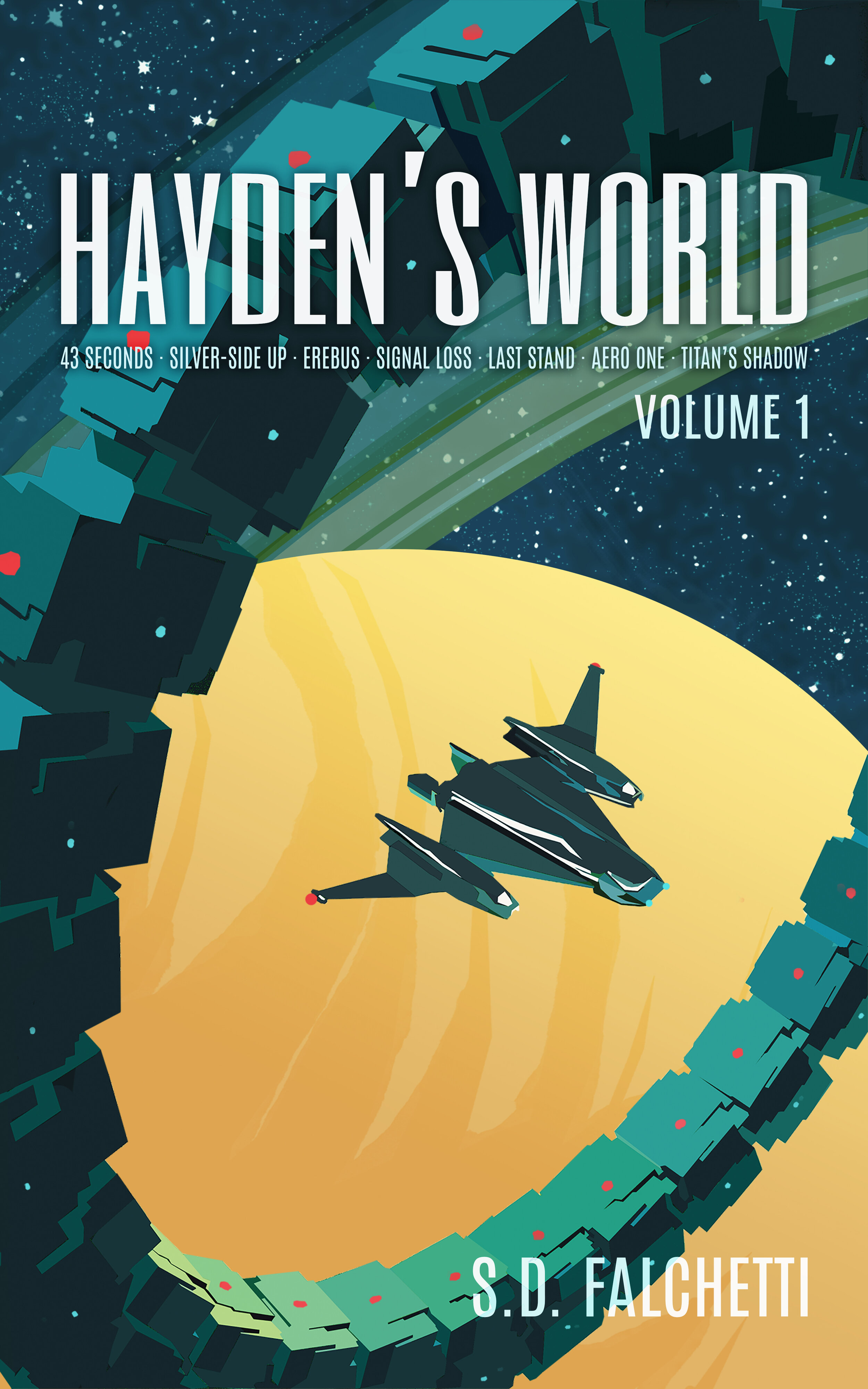
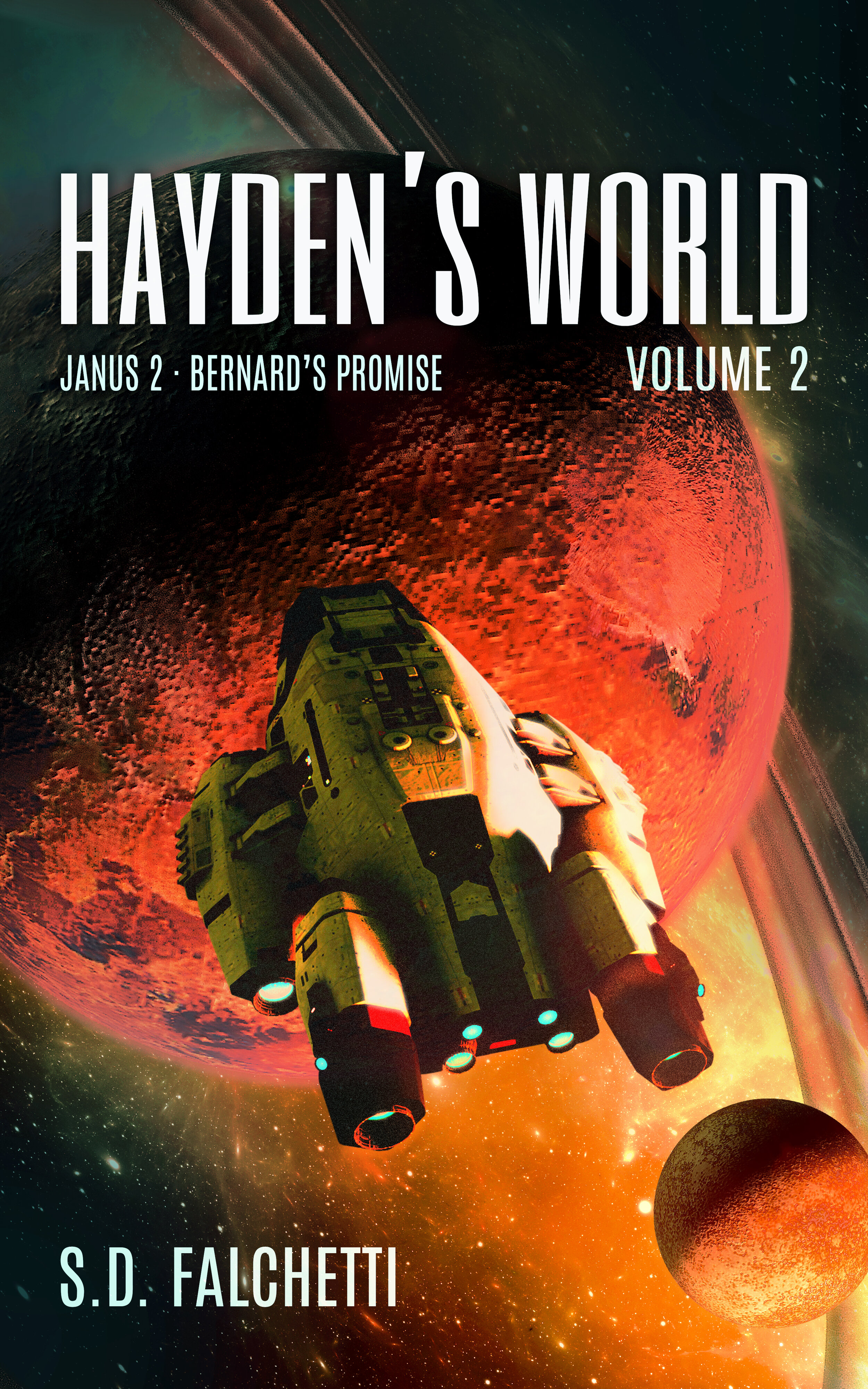
Hayden’s World: Volume 1 is now available as a hardcover produced by IngramSpark.
Hayden’s World: Volume 1 is now available as a hardcover produced by IngramSpark. The edition features a full-color dust jacket over a blue fabric-bound book with gold leaf lettering. I’m very happy with how it turned out.
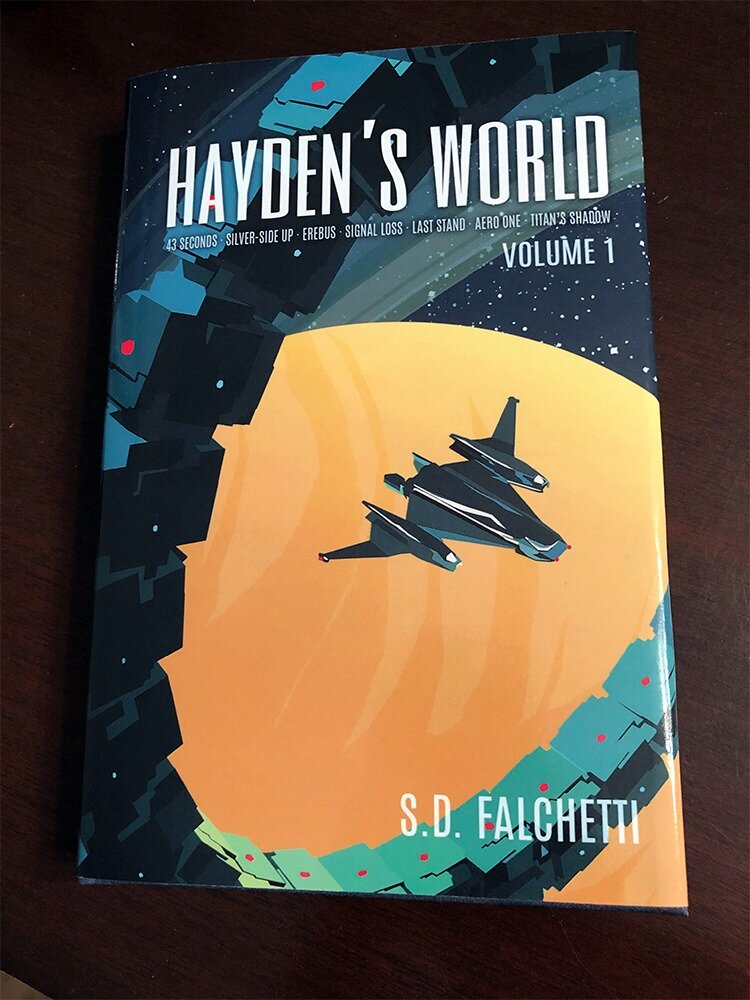
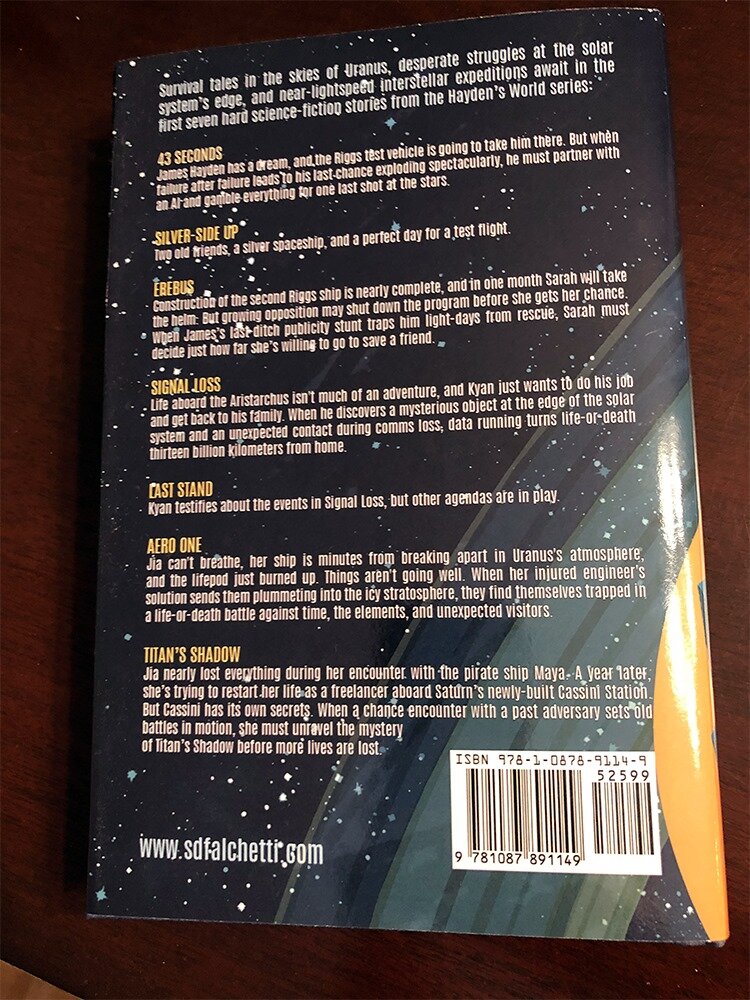
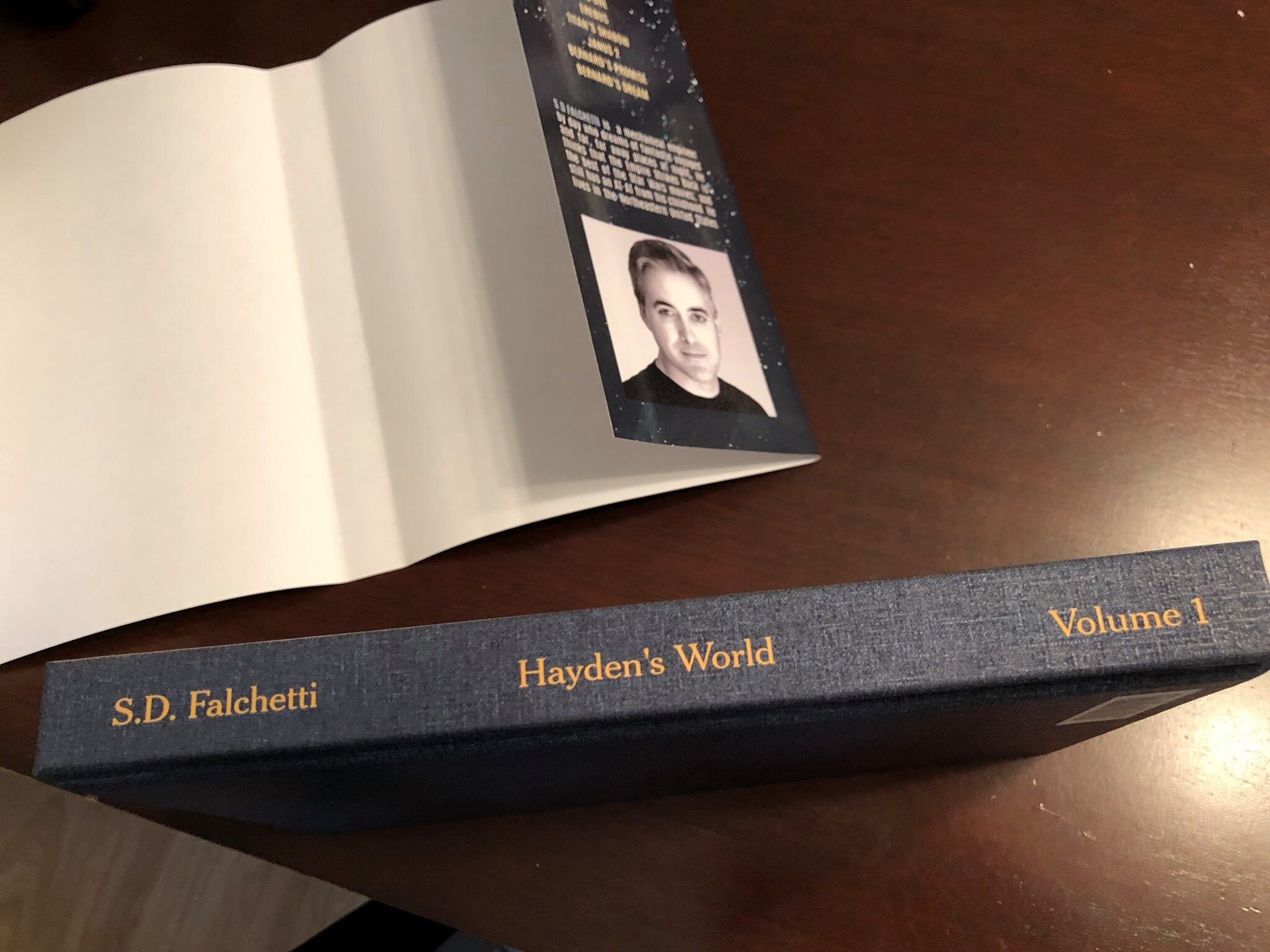
Amazon has recently added a hardcover option to KDP as well, but unlike IngramSpark’s, Amazon’s books are case-laminate only (the cover art is printed directly on the book without a separate dust jacket). Setting up the book for publication was definitely more difficult in IngramSpark’s interface than Amazon’s, but it wasn’t too hard once I understood the requirements. My interior layout was handled by Vellum, same as all of my ebook and print titles, and Vellum formatted everything perfectly on the first try. The cover artwork required significant work to extend it to cover the inside dust jacket flaps, and the technical requirements were a bit involved (although if you’ve created cover art for Amazon’s KDP paperbacks, it’s not that much different). With IngramSpark, I definitely had some confusion regarding the timing of my physical proofs and the book’s go-live dates, which almost resulted in the book going into distribution before I’d seen the proof, but it all worked out in the end. I hope you enjoy it! I have a certain fondness for dust jackets, and it’s very cool seeing my work in this format.

Thoughts on Reminiscence
Westworld’s Lisa Joy writes and directs the near-future sci-fi noir Reminiscence, starring Hugh Jackman, Rebecca Ferguson, and Thandiwe Newton. How does it fare?
We’re in a strange pandemic timeframe where new movies are few and far between and those that are released may simultaneously go to screen and streaming services. I’m curious if, once we get over the pandemic hump, the watch-from-home options will continue (I suspect they will). This weekend, I found myself pleased to find a new sci-fi offering with A-list actors available on HBO Max.

Hugh Jackman in the sci-fi noir flick, Reminiscence
Reminiscence is set in a near-future where climate change has caused ocean levels to rise and made daytime temperatures unbearable. As a result, Miami has turned into a Venice-like Sunken Coast, with boats ferrying people between neon-lit skyscrapers. To avoid the heat, people are awake at night and sleep during the day. Many people want an escape from their dreary existence and Hugh Jackman’s character, Nick, offers them just that. He and Thandiwe Newton (Watts) have a very Minority-Reportish business that involves clients laying down in a water tank while holographic projectors visualize their favorite memories. Hugh Jackman acts as a hypnotist, verbally leading clients along a path to find their memory, while Thandie operates the equipment. They record the memories for legal (aka “plot”) reasons and store them in a bank vault. The plot kicks in when Rebecca Ferguson, who plays femme fatale Mae, shows up asking for help retrieving a specific memory. Hugh Jackman is captivated by Mae, falls for her, and makes it his personal mission to discover what plot she’s entwined.
Just about every review you’ll read on Reminiscence points out that it’s derivative of other well-known sci-fi movies, and I’ll follow suit. The water tank and hologram are very much Minority Report.

Hugh Jackman in the water tank in Reminiscence

Agatha in the water tank in Minority Report

Hugh Jackman peeps through Rebecca Ferguson’s memories in Reminiscence

Tom Cruise relives a memory from when times were better in Minority Report
The idea of having a recording of someone’s memory that the bad guys want is right out of Strange Days.

One of Strange Day’s memories, saved on Mini Disc. Well, it was 1999.

Hugh Jackman guiding people through their memories reminds me of Leonardo Dicaprio guiding people through their dreams in Inception.
Visually and thematically, Hugh Jackman and Rebecca Ferguson’s relationship is very much like Blade Runner’s Ford and Young, complete with foggy, atmospheric interior shots with gold light shining in through windows.

Blade Runner’s sci-fi noir atmosphere

Reminiscence’s sci-fi noir atmosphere
The visuals for Miami’s Sunken Coast are quite good, and I enjoyed the nighttime-only city on the water views. Some reviewers have compared it to Waterworld, but I don’t think that’s a fair comparison. I found the visualizations to be original and interesting, and one of the better components of the movie.

It’s also worth noting that Reminiscence is a bit of a Westworld reunion, with the director, Lisa Joy, and two actresses Thandiwe Newton and Angela Sarafyan.

Thandiwe Newton in Reminiscence

Angela Sarafyan in Westworld
So, what to make of Reminiscence? It’s a convoluted sci-fi noir film with a detective, femme fatale, alcoholic partner, crime bosses, and a dark neon future. Like a gumshoe in 40s detective fiction, Nick offers voice-overs throughout the story. These aren’t necessarily bad elements - to become a trope, something must be enjoyable enough that audiences keep demanding it - and the similarity to other movies isn’t much of a deal-breaker for me. Certain themes, such as being able to record people’s memories, appear again and again in sci-fi, and exploring them isn’t a bad thing - but it does help if you have an interesting spin so that you’re not simply making a collage of other movies.
The main detractors for me in Reminiscence were:
The plot is convoluted, in the way that detective novels tend to be. There are crime bosses, henchman, devious heirs, prosecutors all wanting something and at times it feels like Nick is on a side-quest, leaving the viewer wondering where the movie is going. It’s the type of plot you’ll need to Google afterwards to determine how everyone was related to the storyline.
The plot is that Nick is obsessed with Mae and makes it his mission to track her down. From a stakes standpoint, he really could walk away at any time, and the bad guys don’t really care about him or even know who he is.
The two main action scenes (a shoot out at a crime boss’s club and a fist fight in a water-damaged hotel) were silly. The first was cartoonish and the second seemed to be a checklist of action scene tropes (have the fist-fighters roll down the stairway together, etc).
On Rotten Tomatoes, Reminiscence scored a 37%. I don’t think it was that bad. I’d probably score it a low 3 out of 5. I didn’t mind watching it and it was nice to have a new sci-fi movie to binge on a Saturday night, but it was (ironically) forgettable. I think the directing and acting were good but the writing and dialogue needed work. But, if you have HBO Max and are looking for something to watch, I say give it a go. It’s not a “I want my two hours back” kind of a movie, it’s a “there are ways it could have been better” kind of flick.

Aviation Procedures in Microsoft Flight Simulator and X-Plane
If you enjoy flight simulation and aviation, come join me on my YouTube channel where I have 108 videos featuring VFR and IFR flights using real-world procedures. I’ve pulled together a short list of some of the more interesting one.
If you enjoy aviation and haven’t stumbled upon my YouTube channel yet, be sure to check it out. Over the past two years I’ve made 108 videos of X-Plane and Microsoft Flight Simulator 2020 flights. It’s been a journey, and I’ve learned a lot about aviation procedures along the way. In particular, once I joined PIlotEdge, which offers by-the-book online air traffic controllers to interface with, I needed to learn real-life radio phraseology and VFR procedures. I remember when I first started being a bit baffled about how to fly in the pattern at an untowered airport. Later, learning how to talk with ATC to navigate out of a Class Charlie airport was a challenge. Even later, flying procedures like DME arcs was both fun and difficult. It always helped if I could find a YouTube video of someone doing the same thing, so I thought I’d list some of them from my channel if you’re looking to see how I tackled a particular procedure:
Class C Departure (Portland International)
VFR departures from a Class C airport will need to talk to Clearance Delivery, Ground, Tower, and Approach, and will receive a squawk code. You will also likely receive altitude and heading restrictions.
Class C Departure with Flight Following (John Wayne International)
VFR departures from a Class C without flight following will be told “frequency change approved, squawk VFR” upon departing the Approach ring, but if you have flight following you’ll keep your squawk code and be handed over to the next controller, who will give you traffic advisories as workload permits.
CTAF calls from Untowered airport to Untowered airport (PilotEdge CAT-01)The Common Traffic Advisory
Frequency (CTAF) is published for each untowered airport. Pilots should (but are not required) make calls on it to announce their intentions to other pilots.
Los Angeles Bravo Transition via the Coastal Route
The LAX Bravo is a complex airspace that has corridors carved out for VFR flights. Some allow you to fly simply making CTAF calls using Special Flight Rules. Others require precise flight paths and altitudes.
Basic IFR Flight
Instrument Flight Rules (IFR) rely on navigating with your plane’s instruments and ATC communication.
IFR Flight Planning using VOR/DME
You don’t need a GPS to fly IFR, depending on the airways you’ll fly. This tutorial takes you through the details of planning an IFR flight.
Flying an Airliner IFR
Jets add complexity but also automation, helping you get from point A to point B.
New York Bravo Hudson River Exclusion Special Flight Rules
Similar to Los Angeles, New York’s Bravo has areas carved out for VFR pilots. The Hudson River Exclusion is a scenic area with special flight rules.
NDB Approach with Procedure Turn
Non-directional beacons (NDB) are like homing signals for your aircraft. Some airports still have instrument approaches using them. Procedure turns are a series of maneuvers to precisely reverse your course.
Flying a TEC Route
Tower Enroute Control (TEC) Routes are pre-packaged IFR flight plans that let you fly between airports without needing to talk to Center. Instead, you’ll talk to Tower and Approach.
Flying the OshKosh Fisk Arrival
Every year hundreds of pilots flock to OshKosh’s AirVenture show, flying the well-known Fisk Arrival to get there.
Flying a DME Arc
Before GPS and RNAV approaches, pilots needed another way to precisely fly an instrument approach where VOR intersections were not available. Distance Measuring Equipment (DME) allowed pilots to fly an arc of an orbit around a fixed point, executing a turn to line up with the runway.
VFR Navigation using NDB, VOR and visual references with Special Flight Rules
There are many tools for VFR navigation, and I use them all here.
VFR Flying with Visual Navigation Only
The main tool a pilot needs for VFR navigation is his eyeballs. The photogrammetry in MSFS is so good that you can navigate like a real-world pilot, spotting buildings, roads, and rivers to get you there.
VFR Flight Planning using Visual References
You’ll need a plan before you climb into the pilot’s seat.
Pattern Work/Touch and Gos
I use visual navigation to fly to a Class Delta airport and execute a few touch and gos while remaining in the pattern.
I hope you enjoyed these!

Bernard's Dream: Deleted Scene
A pantser becomes a plotter, and shares a scene from the cutting room floor.
A funny thing happened as I embarked on the journey of penning Bernard’s Dream: I became a plotter. In writer’s jargon, there are two types of writers: pantsers and plotters. Pantsers write by the seat of their pants, telling themselves the story as they go along. Plotters write an outline, filling in the details as they write each scene. In real life, I am a solid plotter. After all, I’m an engineer, and that’s kind of our thing. For writing, however, I’ve always been a pantser, and that’s because I get my ideas as I write. I’m actually a little perplexed why I wrote out Bernard’s Dream as a scene-by-scene outline, but wow — it is so much easier to write a story when you have all the scenes laid out. I think the reason I was able to switch to this approach is because I felt very comfortable with the characters and goal of the story, so the scenes were clear to me. It also helped with theme. One of book’s themes is aging and time, and plotting ensured it was woven through the assorted scenes. That doesn’t mean I had everything worked out. For example, my original notes for the ending problem simply stated “The Stars need something from Promise and it’s going to be very difficult to get.” That’s quite a simplification of the multiple problem-solving scenes and climatic resolution that ended up in the book. Other parts of the outline were beat-for-beat, however. The beginning chapter outlines had exactly the scenes with Willow at Apogee, Will at the Griffith Observatory, and Sarah with the Nightcrawler.
One of the nice perks of plotting versus pantsing is that you throw less away. When pantsing, I’ll write entire scenes, decide they don’t work and then rewrite them from scratch. Quite a few scenes end up on the cutting room floor. With plotting, the only scenes I deleted were for pacing. It was actually harder to delete: they were good scenes, right on point with the story’s themes, but I could tell the reader would skim them. In Bernard’s Dream, this was the get the crew off Earth problem and scenes that got deleted stood in the way of that goal.
The single scene that got cut was titled “Captain’s Launch Party”. Here, James meets the captains and AIs of the other starships. I do intend to write short stories featuring their adventures, so this was mainly a setup scene (which is why it got cut). With it cut, you only see the other captains’ ships and briefly hear Noah Bouchard address the fleet. From a pacing standpoint, this was replaced by James and Will’s beer on the front porch the night before launch, which thematically was more on point. Here’s the original scene:
Captain’s Launch Party (original opening to Chapter 12: Dreams)
Twilight over the Amalfi Coast is spectacular from the hotel’s open-air terrace perched three-hundred-and-fifty meters above sea level. Colorful house lights speckle the residences cascading down the shoreline with curving mountains jutting from the sea. The terrace itself is adorned with amber crystal lamps, each casting their own oasis of light from slender Roman columns. James stands there, drink in his hand, taking in the sights and enjoying the fresh air of the hot July 2094 night. Behind him, the hotel’s ballroom is filled with people in formal wear. It’s the Captain’s Party for the crew of the five starships, organized by the United Nations and hosted here. The hotel is theirs for the next week to enjoy the finest luxuries Earth has to offer. Tonight is the gala, filled with speeches and photo ops. Earlier, James caught himself smiling as he shook hands with everyone at the world leader’s table. “Mister President, Madame President, Mister Prime Minister, Madame Secretary General, Mister President,” he was saying. The crews of the five ships represent Japan, China, Canada, Sweden, Spain, Finland, Hungary, Austria, the Czech Republic, Greece, and the United States. That’s a lot of world leaders. Here he was, breaking bread with them all.
Soft footfalls sound behind him and a woman’s hand touches his elbow. When he turns, Willow is standing there wearing a striking red gown with a diamond pendant dancing down into her v-neck. Her blonde hair is down and teased into waves. “Catching a little air?” she says. “Not like you to be on your own.”
James raises his eyebrows. “Had to rest my cheeks. Getting tired from all the smiling and hand shaking.”
She points to a dimple in the side of her mouth. “Get’s you right here, doesn’t it? Takes practice.”
“Probably why my movie star career never took off.”
She glances back over her shoulder. “There’s some captains that want to meet you.”
James takes a sip of his drink. “Well, now, that’s more my speed.”
She turns and walks back into the ballroom, James in tow. Soft, ambient music plays in the background and the din of conversation washes over them as they navigate amongst the crowd and tables. At this time of night, people have mingled into clusters, chatting and enjoying the party, and the demarkations of nationalities have faded. There’s something uplifting about it, seeing each nation leave the tribe of its table and merge with the others in conversation. After all, it’s what the United Nations is all about. Equally interesting is the table that contains five screens pulsing with their own colorful ripples. Ananke’s familiar blue screen is one of those faces. Two women are chatting with the AIs, and Willow leads James to them.
The closest person is a forty-year-old Japanese woman with short black hair cropping her cheeks. Willow smiles to her and offers a bow. “Ichikawa-san, hajimemashite.”
“Hajimemashite,” the woman says, returning the bow. “Please, call me Hana, Miss Parker.” Hana extends her hand towards James. “Mister Hayden, it’s an honor.”
James shakes her hand. “Honor’s mine. I’ve read about your career. Very impressive. The Peregrine couldn’t have a better captain.”
“Thank you,” Hana says. She motions with her left hand to the woman beside her, a fair-skinned person with striking blue eyes and medium blond hair. “Have you met Captain Erikkson?”
James extends his hand. “James.”
Captain Erikkson accepts it. “Maja. Good to meet you, James.”
“You’ll be commanding the Aletheia?”
“Yes, returning back to Astris to study the Mimic. I was just talking with Ananke about your experiences there. Any tips?”
“Come in peace, but be prepared to fight. I think that’s the thing that took the most adapting to once we got out there.”
She nods. “We’ve reapplied your ship’s upgrades. I think it’s wise to be prepared.” Maja points to an undulating blue screen near her. “Lewis and Ananke are chatting up a storm. It’s helpful to build upon what you’ve already discovered.”
“Hello, Mister Hayden,” Lewis says, a ripple of purple curling through his display. “It’s very exciting to meet you. I’m learning great things from Ananke.”
“Hello, Lewis,” James say. “I, too, am always learning great things from Ananke.”
Ananke’s screen introduces a swirl of purple and she says, “James, allow me to introduce you to Taki, who will be on the Peregrine, Anning, who will be on the Xuanzang, and Strava, who will be on the Dayspring.”
The three AIs respond one after the other. “Hello, James.” He nods and smiles.
Two more people stroll over from his left, coalescing on the captain’s gathering forming in front of the AI table. The older of the two men has spiked black hair with silver tips. He shakes James’s hand and says directly, “Chen Wu, Xuanzang.” The second man is in his thirties with wavy medium-brown hair and a hint of a stubbly beard. His smile is warm. “Noah Bouchard, captain of the Dayspring. It’s a pleasure, captains.”
Willow takes a sip of her wine. “Well, look at us. This is quite a remarkable gathering. The leaders and crews of the ships that will open the doorway to the stars. It’s a bit surreal, isn’t it?”
“Well,” Noah says, “we’re here because you and James made it happen. That was a hell of a speech at the U.N. I remember watching your first Mars flight back in ’81.” He leans in. “You know, I was still in college back then. I would never have thought I’d be flying off to the stars now on my own Riggs ship.”
There it is again, James thinks, the time jump. He still can’t get used to the nine-year fast forward, and he’s not sure what twenty-eight years will feel like. James waves a hand. “I just floated the idea. You all took the conn.” In the corner of his eye, he catches a glimpse of their respective crews mingling in the background. Each ship has a similar setup to his, with engineers, pilots, astrophysicists, astrobiologists and other sciences making up the roster. So many people — forty-four between the five ships and the AIs.
He spies Hitoshi and Lin talking with the Xuanzang’s pilot and engineer, and he recognizes the two Chinese members, Jia Xu and Ping Lao. They were the two freighter pilots that took on pirates over Uranus around the same time he did the Mars flight. Jia could fly, he remembers, outmaneuvering combat craft in a hauler. He’s always wanted to meet her and ask her about her experiences. If he didn’t already have a pilot and engineer, he probably would’ve recruited them. The Xuanzang will be in good hands.
He snaps his attention back to the group, conjuring a smile and raising his glass. “Taking the lead is what it’s all about. You’re the Armstrongs, taking the first step into unknown soil, carving your bootprints into a path so that those who follow know the way.” He quirks his head. “Like Willow said, each of us is reaching for a door handle, and when we open it, Earth will no longer be a lone blue point in the darkness, but instead, a collection of worlds with new lights joining in with each new step you take.”
“Hear, hear,” Noah says, lifting his glass. “To our fine crews and all of the captains. May our journeys be swift and safe, and may the stars shepherd us to new wonders.”
The captains all clink their glasses and take a sip. As James swallows his champagne he glances at Ananke. He’s known her long enough that he can pick out specific shades of blue in her calm face. Her currents have tinges of Bernard’s Blue, the sad color she conjures whenever she is thinking of Bernard Riggs, but they glide in parallel with gleaming aquamarine. Pride. Contentment. She’s sad that Bernard is not here to see his dream realized to its fullest potential, but she’s proud that it is being realized and they are launching Earth’s first star fleet.
James lifts his glass in her direction and gives a soft smile and nod, and Ananke’s screen pulses twice as she watches, her face the picture of serenity among the five swirling screens of the AIs.
I hope you enjoyed the glimpse of what didn’t make it into the book. Thanks, as always, for reading!

New Release: Bernard's Dream
Go interstellar with the newest Hayden’s World novel, Bernard’s Dream.
If you’ve read Bernard’s Promise, you’ll know that it ended with the crew returned to an Earth that had aged nine years while they were gone. Riggs technology was outlawed after a Subversive attack, and James was back in Hayden-Pratt’s CTO seat, wondering what to do next. Of course, you know James — when faced with a barrier he tends to go big — and now you can find out what that looks like in the newest Hayden’s World novel, Bernard’s Dream. Clocking in at 87,000 words, it’s the biggest story to date. The crew faces dangers both on Earth and around new stars, so be sure to check it out. Bernard’s Dream is available on Kindle and paperback on Amazon (and is free if you’re a member of Kindle Unlimited).


Rock Your Wings - Flying with Real ATC at SimVenture 2021
I rock my wings flying the famous Fisk Arrival into OshKosh with real-life air-traffic controllers
When the real-life AirVenture was cancelled at OshKosh last year, PilotEdge rose to the challenge and organized a virtual version of the event. What was particularly awesome is that they used the real-life OshKosh air traffic controllers for the virtual fly-in, and I was one of the virtual pilots. It was an awesome experience and I felt like I’d accomplished something flying the Fisk Arrival while getting direction from real-life ATC.
This year, PilotEdge did it again with SimVenture 2021. Last year X-Plane was my simulator of choice, but this year there is Microsoft Flying Simulator 2020. So, I climbed into my virtual cockpit and took to the skies to once again fly the Fisk arrival, rocking my wings over Fisk to let them know I’d heard them. Check out the flight below:

Thoughts on Andy Weir's Project Hail Mary
In Andy Weir’s latest book, Project Hail Mary, a human and an alien must team up to save their worlds. How does it compare to the Martian and Artemis?
Andy Weir is an indie author’s hero. When he originally wrote The Martian, he published it one chapter at a time on his blog for his friends to read. His friends really enjoyed it, but some found it hard to read on their computer screens and asked that he publish it on Kindle. He originally planned to give it away, but Amazon requires you to sell ebooks for a minimum of 99 cents, so that’s what he did. As it turns out, many people really enjoyed The Martian, and, next thing you know, Matt Damon is playing his main character in a blockbuster.
I stumbled upon The Martian on Goodreads. Based upon the reviews, it was a very polarizing story. Either people enjoyed the MacGyver-like survival science or they disliked a science lesson wrapped in a story. As a hard science fiction writer myself, I can sympathize with this problem. I’ve gotten my share of one-star reviews from readers expecting lightsabers and dogfights who were unhappy with chapters on planetary science and alien biology.
It’s hard not to know the setup of The Martian by now, but if you haven’t read it, it’s set in a near-future Mars mission where the crew abandons their Mars habitat during a severe storm. During their evacuation, one of their crew is killed and they are forced to leave his body behind as they blast off for Earth. What they don’t know is that he’s still alive, it will be four years before anyone can return for him, and he only has thirty days of food. Fortunately, the left-behind astronaut is the mission botanist and he engineers a way to make food for himself and contact Earth to orchestrate a retrieval. Faced with a series of impossible survival problems, he famously says, “I’m going to have to science the shit out of this.”
I greatly enjoyed The Martian’s problem solving. It was like watching MacGyver escape from a vault by freezing some water into the lock. The parts of the writing I initially didn’t enjoy were the characters and dialogue. The trapped astronaut, Mark Watney, spoke and acted like a texting fourteen-year-old boy. It was hard to believe he was a NASA astronaut. For example, when Watney connects live with Earth and is told his text messages are being seen by everyone, he types “Boobs!” and snickers. In general, Watney starts the book as a very annoying character; however, a funny thing happens to the reader as he gets to know Watney.
I recently watched the Amazon comedy series Ted Lasso, which is about an American football coach who moves to England to coach a Bad-News-Bears soccer team. Everyone is hostile to the idea, but Ted is perhaps the world’s nicest and most optimistic man, winning over the hearts of everyone he encounters and transforming his team of I’s into a team of We’s. The opening credits are the best analogy for the series. In them, Ted sits down in blue bleacher seats, and, one-by-one, they turn red around him.
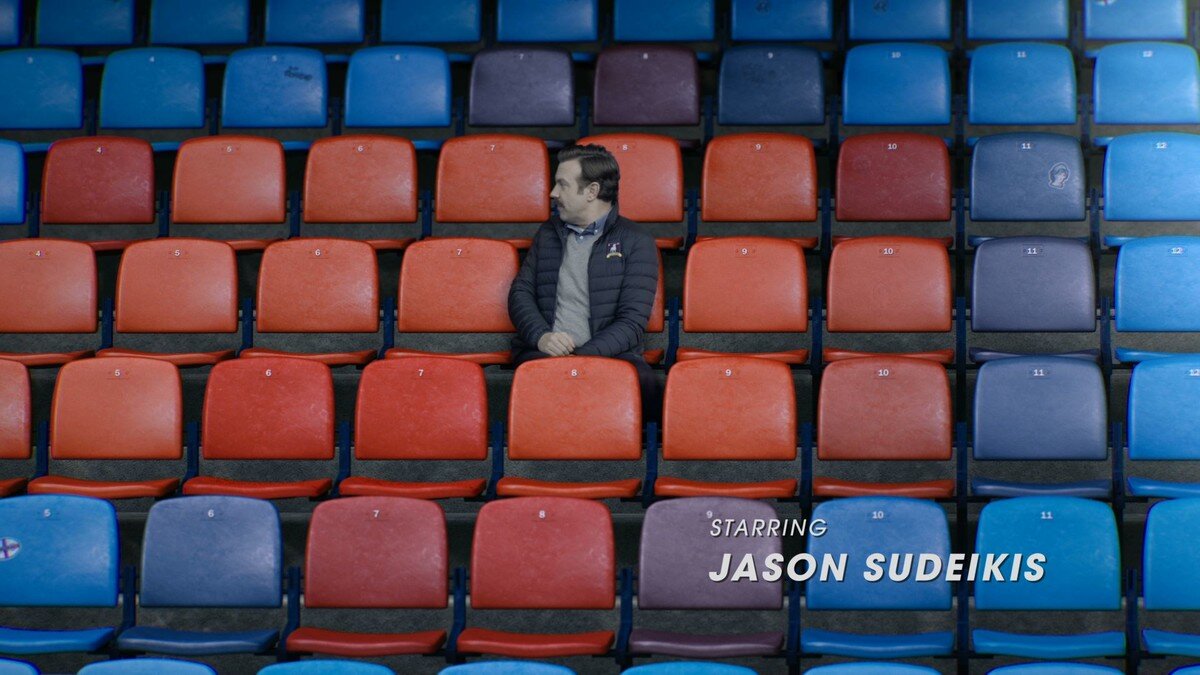
Mark Watney is like this. He faces so many impossible challenges with his high spirits and can-do attitude that you, too, can’t help but root for him. It’s the overwhelming theme of the story: human ingenuity, perseverance and hope will prevail.
Weir’s second book, Artemis, was set on the Moon. I briefly hoped it wasn’t about someone being left behind on the Moon (it wasn’t), but the actual plot faltered and lost the magic of the Martian. It follows Jasmine Bashara around a moon base in the 2080’s (same year as the Hayden’s World series!) as she becomes entangled in a conspiracy to control the base. What I recall about the story is that the descriptions of the moon base and lunar surface were interesting, but the plot itself didn’t engage me.
Weir’s most recent book, Project Hail Mary, is a return to the formula that made The Martian so successful. It once again creates a main character who is completely cut off from humanity who needs to solve a series of technical problems to succeed. The premise is that Earth’s sun is mysteriously dimming and soon all life will perish. The reason for the dimming is a microscopic spacefaring life form that flies in an arc between Venus and the Sun, stealing a little energy from the Sun with each trip. All of Earth’s neighboring stars show the same dimming except for Tau Ceti. So, Earth builds an interstellar mission to Tau Ceti to understand why that star is unaffected and hopefully bring a solution back to Earth.
The story starts out a bit cheesy with an astronaut with amnesia who awakens upon a ship. It’s a narrative construct to dole out back story and it has a soap-opera plot feel to it. Once the amnesia wears off and the mission is revealed, the story picks up. The main character, Ryland Grace, is the sole survivor of the three-man mission. The technology is current day’s and the way Earth constructs a ship capable of reaching Tau Ceti in only a few years is clever. Where the story really takes off, however, is when Ryland arrives at Tau Ceti and discovers another alien ship is also there. Similar to Ryland’s situation, the alien is the sole survivor of his mission and is also searching for a cure for his home world’s dimming star.
Weir clearly put a lot of thought into his alien and I appreciate that it is, indeed, alien. You’ll find no Star Trek “human with a nose wrinkle” vision of aliens here. The human and alien environments are so different that each would be nearly instantly lethal to its counterpart. The alien lives on a Venus-like super Earth with intense pressure, heat, and gravity. Because it looks like it’s made of rock, Ryland nicknames it Rocky. Fortunately for Ryland, Rocky acts very human. He carries tools, wears clothes, is intensely curious, wants to work together, and is even a bit sarcastic. The two quickly develop a way to communicate and in no time are speaking to each other with the assistance of a laptop.
The Rocky/Ryland partnership is the gem of the story. Rocky has a distinct personality and is very gung ho, and this taps into the optimism theme that permeated The Martian. At times he’s a bit too human, doing things like shaking his first in anger and pointing to a clock when Ryland is late, but it’s forgivable. After all, we need to relate to Rocky to like him, and if he were a completely inhuman rock that would be difficult.
I thoroughly enjoyed the partnership’s fascination and curiously with each other. Rocky is just as amazed that humans can breathe dangerous oxygen and “hear light” with their eyes as Ryland is that Rocky doesn’t need to breathe and has a body temperature in the hundreds of degrees. Surprisingly, Rocky’s home world is lower-tech than Earth’s. They have no computers, don’t understand relatively, and have still managed to build an interstellar ship using math they do in their heads. It’s a bit like watching a bunch of 60s NASA engineers do rocket math with slide rules and still plop a craft down on the Moon. It’s great fun seeing Rocky and Ryland compare notes. “Humans are weird,” Rocky states more than once.
I did cheer when the book had its “science the shit out of it” moment with this quote spoken by Rocky in broken English:
“You ship has more science than my ship. Better science. I bring my things into you ship. Release tunnel. You make you ship spin for science. You and me science how to kill Astrophage together. Save Earth. Save Erid. This is good plan, question?”
“Uh…yes! Good plan! But what about your ship?” I tap his xenonite bubble. “Human science can’t make xenonite. Xenonite is stronger than anything humans have.”
“I bring materials to make xenonite. Can make any shape.”
“Understand,” I say. “You want to get your things now?”
“Yes!”
I’ve gone from “sole-surviving space explorer” to “guy with wacky new roommate.” It’ll be interesting to see how this plays out.
Weir, Andy. Project Hail Mary (p. 254). Random House Publishing Group. Kindle Edition.
Ryland is also toned down versus The Martian’s Watney. He’s played as a nice guy in a generally desperate situation who doesn’t give up. Admirably, he makes a genuine friendship with Rocky and is willing to risk his life to save him, as Rocky is willing to risk his to save Ryland.
I should note that, similar to The Martian, the story alternates between scenes with the isolated astronaut and scenes back on Earth. The Earth scenes are all flashbacks, dealing out chunks of story about how the Sun’s problem was detected and how the starship was built. While necessary, I found them not very engaging and often leafed through them. The real story is Rocky and Ryland’s. Weir, like many hard science fiction authors (myself included), wants to ensure the reader knows how everything works and fits together. Really what engages the reader is the Rocky/Ryland friendship and their teamwork. There’s a bit of a writing lesson to be learned there for character over world building.
I enjoyed Project Hail Mary and I think Weir has another winner. Be sure to check it out if you enjoyed The Martian.
When I’m not flying the virtual skies, I’m the sci-fi author of the Hayden’s World series. If you love exploration and adventure, be sure to check it out.

Thoughts on Netflix's Love, Death and Robots Season 2
This weekend Netflix released Season Two of the anthology Love, Death and Robots. I give my thoughts on how it stacks up to Season One,
Season One of Netflix’s Love, Death and Robots was released in 2019, consisting of eighteen sci-fi short stories based loosely upon the themes of the series title. I’d read many of the stories before because they were by my favorite authors, such as John Scalzi and Alastair Reynolds. While it was exciting to see a sci-fi anthology flex its technical muscles to stunningly visualize some of those great shorts, as a whole I felt disappointed that many of the shorts focused on nudity and violence for the sake of rendering them in high-definition CGI glory. There’s a certain Mortal Kombat vibe that some video games emit where the focus is on the gory fatalities and this focus reduced many of Love, Death and Robot’s Season One’s episodes to video game status. There were still some great episodes in Season One, but as a whole they were the diamonds in the rough.
This week, Netflix released Season Two of Love, Death, and Robots. Where Season One’s eighteen episodes were more of a throw-spaghetti-on-the-wall-and-see-what-sticks approach, Season Two’s eight episodes feel more like a carefully-selected collection for your consumption. Similar to Season One, the stories are bingeable shorts that can each be watched in ten to fifteen minutes. The author roster isn’t as recognizable as the first season (other than John Scalzi and Paolo Bacigalupi), but this is a plus, as I hadn’t read any of these stories and it was enjoyable encountering them for the first time. The gratuitous nudity from the first season is gone. In fact, only two episodes contain any nudity, with Snow in the Desert showing a woman’s bare back before fading to black to imply a sex scene, and The Downed Giant taking a detached, clinical view of a giant naked man’s body awash on a beach. The violence has also been toned down with only one episode, Snow in the Desert, containing a high level of gore. I was happy to see these changes. I don’t have issues with stories that contain these elements, but I want the story to be the focus, not the elements.
When I wrote my review for Season One, I grouped the episodes into Best and Worst categories. Season Two doesn’t lend itself to this, in part because there are half as many episodes, but more so because all of the stories are done well and there are none that should be skipped. So, instead, I’ll present them in order with my thoughts on each (and I’ll try to avoid spoilers where possible):
Automated Customer Service - A women’s Roomba-like housekeeping robot turns murderous after she and her dog interfere with its tasks. Based upon a very short John Scalzi story (https://whatever.scalzi.com/2018/11/19/a-thanksgiving-week-gift-for-you-automated-customer-service/), the animation renders everyone in caricature and the tone rides the line between farce and horror. If you don’t know it’s a Scalzi story, you might be confused upon first viewing, wondering whether it’s meant to be funny or scary. It makes perfect sense once you realize that it’s Scalzi’s sense of humor (he is the author behind Red Shirts, after all). I will say that Scalzi’s written version is told entirely from the automated customer service bot’s voice and is funny because of its escalation and that you need to infer what’s going on from the responses. The animated version is from the perspective of the terrorized woman and this causes the automated voice’s snarkiness to seem out-of-place.
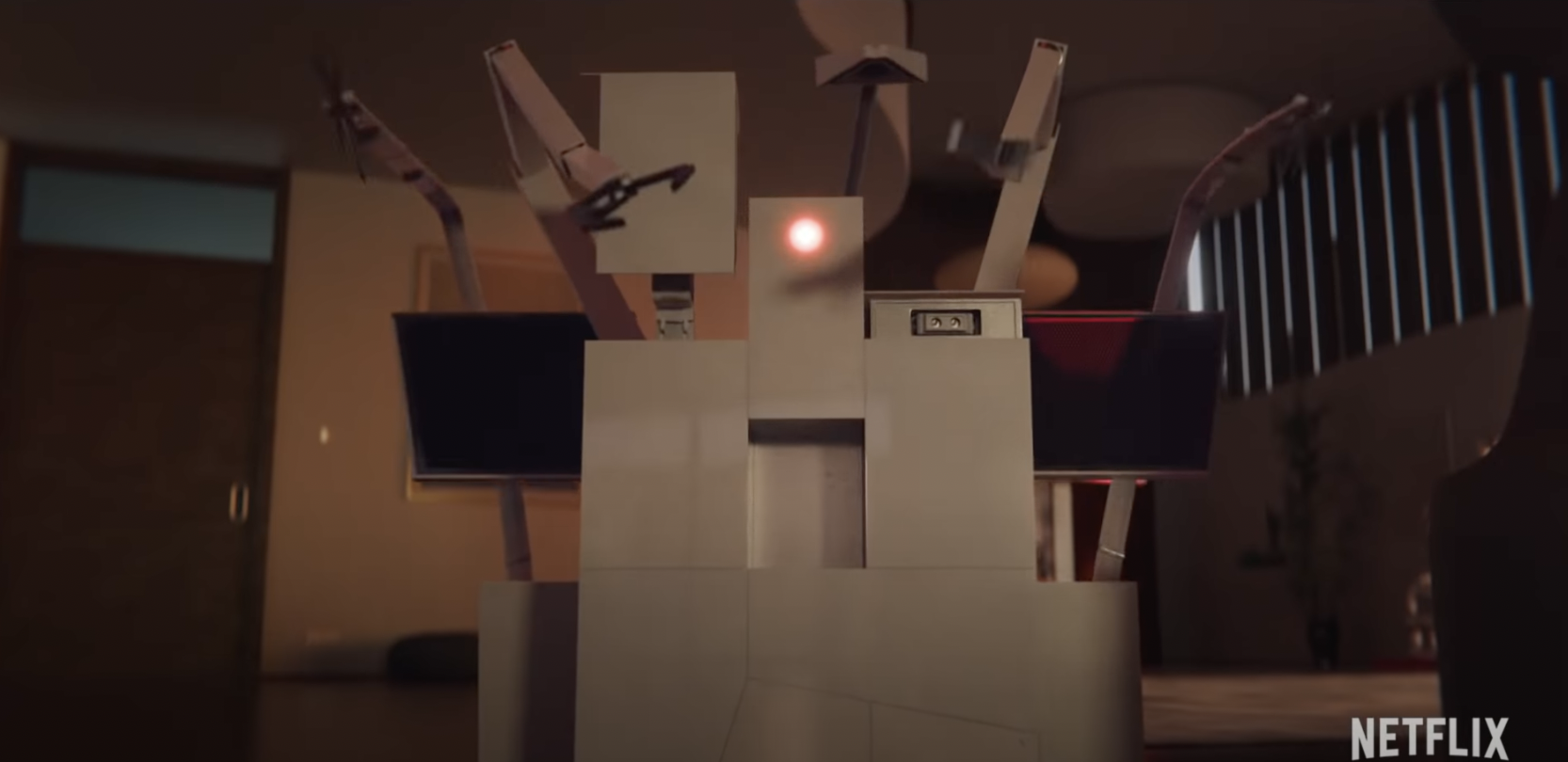
The animated version reminds me a bit of 1984’s Runaway with Tom Selleck, where a housekeeping robot goes on a murder spree in a family’s house before being stopped by Selleck.

Ice - On an alien world where most humans are modded with enhanced strength and agility, an unmodded teenager feels left out, trying to prove himself in a dangerous race. The episode is hand-drawn in an animated style that you will instantly recognize from the Zima Blue episode of Season One.

This story reminds me of 1997’s Gattaca, which also focused on two brothers, one of whom was genetically enhanced, and the normal brother’s willingness to risk his life to outdo his enhanced sibling.

Ethan Hawke in Gattaca, winning the race because he didn’t save anything for the swim back
Read Rich Larson’s original short story in Clarkesworld http://clarkesworldmagazine.com/larson_10_15/
Pop Squad - In a dark future where the rich are immortal, unregistered children are illegal, hunted and killed by the police. The protagonist is one of those police and faces a crisis of conscience. A dark, heavy story with some Blade Runner-like visuals and themes. The original short was written by Paolo Bacigalupi, author of the Windup Girl https://windupstories.com/2007/02/11/great-review-of-pop-squad/
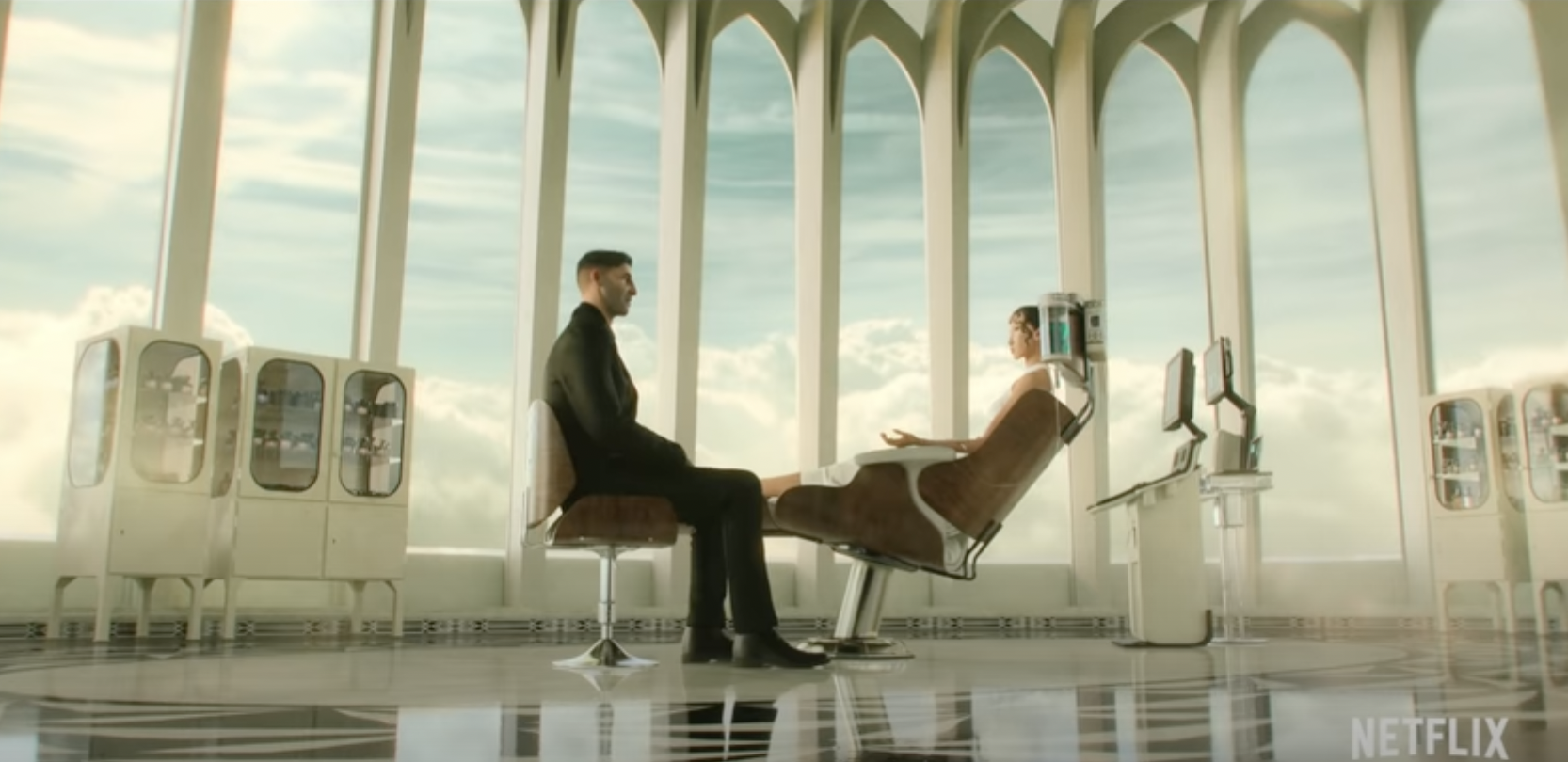
Snow in the Desert - On a desert world at the galaxy’s outskirts, an ageless man is pursued by bounty hunters set on harvesting his body parts. Out of the Season Two episodes, Snow in the Desert is the most technically advanced, with CGI that had me questioning whether I was watching live action or animation. This episode makes me believe that you could make movies with entirely CGI actors. The setting is merciless and the violence follows suit, but it all makes sense in the context of the world. The feeling is that of Chronicles of Riddick without the campiness. The original short is by Neal Asher https://www.nealasher.co.uk.

The Tall Grass - When a train stops briefly in the middle of nowhere, a passenger investigates lights in the surrounding tall grass fields. The animation is intentionally low FPS and has a stop-motion feel to it. The story itself feels like something out of Cthulu. The original story is by Joe R Lansdale https://www.goodreads.com/book/show/23626097-the-tall-grass-and-other-stories

All Through the House - When two children stay up late on Christmas Eve to spy on Santa, they find something terrifying. This episode looks like it is straight from Guillermo del Toro’s mind, but is written by Joachim Heijnderman (https://gallerycurious.com/2017/12/24/christmas-eve-extra-all-through-the-house-by-joachim-heindermans/) Dark humor done right.

Life Hutch - When a man’s starfighter is shot down, he must survive planetside in an emergency shelter until he is rescued. Unfortunately for him, his company is a malfunctioning murderous maintenance robot. Great visuals throughout this episode, from the military space battles to the cat-and-mouse game of the man and robot. There is almost no spoken dialogue, but the whole story is tense and tight. As a writer, I particularly appreciate how the director trusts the viewer to understand how the robot is reacting and what triggers it.

The original short is by Harlan Ellison, published in 1974’s Deep Space. Harlan Ellison is the writer behind countless classic sci-fi TV series episodes, notably including the 1960s Star Trek episode “The City on the Edge of Forever” where Kirk, McCoy and Spock travel through a time portal to 1930s Earth, encountering Edith Keeler (Joan Collins).
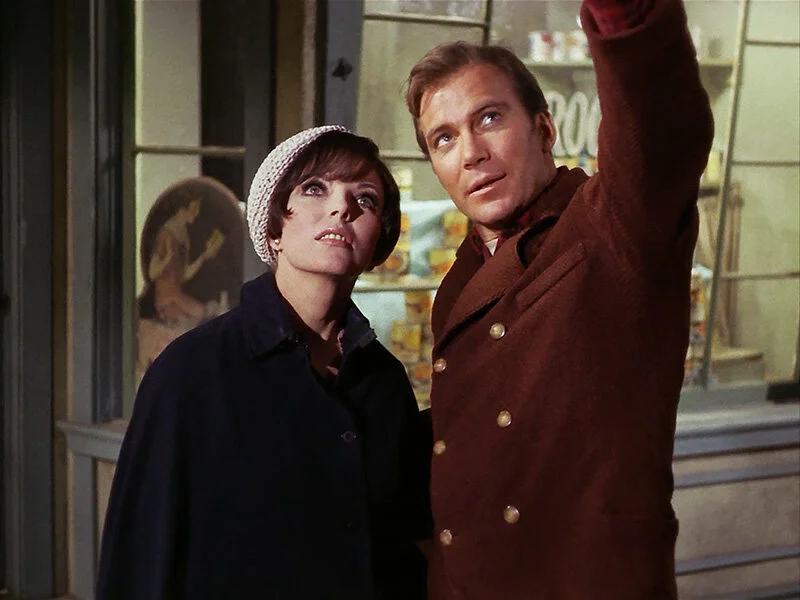
The Downed Giant - When a giant man’s naked corpse washes up on the beach, a local scientist documents the fishing village’s reaction. The resulting story is a vignette of humanity. The story has a Gulliver’s Travels feel to it, and the narrator’s dialogue is nearly word-for-word from the original short by J.G. Ballard http://lucite.org/lucite/archive/fiction_-_ballard/ballard,%20j%20g%20-%20drowned%20giant.pdf, which is a good thing. A strong story to end the series.

My overall verdict: Recommended. The selection of stories is tighter and the quality better than Season One. An enjoyable way to spend a weekend night.
When I’m not flying the virtual skies, I’m the sci-fi author of the Hayden’s World series. If you love exploration and adventure, be sure to check it out.
Looking for Love, Death and Robots Season 3 review? Find it here.

Thoughts on Netflix's Stowaway
Netflix’s original movie Stowaway was released this weekend. How does it fare as cerebral sci-fi?
Netflix released the original sci-fi movie Stowaway this weekend and I promptly spent one hour and fifty-six minutes of my Saturday night watching it. There’s a bit of a minimalistic art to writing the one-sentence movie summaries that appear in television channel guides and Netflix’s Stowaway website condenses it to “A three-person crew on a mission to Mars faces an impossible choice when an unplanned passenger jeopardizes the lives of everyone on board.” The three-person crew is an A-list of actors: the captain, Toni Collette; the doctor, Anna Kendrick; the botanist, Daniel Dae Kim. The fourth man - the stowaway - is played by Shamier Anderson. Everyone’s acting is top-notch and the characters are all relatable and likable.
Stowaway is near-future science fiction with technology and ships similar to the Martian. On a spectrum where space opera is a one and hard sci-fi is a ten, Stowaway is a seven. The ship is well thought out and logical and the characters operate within the rules and constraints of their environment, but the science is an undercurrent to the morality-driven drama. The film’s structure is more like a one-hour television episode, or perhaps a play, where a small cast is constrained to two or three set locations and faced with a dilemma.
The movie starts with the crew’s launch from Earth, the rocket engines shaking everyone violently with each actor showing how unpleasant the experience is.

It reminds me a bit of Ryan Gosling’s opening space launch sequence in First Man. In First Man, launches are noisy, violent, and terrifying, with the ship’s hull screeching like horror movie screams due to temperatures and stresses.

In Stowaway, the launches aren’t as violent, but they seem unpleasant, and Daniel Dae Kim’s character vomits once they make orbit. The crew of three is on a two-year trip to Mars and become committed after a final acceleration and ship setup.
The plot kicks in when the captain finds an unconscious man in the ceiling. When she opens the panel supporting him, he tumbles out like a body in a horror film, falling on her and breaking her arm. Critically, his fall damages the life support system. After his wounds are treated by the doctor, he awakens to reveal he’s an engineer who became trapped in the ship during ground checks (point of order - he’s not actually a stowaway because stowaways intentionally hide aboard a ship. He’s more of an unintentional passenger). He’s truly in a panic when he discovers that he’s in space, now committed to the same two-year mission as the crew. The crew does a good job of integrating him and making him feel like one of them - they even have him sign the mission plaque - but in the background the captain realizes that four people on a three-man ship with a damaged life-support unit means that no one will live to arrive at Mars in two years.

The setup is familiar in isolation stories. A small group of people, stuck someplace, do not have enough food, water, air or other vital resources for everyone. It’s the triage nightmare that’s always in the back of human thinking: what would I do if there wasn’t enough for everyone? Spaceflight lends itself to this type of story naturally. It immediately reminded me of 2007’s Sunshine, where an accident during a spaceflight to the Sun results in the crew not having enough oxygen for everyone. One person must die to balance the equation. They draw straws at one point to choose their sacrifice. In that movie, they are spared needing to murder a crewmate when the crewmate commits suicide.

2007’s Sunshine - the first half of the movie was pretty good, until it went off the rails at the midpoint and turned into a monster flick
Stowaway has a similar setup where the crew wrestles with the morality of killing the stowaway, offering him a painless way to commit suicide. The story does a good job of having the three main crew members each represent a different point-of-view. All three are aghast at the thought of killing the stowaway, but Anna Kendrick’s doctor is the optimist (save the stowaway at all costs); Toni Collette’s captain is the pragmatist (do what is necessary to save the crew), and Daniel Dae’s botonist is the rationalist (every day they delay the inevitable jeopardizes them all). It is Daniel Dae who hands Shamier the suicide option, going against the will of the crew.
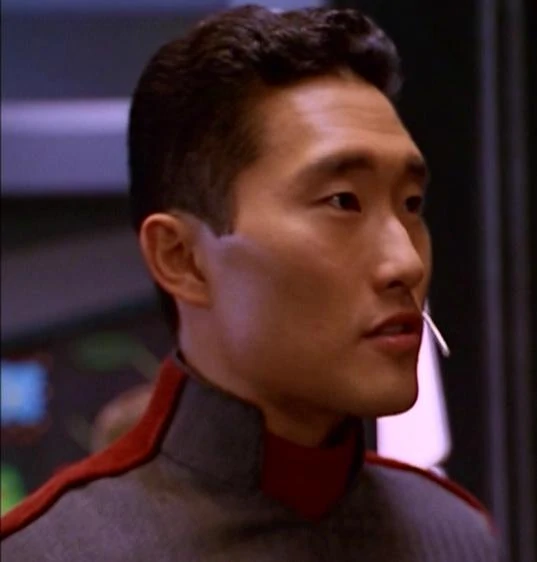
Incidentally, Daniel Dae Kim is no stranger to sci-fi and space stories. You’ll certainly remember him as Jin on Lost.

He also appear both in Star Trek: Voyager and Star Trek: Enterprise. In Voyager, he was an astronaut on a world where time spun faster than the rest of the universe, with Voyager snagged in the world’s orbit in the episode “Blink of An Eye”. Blink of An Eye was an excellent sci-fi story, and I remember his character singing his world’s version of Twinkle Twinkle Little Star, where Voyager was the star.

In Star Trek: Enterprise he was Corporal Chang, one of the MAKOs (Enterprise’s Special Forces).

In the Babylon 5 spinoff, Crusade, he played John Matheson.
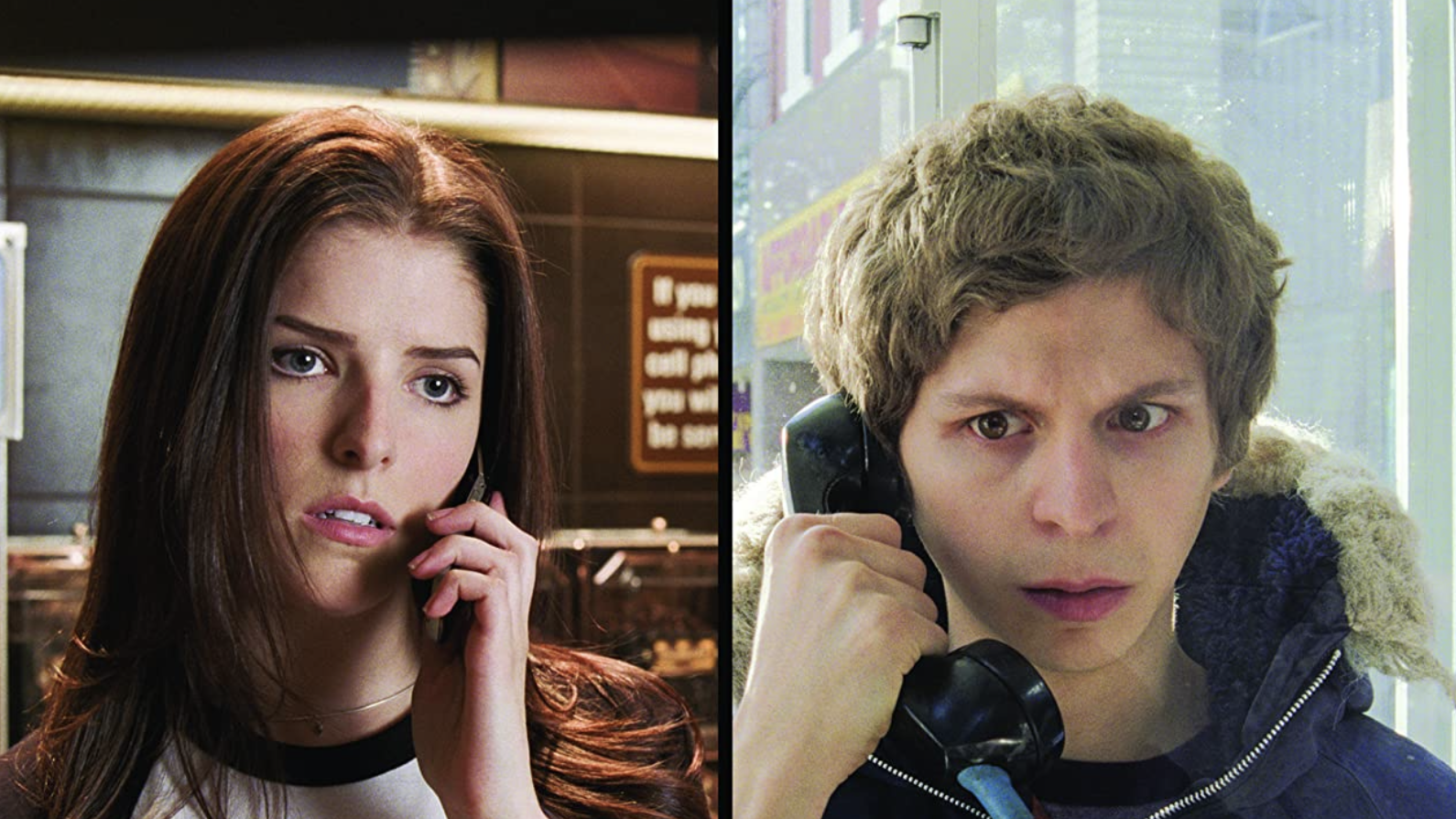
I couldn’t find any space shows for Toni Collette or Anna Kendrick, but in the sci-fi/fantasy realm you’ll remember Anna from Scott Pilgrim versus the World.
Stowaway is described as a “sci-fi thriller” but that is a bit of a stretch. It’s more of a sci-fi morality play. The story takes its time following the characters around their daily business and decision-making aboard the ship with extended conversations over algae racks or sitting in front of the cupola while Earth and stars spin outside. A heroic spacewalk scene in the last act is interesting, but not thrilling. Although it is a life-or-death situation, the tension feels numb in the dreamy slow-motion weightless of space, and the inevitability of the movie’s realistic logic means we have low-expectations for that mission’s success.
Overall, I liked Stowaway. I have a special fondness for intelligent sci-fi that takes its time and has environments that feel authentic. One of my criticisms is that the story didn’t develop its characters very much. We know very little about each of the crew other than their titles and dominant personality trait (“doctor/empathy”). The extended conversations over algae were often about superficial topics, such as why Daniel Dae’s character likes jazz, and it feels like a missed opportunity for back story. The only character who has any backstory is the stowaway (he cares for his younger sister and is stressed that he’s cut off from her in space). The other criticism is that it is, perhaps, too logical. The situation matter-of-factly gives the characters the grim news and then puts them on rails. In real life, we’re served up impossible situations and we’re sourly stuck with the outcomes. In stories, though, we like to see perseverance. In stories like the Martian, the lead character is served with an unsurvivable scenario and we enjoy watching him think his way out of the impossible. The Martian would not have been a good story had Watney slowly starved to death, the film ending with a panning shot of his slumped body at his desk. It would have been logical, but not cinematic. I will also say that for a story locked into its own logic, the setup of how and why the stowaway is trapped in the ceiling isn’t really explained other than an accident occurred during ground checks, and the movie rolls forward with some brief hand-waving.
So, if you enjoy movies like Gravity, the Martian, or even 2001: A Space Odyssey, check out Stowaway. It’s not a bad way to spend two hours on a Saturday night.

Save the Fish
There are clear winners for game choices in Detroit: Become Human, but, thinking like a writer, what are the best story choices?
One of the great accomplishments of Quantic Dreams game Detroit: Become Human is that its ending is truly in your own hands. There is no right way to play it, although there are optimal outcomes where everyone survives and achieves his goals. But does the best outcome yield the best story?
SPOILER ALERT: THIS ENTIRE POST ASSUMES YOU’VE PLAYED THROUGH THE GAME AT LEAST ONCE
The best outcome is the peaceful protest with Connor turned deviant and Kara, Alice, and Luther taking the bus to Canada. If you’ve played your cards right, everyone survives and the androids are free.
Just because it’s the best outcome doesn’t mean it’s the most compelling story. If you think about a movie like Star Trek II: The Wrath of Khan, you can imagine how less compelling the ending would be without Spock’s sacrifice.
In writing, when a character develops over the course of a story it’s called an arc. Arcs can be positive (Daniel and Miyagi in the Karate Kid facing the bullies) or negative (Walter White’s downward spiral in Breaking Bad). In the game, Connor and Marcus both have positive or negative arcs based upon your choices. Connor’s arc gets the focus in the game, though, and has the most impact on the story.
Positive Arc: Connor’s relationship with Hank causes him to become more human, ultimately joining with the deviants to help liberate them.
Negative Arc: Connor loses his humanity in his obsession to achieve his mission, becoming the villain.
If I put my writer’s hat on, scenes should be structured to invest us in Connor’s quest and show his arc. Characters should sometimes fail, and even die, to support that arc. The best story isn’t always the happiest one. Here’s the choices I’d make to have the best storytelling experience for the positive arc. I haven’t listed every chapter in the story because some, like “The Interrogation”, are more video-gamish where you simply need to get to the scene end without messing up. Instead, I’ve listed some of the key fragments that best build the story:
The Hostage:
Save the Fish
Our introduction to Connor nails two writing tricks right off the bat:
1) When we first meet a character, try to have him doing something unique to his personality or skills that immediately shows us something about him. For Connor, he is tossing a coin back and forth with android precision.
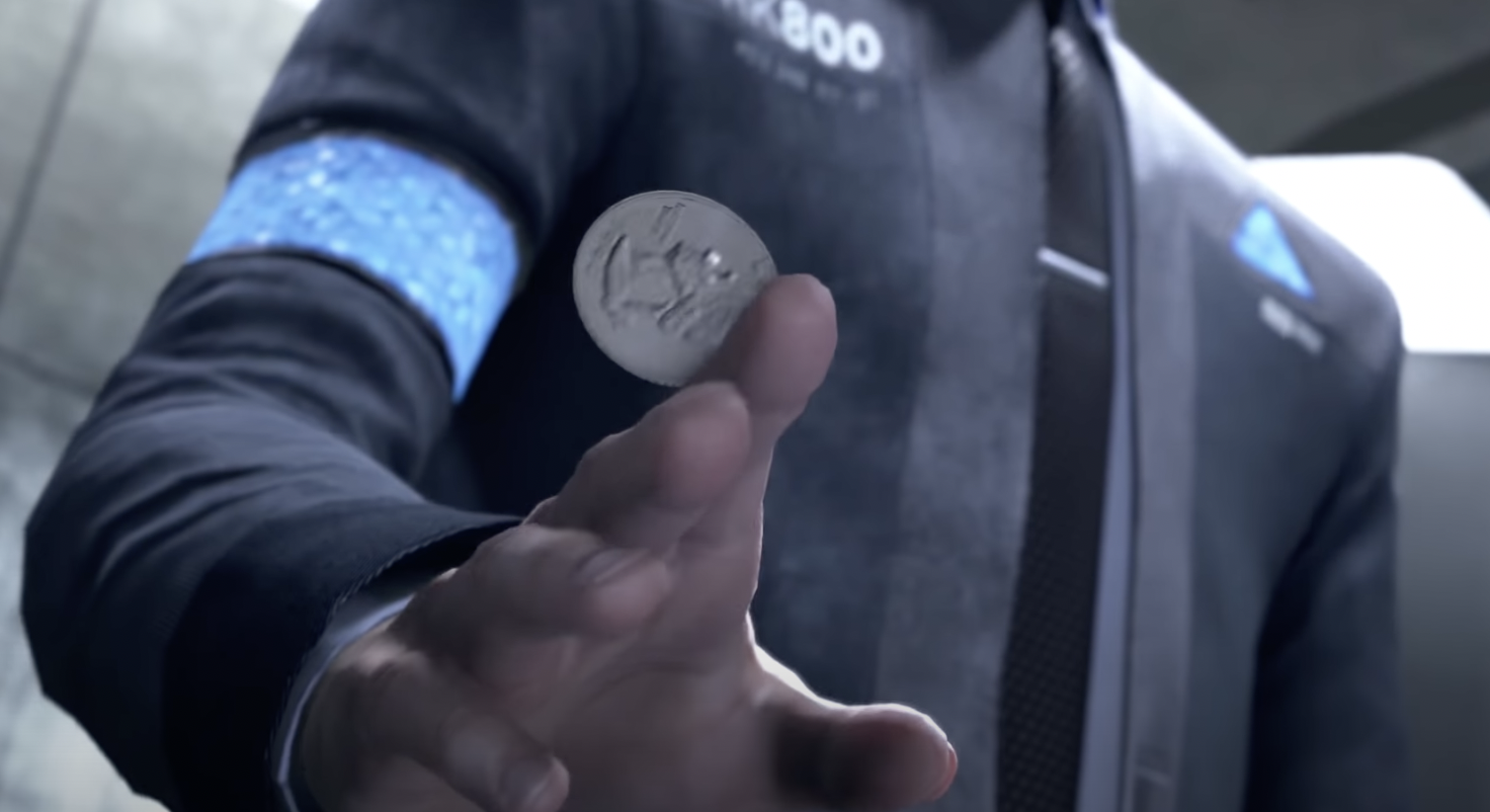
2) Try to have the character help or show a kindness to someone that he doesn’t need to help. This establishes that he is a good person to be admired and trusted. Putting the fish back in the tank is the kindness. For Connor’s arc, this shows that he is not just a machine, but has empathy.

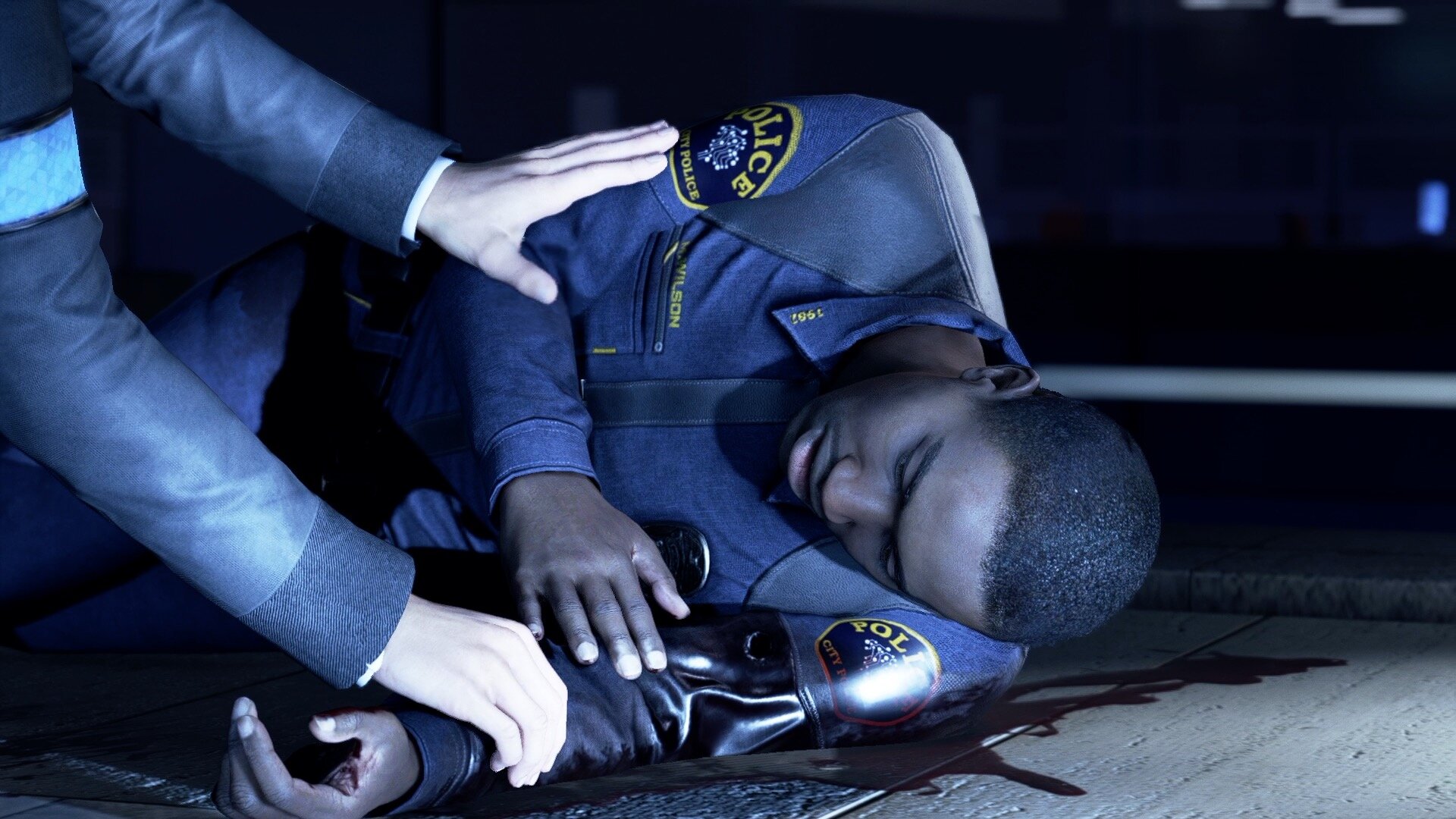
Save the Policeman
A bleeding policeman lies outside on the terrace. If Connor stops to help, Daniel threatens to kill Connor. If you choose to ignore Daniel and help the policeman, you are rewarded with one of Connor’s great lines, “You can’t kill me, Daniel, because I am not alive.” Saving the policeman jeopardizes Connor’s mission, which is why this is a great “show, don’t tell” moment for establishing that Connor cares about people (and you will encounter the saved policeman later in the game when he thanks you during your investigation at the Stratford Tower).
Push Daniel and Yourself off the Ledge to Save Emma
There are three ways to save Emma. From a game standpoint, the best way is to talk Daniel into trusting you, which results in him releasing Emma. Here, you promise nothing will happen to Daniel…then you nod to the snipers when Emma is clear and they kill Daniel.

From an arc standpoint though, this establishes that Connor will lie to get what he wants. Connor also immediately turns his back on Emma and ignores her, his mission complete. The second option is to get close to Daniel and shoot him. Once again, Connor ignores Emma and walks away. It also undermines the scene as there is nothing special about Connor required for him to simply pull a gun and shoot Daniel. The third option is the best from a story standpoint: Connor tries to talk Daniel down, but Daniel flings himself and Emma off the ledge, Connor lunging for them in response. Connor manages to grab Emma’s hand and pull her back onto the ledge, but at the cost of sending himself and Daniel off the ledge. Here, Connor is the hero, sacrificing himself to save Emma. It’s also a nice reversal at the end of the story hook because you don’t expect the protagonist to die in the opening scene. It also saves Emma in a way that is unique to an android because Connor simply comes back after his death in a new Connor unit.

The Painter
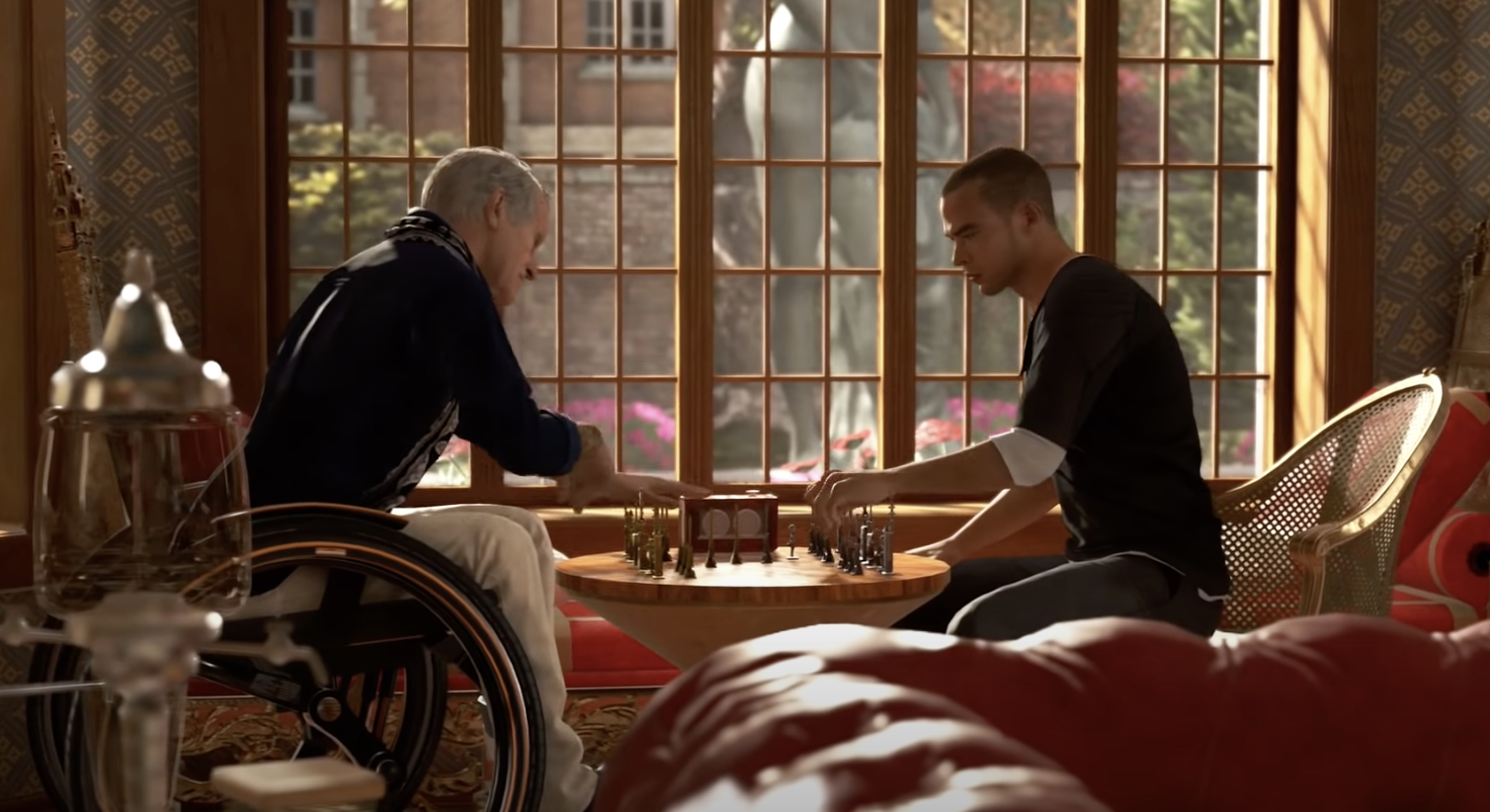
Play Chess
Dave Cage, the writer and director of Detroit: Become Human, does quiet moments exceptionally well. Out of the options Marcus has to occupy himself while Carl has breakfast, playing chess is the interactive choice. Marcus joins him and gives him a life lesson as his mentor, which builds Marcus’s arc. Each of the other options, such as reading a book, also result in a life lesson from Carl, but in chess you are directly engaged with Carl. Chess also provides a nice allegory for the branching choices Marcus must make throughout the story.
Stormy Night:
Don’t Take the Gun
Kara’s character is so much more compelling and human when she is vulnerable and trying to protect Alice. The gun negates that vulnerability. When she encounters danger later on, such as the unstable knife-wielding android Ralph, the whole scene is less tense when you know Ralph has brought a knife to a gun fight. The other problem with taking the gun is that once you draw it, your only option is to shoot and kill Alice’s father, Todd. Kara is a caretaker and her role is to whisk Alice out of harm’s way, not leave a trail of bodies in her wake.

Fugitives:
Stay in the Motel
Out of the three overnight options, staying with Ralph is the most interesting, but from a character development standpoint it’s one of those choices that readers would shake their head at. A clearly unstable Ralph just held Alice at knife point. No mother would choose to let Alice sleep in his house (and if you’ve played the Ralph scene you know it wraps up poorly).

Having Kara back away and say “no, we should be going” gives readers confidence in her protector role. From a pacing standpoint, the motel gives the characters a little downtime to talk, and Kara closing the blinds and lying down next to Alice in bed is compelling. Stories need breathers from tension.

On the Run:
Fail at Sneaking Past the Police
As Hank and Connor close in on Kara’s motel room, Kara and Alice slip out and try to make their way to the train station, sneaking past police. If they succeed, they’ll quietly get on the train. If they fail, they’ll make a dramatic run for it pursued by Connor, trying to lose him in a nearly-suicidal rush across a high-speed autonomous vehicle highway. This scene is really great because it pits two protagonists, who are both good guys that you want to survive, at odds with each other. Connor should choose pursuit, since he always views his destruction as a temporary inconvenience. This is an interesting chapter where failing your objective (sneaking past the police) is much more interesting (and better storytelling) than succeeding. Readers like to know that characters can fail because it creates tension each time the characters are tested. It’s also one of the only story choices that bring Kara and Connor together.

The Nest
Save Hank
Most players pick this option because, well, we’re human and wouldn’t watch our partner fall to his death. Letting the deviant get away so Connor can save his partner is another moment to show that Connor values human life more than his mission. It’s also essential to developing a genuine friendship with Hank, which is what shapes Connor’s humanity. Now, if you are playing the negative arc version of Connor, this is the perfect scene to show that Connor cares about nothing but his mission (Hank pulls himself back up and is furious that Connor left him there to die).
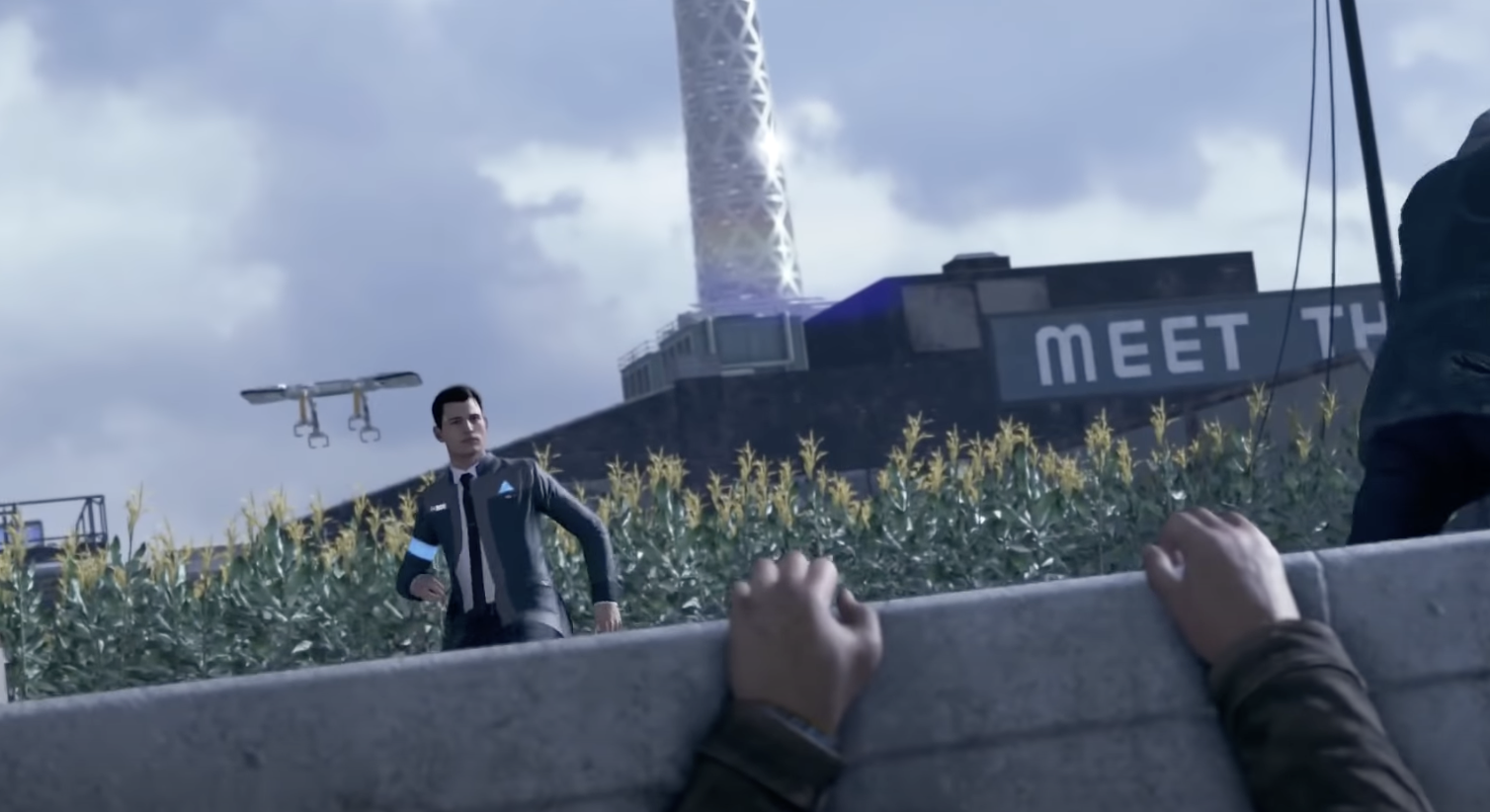
Zlatko
Release the Monsters to Kill Zlatko
Zlatko is defeated either when Luther shoots him or when Zlatko’s tortured android mob beats him to death. When you write someone as despicable as Zlatko, you want more than a straight-forward “bang! you’re dead” ending. The android mob is fitting. Luther is a kind protector. Although him shooting Zlatko is suitable for his arc, him being spared the choice works better for the gentle android.

The Eden Club
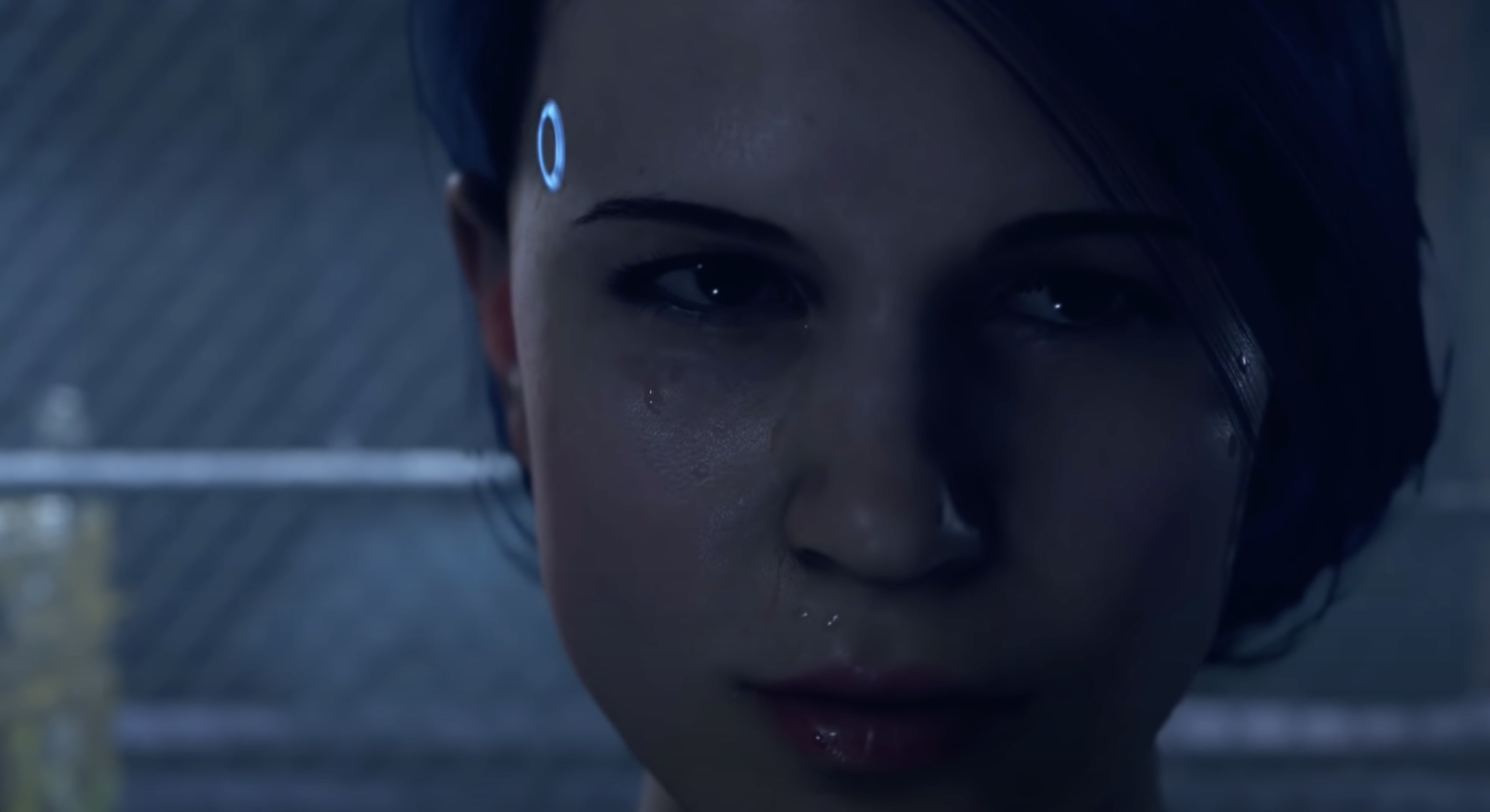
Let the Tracis Go
A fun fact about this scene is that the actor who plays Connor and the actress who plays the blue-haired Tracy are husband and wife in real life. This is the first scene where Connor shows empathy for another android. I actually think it’s misplaced in story order. The Kamski scene, where Connor chooses not to shoot the Chloe android, should come first. After all, that should be an easier choice, since Chloe has done nothing wrong and is not a deviant. The next step up in empathy would be choosing to spare the Tracis, who have killed a human and are deviants. From a story pacing perspective, I feel the narrative’s transition to Connor letting deviants go here is a bit too abrupt. Connor hasn’t given any indication of showing empathy for androids before this point. This is why I think the Kamski scene should come first. There, Connor isn’t sure why he spared Chloe and Hank reassures him with “Maybe you did the right thing”. This would plant the seed that Hank approves and that sparing androids is the human thing to do.
The Stratford Tower
Simon Gets Shot in the Hallway
Readers feel tension when they’re not guaranteed everyone will be fine. Botching the guard ruse and getting Simon shot sets up a good scene where the protagonist’s plans have gone awry and he is trying to salvage them while facing a moral dilemma about how to handle the wounded man. It’s so much better than them all escaping. It frames a choice for Markus that is similar to many of Connor’s and if you choose man over mission you establish that Connor and Markus are on parallel arcs. You don’t get this character development when everything goes as planned.
Note if Simon doesn’t get shot in the hallway, he will get shot when the SWAT team bursts into the control room (assuming you didn’t shoot the fleeing human in the back when you took the control room). The outcome - wounded Simon on the roof - is the same - but the pacing is much better if it happens before they take the control room. If it happens after, they’ve already accomplished their goal and there is less tension.
You can entirely prevent Simon from being shot simply by killing the fleeing human, but for a positive Marcus arc this doesn’t work. Either way, losing a side character works much better than everyone’s plan going off without a hitch, as it raises the stakes by demonstrating that characters can die.

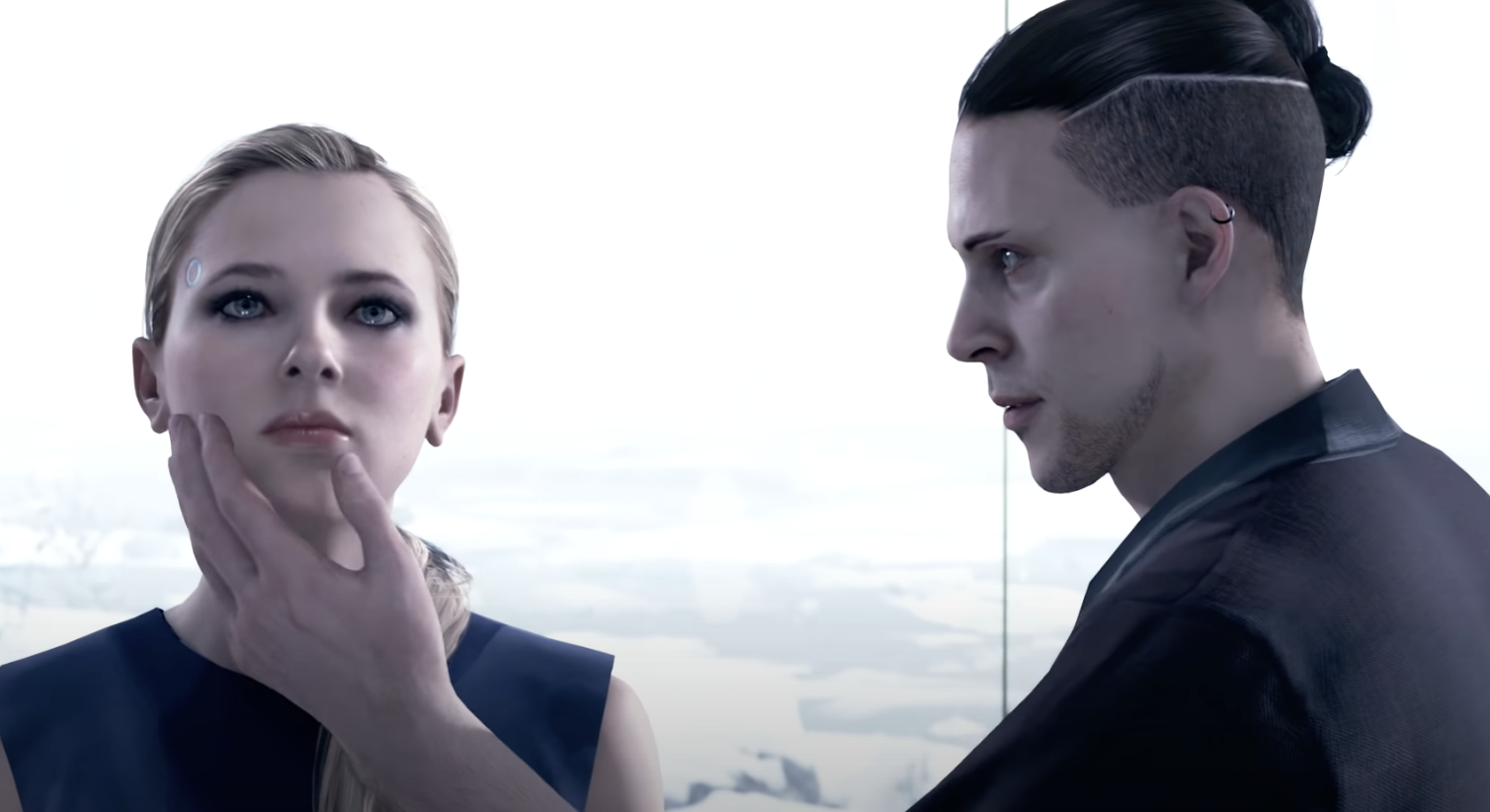
Meet Kamski
Spare Chloe
The choice here is dependent on Connor’s arc. If he is on a positive arc, then he must spare Chloe. I think Kamski’s empathy test is a great scene because it frames a central theme of the story as a choice for the main character.
Freedom March
Try Peace But Fight When Attacked
Here is where we need to decide if Markus will use peace or violence to achieve android liberty. I can tell you that readers like characters who stand up and fight. While characters who endure are admirable, we all endure to some extent in our everyday lives. We want to see characters do the things that we can’t. Although the pacifist path in Detroit: Become Human works out better for everyone, it’s the less compelling narrative. Markus should try to be peaceful, but when the police start killing people around him, he needs to fight. Once in the fight, he should fight to defend himself and let the police disengage when they flee. If you choose to fight, this is an exciting action scene with epic music. In terms of story mechanics, fighting is the point-of-no-return door that a main character must open to progress the story. If you back down from the police, you are delaying opening that door and pushing it to a later point in the story that feels out-of-place for readers.

Crossroads
Connor becomes a deviant and Kara, Alice, and Luther are captured
Connor has been on a humanity arc this entire time and this is the place where it is realized. Personally, I think the positive arc for Connor is the better story. Seeing him switch sides and join Marcus is a crowd-pleaser because readers are invested in both characters and the only way they can both succeed is if they are on the same side. The negative arc version of Connor works well as a story also, setting the stage for a final battle between Connor and Marcus, but that feels predictable compared to the twist of them teaming up.

Kara, Alice and Luther will either escape, be captured, or be killed. Escaping will send them on a route to the Canadian border, which will have its own drama but ultimately remove them from the plot. Other than their brief interaction with Marcus at Jericho, this will reduce Kara and Alice’s arc to a background event. Personally I can say that I went back and replayed the story so I could choose to get them to Canada because I was invested in the characters and wanted them to have the happy ending, but in retrospect the plot works better if they don’t go to Canada.
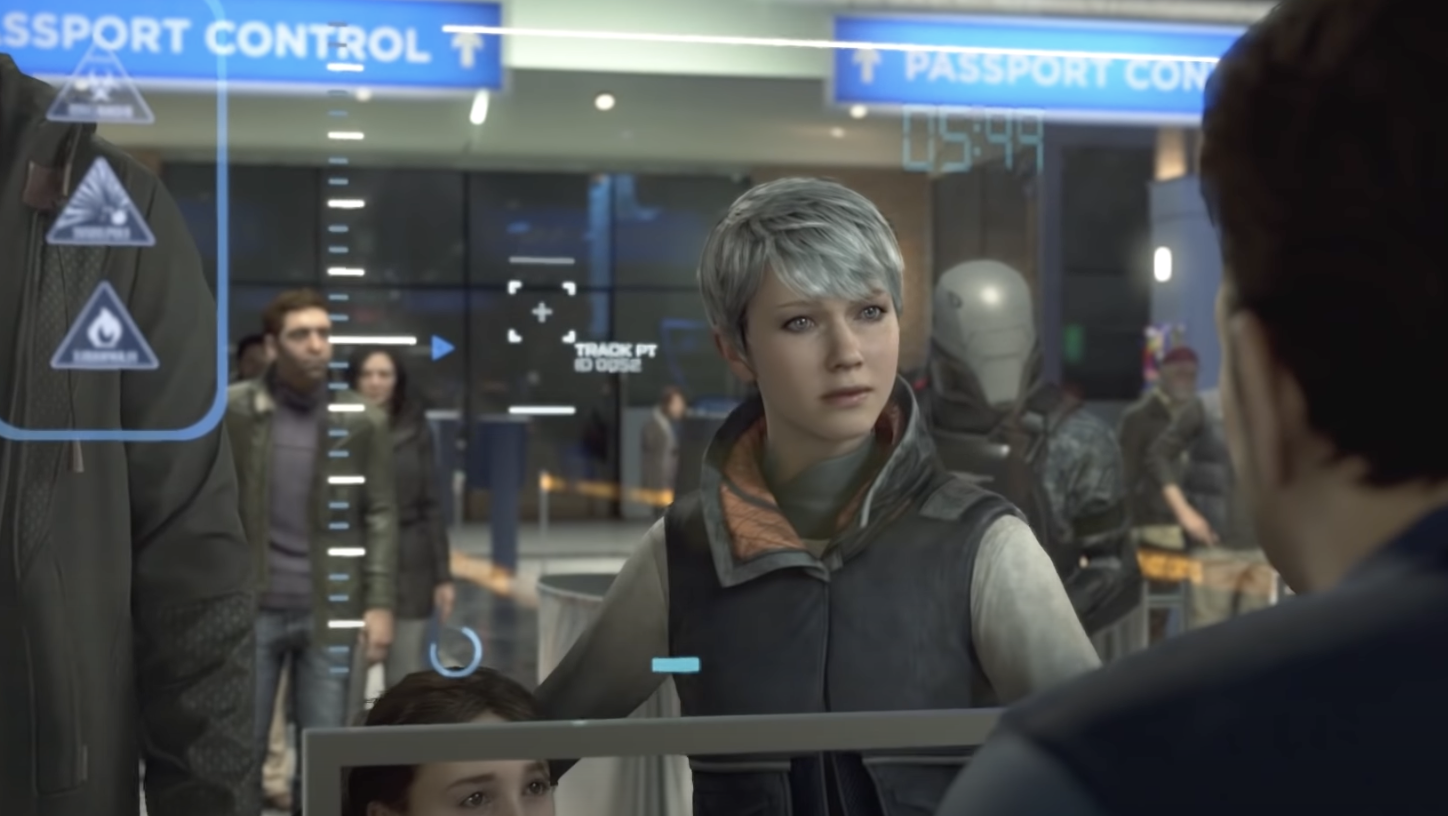
If they get killed trying to escape Jericho, the scene where Kara falls to her knees holding a dying Alice, both shutting down frozen in that pose, is heartbreaking and powerful. But, they are major characters, and their deaths here do not have a purpose other than to pull tears.

The best story is for them to be captured, as this will up the stakes for the finale. From a plot structure standpoint, this takes the three plot threads of Kara, Connor, and Marcus, unites them at Crossroads, and binds them all to the outcome of the Battle of Detroit.
Night of the Soul
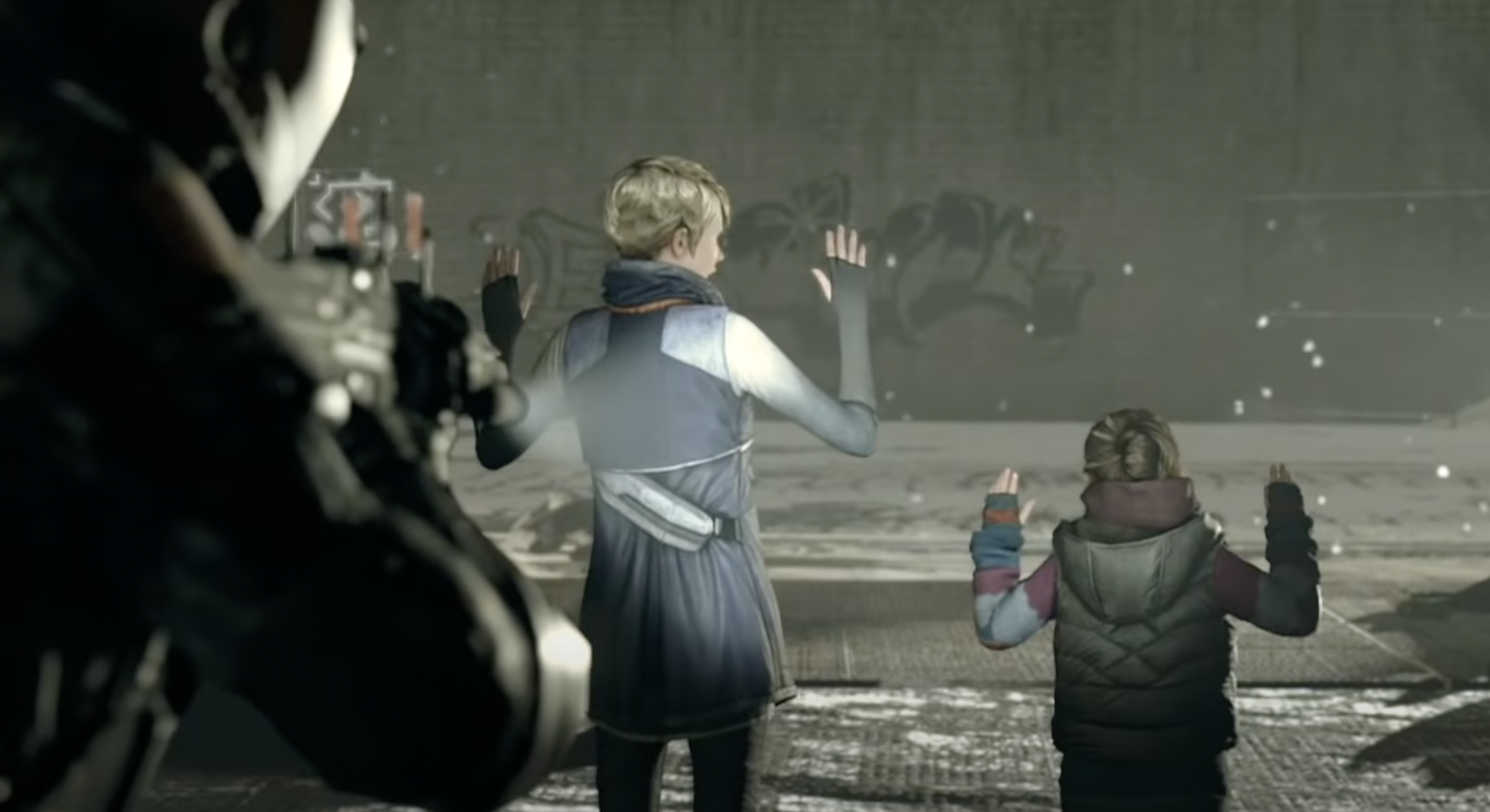
Liberate the Camps by Force
Night of the Soul is a very classic scene showing the protagonists overcoming their self-doubts the evening before the final confrontation. Here you have one final decision to pursue either a peaceful standoff outside the camps or a violent liberation. Although the peaceful avenue is admirable (even if the actual kiss-the-girl and Les-Miserable endings for it are a bit cheesy), the problem is that the narrative has piled endless atrocities upon the heroes, including building actual death camps.

“Do you hear the people sing? Singing the song of angry men…” Oh wait, wrong story.
Readers don’t want passive responses. If you have a character pushed down throughout a story, it is a setup for him to take a stand.

Battle for Detroit
Save Hank
At this point, Hank and Connor are friends, and Connor must choose the human life over the mission. As an aside, I love that this scene has fun with the sci-fi trope of “ask me a question only the real Connor would know”.

Alice, Kara, and Luther are in the Recall Center
The recall center is a difficult scene to both watch and play, yet Alice and Kara ending up here makes for a perfect ending since Marcus is no longer just liberating nameless androids but characters you are invested in. Alice, Kara and Luther must stick together and show courage in a hopeless situation. It is possible for them to engineer their own escape, but it’s better storytelling if their freedom is tied to the final battle’s success. In the end, they will be saved.

The actual battle itself is a bit more video-gamish where the choices mainly affect whether you lose any friends and win the fight. It’s a great bit of action to play through, however, and feels suitably desperate and epic for the liberation of the camps.
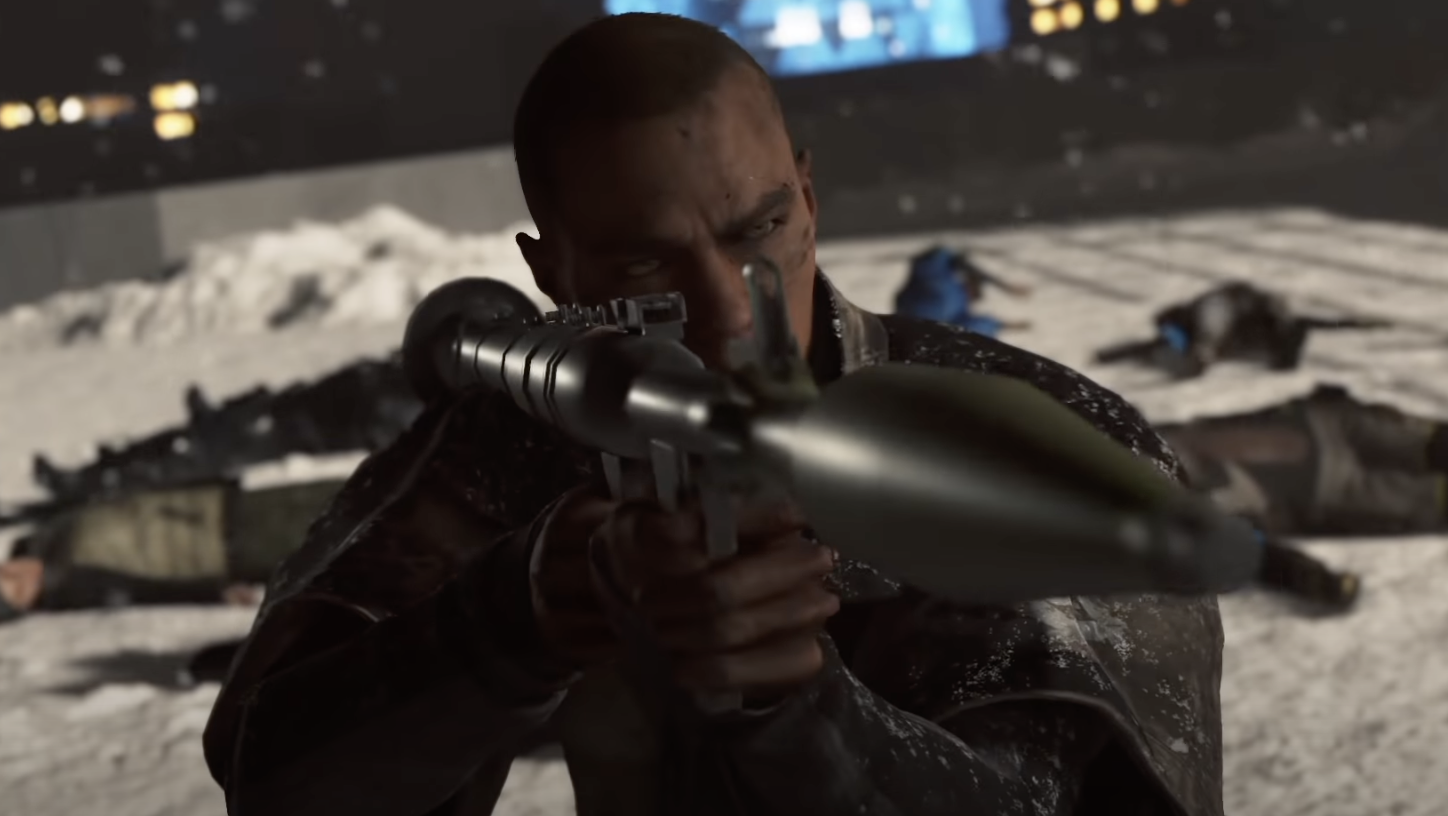
Note you will have radically different endings if you choose other arcs for Marcus and Connor. The negative Connor arc works well in that he must fight Marcus (or North) and either fail (because he is the villain and we want him to fail, allowing the true hero to succeed) or he successfully kills Marcus and squashes the rebellion, only to realize his obsession has cost him everything (when Amanda coldly states he will be decommissioned and replaced by a better model, treating him as he’s treated the other androids throughout the story).
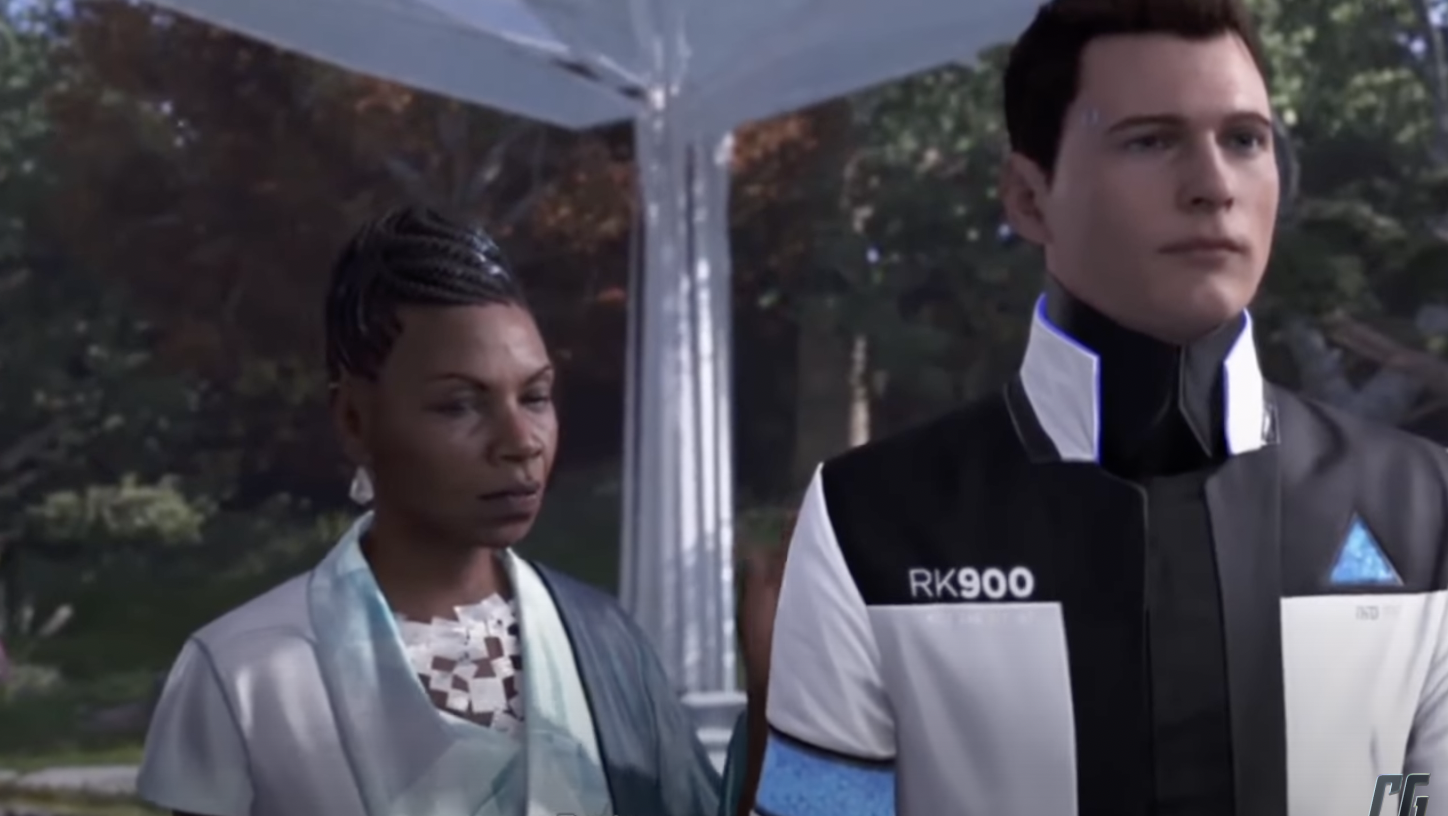
If playing the negative arc, Hank will try to stop Connor just before the final battle. Here, Connor should kill Hank by dropping him from the roof. It’s the point-of-no-return scene for Connor, where he has abandoned his last shred of humanity and fully committed to the final battle.

Here, he is firmly the villain who must be defeated by Marcus.
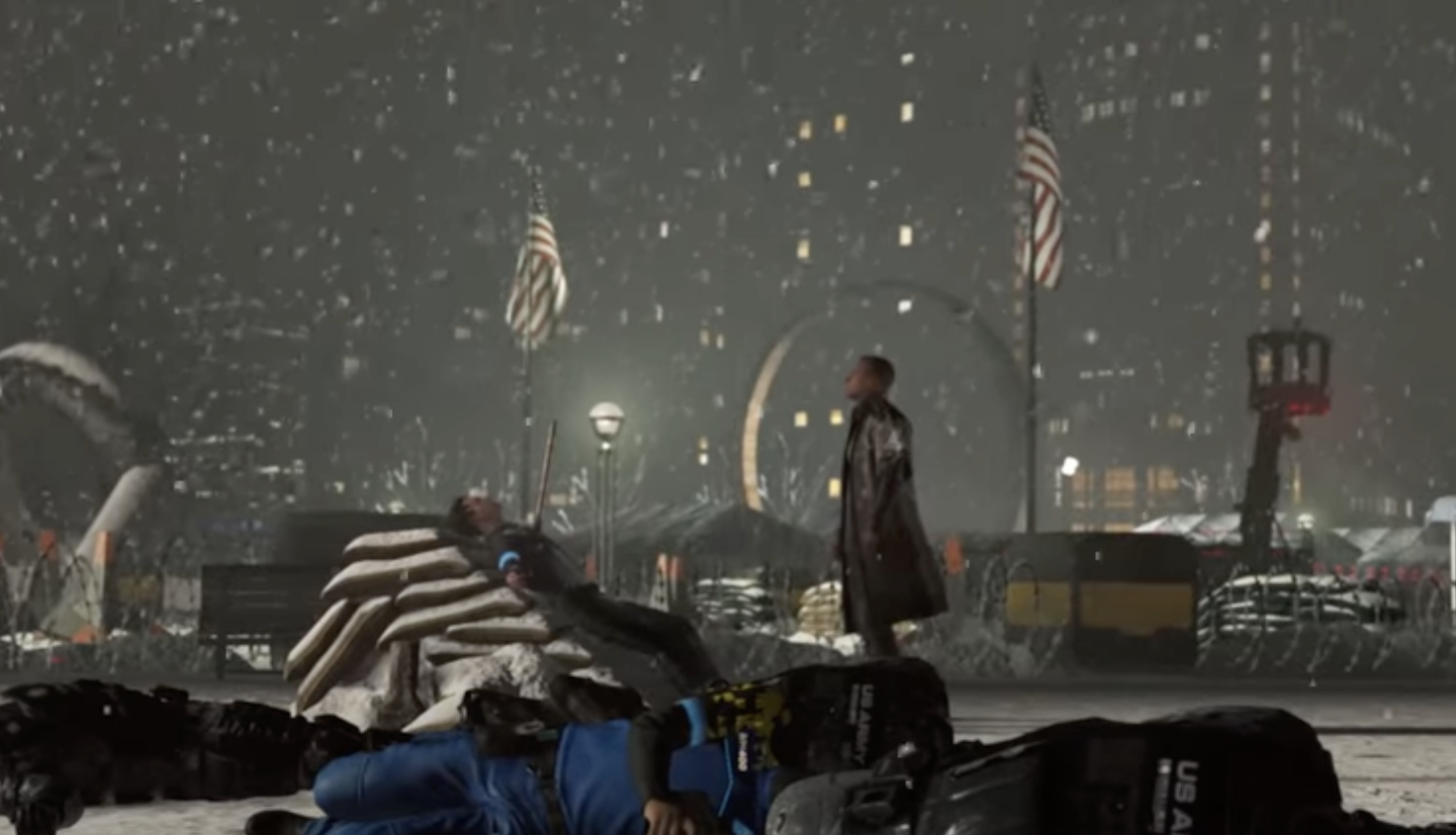
All in all, I’m thoroughly impressed with the writing and direction in Detroit: Become Human. The fact that I finished the story and I’m still learning from how it was assembled speaks highly of it. I hope you enjoyed it as much as I did, and I’m curious to hear your thoughts.

Thoughts on Detroit: Become Human
As a writer, I thoroughly admired the effort that went into producing Detroit: Become Human
A few years ago I played through the Witcher 2 and was captivated. Although the game does have its share of button-mashing sword battles, I spent the majority of my gameplay in interactive cutscenes. The strange thing is that I found myself wanting to soldier through the combat sequences just to get back to the cutscenes. The reason is that the game was like playing an HBO series rich with characters, plots, and consequences. The cutscenes were directed with the same care. I felt like I was playing a movie, not a game.

RPGs have long allowed you to make choices as the hero or villain, but the choices are usually at the extremes of morality. It’s often obvious which choice you’re supposed to make. Ultimately the story wraps up with a quest succeeded or quest failed status. In the Witcher 2, however, something interesting happens after the first act. You are asked to make a split-second decision to free an enemy, throwing him a sword to defend himself, or keeping him bound. The choice is not clear, as you are picking a side between two factions. In my first play session, I threw him the sword and spent the second act in a dwarven city. After completing the game, I tried the other choice. To my surprise, the plot branched into an entirely different human city and I didn’t see the dwarven city or plotlines at all. It was as if the developer had written two games complete with different settings and characters based on the split-second choice I made with the sword.
What I enjoyed most about the Witcher 2 is that it was a good story. The characters seemed real and my choices impacted them. Like life, the choices weren’t straight forward and the story continued on, weighted by the consequences of those choices.
A few years ago I saw a YouTube clip of Quantic Dream’s Heavy Rain. Designed for the Playstation, the game used the PS controller’s buttons and joysticks to execute actions at the right moment or select choices from a list of options.

The clips were both perplexing and intriguing. In one scene, you swished your joystick back and forth to do mundane things like brushing your teeth. In another, a character fights off an attacker in a high-rise apartment while the game camera swoops and cuts like something right out of a thriller movie scene, complete with movie-scene action music.
The mechanism was Quick Time Events (QTEs) - pressing the right button at the right time. QTEs have been around for a long time. 1983’s Dragon’s Lair was an animated laserdisc game (literally animated - it was a hand-drawn cartoon by Don Bluth) that played pre-recorded laserdisc animation segments requiring you to move the joystick or hit the sword/jump button at the right time. Succeed, and the animation continues. Fail, and there’s a brief stutter while the laserdisc loads up the fail animation, showing your hero coming to an end.
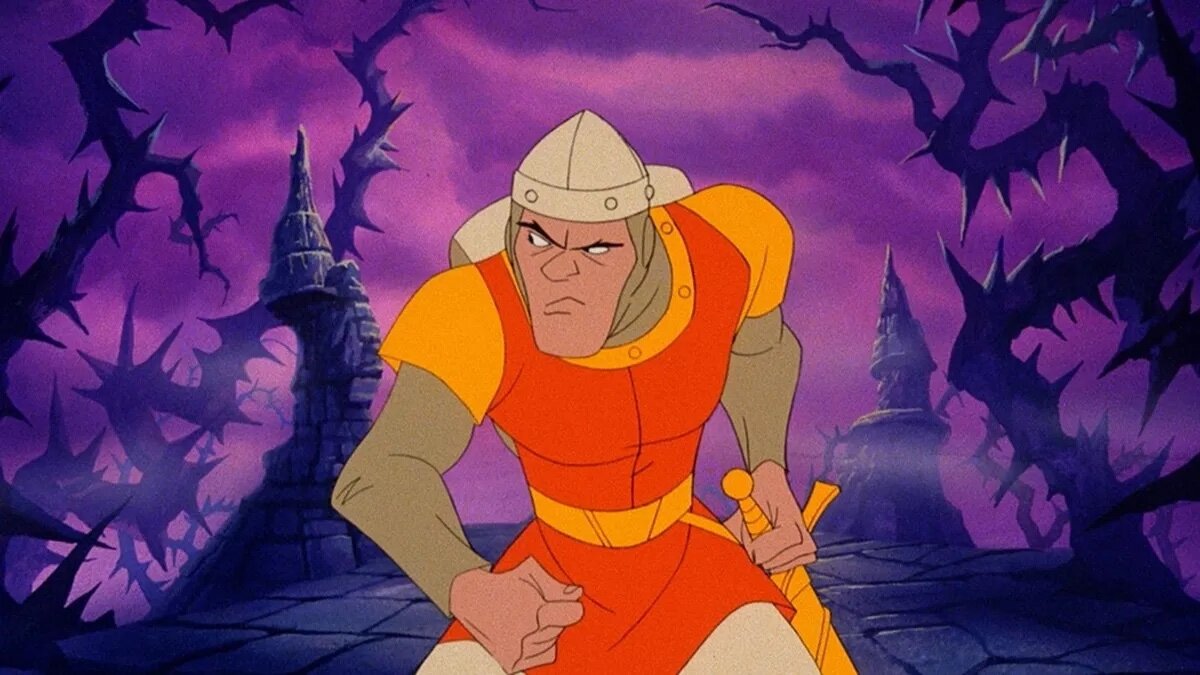
Detroit: Become Human is Quantic Dream’s 2018 interactive cinema release. Similar to Heavy Rain, it follows a handful of playable main characters through a story about androids revolting against their human creators. Sweeping cinematic music and camerawork right out of a blockbuster frame this for what it is: you are playing the main characters in a movie. All of the characters look like their well-known actor counterparts and are fully motion captured with facial mapping. When the camera zooms in on a troubled character who is thinking about what you just said, you can actually read his expressions and see the actor’s response. It’s one of the few games I’ve seen where the character’s faces emote the subtle body language cues we’re used to looking for as humans.
The game starts with a tense scene where you are an android hostage negotiator named Connor who arrives at a high-rise rooftop standoff. A family’s android has turned homicidal, killing the father and several responding cops, and now holds the daughter hostage at gunpoint at the edge of the roof.
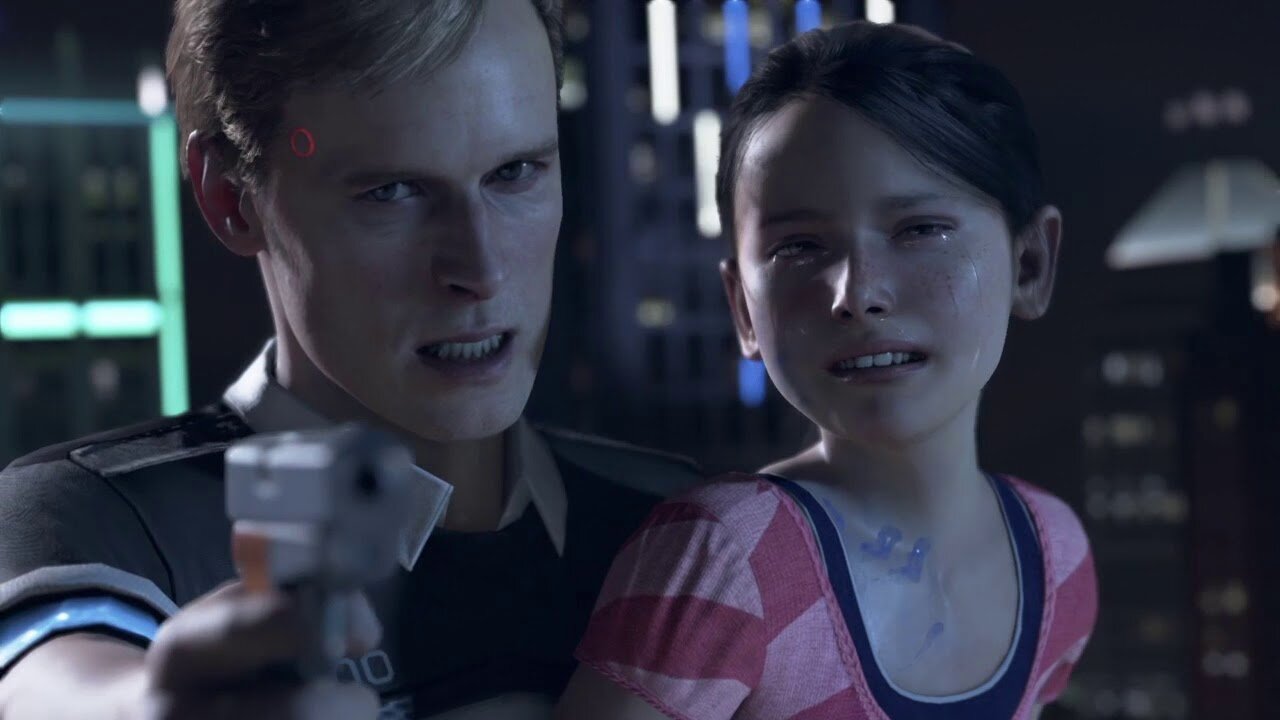
Police helicopters and snipers add to the tension. Before you head out to talk, you gather as much info from the crime scene as possible to understand the android’s motivations. These scenes - where you investigate in a way only an android could by zooming in on details, forensically sampling clues by tasting them, and reconstructing events based on where bodies and bullet wounds are located - are great fun. But the real fun starts when you step out onto the roof. Did you find the slain policeman’s gun and take it with you out here, giving you gun options, or are you unarmed?
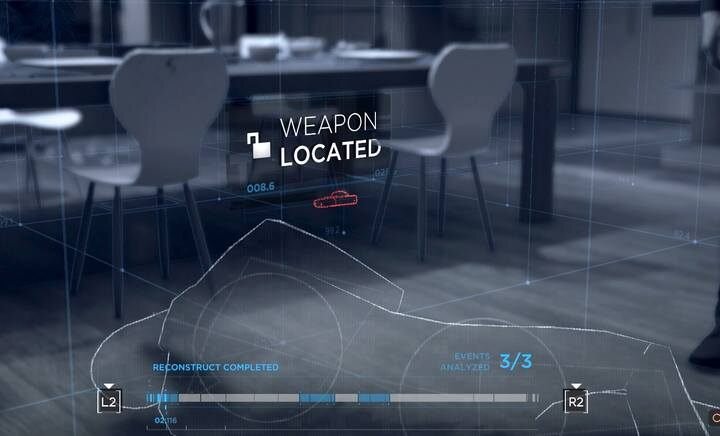
Will you treat the wounded cop bleeding on the ground despite the android’s threats to shoot you, or will you step over him? When I made my choices, the android decided to fling himself and the girl off the roof. As he started to move, the camera zooming in slow motion, matrix-style, I had the option of charging him because I’d chosen to steadily advance and I shoulder-checked him while pushing the girl back onto the roof, sending both me and the android over the edge. As the camera followed me down to my death, a slight smile pulled across my android face, and the words Mission Successful appeared. It seemed epic. It was a nice twist - sacrificing myself in the first scene but saving the girl - and it seemed like the scene was written to end that way.
Much to my surprise, there is no way the scene is supposed to end. In fact, this rooftop scene can end a dozen different ways with every permutation you can imagine. You can save the girl other ways without flinging yourself over the edge; you can survive but the girl can die, you and the girl can die, you can save the girl but still die in other ways. I think what’s particularly awesome about all of those options is that each is written with such care that it feels like the way the mission was supposed to end. When I chose another path that had Connor promise the the android he wouldn’t be hurt if he released the girl, only to have police sniper’s bullets rip the android apart in slow motion, the android looked betrayed, saying “You lied to me, Connor.” It equally felt epic and set the tone for Connor’s character. Here, Connor was a calculating machine doing what was necessary to save the girl. Similar to games like Star Wars: Knights of the Old Republic, where choices nudge you towards the light or dark side, an icon popped up indicating Connor had nudged more towards the machine side.
Connor is a joy to play. He has a Terminator-like focus on achieving his mission, and when he’s off chasing another android they both parkour through diverse obstacles and scenery in a Jason Bourne kind of way. He’s particularly fun if you play him on a journey to become more human, as you see these little glimmers of understanding when he makes the moral choice over the more direct mission-ending choice.

He’s paired up with washed-out human cop Hank (played by the always excellent Clancy Brown), and their relationship is a mix of familiar buddy-cop tropes that works well. Hank of course doesn’t want an android partner, and winning him over is one path you can take.

Hank, played by Clancy Brown. If Connor truly becomes Hank’s friend, you will get this scene after the game’s credits roll.
Connor has the biggest character arc in the game, and that arc is entirely defined by you. Either he will become increasingly more feeling and human, turning into a genuine friend to Hank, or he will become increasing more calculating and cold, turning into the story’s villain.
The other main characters include Kara, a housekeeping android, and Marcus, a caretaker android. Kara witnesses domestic abuse between a father and his young daughter, with Kara fighting off the father and ending up on the run with the girl, Alice.

Her early scenes, where Alice is freezing outside and Kara has no money as an android, needing to find a solution to keep Alice safe, are compelling. You have to chose between morally questionable actions such as stealing clothes, robbing a convenience store, or staying in dangerous locations such as an abandoned car or boarded up house. Alice reacts to your choices. One way to get money is to have Alice distract the cashier at a store. Alice becomes mad at you for using her to steal, but you now can sleep in the motel instead of the car or boarded up house. As an android on the run, Kara is soon pursued by Hank and Connor, and these scenes are really compelling because everyone involved is a good guy. You don’t want any of the characters to die in the conflict, but all of them can depending on your choices.

I think we’re used to video games where, if the situation is “save the child”, the game isn’t really going to kill the child if you fail. Not Detroit, though. Make the wrong choices and it will show you the terrible consequences. The game doesn’t spare you with a game over credit roll, either. The plot continues, the aftermath of the character’s death changing how the remaining events unfold. Because of this, it accomplishes something writers are familiar with: stakes. It’s really quite stressful, actually, when you become invested in characters and are constantly aware the game will kill them based on your poor decision making.
In my first play through, Kara and Alice are captured and rounded up into an android camp, where androids are systemically lined up and destroyed. The entire scene is awful to watch and play through. Alice’s terror is palpable and Kara’s despair, despite her trying to comfort Alice, is heavy.

Yet, the choices I made had a parallel plot in play with Marcus leading an assault on the camps. As the scenes cut back and forth to Marcus’s forces shooting it out and advancing through the guards while Alice and Kara were headed into the disassembly room, I was riveted. It felt like this was the way it was meant to be. You can imagine my surprise when I discovered Kara and Alice didn’t need to be in the camp at all. Had I made better choices earlier, they could have slipped across the Canadian border and not been a part of the fighting. That entire gut-wrenching scene occurred because I tried to have Kara and Alice make a run for it during an earlier scene.
I should mention that the camp scene is an example of one of the criticisms of Detroit: Become Human. The main plot is about androids becoming self-aware and wanting to be treated equally, with the same rights and protections as humans. Fundamentally, it’s a civil rights movement, which tries to achieve its goals through peace or violence. The writing is quite heavy-handed with the real-world analogies, creating quite obvious segregation and concentration camp references. Connor and Markus are critical to the plot, since Connor is trying to stop the spread of android awakenings (“deviancy”) while Markus is causing it and leading the revolution. Although Kara’s story is compelling, it is incidental. She is simply an awakened android on the run who sometimes ends up at places where the plot is happening. Action movies have a long history of sexist tropes where men are heroes and women are there to be rescued or romanced, and unfortunately Kara and Alice exist to be in danger, chased and rescued. Kara is perhaps the most empathic android in the cast, emoting motherly love and concern for Alice, and is still a great character to play. I just wish that she had more of an arc and more importance in the story than to be abused by evil men. There is another prominent female character, North, who is Marcus’s second-in-command, but she defers to Marcus’s orders and falls into the trope of love interest, based on your choices. She is a key mover of the plot, however, and will take over command if you manage to get Marcus killed or kicked out of the resistance.
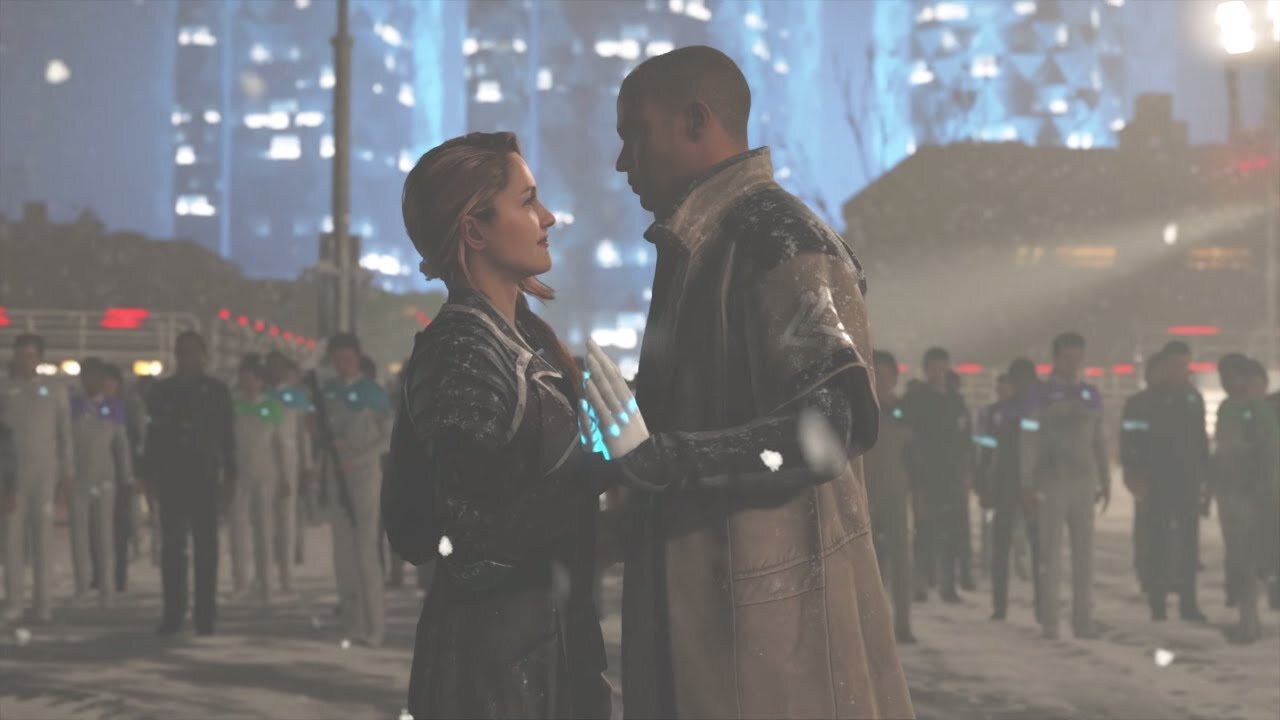
The other thing some reviewers complained about is tropes. Tropes are recurring situations or characters that writers continually use. Now, full disclosure: I use tropes in my writing. Really, everybody does. There’s a reason these situations are reused: readers like them. In my stories, Beckman is the tough, veteran security officer of few words. Nothing original about that. But, readers love Beckman. Detroit: Become Human is filled with tropes from dozens of sci-fi movies and books. An android cop partnered with a depressed, alcoholic human to hunt down deviant androids; a skyscraper caper with a base-jumping parachute escape at the top; two identical Connors both trying to convince Hank they’re the real Connor and that Hank should figure it out by asking them questions only the real Connor would know. But, here’s the thing - although I recognized the trope immediately, it was awesome to play it. When Hank started asking me questions to prove I was the real Connor, a clock ticking down for my answer, I found myself scrambling to remember what his dog’s name was. Yes! I thought, I’ve seen this scene a million times and always wondered how I would handle it. Even the way Connor says, “Wait! Ask me a question only the real Connor would know,” is said as if Connor were remembering it from a movie he’d seen. The solution to prove myself was based on choices I’d made earlier in the game. If you google this scene, you’ll find a dozen different ways it could play out.
I really loved this game, faults and all. I admit, as I’ve gotten older I’ve been less interested in button-mashing games and more interested in narrative experiences, and Detroit: Become Human was really like nothing I’ve played before. I’m going back and replaying scenes with different choices. From what I’ve seen on YouTube, the endings are wildly different based on choices you make, and I’m looking forward to exploring each one.
When I’m not flying the virtual skies, I’m the sci-fi author of the Hayden’s World series. If you love exploration and adventure, be sure to check it out.

Creating an Audible Audiobook through ACX
43 Seconds is now an Audible audiobook. I talk about the process of creating it.
Some time ago I had an epiphany. Each morning I got in my car, drove thirty-five miles to work, then drove back. During that time I listened to XM Radio. My first ahah came when I realized I could listen to podcasts and actually learn something during my ride. My second ahah was so obvious that I wondered how I hadn’t thought of it during all those years of driving: I could listen to audiobooks. I think the reason I didn’t consider audiobooks is because I’ve always been a physical book fan. I enjoy the feel of book paper as I turn the page. I love the appearance of the typeface and the slippery touch of a book jacket. Indeed, I was a late adapter to ebooks for the same reason (which is ironic because I now primarily publish in ebook format). All of that changed when I listened to Wil Wheaton’s narration of Ready Player One. I loved the book, but when I heard it narrated it was like watching the first Harry Potter movie after having read the book. It had a whole new life of its own in those spoken words.
In November of 2020 I began researching how to publish an audiobook. Just as I began searching for a narrator, a narrator found me. It was one of those happy coincidences where the timing is right and everything falls into place. Shamaan Casey is a professional narrator who approached me with a pitch for 43 Seconds. When I listened to him read a sample of 43 Seconds, I couldn’t help but smile. Here was James Hayden, full of swagger, larger-than-life, debating with a gruff William. I’d written the words that were spoken, but somehow my writing just sounded better. And I knew why - it was the inflection, the dramatic pauses, the extra weight and nuances that Shamaan expertly placed upon my prose that breathe life into it. It’s the same way that a movie script can translate into a great movie with the right actor in the role.
If you’re used to self-publishing ebooks through Kindle Direct Publishing, then you can think of ACX as the KDP of Audible. Unlike KDP, you are probably collaborating with someone else (the narrator), and ACX has features to search its narrator database, listen to samples, contact narrators, have them audition, negotiate payment terms, sign a contract, upload chapters for proofing, and get final author sign-off before publishing. Once published, ACX operates as your book sales dashboard. Note there are many other services besides ACX to publish audiobooks and some of those services publish to Audible, so ACX is not the only way to get your audiobook on Audible, just as KDP is not the only way to get an ebook into Amazon.
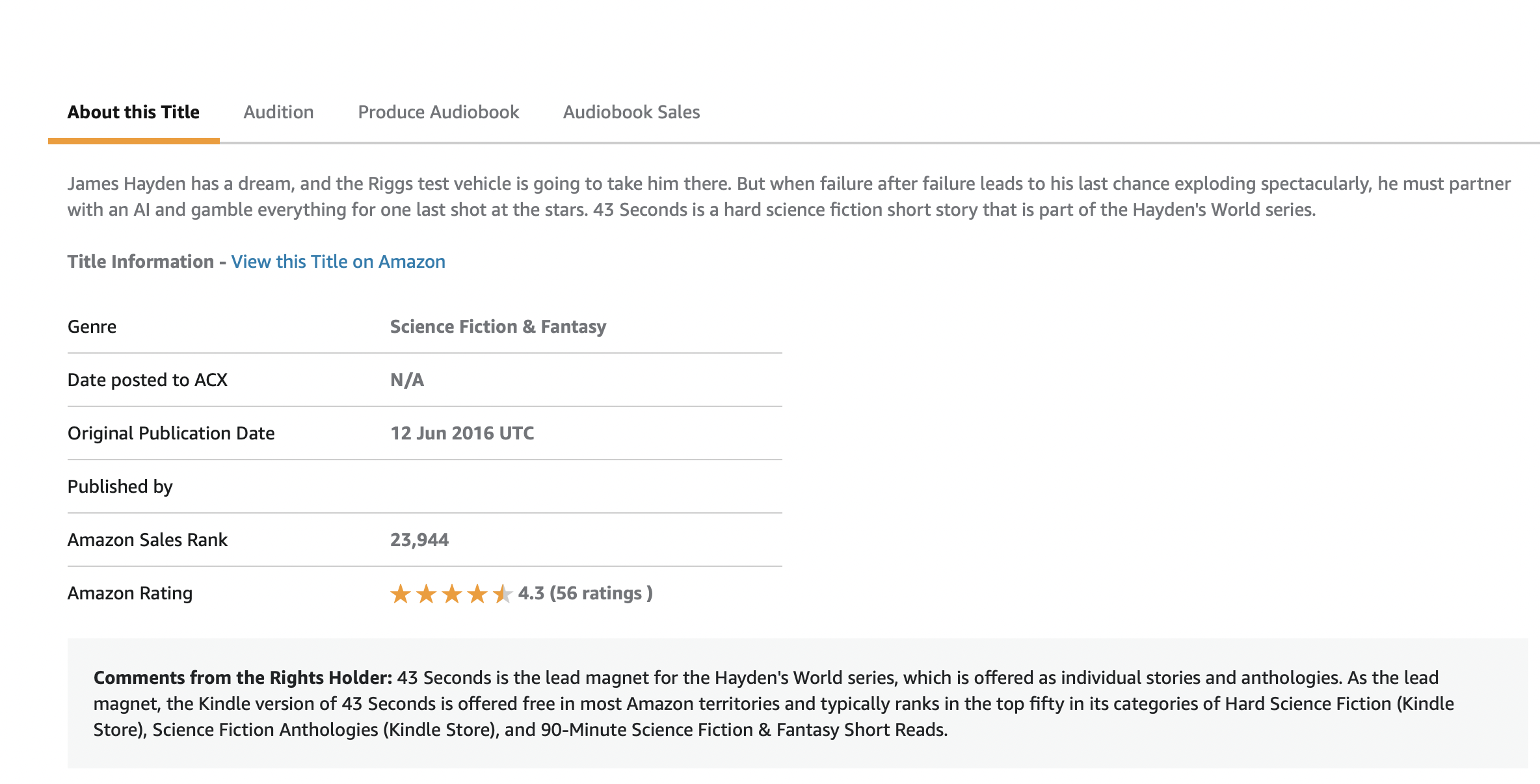
ACX title screen for configuring a new audiobook

ACX production screen. As the narrator completes and uploads each chapter, the author reviews them and provides approval or requested changes.
In my case, Shamaan and I had worked out the details offline, so in ACX I skipped the auditions step and sent an offer directly to him. ACX emailed us both contracts to sign. I admit, as each new chapter was uploaded, I was excited to listen to it for the first time and hear how Shamaan tackled each scene. I’d make notes as I listened and send any pronunciation corrections, which he’d quickly make and resubmit. Corrections were few - things like acronyms I’d made up for the story - and if I were to do another book I’d know to scan it first for acronyms or unusual names and send a pronunciation cheat sheet before narration began.
I should note at this step that narration involves much more than narrating. The narrator is also the sound engineer and needs to edit and produce the audio file to meet ACX’s standards. Once the book is submitted to ACX, it can spend up to a month in QA review. A professional narrator handles all of this so that you don’t have to. Also, much like a two-hour movie takes much longer than two hours to make, you should keep in mind that most narrators give you a quote per finished hour (PFH). It will probably take them seven hours of work to make one hour of audio. So, if the price seems high you need to realize it’s not an hourly rate, it’s a price to produce a finished product that is one hour long.
If you’re used to KDP for ebooks, ACX’s process will seem slow. Shamaan’s narration went quickly, but ACX’s approval process takes weeks. The project was completed on Dec 23 and in the Audible store on Feb 1. My advice: have patience.
My experience was great, overall. ACX is easy to use and I was fortunate to connect with a talented, professional narrator. Shamaan also helped me through the process, offering advice at different steps and helping with promotion by cross-posting to social media.
43 Seconds is available on Audible and iTunes. Note ACX sets the price based on the length and it’s currently around seven dollars.


MSFS 2020 Mods Used in My YouTube Channel
I share a complete list of all the Microsoft Flight Simulator 2020 mods featured on my YouTube channel.

Well, I blame James Hayden, the star of my Hayden’s World book series. In the stories, he’s an awesome pilot, and it’s hard to write about an awesome pilot without learning a thing or two about airplanes. What started out as curiosity evolved into hundreds of virtual flight hours in X-Plane and Microsoft Flight Simulator 2020.
Both X-Plane and Microsoft Flight Simulator have vibrant communities of talented fans who create both free and payware mods for the sims. Now that I’ve made over a hundred YouTube videos, it seems easier to list them all in one place so you don’t have to hunt and peck to find your favorite mod.
While you’re here, be sure to subscribe to my YouTube channel. If you enjoy sci-fi stories about pilots, why not grab the first story in the series, 43 Seconds, for free? It’s a fun short story that takes about twenty minutes to read, and is about a pilot willing to risk everything for a shot at the stars.
download MY TRACKIR PROFILE
SCENERY
PAYWARE
Orbx KSJC San Jose International
LatinVFR KBDL Bradley International
LatinVFR KMIA Miami International
FlightBeam Studios KPDX Portland International
Flightbeam Studios KIAD Washington Dulles
Flightbeam Studios KTEB Teterboro
Vertical Sims KPCM Plant City Municipal
Sierrasim KSYR Syracuse Hancock
FREEWARE
KBWI Baltimore/Washington International
MYNN Lynden Pindling International
KLGA and New York Bridge Improvements
AIRCRAFT
LIVERIES
A320
TBM 930
DA62
DA40NG
Diamond DA40 Explorer Liveries
C172
1956 Cessna C172 G1000 Classic
Cessna 172 60s and 70s Colour Palette
C152
JustFlight Piper Warrior II
P28A Warrior II Clean Livery Pack
JustFlight Piper Arrow IV
Turbo Arrow IV Clean Interior Mega Pack
Savage Cub
Cubcrafters XCub
Cessna 208B
Aerosoft CRJ700
GROUND VEHICLES
MODS & UTILITIES
JustFlight Piper Arrow 3 In-Game Checklists
More Interesting Weather Presets
MSFS 2020 Google Map Replacement
WEBSITES

Astrophotography with the Nexstar 8SE
I share some of my process for taking astrophotographs with the Nexstar 8SE
Earlier this summer, Comet Neowise passed by, giving me a glimpse of the second comet I’ve seen in my lifetime. The previous sighting was the amazing Hale-Bopp in the 90s. Although I am old enough for Halley’s 1986 visit, I couldn’t see it at all from my location in the northern hemisphere. Comet Neowise was visible to the naked eye once dark-adapted, and its tail spanned a large swathe of sky. My one regret is not having a decent telescope for its viewing.
If there’s one thing about the house-arrest experience of 2020’s pandemic, it’s that it encourages you to take up new hobbies. Astronomy was always one of my hobbies, but, like many, it had been back-burned as I got older. Newly-motivated, I purchased a Nexstar 8SE. Since one of my other hobbies is photography, it seemed inevitable that I would delve into astrophotography.

So, I think my biggest misconception about astrophotography was that all of those amazing internet photos were taken with giant telescopes. Bigger must be better for astrophotography, right? Well, I think I was surprised to learn that most photos I viewed were taken with relatively small (80 mm - 100 mm aperture) telescopes. The Nexstar 8SE has an 8” (203 mm) aperture. Many of these smaller scopes had modest focal lengths in the 250 mm - 450 mm range, compared to the Nextstar 8SE’s 2032 mm. So what gives?
I wrote a separate blog post about what to consider when buying a telescope. The things to keep in mind are:
Focal length directly affects magnification. Divide your eyepiece into your focal length for magnification. So, a 400 mm telescope with a 10 mm eyepiece magnifies 40 times.
Aperture directly affects brightness and detail. The dimmest object you can see is determined by aperture.
Focal Ratio (f/stop) directly affects how long of an exposure you will need to take to photograph a given object. Divide aperture into focal length to get focal ratio. Camera owners are very familiar with f/stops and know that “fast’ lenses will let a lot of light in, allowing shorter exposure times..
So the desired combination of these elements depends upon your stargazing targets. For example, most people don’t realize how big the Andromeda Galaxy is in the sky because you generally can’t see it with your naked eye. Imagine a full moon, then copy and paste that moon six times wide and three times tall. The Andromeda Galaxy is a little bit bigger than that in our sky! So, if you want to photograph it, and your telescope has so much magnification that it can’t even fit the entire full moon into a single frame, it has zero chance of capturing the Andromeda Galaxy. The Nexstar 8SE cannot fit an entire full moon in frame. I took this daytime photo of the moon by stitching together six photos:

So, if you want to photograph Andromeda-Galaxy-sized things, a smaller focal length telescope, like one of those 200 mm scopes I mentioned earlier, will work better than the Nexstar’s 2032 mm focal length.

Stellarium is excellent free software for planning your astrophotography session. You can see croppings showing exactly what your camera, telescope, and accessories like focal reducers or barlowes will yield. This box shows what to expect from the Nexstar 8SE with a f/6.3 focal reducer and standard DSLR. Even with a focal reducer, you can’t get the entire galaxy in frame. You’ll need a different telescope to accomplish that.

A lens or telescope with a 300 mm focal length should be perfect for getting the entire galaxy in frame.
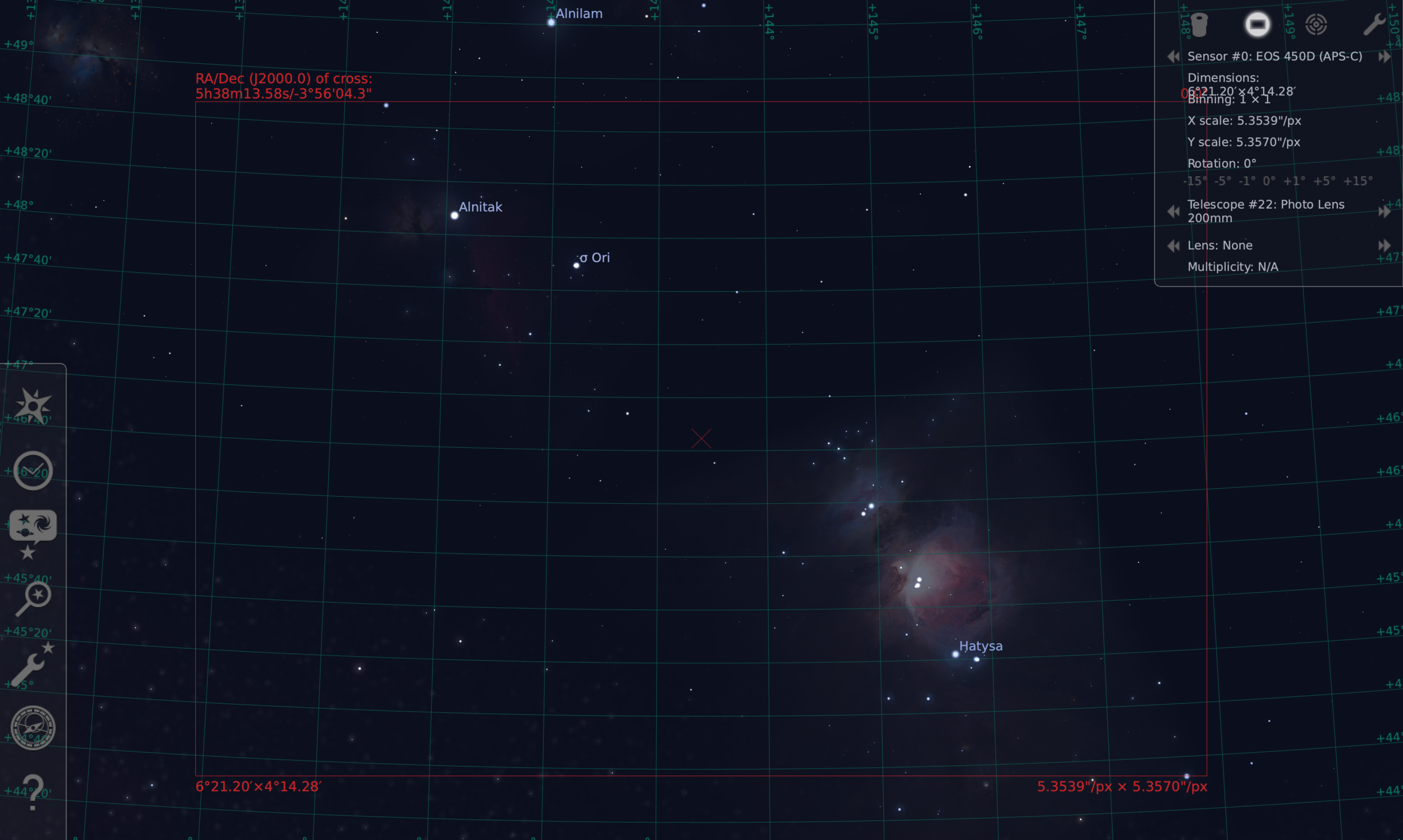
If you want to get the Orion Nebula, Horsehead Nebula, and Flame Nebula all into one frame, a DSLR with a 200 mm lens is a good choice

That’s exactly what I did in this picture, using a piggyback mount with my Canon T5i DSLR with a 200 mm lens. 272 fifteen-second exposures. Not bad for an alt-az mount! Note this picture is cropped slightly compared to the Stellarium framing because you will loose the edges of your photos due to field rotation.

M45 Pleides, taken with a DSLR piggyback mounted to my 8SE, through the DSLR’s 200 mm lens. This let me use the Goto mount’s tracking to keep the image centered. 75 ten-second exposures, stacked.

Another piggyback mount photo - 300 mm lens with 396 10-second exposures of the Andromeda Galaxy.

50mm f/1.8 lens, piggyback mount, Cassiopeia region with the Heart Nebula visible in the upper right. 120 8-second exposures.

Nexstar 8SE with a piggyback mount (center, right). Ideally, I’d have a separate EQ mount for my DSLR, such as a Skywatcher Star Adventurer, but for $20 the piggyback bracket was a cheap way to try out wide-field astrophotography without purchasing a second rig. The smaller of the two lenses is the Starsense camera, which auto-aligns the telescope using plate solving. I should note that the 8SE’s alt-az mount is rated for 11 lbs, and the 8SE OTA weighs 11 pounds, so piggybacking anything puts you over the mount’s payload...but, it is the same DSLR I already attach to the mount’s visual back for photos.
Also highly recommended gear: Warm jacket, red head lamp, and rechargeable hand warmers. It was 9 degrees Fahrenheit when I snapped this photo, and the one above it.
Now the next part is a little tricky. As much as you may try, your eyes cannot take long-exposure images. So if you want to see dim things, you’ll want a larger aperture telescope. But if you want to photograph dim things, you want a telescope with a fast focal ratio, since focal ratio affects exposure time.
Those small scopes make a little more sense now. They all have very fast lens with medium focal lengths and are built for astrophotography. Could you use them for visual astronomy? You could, but for eyeballs the big guys like the Nexstar 8SE will do a much better job.
The other thing the small scopes have in common is a tracking equatorial mount. The Nexstar 8SE has a tracking altitude-azimuth mount. In theory, if you wanted a one hour time-lapse camera exposure, both telescopes should be able to keep everything motionless and centered due to their tracking capability, right? Well, no, not for an alt-az mount, and this is the part that confused me at first.
To understand why, let’s do a quick exercise. Make a fist and stick your arm straight out. I’ll wait…okay, I see you’re not doing it, c’mon…that’s better. Now, rotate your arm so that your fist turns clockwise. We’re going to call the axis that your arm is rotating the z-axis. Now lift your arm up as if pointing to the moon and bring it back down. The up-and-down motion of your arm is the y-axis, or altitude axis. Now swing your arm to the left and right. The left-right motion is the x-axis, or azimuth axis. An altitude-azimuth mount can move in the left-right and up-down directions, but can’t rotate in the z-axis.
An equatorial mount rotates in the z-axis, or right ascension axis. Stick your fist back out. Now, imagine an arrow coming up off the top of your hand. Move your hand up six inches in the direction of the arrow and bring it back down. By doing this you’ve added a second axis. The up-down motion is the declination axis.
Now, rotate your wrist 90-degrees clockwise. The imaginary arrow coming off the top of your hand rotates with it and is now pointing to the right. Swing your arm in the direction of the arrow. This is still the declination axis. It’s always in the direction the top of your hand is pointing, regardless of how you rotate it.
I found right ascension, declination, altitude and azimuth thoroughly confusing, but the arm exercise helped me understand it. So, why on earth would you want to use the complicated equatorial mount? The answer is because you are on Earth, and Earth has this inconvenient feature of constantly rotating. Because of the Earth’s rotation, stars travel in arcs across the sky. Like an archer’s arrow, they rise, peak, then fall below the horizon. If you remember your geometry days, trying to draw a circle using (x, y) coordinates is complicated. But drawing it in polar coordinates is mindlessly easy. Alt-az is x,y and equatorial is polar.
It’s not just that it’s harder. Imagine your archery friend wants you to take a video of him shooting an arrow. You zoom in on the arrow as it shoots 45 degrees up into the sky and you perfectly track it as it reaches its apex, tilts down, and descends, sticking in the ground. When you play back the video, the arrow is perfectly centered in frame, but it rotates, initially pointing up, flattening, then pointing down. That’s because you are tracking it in the x-y (alt-az) axis. You’d need to add a third axis, rotation of your wrist, to compensate for the rotation of the arrow.
Get it? The Nexstar 8SE will perfectly track Saturn across the sky, keeping it centered in frame, but, like the arrow, Saturn’s rings will start pointing up at 45 degrees, flatten, and then point down over time. The only way to fix that is to add a z-rotational axis to your telescope. If I were to do a long-exposure of Saturn, the disc of Saturn would stay centered but, like a snow-angel’s wings, Saturn’s rings would fan out into blurry arcs and its moons would trace star trails.
One of the best explanations of right ascension/declination and alt-alz coordinate systems and mounts can be found in this YouTube video by Astrophotography P2
The answer to “how long of an exposure can you take with the Nexstar 8SE before getting star trails” is complicated, but in general, probably about 30 seconds. Things close to the North Star trace smaller arc than things further away, so the amount of blurring you get depends on where the object is in the sky. I usually limit exposures to 15 seconds.
The other issue is that the tracking control software drifts over time and makes a correction every 30 seconds or so. In the 360-photo sequence of the Orion Nebula, below, you can see the nebula drift up and then back down. If I tried to do 60-second exposures, it would have been a blur. But as 5 second exposures it was fine. The photo stacking software re-aligned all the images in post-processing:


Frame captured during the mount’s error correction slewing.
This is a good segue into the next misconception I had for astrophotography: what you see in the telescope doesn’t remotely look like the Hubble-telescope-type photos posted on the internet. First, your eye can’t take 15 second exposures, so even bright objects like the Hercules Cluster look like milky, faint cotton balls and colorful objects like the Orion Nebula look like milky, faint wedges. Second, 15 seconds isn’t enough even for a camera. To get those amazing photos, you need to stack hundreds of images. Imagine you’re using an old film camera and a 15 second exposure would blur due to movement. Instead, you do 15 one-second exposures, all on the same piece of film. The end result is 15 seconds of exposure without the blurring. This is key: even though I am limited to short timeframes for my exposures, there’s no limit to the number of exposures I can take, other than my time. So, if I want a one-hour exposure of a faint galaxy, I can take 360 ten-second exposures.*
*Sort of: Dylan O’Donnell tested one 300-second exposure versus thirty stacked 10-second exposures. The 300-second exposure won. You need a minimum signal (observable image separate from background noise) to stack, so low exposure times may not have enough detail, even when stacked.
Now that I’ve got you grounded, here’s the equipment and software:
The Nexstar 8SE, upgraded with the StarSense camera. The 8SE has a 3-star alignment process by default, which requires you to center stars it picks in the finder scope. The StarSense camera automates this fully using plate-solving to identify all of the visible stars and figure out where the telescope is. During sub-freezing January nights, you will appreciate turning it on, going inside and getting a cup of tea, and coming back out to have the telescope all setup and ready to go.

Left to right: 1) Bahtinov mask - placed over the telescope’s end, it produces a spiked diffraction pattern around a star that you can use to perfectly focus the telescope. You remove the mask afterwards. 2) Intervalometer - a programmable timer for your camera. You can set it up to take hundreds of exposures at a specified interval and duration. It plugs into the cable release on your camera. 3) Camera T-adapter - screws onto your camera like a lens. The narrow end is 1.25” and fits in your telescope like an eyepiece. Essentially, it changes your telescope into a giant camera lens. Note, instead of mounting your camera through he eyepiece, you can also buy an adapter that mounts directly to the visual back. Keep in mind that the number of things between your camera and the telescope will affect its focal point, and some combinations may exceed the back focus of your scope (it will be impossible to focus without adding things like extenders) 4) Anti-vibration pad - shock absorber placed under the legs of your mount. You’d be surprised how much your telescope picks up deck vibrations.

Diffraction pattern produced by a Bahtinov mask when a star is in focus. Tiny adjustments to the focus will rotate the center diffraction arc towards the top or bottom arcs. The goal is to have it centered between them. This is done in realtime using your camera’s live view. On my Canon T5i, I turn on the video display and then 10x zoom to isolate the star and see the diffraction pattern.

Stellarium+ iPhone app - point your phone at the sky and it will tell you what you’re looking at. I use it mainly for planning (and you do need to have a plan based on what’s visible tonight)

Clear Outside iPhone app: Clear nights are fairly rare. This lets you see the week ahead and the hour-by-hour cloud cover along with moon light pollution. It lets me work out my targets ahead of time and not be scrambling at the last minute poking my head outside to see if nature is cooperating. Don’t have the app? Just go to their webpage, clearoutside.com.

Astro Pixel Processor: Stacking software for astrophotography. APP is able to do all sorts of advanced things like stacking hundreds of images, removing light pollution, and assembling composite images taken at different times and angles. If you have a Mac, like me, it works in Mac.

Backyard EOS (Windows) and AstroDSLR (Mac) each connect to your DLSR via USB, controlling it in much the same way that you’d control a dedicated astronomy camera. You can program complex sequences, hit start, and head inside while it does the work. You can use this as an alternative to an intervalometer.. Both can do plate solving and communicate with your mount to correct for errors - which means you can have perfectly centered photos with the click of a button.
You certainly don’t need plate solving to take astrophotos, but if you have a way to control both your camera and mount via laptop, it makes things easier.
Plate solving with AstroDSLR and AstroTelescope, using a free nova.astrometry.net account. Solving takes about 60 seconds. Afterwards, I press the Sync and Center key and my telescope will slew to the correction.
These are my tools, now a quick primer on how they work. Stacking software aligns your hundreds of photos by matching up stars, then it reinforces the repeating elements and discards the anomalies. When you take your photos, you’ll take up to four sets:
LIGHTS: The normal-exposure photos of the thing you’re photographing. Usually I take at least 25 lights at ISO 1200 - 3200 with exposure times of 5 seconds - 15 seconds
DARKS: Dark photos are taken with the telescope’s lens cap on, so they are black. They need to be taken at the same ISO and exposure time as the Lights and the camera should be at the same temperature as the Lights. I usually take 25 - 50 darks. Your camera produces inherent noise in low-light which will show up in the dark photos. The noise will then be subtracted from the Lights in your stacking software.
BIAS: Bias photos are taken with the telescope’s lens cap on at the same ISO as the Lights but with the fastest exposure your camera has. My T5i can do 1/4000 second. I’ll take 25-50 bias photos. The electronics of your camera produce inherent noise in the sensor, which shows up in the bias photos. This noise is then subtracted from the Lights in the stacking software.
FLATS: You can make flats anytime by putting a diffuse, even, white light source over your telescope and photographing it. Some people use an iPad with a white screen and a t-shirt over it. Your camera’s sensor sensitivity is probably uneven and this will produce stripes or gradients that are noticeable when you boost low-light photographs. These will be subtracted from the Lights in the stacking software.
DARK FLATS: After you take your flats, put the lens cap on to take your dark flats. I was a bit perplexed how these were different than Darks, but Darks at taken at the same temperature and exposure as Lights, while Dark Flats are taken at the same temperature and exposure as Flats.
You feed your lights, darks, bias, and flats into Astro Pixel Processor (or another freeware program like Deep Sky Stacker) and it does the rest. Depending on the number of images you give it, it may take most of the day to process them. The image that you get out of stacking is surprisingly dark, but the image data is there hidden in the pixels. The next step is to make the data visible, a process called stretching. Astro Pixel Processor will do some of this for you, but I prefer Photoshop. During stretching, you adjust the curves of the photo to make the data fall into the visible range. If there are other issues, like the red-green-blue channels being misaligned due to aberrations, you align them to fix the color. It’s interesting that your telescope picked up all this data but it was just too dim to see.
Here’s what the unedited 5-second exposure of the Orion Nebula looked like coming straight from my camera at ISO 3200:

I took that picture 360 times, along with darks and bias photos, and fed it into Astro Pixel Processor. Here’s the Astro Pixel Processor output:

Note the field rotation. The overlapping squares are rotating clockwise. This is because of the alt-az mount.
I then stretched it in Photoshop. Here’s what the final photo looked like:

Just a little different than the original! It’s crazy that all of that was in the top photo to start. I didn’t add anything in Photoshop. I just reset where the white and black points were to straddle the wavelengths of the Orion Nebula. I’m still in awe that I took that from my deck.
Here’s the Orion Nebula taken a few months later with an f/6.3 focal reducer and dual bandpass clip-in UHC filter. Note the difference in colors. (The focal reducer is one of the best additions I’ve purchased and the UHC filter is great for emission nebula like M42):

Fifty 15-second exposures stacked for a total exposure time of 12.5 minutes. There were some tracking issues that caused the elliptical stars, so I’ll be sure to repeat this imaging. This image is inverted versus the first because the original had the star diagonal in place.
Note you should not stack all of the photos you take. You should visually inspect the set before stacking and remove any with blurred stars, clouds, satellite streaks, etc. Had I done that with this photo, I probably could have avoided the elliptical stars.

128 ten second exposures at ISO 3200, taken in January 2022, a year after the previous photo. Despite throwing out the poor tracking shots, the stars still have a pear shape, which was due to the alt-az mount’s tracking capability, the position of Orion in the sky, and field rotation. Note part of the Running Man nebula is visible in the top-left. Due to the 8SE’s error correction, some images would shift down and then back up. During this time, the Running Man nebula was in frame. AstroPixelProcessor stitched it all together.

I now manually review all of my images before stacking them, color coding them red/yellow/green by quality. If I have enough greens, I’ll do the stack with only greens, otherwise I’ll include the yellows.

UHC dual bandpass clip-in filter for my DSLR. It didn’t have much effect for visual astronomy, but for astrophotography it’s great at bringing out the reds in targets if you can manage the extra exposure time. Be sure to take a photo of an even gray surface under noon sunlight with the filter in place so you can set a custom white balance image for the filter’s use. This will correctly remove the blue tint from the filter when you take the picture, instead of trying to color-correct in post.
Note consumer DSLRs like the T5i have a built in IR filter that makes it difficult to photograph dim red emission nebula. You’ll need a dedicated astronomy camera or a willingness to sacrifice your DSLR via surgical extraction if you want to get around it. In my case, I didn’t modify my DSLR.
Hopefully this was helpful. Incidentally, the Cloudy Nights forums are filled with opinions stating that the 8SE is only good for visual astronomy and planetary imaging. I disagree. All of my pictures are taken with the default alt-az mount and a DLSR (and a focal reducer for some), so you definitely can enjoy both visual and astrophotography out-of-the-box. I agree that the 8SE is designed to be a visual astronomy scope, but that doesn’t mean you can’t take some nice astropics with it. A couple of opinions:
Generally, I’ve been successful imaging things in the Messier catalog, although it depends on the color of the target (I don’t have a modded camera and targets with deep reds are harder to photograph than targets with greens). Targets up to 6.5 magnitude can usually be imaged, although I can certainly image fainter magnitudes depending upon the color.
If you envision a time lapse with star trails spinning around Polaris, the ones closest trace small arcs and the furthest large. Same deal when imaging, so the length of an exposure you can take without star trails depends on where an object is in the sky. It’s why there’s no single answer to “how long of an exposure can you take with the Nexstar 8SE?”
There is no reason you can’t piggyback mount a camera to your scope and take wide-field astropics. When you do this, you get all the benefits of the Goto mount and Starsense setup.
Keep in mind that the trade-off for upgrading to a more expensive mount is that you will either need a helper to set up your scope or you’ll need extra time to carry it out piecemeal and assembly it. It’s definitely a plus that I can carry the entire assembled scope onto the deck by myself. The typical EQ mounts people direct 8SE owners to on the forum weigh in at 76 pounds, excluding the telescope and accessories, so your total kit weight will exceed 100 pounds with these.
I may upgrade to an EQ mount for longer exposures, or I may get a lightweight camera-only EQ setup, such as a Star Adventurer. I’m leaning towards the Celestron AVX, since weight is important to me. I realize guiding will be trickier with the AVX than a higher-payload scope such as the CGEM, but I just don’t think I’ll use my scope as often if I need to assemble it each time.
You can use light pollution or ultra-high contrast filters, but these further eat into your exposure time because they block not only the bad light but also a little of the good light, so these work best with brighter objects such as the Orion Nebula and/or a focal reducer (although if the target’s color is right, such as the Dumbell Nebula, these have helped me with faint objects).
Here’s a few other (less dramatic) photos I’ve taken in the months leading up to the Orion pic. These all have much less exposure time but were fun none-the-less:

M13 Hercules Cluster - a great visual eyepiece target as well - it’s a very bright cotton ball to the eye

M27 Dumbell Nebula - hard to see through the eyepiece, but colorful in a long exposure. The super-colorful photos you’ll find on the internet are done with special narrowband filters

Same image of M27 taken a year later with a focal reducer and UHC filter. Much easier to see through the eyepiece with a focal reducer. Two things to note versus the previous image: 1) The focal reducer changes the telescope’s f-stop from f/10 to f/6.3. You can see dimmer parts of the nebula’s sides visible in this image that were lost in the first. 2) The UHC filter, which is blue, makes reds more visible. The reds at the top and bottom of the nebula are stronger and more saturated here. Also, individual stars are red. Note this is a magnitude 7.5 object, still easily photographed both with and without a focal reducer using the 8SE.

M57 - the Ring Nebula - small even with my Nexstar’s huge 2032 mm focal length. What’s awesome about the Ring Nebula is that it looks exactly like this visually through the telescope eyepiece. M57’s magnitude is 8.8 - again, easily photographed without a focal reducer and readily visible through the eyepiece.

This one needs no introduction! It was a bit late in the summer before I figured out how to get good planetary photographs and Saturn was already past its peak. Next summer I should get a clearer image. Not too bad, though. Planets are so bright that the best way to photograph them is to take a video and feed the video into the stacking software. The video will contain thousands of frames to stack. Keep in mind that with video your exposure is limited to your frame rate, so if your video captures at 30 frames per second then your exposure is 1/30 of a second. Generally you’ll only be able to capture the Moon or planets at 1/30th of a second.

Saturn taken the following summer. I had better optics, since I’d upgraded everything to 2” Luminos, including the Barlowe in use here, but was still using a Canon T5i DSLR. I may need a different imager if I want to get a less pixelated image for something this size.

NGC2301 Hagrid’s Dragon, taken with a f/6.3 focal reducer on the Nexstar 8SE. A good visual target as well because it looks similar to this and you can make out the yellow and blue star colors easily by eye. This photo is yet another plug for owning a focal reducer - the clarity of the stars is greatly improved compared to my non-focal reducer photos.

M81 Bode’s Galaxy taken with a f/6.3 focal reducer. Galaxies are not one of the strong points of the Nexstar 8SE when shooting with an alt-az mount, mainly because your exposures will be 10-15 seconds and you need more signal for the faint structures of galaxies. Bodes is one of the brighter galaxies and photographs well, however.

The Moon taken with a f/6.3 focal reducer. I included this so you can compare it to the earlier daytime moon photo that was stitched together with six pictures. This nighttime photo is a single picture, so you can fit the entire moon in frame with the focal reducer. This is still too much magnification to photograph the Andromeda galaxy, however (which is 6 full moons wide). Note the slight reddish tint in the upper left of the Moon. The Moon’s colors normally are lost to our eye, washed out by sunlight, but you can see a hint of them here.

M17 The Swan Nebula taken with a f/6.3 focal reducer and UHC filter. Through the eyepiece, this nebula appears like a milky cone.

M8 The Lagoon Nebula taken with a f/6.3 focal reducer and a UHC filter. M8 is a great summer visual target where I live.
While you’re here, if you enjoy sci-fi stories with a classic exploration theme, why not check out my series, Hayden’s World, available on Amazon and Audible?

IFR Flying in Microsoft Flight Simulator 2020
Once you get comfortable flying with eyeballs, it’s time to learn how to fly blind.
Microsoft Flight Simulator 2020 launched last fall and is the sim that we all hoped for. While we’re all used to too-good-to-be-true video game trailers that never quite materialize in real-life game play, MSFS 2020 actually looks like its awesome trailers. MSFS 2020 isn’t perfect - many of its aircraft systems lack the sophistication and polish of their X-Plane counterparts - but it does offer the entire world modeled with photo-real weather for you to explore.
MOSTLY UNNECESSARY DISCLAIMER: I’m just some guy playing a video game, and the info below is for flight sim use only. If you want real-world aviation advice, talk to a real-world Certified Flight Instructor.
In real life, aspiring pilots start with their Private Pilot License certification. In the United States, you need a minimum of 35 hours of flight time followed by a check ride to get it. It’s quite expensive. You’ll need to rent an airplane and pay a flight instructor for each of those hours. With rentals starting at $200/hour, the rentals alone are $200/hour x 35 hours = $7000. But, don’t let this discourage you. This is a high cost/short duration activity. We’re used to glossing over the cost of our extracurricular activities because they are low cost/long duration activities. For example, I took karate lessons for fifteen years. At $50 per month, I spent $9000 on karate lessons. But it was spread over fifteen years, not six months.
Pilots first learn to fly VFR (Visual Flight Rules). This is the same way you drive your car, looking through your windshield to figure out where to go and only occasionally glancing at your dashboard to make sure you’re not speeding. You may have a GPS in your car, but you’re not using it to keep your car on the road. If a blinding, torrential downpour rolled in, you’d slow down and pull over.
Most pilots stop there. VFR flying is no-hassle. Much like having a driver’s license where you don’t need anyone’s permission to hop in your car and go someplace, you can generally hop in your plane, fly someplace, change your mind mid-route and go someplace else, all without talking to a soul. You don’t even need to file a flight plan. The only exception to this is when passing through airspaces (typically near larger airports) where air traffic controllers manage traffic.
In exchange for this freedom, you have limitations. You cannot fly through a cloud or even come near to one and you need several miles of visibility. This is because you’re flying by eyeballs, and when you can’t see it’s as illegal as driving your car with your eyes closed. If you’re a weekend aviator looking forward to a hundred-dollar cheeseburger, your hopes may be dashed by low clouds or fog.
Instrument Flight Rules (IFR) is the next step. When flying IFR, you are flying by instruments, not eyeballs. You are flying a precise set of rules and routes that keep you from crashing into terrain. That’s not enough, though. You also need to not crash into other pilots. For that, you need an air traffic controller watching you on radar. You’ve probably flown on commercial jets many times is bad weather. Commercial jets always fly IFR and can mostly ignore clouds, rain, and fog. Imagine if you could only fly commercial on sunny days.
The trade-off of this new superpower is a lot more preparation and rules. You’ll need to file a flight plan, get it approved by ATC, stick to it, and talk to the ATC the entire way.

VFR map for arrival to San Jose. The map shows things you look for with your eyeballs, like mountains, towers, roads, and power lines.

IFR map for arrival at San Jose. The maps shows airways, navigational waypoints, and navigational frequencies.

IFR plate for landing at San Jose using runway 30L. There are precise waypoints and altitudes to hit at specific distances from the runway. For this procedure, you need a GPS with RNAV capability.

In IFR maps, someone has worked out the safe altitudes and flight paths between two points. On the map above, the airway labeled V107 (to the left of the Los Angeles postage stamp) connects the waypoints GUYBE and SADDE. The 5000 number above the V107 tag indicates that the minimum enroute altitude (MEA) is 5000 feet above sea level. If you fly an altitude of 5000 or higher along this segment, you are guaranteed VOR reception and you will not hit terrain. The 10 number below V107 indicates this segment is 10 nautical miles long. Because the airway line is bolded, it is legally flyable. If it were not bolded, it would be for reference only.
Usually, the airport itself is not along a flyable airway. Even if it were, it would be below the minimum airway altitude. That means that when you take-off or land IFR at an airport, you need someway to get off the airway and safely navigate to the airport. The simplest is radar vectors from ATC. They will verbally guide you to where you need to be. If people are always getting vectored from the same waypoint and ATC is always sending them along the same paths, then the airport may just say “Alright, this is the standard way that planes arrive when coming from this waypoint.” They’ll then publish it as a Standard Terminal Arrival Procedure (STAR).

One of the STARs for San Jose. It covers standard arrivals for three different directions that planes may arrive, called transitions. Planes arriving from the north at Red Bluff VOR at the top of the map will use the Red Bluff transition for the BRINY TWO arrival.
Similarly, if planes are always vectored along the same paths when departing, the airport may publish a Standard Instrument Departure (SID) procedure.

Burbank’s VAN NUYS THREE SID. There are instructions for each runway and what direction you intend to fly. If you are departing to the northwest along to top left corner of the map, where the Avenal VOR is located, ATC may say something like “Cleared IFR via the Van Nuys Three departure, Avenal transition…”
The arrival just gets you to the airport. You still need a way to land. In flight terms, this is called the approach. The airport will likely also have published approaches. Usually there are multiple options to accommodate the wide range of technologies on aircraft.

ILS (instrument landing system) approach for runway 30L at San Jose. You will need to arrive at a specific waypoint and a specific altitude to begin it (this point is called the initial approach fix - in this case it is KLIDE waypoint at 4000 feet, which has the letters IAF, short for initial approach fix, on the chart). For an ILS landing, your navigation equipment is picking up a signal from the runway that guides your plane to the runway. You need to intercept the signal at a specific location, called the final approach fix (in this case HIVAK waypoint at 2700 feet, marked by a treasure-map-like X on the chart). From that point, if you have an autopilot with vertical navigation capabilities, your plane will fly itself down to the runway, “riding the beam”. Even if you don't have an autopilot, the ILS signal will give you horizontal and vertical guidance on your instruments, allowing you to hand fly the beam.
So, your IFR flight may look like:
File your flight plan. After starting up your plane, contact Clearance Delivery at the airport and get your flight plan approved. Note they may change any element of it as needed.
On departure, fly a SID (Standard Instrument Departure) procedure
The SID will transition to the enroute portion of your flight
The enroute portion of your flight plan will transition to a STAR (Standard Terminal Arrival) procedure
The STAR will transition to an IAF (initial approach fix). ATC will probably get you from the STAR to the IAF via radar vectors.
Once at the IAF, you will fly the approach procedure to land
Not every airport has published SIDS and STARS, and if an airport does have one it’s really up to ATC whether they send you on it. They might just send you direct via radar vectors to your transition, for example, if traffic is light.
Microsoft Flight Simulator 2020, to its credit, has a nice graphical flight planning tool for selecting IFR routes, SIDS, STARS, and and approaches. It easily lets you toggle through all of the procedures and visually see how you’ll be flying

Planning an IFR departure from Seattle. The SID is the yellow line. The one selected, which takes me far to the west, doesn’t make sense for a south flight to Portland, so I would keep toggling through SIDs until I found one designed for a southern departure. The enroute portion of the flight is the blue line.
What’s nice about the visual flight planner is that MSFS uploads it all into your plane’s GPS. The planner isn’t perfect - if there are multiple transitions available for a departure it takes its best guess, sometimes flying you in crazy loops - but overall its pretty good. ATC will give you instructions based upon it, although the game fudges ATC vectoring near airports by having your GPS send you direct to initial fixes. If you’re completely overwhelmed by the choices, you can just set it to automatic and the game will make the flight plan for you.
For a very detailed tutorial on IFR flight planning, check out my YouTube video for my flight from Syracuse to Teterboro:
To see an overview of some of the tools, such as Navigraph charts, you can use for IFR flights in MSFS, see my video Comparing Navigraph and Foreflight in MSFS:
I’ve done a couple of IFR flights now, ranging from light general aviation aircraft like the Diamond DA40 all the way up to airliners like the Airbus A320. It’s really fun, and I feel like I’ve learned something with each flight. Check out a few my flights on YouTube:
While you’re here, if you enjoy sci-fi stories where exploring the stars is a central theme, why not check out my series, Hayden’s World, available on Amazon and Audible? If you’re like me and you enjoy classic sci-fi adventure and exploration, you’ll enjoy it.


Thoughts on Amazing Stories 2020
After thirty-five years we got an Amazing Stories reboot, but is it amazing?
Sunday nights in 1985 were all about Spielberg’s Amazing Stories. The opening credits were a mix of fantastical John Williams music and sweeping computer animation. In the preceding year, The Last Starfighter demonstrated that mid-80s CGI had advanced to the point of motion-picture-level special effects, and the Amazing Stories opening gave us a knight in armor swinging a sword, animated books flying through a Harry Pottereseque castle, and spaceships soaring through the stars. The series was an anthology, each episode a different amazing story with a different cast, inspired by its namesake, the Amazing Stories magazine first published in 1926.

Spielberg, during the amazing 80s
The anthology format flourished in the 80s. Think about the anthology movies - 1981’s Heavy Metal and 1982’s Creepshow come to mind. When was the last time you saw a modern movie that was a collection of short stories? Certainly anthology television shows still exist. Netflix’s Black Mirror is a perfect example, and I’ve written reviews on my site about some of Netflix and Amazon’s other offerings of Electric Dreams and Love, Death and Robots. So, when I saw a 2020 reboot of the 1985 series, in particular during a pandemic year where we’re craving new content, my interest was piqued.
Premiering on Apple+, the 2020 reboot smartly retains the original John Williams theme music with a newly-imagined CGI opening.
There are only five episodes, which seems quite small considering the 1985 series had twenty-four episodes per season. In the pilot, “The Cellar”, a handyman restoring an old house time-travels to 1921, where he meets a free-spirited young woman while trying to figure out how to return to modern day. The mechanism of time traveling is a sudden drop in air pressure from a super storm. He deduces, Back-to-the-Future-style, that being at the right place when the storm hits will jolt him to the present. It’s a very generic time-travel story. A man travels into the past and meets a woman.
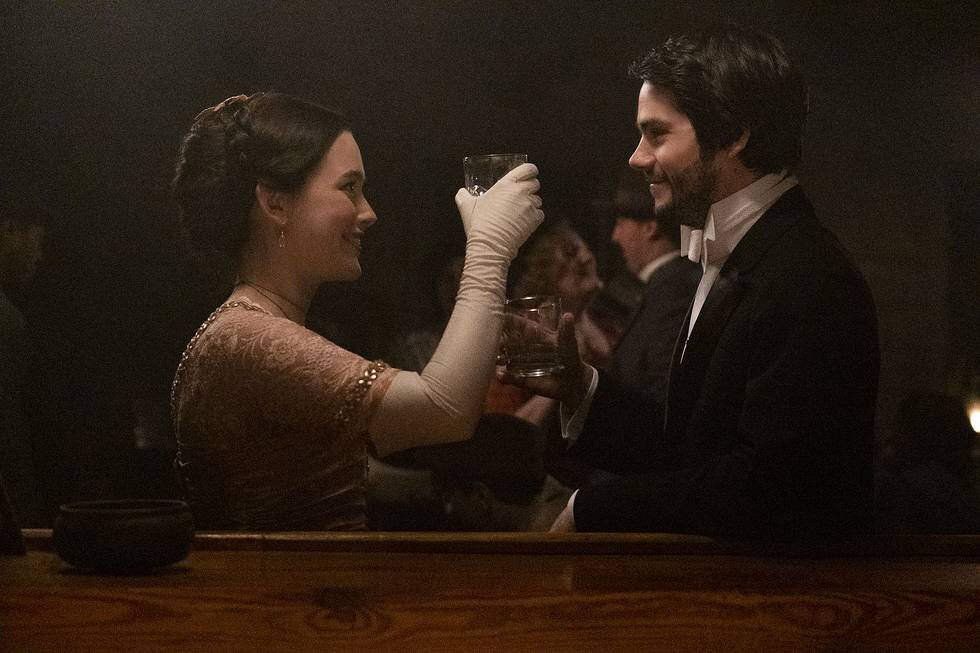
It’s quite similar to the 1980 movie Somewhere in Time starring Christopher Reeve and Jane Seymour.

“The Cellar” isn’t a bad story. It’s just not an amazing story. The pacing is slow and it lacks the Spielberg hook. As a writer, there are certain story beats you need to hit. In long fiction, you establish normal life before introducing an upset to kickoff the plot. In short pulp fiction, you jump right into things with the hook. Spielberg had a mastery of using the hook even in feature-length movies. In 1977’s Close Encounters of the Third Kind, it was the discovery of a perfectly-preserved WWII squadron in the middle of a desert.

In 1981’s Raiders of the Lost Ark it was a dangerous trek into a trap-laden mountain in search of a golden idol.

There’s no setup for the characters in these opening scenes. Who are they and what are they doing is part of the hook. It’s the opening beat of an amazing story. Arguably, the opening of Raiders isn’t even part of the plot. The golden idol’s acquisition has nothing to do with the quest for the ark and doesn’t provide any momentum for that storyline. Its sole purpose is to introduce us to Indiana Jones, rugged relic-hunter, and learn that he has a nemesis, Belloq. But it works. The hook is set.
The remaining four Amazing Stories episodes generally suffer from the same issue with beats. There’s a person who doesn’t move on after her death, an alien-possession of a coma survivor, and a time-traveling WWII pilot who helps a family before returning to the past. The standout episode is “Dynoman and the Volt!’, which feels like an amazing story. A comic-book-loving boy, who is made fun of and ditched by his friends, teams up with his grandfather, a grumpy man who is recovering from an injury that’s cost him the ability to work. His grandfather also loved comic books as a boy, and ordered a ring that his favorite superhero, Dynoman, wore. Sixty years later it arrives in the mail. When the grandfather puts it on, he slowly gains Dynoman’s powers.

There is no crime-fighting in this story. Both the boy and the grandfather want to use the ring’s powers to impress their peers and regain respect. The story is a character story about the strained relationships of the grandfather, father, and boy, but what makes it work is that it’s just fun. It hits the right note that there’s still the adventure-loving boy in all of us, regardless of how grown-up we may think we’ve become.
In a way, I wish there were more than five episodes. There weren’t any bad episodes, but most were bland, except for Dynoman. It makes me wonder that, with a twenty-four-episode season like the 1985 original series, how many more Dynomans there could have been.
Incidentally, as I thought about the original series I found that all I remembered was the opening theme. I mean, there were forty-five episodes, certainly some must have stuck out? Sure, it’s been thirty-five years (!), but I can remember plenty of Star Trek: The Next Generation episodes from the same timeframe. It turns out, the original series really wasn’t that good. There were a few Dynomans in there, such as Christopher Lloyd in “Go to the Head of the Class”, a very Death-Becomes-Her plot where two students curse their teacher with unexpected consequences.
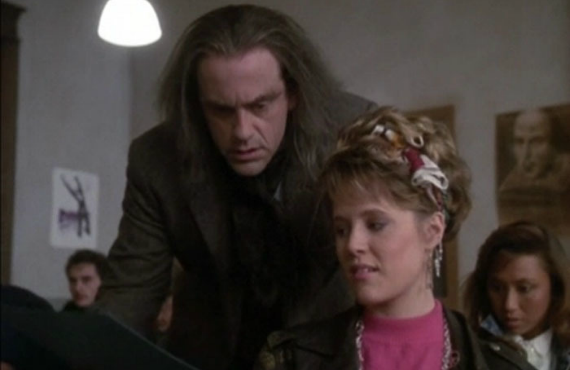
Or “Remote Control Man” where a meek man discovers his remote control can replace his awful family members with television characters, which at first seems great until he realizes the characters come with all of the crazy plots that TV characters have.

Just from the one-sentence plot summary of “Remote Control Man”, you can tell there is a bit of a moral to the story, in the same way that the Twilight Zone and the Outer Limits episodes usually had a perspective on mankind. It’s interesting because it’s not so much the plot that makes it a good story - I mean, the 70’s Hulk literally bursts through the remote control man’s wall at one point - but it’s the lesson. Anyway, something to noodle on as I search for some of the original forty-five episodes to rewatch.


VFR Flying in Microsoft Flight Simulator 2020
After four months of flying the virtual skies in the amazing Microsoft Flight Simulator 2020, I share my thoughts about VFR general aviation flying in a virtual recreation of Earth.
Microsoft has been tantalizing the flightsim community throughout the year with too-good-to-be true screenshots and videos of its new product, Microsoft Flight Simulator 2020. I immediately bought it on its release date in August and have been using it nearly daily since then.

Actual in-game footage from one of my flights
Amazingly, Microsoft’s first release of Flight Simulator was forty-one years ago in 1979. I recall being a bit perplexed about it in the 80s, wondering what there was to do in it. How did it function as game? Were you just taking off, flying in a straight line for two hours, and landing? Did you get points? In the 80s, my video game attention span was limited to spaceship battles, magic sword fights, and pac men.
Fast-forward to a few years ago when I developed an increasing interest in aviation, writing a series a sci-fi stories about a pilot. In my quest for knowledge, I started watching YouTube aviation channels. It occurred to me that I could download the free trial version of X-Plane and tinker with each of the airplanes. I admit, it was a very engineerish thing to do, the virtual equivalent of taking something apart to see how it works. Of course, once I figured out how to start my virtual Cessna, there it was: the dark stretch of runway, blue sky, and a spinning propeller. The clouds beckoned their challenge. I reached for the throttle.
As I learned the ins and outs of virtually flying using the same maps and tools as real pilots and learning radio work on subscription ATC services such as PilotEdge, I understood now what eluded me in the 80s. The fun is in it not being a game. I felt like I was actually learning something and demystifying what happens behind those closed cockpit doors. Whether you think a simulator can teach you how to land a real-life plane or not, you can’t argue that I didn’t learn how to read actual FAA VFR sectional maps, navigate complex airspaces using traditional nav aids such as VORs and NDBs, and make and receive by-the-book ATC radio calls. One of my X-Plane virtual flights to Oshkosh was a recreation of the real-life annual AirVenture fly-in there, and the air traffic controllers giving me instructions on the radio were the actual real-life air traffic controllers from the Oshkosh event.
If I can follow instructions from a real-life controller, I must have picked up something.
The other surprising aspect of X-Plane is that it simulated the entire world. All of the airports were real and accurate, down to the simplest grass strips in the countryside. Roads, mountains, rivers and buildings were all correct. The advent of Google Earth, Open Street Maps, and other databases meant that X-Plane used a model of the Earth. I could follow actual streets in my neighborhood from the air, and find my house. From the air, my home town looked like my home town in real life.
Like most video games, you buy the game but the community provides mods. X-Plane brilliantly crowdsourced its world to its users, giving them easy-to-use tools to replicate real-life airports. If you buy X-Plane today, four of its airports were made by me. Other third-party tools allow you to import Google satellite images and cover your virtual world in them. So, what you end up with is a Google Earth-style recreation of the world.
Pilots fly using either Visual Flight Rules (VFR) or Instrument Flight Rules (IFR). VFR is how you drive your car, looking out your windshield with eyeballs to see which way to go. If you were to drive your car IFR, you’d be looking at your dashboard and GPS constantly, following precise written instructions while someone on the phone gives you cues when to turn and by how much. Many flightsim enthusiasts like to fly commercial jets, and these are flown IFR. You really don’t need a visually detailed world for IFR. In fact, much of your flight may be in the white-out of a cloud. All you need is an accurate navigation database and realistic working instruments. But for VFR, you need to find real-life things visually.
So, what is so exciting about Microsoft Flight Simulator 2020 is that Microsoft owns Bing, and Bing Maps is used to stream the entire Earth to the simulator on demand. It’s literally petabytes of data. Like Google Earth, some areas of Bing Maps have fully recreated 3D cities and towns based on satellite scans. In these areas, not only can you find your house, but it actually looks like your house, your yard, and your car in the driveway. The Dunkin Donuts down the street? It’s there. You can navigate just like real pilots, looking for a specific shopping center or a church or a bridge as a waypoint.
Visually, MSFS 2020 looks like it’s about ten years ahead of X-Plane. In terms of flight simulation, X-Plane feels like it’s about two years ahead of MSFS. I imagine that gap will close over the next year. But, as a virtual pilot who enjoys flying light general aviation Cessnas and Pipers VFR, I’ve been tickled. I have a YouTube channel where I share my X-Plane and MSFS flights, and there’s at least a dozen flights since getting MSFS.
If you’d like a detailed tutorial on simulator VFR flying, check out my blog post A Rookies Guide to Getting Started on PilotEdge. It’s written as a primer for using the online ATC service, PilotEdge, but it applies to any VFR flight and will take you through reading VFR sectional maps, flying the pattern, departing towered and untowered fields, and making CTAF radio calls.
Here’s a few of my recent flights. In some cases, in real life I’ve been to the places I’m flying over, and they look the same as they do in the simulator:
When I’m not flying the virtual skies, I’m the sci-fi author of the Hayden’s World series. If you love exploration and adventure, be sure to check it out.

Thoughts on Ready Player Two
As a forty-something, Ready Player One was written for me. Does Ready Player Two hit the same mark?
My superpower is being the last person on the planet to get on board with something popular. I’d love to pretend that it’s due to some hipster attitude of only considering things cool if they’re obscure and overlooked by the masses, but the reality is that I’m usually so engrossed in my preferred content that I ignore what is trending outside of my channels. I didn’t, for example, discover Breaking Bad until the series had ended. When I did, I binge-watched all seasons over the course of a few weeks. I admit, I didn’t watch it when it launched because the premise of a chemistry teacher turned meth kingpin didn’t appeal to me. But, it was brilliant.

The “You got one thing wrong. This…is not crystal meth” scene showcases the same nerd-hero (or in this case anti-hero) themes that permeate Ready Player One
Ernest Cline’s Ready Player One was a similar experience. Years after it had been released and trended through the markets, I stumbled upon it. I vaguely knew it was peppered with 80s and gamer references. I hadn’t read it because I was engrossed reading exploration science fiction, and gamer/80 sci-fi wasn’t on my radar. After reading the first few chapters on my Kindle, I had a twelve-hour round trip drive planned for work, and opted for the audiobook narrated by Wil Wheaton. It was the perfect length for the trip.
I’m the same age as Ernest Cline. For the first time in my life, I felt that someone had written a book specifically for me. There are plenty of movies, tv shows, and books that throw 80s nostalgia at you, but Cline’s version is a specific subset of the 80s that applied to me. His character played Zork on a Commodore 64, knew about the secret dot room in Atari’s Adventure, and had posters of the same bands as me. Ready Player One’s protagonist, Wade, was poor, living in the futuristic version of a trailer park, using video games as an escape and watching other users do things easily, like teleporting off-world, that would break the bank for him. You get the feeling that this was the author’s experience growing up. I think this was one of the reasons RPO resonated with me so much. Growing up, I played Dungeons & Dragons with my friends because I loved the imagination of it, but also because it cost nothing once you had a rulebook. Where other students showed up Mondays wearing North Face parkas littered with ski lift tickets, my weekend budget was limited to $5 for a roll of quarters at the local arcade and a few cans of soda drank on a Sunday afternoon with four friends and a Dungeon Master’s Guide. Ski lessons or tennis lessons or any lessons that weren’t offered for free through my public school were out-of-reach, so I related very much to Wade in the opening portion of Ready Player One. It’s also one of the reasons that RPO was such wish-fulfillment for so many people. The little guy with scarce resources goes up against the mega corporation and wins.
When I saw the announcement of the sequel, Ready Player Two, I wondered where Cline could possibly go with the story, in the same way I wondered where the Matrix’s sequel would go. At the end of the Matrix, Neo has godlike power to control the matrix. What could challenge him? In the same vein, at the end of RPO, Wade is the omnipotent owner of the OASIS. Sequels are tough. People want more of the same but also something new. Deviate too far in either direction and everyone’s unhappy.
Ready Player Two picks up exactly where RPO left off. Wade is indeed the OASIS owner, granted superuser powers by the Robes of Anorak he was awarded at the end of the last book. Soon he learns that Halliday has other surprises for him, including a never-released new technology that allows users to directly connect their brains, Matrix-style, with the OASIS. In addition to “as real as life” immersion, the tech allows users to record real-world experiences, save them, and share them with others. If that sounds familiar, it’s the plot of 1995’s excellent movie Strange Days, where people sell life clips on the black market as a type of addiction.
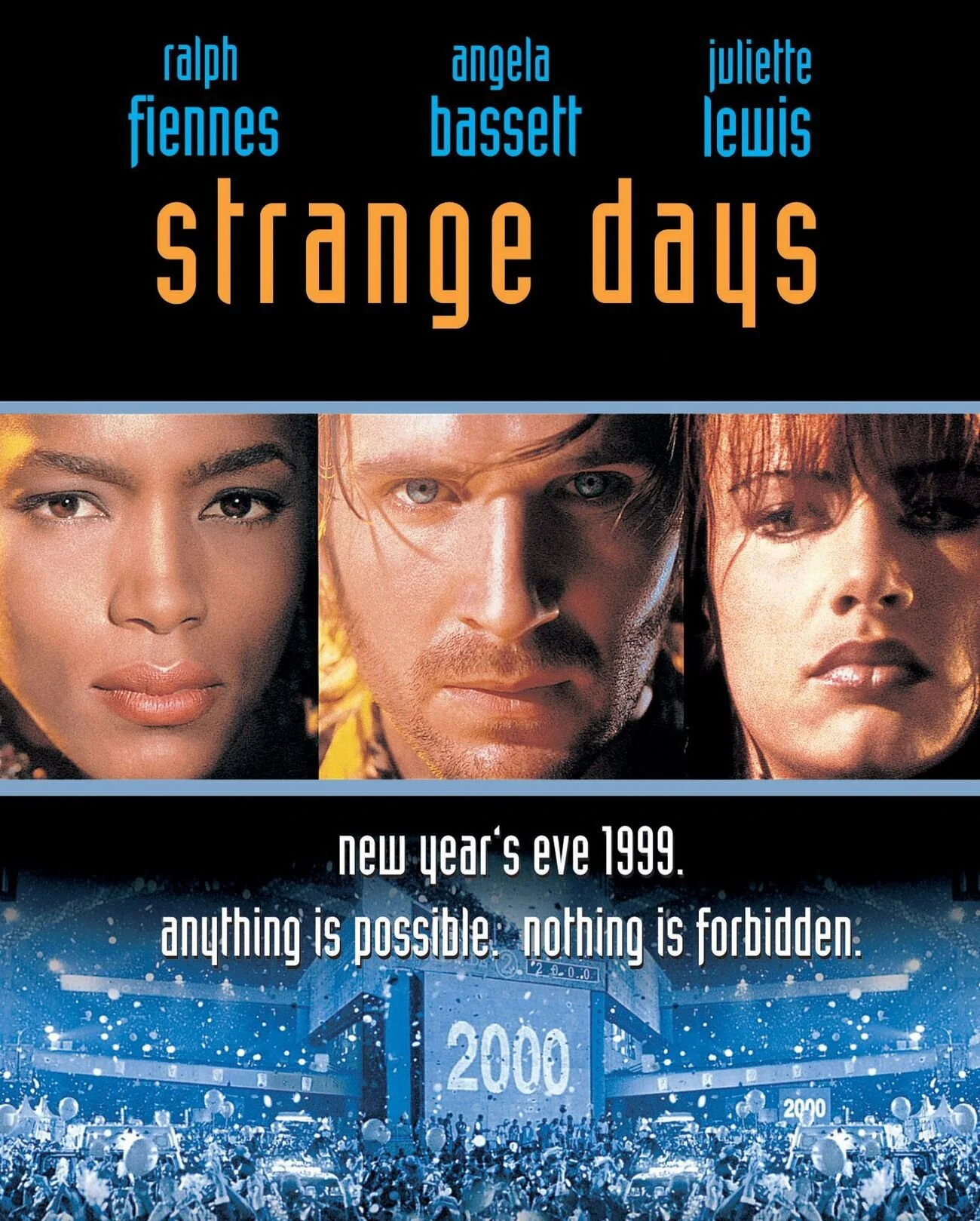
RPT very briefly explores the possibilities of living another person’s experiences, mostly as an exposition dump, but quickly moves on. Indeed, the decision to release the OASIS Neural Interface (ONI) tech is summarized in a few sentences by the main characters, with only Artemis objecting. Perhaps on a disappointing note, Artemis and Wade immediately break up at the beginning of RPT. It’s feels like a cheat, like after watching Daniel Laruso spend the entirety of the Karate Kid fighting black belts so that he could go on a date with Ally only to have the Karate Kid II open up with a throw-away line about how they broke up off-screen.

Well, that was short-lived
To be clear, Wade is a jerk in RPT and Artemis should break up with him, but usually when you start the protagonist out as a jerk it’s a setup for a redemption arc, not an inherent personality trait. And Wade is a jerk. His superuser powers go to his head and he uses them to smite vengeance upon anyone who disrespects him, violating friends’ and strangers’ privacy because he has the ability, and even spying on people through their own unit’s cameras in real life. He’s like a malevolent Alexa.
SPOILERS AHEAD
In every superhero story, there’s a chapter where the hero loses his powers. It’s humbling, and intended to humanize them.

If you don’t know what this scene is from, you’re probably not the target audience for RPO
When this happens to Wade, my writer’s brain clicked and went ah-ha! Now I understand the set up. Wade will learn the error of his ways and have a redemption arc. Where he embraced technology without much thought of consequences, he will emerge at the end relying on human connection and the real world, a juxtaposition to where he started. In fact, the first novel had this. Wade, Artemis, and Aech all have something about their appearance that they are masking in the OASIS, and when they get together in real-life those differences turn out to be something that connects them. Instead of social-media-photo-perfect versions of themselves, they are real people, connecting in real life. In Superman II, admittedly Superman doesn’t really learn anything from giving up his powers other than he’s been given the great responsibility of keeping humanity safe and can’t ever lay it down. After he regains his powers, he simply returns to the diner where the bully was and knocks him senseless. As much as the viewer enjoyed the retribution, Superman didn’t learn anything from it.

This is also the case with Wade in Ready Player Two. The way the ONI technology becomes a problem isn’t due to humanity misusing it, but more due to a evil third-party exploiting it. The stakes - half a billion lives - are incredibly high. At the story’s resolution, you’d expect Wade to take a step back and say, “Wow! That was intense. Maybe all this wasn’t such a great idea, right now.” Based on my lead-up, you can guess how he handles it.
BIGGER SPOILER AHEAD
The plot deals with AI, which does seem like an inevitable evolution of the Matrix-like world of RPO. The technology to create an AI relies on copying a living person via a brain scan. The resulting duplicate is a sentient version of its real-life counterpart, persisting even if the real-life person dies. The scan can be captured without consent or knowledge of the real-life person.
Ready Player Two’s approach to the hugely ethical issue of duplicating a person without his consent and creating a new life imprisoned in the OASIS can be summed up as “Cool. Let’s do it!” The concept itself usually appears as a horror theme in sci-fi. In Black Mirror’s USS Callister, a programmer creates a virtual Star Trek-ish universe and populates it with sentient copies of his co-workers. From the copies’ point of view, they are his co-workers who awoke on this spaceship, remembering everything about their lives. The programmer makes himself the all-powerful captain, and their jailer. The result is a mix of comedy, horror, and satire that is simply brilliant.

The 2010 Battlestar Galactica spinoff Caprica went fully dark with its take on this technology. After two men lose their daughters in a terrorist attack, one tries to recreate both as AIs in virtual reality. When he brings the other grieving father in to see his creation, the father is rightfully aghast. His dead daughter has been recreated in a virtual space where she appears terrified, not knowing where she is in this dark void, aware that she is not breathing and has no heartbeat. “It’s an abomination,” he says.

Ready Player Two’s characters handle this technology with all of the curiosity of a new iPhone app.
Hearing all of this, you’d think I didn’t like Ready Player Two. That’s not the case - I’d give it 3.5 stars. It’s as imbued with 80s settings and trivia as the first, but still manages to be very imaginative, and some of the quest scenes are worth a second read just because of how crazy and fun they are. There’s an entire world dedicated to Prince, complete with a Scott Pilgrim-like arena showdown at its end. There’s a world that is a mash-up of John Hughes movies, with a bit of wish fulfillment to change the ending of Pretty in Pink. The final battle of the book is satisfying in the same way that a hovering Superman asking Zod to step outside of the Daily Planet was in Superman II.

The Ready Player series are all about having fun. They’re escapism for forty-somethings who would love to play with their childhood toys again. In a way, they’re a bit like Superman stepping into his crystal chamber to put down the mantle of responsibility for a while. For me, and I am squarely in Cline’s target audience, they are a chance to slip away from adulthood for just a while and enjoy the comfort of my Empire Strikes Back bedsheets, imagining a world like my D&D character’s where the nerd is the hero. So, whenever you read a book, you have to ask, “Did the author accomplish what he set out to do with the story?” It helps to view RPT as a popcorn-fun indulgence, and ask if you had fun reading it. I did. My critical comments here are how I think it could have been better.
Ready Player One resonated much more with me than Ready Player Two, and the main reason is that Wade was the underdog fighting his way to top. In RPT, he’s already at the top, so the story is less compelling when you’re already given every advantage to succeed. The story touches on several technological advancements that come with moral issues, but it doesn’t engage those issues. Wade needs a character arc and instead is given a straight line. These are ways it could have been elevated from popcorn fun to a memorable story.
So, my verdict? I’m glad I read it and I had fun. I did listen to the Wil Wheaton audiobook version this time, as well. If you can do audiobooks, it’s the way to go. Wil Wheaton is the voice of Parzival. If you enjoyed RPO (the book, which was different than the movie), you will probably enjoy RPT, so give it a shot.
When I’m not flying the virtual skies, I’m the sci-fi author of the Hayden’s World series. If you love exploration and adventure, be sure to check it out.

Nexstar 8SE
After a week of using the Nexstar 8SE, do I have any regrets?
If you’ve read my stories, you’ll know that I have a passion for the stars. Growing up, I had a refractor telescope and when I got my first job I bought a 4.5” reflector. I’ve been interested in upgrading, and decided upon the Nexstar 8SE. After a week of stargazing, I plopped a review on Amazon and thought I’d post it here as well:

There are over four hundred Amazon reviews for this telescope, so I won't cover all of the technical details already discussed; instead, I'll hit on some of the things I still had questions about before buying the Nexstar 8SE.
One of the hard things about choosing a telescope is knowing how you want to use it. Whether you want to look at planets (which are super bright) or deep space objects (which are super dim) affects your choice. A scope with tons of magnification from a long focal length may be great for Saturn but have too much zoom for things like the Andromeda Galaxy.
Portability is also a factor. Can you carry the entire assembled scope out on to the deck yourself each night, or do you need to spend an hour lugging it out piecemeal, assembling, leveling, and aligning it? Once it's set up, how easy is it to find objects? If you want to look at Jupiter and the Moon - piece of cake...but what about objects too faint to see with your naked eye? Do you have the time and skill to read star charts under a red light, hunting-and-pecking across the night sky searching for dim fuzzies?
Lastly, do you want to take photos of your view? If you want exposures of more than a few seconds, does your mount have a way to compensate for the Earth's rotation to prevent your stars from blurring to streaks? If you're taking pictures of big things, like a nebula, will you have to make a mosaic because your scope has too much magnification to fit it all in frame?
I thought about all of these, and chose the Nexstar 8SE. It is a great scope and fairly easy to use (although not as easy as Celestron's "no knowledge of the night sky needed" slogan suggests). Here's how it fares for my selection criteria:
Portability:
If hours of free time are needed between setup and gazing, the scope will be relegated to weekend use only. That may not seem bad, but consider that out of those weekends, it'll further be whittled down to ones with clear nights. So, if I don't want a scope I can use only once or twice a month, I need something portable. The 8SE weighs 33 lbs fully assembled (and can easily be separated into three lighter components). So, imagine picking up a 16 lb bowling bowl in each hand and walking out onto the deck. If you think you could do that, you can carry the 8SE out. I leave mine fully assembled and just carry it out myself whenever there are clear skies. It takes two minutes. If it's too heavy, there are three thumb-tightened knobs that quickly separate the tripod from the mount and tube, splitting the weight in half.
Type of Astronomy:
The 8SE has a 2000 mm focal length and 8" aperture. 2000 mm is two meters (6.5 feet!) so you'd expect the tube to be at least 6.5 feet long unless it can bend space and time. Turns out, it does - well, not literally - but it's a Schmidt-Cassegrain telescope so it uses both reflectors and refractors to double-up the light path, resulting in a very short, fat tube that is highly portable. It's a great "best of both worlds" solution. High focal length (which translates to magnification) for planetary and lunar views and wide aperture (which translates to brightness and detail) for views of dim objects like galaxies. For me, it's perfect. I can bounce around the night sky seeing all of the planets and everything in the Messier catalog (globular clusters, nebula, and galaxies). The 8SE comes with a diagonal and a single 1.25" 25mm Plossl eyepiece that is one of my favorite eyepieces for this scope. With it, you will clearly see a small Saturn with its rings and shadows, or the disc of Jupiter with small cloud bands and its four largest moons. Deep-sky objects will be faint, dim cotton balls. Of course, you can increase the magnification by buying additional eyepieces or increase the contrast of DSOs with filters. I have a small refractor scope that uses 1.25" eyepieces and filters, and all of them are interchangeable with the 8SE.
Astrophotography:
I think it surprised me that most of those awesome astrophotography pics we've seen that look like Hubble telescope photos are taken with cameras or sensors attached to small refractor scopes. They're all taken on equatorial mounts that are polar aligned, rotating like clockwork to compensate for the Earth's rotation. The default 8SE cannot do this. It has an alt-az mount, not an EQ. Although it will track an object and keep it centered, it's just not able to rotate in the direction that the sky does. As a result, the object will spin in place over time, and all the neighboring stars will orbit it, leaving streaks. You can purchase an EQ wedge that tilts the entire mount onto a polar axis but to be honest for the price and added weight of the 15 lb wedge you could just get a Sky Watcher mount and tripod and plop a DSLR with a decent lens on it, taking some nice wide-field long-exposure photos. That being said, short-exposure photography works great on the 8SE. A cheap t-adapter lets me attach my DSLR directly to the back of the scope. I can manage fifteen-second exposures without star trails. I took the attached photo of the Hercules cluster this way (by the way - for reference - the Hercules cluster does not look like this to your eye in the scope. In the scope, it is a milky cotton ball). So, can you throw a couple of thousand dollars to convert the 8SE into a long-exposure astrophotography scope? Sure - but I would suggest instead using that money to buy a separate, dedicated mount and tripod for DSLR photography.

Ease of Finding Objects:
First, you can just use the keypad arrows to slew the scope wherever you want without bothering to align it. Line up a star or planet in the red dot finder and just have a look; however, if you want the telescope to find and track it, you'll have to align it. There are four ways to do this: 1) 3-object auto-align: center the scope on any three bright stars or planets and the controller will plate-solve to figure out what they are. You don't even need to know or tell it their names; however, every time I tried this, it failed. 2) 2-star auto-align: center the scope on one star and tell the controller what it is, then it picks the second star and you center it. Works sometimes, but the scope has no way of knowing if its chosen star is obstructed (by trees, neighbor's houses). 3) 2-star manual align: You pick two stars, tell the controller their names, and center them. Always works for me. 4) 1-star manual align: Same as two-star, but less accurate. 5) I know I said there were only four options, but a fifth option is to buy the somewhat-expensive Sky Align accessory, which is a camera that will do all of this for you. I find that the two-star align is accurate for the part of the sky you chose when picking alignment stars, but quickly loses accuracy when you swing to distant parts of the sky. Fortunately, you can pick new alignment stars on-the-fly, so I typically align to the southern sky, see everything I want, then realign to the northern sky. When the alignment is accurate, it's really great for finding deep space objects. I can look at a dozen DSOs in thirty minutes, where I could look at only two or three if doing it manually. The single review-star I deducted is due to the somewhat endless frustration I have with the GoTo alignment process, and that in general I haven't been able to just align the scope to the sky, but have to realign to portions of the sky as I look in different areas. One other complaint is that the 8SE's controller has been upgraded over time (to have a mini-USB connection instead of RS-232), but the telescope's manual was not updated. The manual still has photos and instructions only for the old controller, including keypad buttons which are in different locations or have different names.
So, I think the 8SE hits the Venn-diagram sweet-spot intersection of portability, aperture, and focal length for me, and I'm happy with my purchase and recommend it to others searching for that same intersection.
When I’m not flying the virtual skies, I’m the sci-fi author of the Hayden’s World series. If you love exploration and adventure, be sure to check it out.

Rock Your Wings
Flying the Fisk Approach with real-world air traffic controllers in a virtual Cessna 150.
Every year, thousands of aircraft fly to KOSH Wittman Regional in Oshkosh for AirVenture. The volume of aircraft is so high that the traditional rules of call-and-respond for ATC are changed for the event, with ATC spotting craft with binoculars and calling to them by their appearance, instructing them rock their wings if they hear their instruction. A special NOTAM (notice to airmen) is published for the event detailing the rules to arrive and the colored dot system on the runways which allows multiple aircraft to use a runway at the same time.
This year, the Oshkosh AirVenture was canceled, but the online ATC flight sim company, PilotEdge, partnered with the organizers to provide a virtual recreation of it. NATCA provided real-world air traffic controllers. The result was a week-long event during the Spirt of Aviation week with hundreds of virtual pilots flying the famous Fisk approach to Oshkosh. I was one of them. Fly along with me in the video, below.
Of course, all good things must come to an end, and I needed to fly back home. Getting out of Oshkosh was as much fun as getting in: