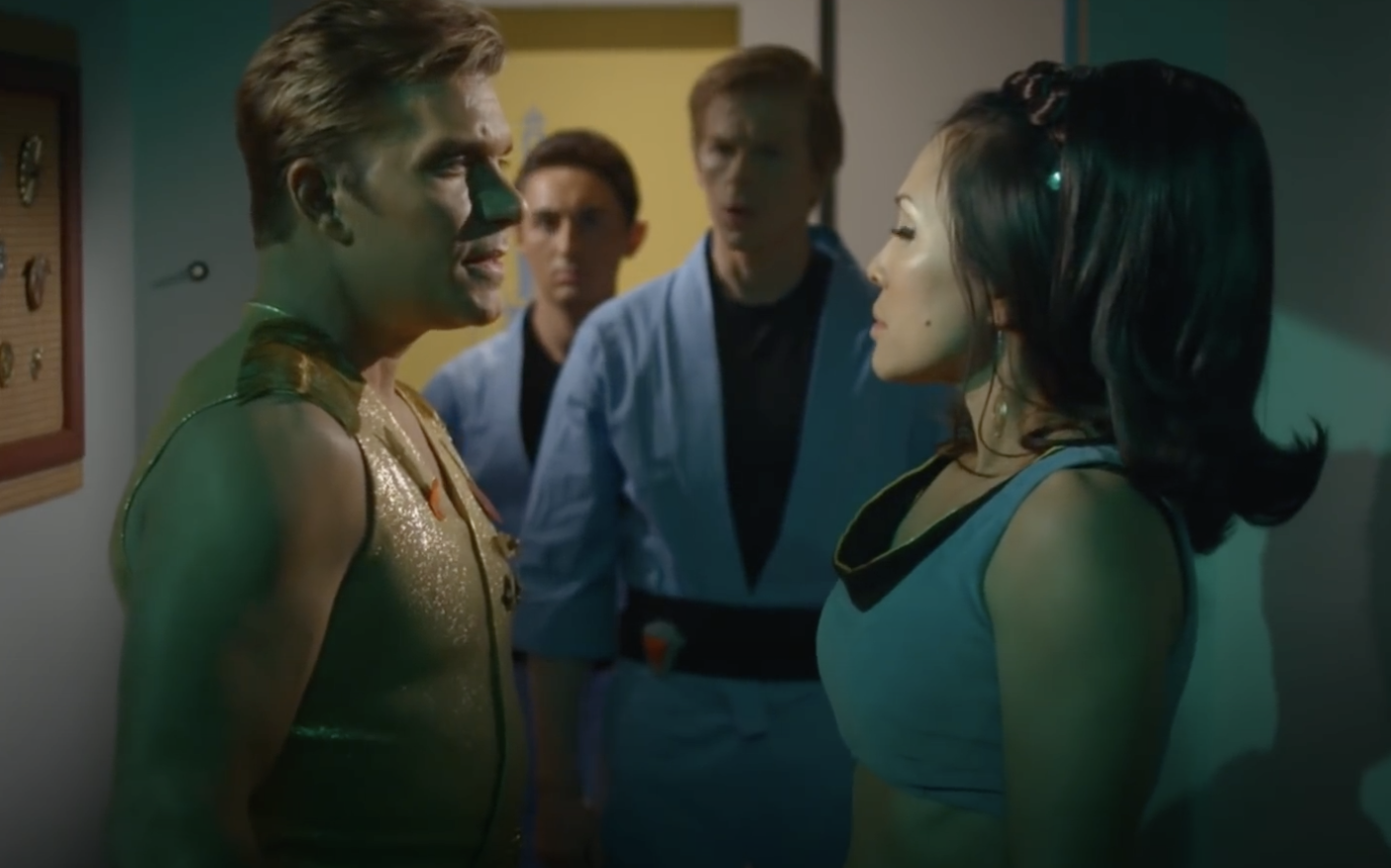
Thoughts on Star Trek Continues
I weigh in on the outstanding series Star Trek Continues
There are countless Star Trek fan films available on YouTube, but Star Trek Continues is in a league of its own. In an age of big-budget network spin-offs such as Star Trek: Discovery and Picard, it’s refreshing to find a fan series that so beautifully nails the looks, themes, and fun of the original series. There are no JJ Abrams-style lens flares or coolifying of technology and characters in an attempt to fix a problem that never existed; instead, each episode is a lovingly-crafted homage to the 60s series. Every element, from the sets, props, costumes, lighting, camera angles, special effects, and music, is a faithful reproduction. It quite literally is a continuation of ST:TOS. Perhaps the highest praise came after my wife and I watched “What Ships are For” together, and after the credits rolled, complete with stills of Scotty in a Jeffries Tube and the dancing Orion slave girl, we both stared, stunned, and said, “Wow. That was a real Star Trek episode.”

Even the special effects capture the accurate look of the 60s series models, avoiding the pitfalls of modernizing everything with CGI
Kirk is played by Vic Mignona, who also writes and directs the episodes.

It would be easy for anyone to turn Kirk into a bad Shatner impersonation, but Vic does a brilliant job of playing Kirk and not Shatner. He emulates Shatner’s body language - for example, Shatner’s habit of bowing out his elbows when standing on a transporter platform, balling his fists as if ready for a fight - but delivers dialogue and often soliloquies with a cadence that reminds of you of Kirk without Shatner’s overt pausing of each word for emphasis. Nicely done.
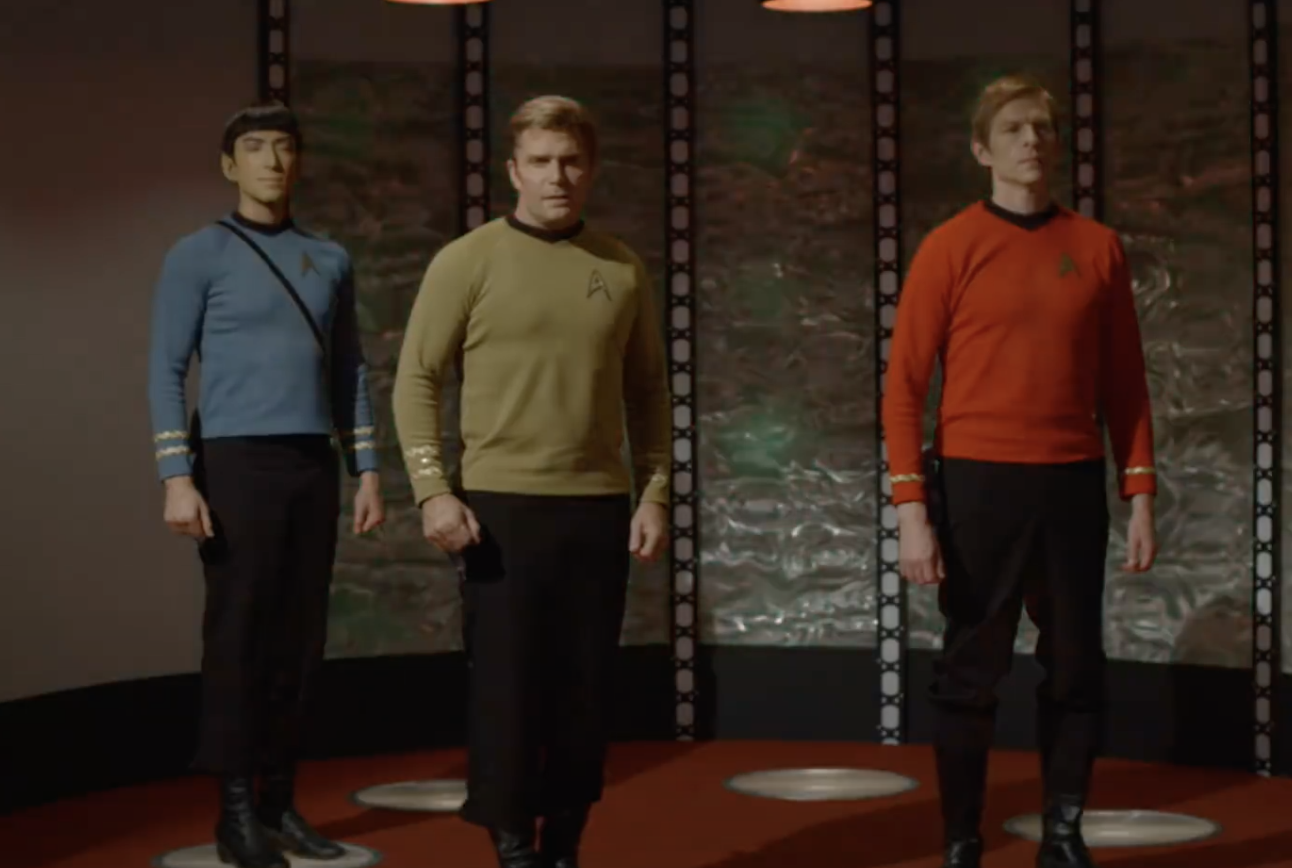
Spock is played by Todd Haberkorn.

Todd’s rendition of Spock is more like Vulcans in later series, such as Tuvok from Voyager, and tends to be matter-of-fact. Nimoy’s Spock tended to infuse emotion into his responses, at times being on the verge of smiling (sometimes nearly out-of-character for Spock), and the 60s series did a good job of giving Nimoy some excellent lines to work with, such as this classic exchange:

I’d like to see more of the original series’s cleverness in Spock’s writing, and more of Nimoy’s “human underneath” emoting in the Spock character, but Star Trek Continues delivers a solid Spock, including episodes where Spock is at odds with duty, friendship, and logic.
In the first two episodes, McCoy is played by Larry Nemecek before the role is picked up by Chuck Huber. Huber is a much better fit for McCoy. I’m not sure what happened in the first episode with the dialogue and casting for McCoy, but he was nearly unrecognizable to me. I wondered for a minute if he was supposed to be the original doctor from the ST:TOS pilot with Captain Pike, which has Chief Medical Officer Phillip Boyce instead of Doctor McCoy. Once the series transitions to Huber, McCoy solidifies. Huber plays McCoy with more warmth than DeForest Kelley, whose crankiness was, let’s face it, grating at times, and Huber’s rendition is welcome.

Chuck Huber as McCoy
Notable support characters include Chris Doohan (James Doohan’s son) as Scotty, who, not surprisingly, has his father’s mannerisms down to an art, and of couse looks like him. Mythbuster’s Grant Imahara plays Sulu. He starts the series trying to impersonate George Takei a bit too much, but comes into his own mid-series. Kim Stinger plays Uhura. She’s a little more like the JJ Abram’s version of Uhura than Nichelle Nichol’s rendition, but she brings a warmth to the character. Wyatt Lenhart plays Checkov, and is a charmer. The series introduces a ship’s counselor, in the vein of Next Generation’s Deanna Troi, with Michele Spect playing Elise McKennah. Spect plays the character with warmth and humor.

Chris Doohan’s Scotty

Kim Stinger’s Uhura

Wyatt Lenhardt’s Chekov

Grant Imahar’s Sulu

Michele Spect’s McKenna
The guest stars for the series are a who’s who of sci-fi. Just check out the series page for a list. A few stand-outs:
Erin Gray (Buck Rogers’s Wilma Deering) as Commodore Gray
Marina Sirtis (ST:TNG’s Deanna Troi) as the voice of the computer
John deLancie (Star Trek’s Q) as an ambassador
Cas Anvar (The Expanse’s Alex) as a Romulan
Jamie Barber (Battlestar Galactica’s Apollo) as a red shirt
Nicole Bryant (Doctor Who’s Pen) as an esper
Michael Forest (ST:TOS’s god Apollo, reprising the role)
Lou Ferrigno (the 70s Hulk) as an Orion Slave Master
PILGRIM OF ETERNITY
1967’s “Who Mourns Adonis” had the Enterprise encounter a powerful entity who claimed to be the god Apollo, played by Robert Forest. The episode ends with the Enterprise phasering his temple, which was his source of power, and having him fade away.

Two years later, in Star Trek Continue’s timeline, the crew encounters him again, now aged rapidly to his 80s. He appears to be powerless, but of course not all is as seems, and soon Apollo is up to his old tricks of seeking mortal adulation and smiting wrath upon those who challenge him. Robert Forest reprises his role as Apollo forty-six years after his original appearance.

LOLANI
In the 60s series, the green-skinned Orion slave girl is memorable for always appearing in the ending credits, yet in reality, she never appeared in an episode with Kirk. Her only appearance was in the unaired pilot with Captain Pike (and later in the Kirk episode which played flashbacks from the pilot at Spock’s trial in “The Menagerie”). In Star Trek Continue’s “Lolani”, the crew rescues a Orion slave from a Tellerite ship. After she spends time getting to know the crew, her slave master shows up demanding his property back, setting up a classic Star Trek conflict of “don’t interfere in other people’s cultures vs. what if what their culture does is morally reprehensible”.

Fiona Vroom as the Orion slave girl.
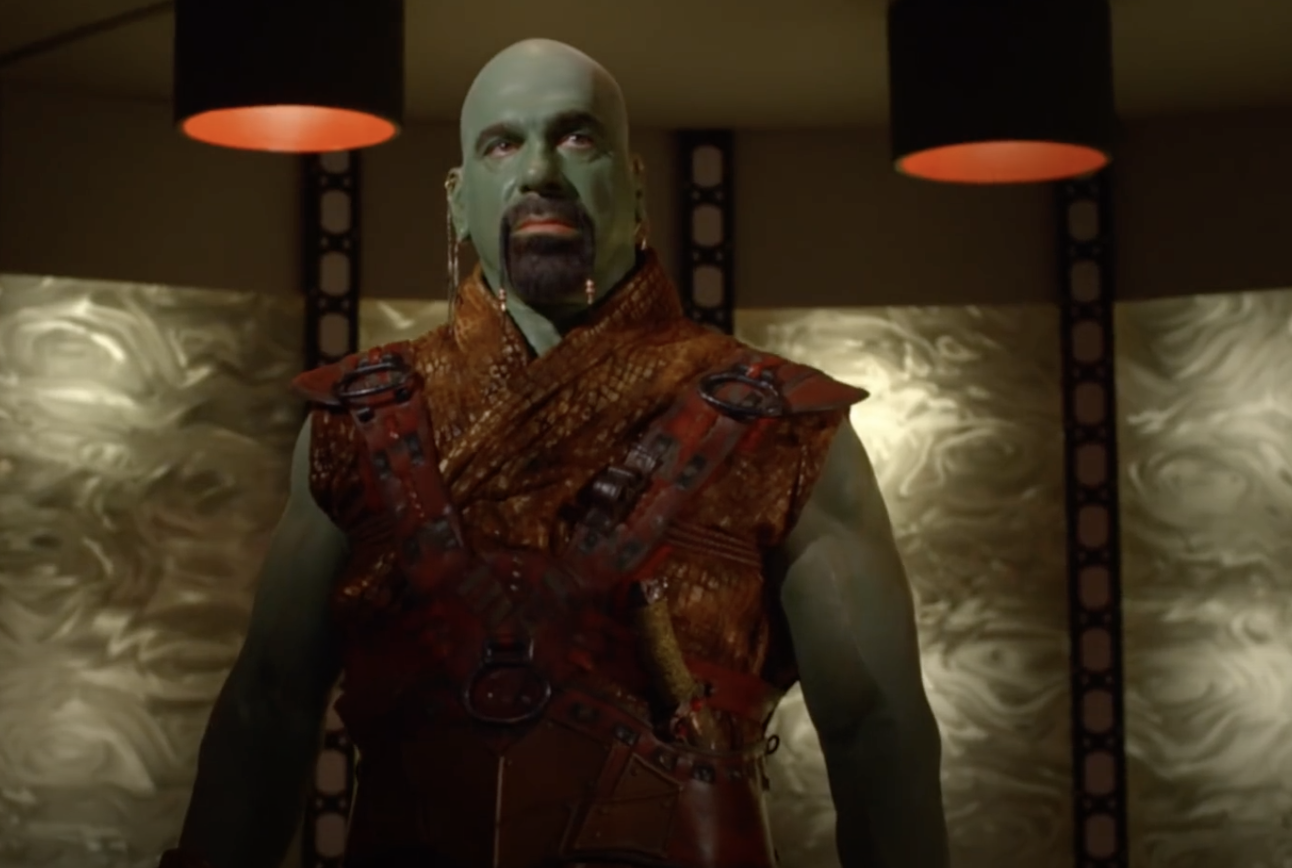
Lou Ferrigno as the Orion slave master.
You know that Kirk will end up in a fist-fight with the slave master, who, as Lou Ferrigno, towers over him. I literally cheered when Kirk did his patented horizontal double-footed kick to the chest.

The episode reminds me in theme of the Next Generation episode “The Perfect Mate”, in which Picard transports a metamorph woman who is intended to be a gift for a peace treaty. Picard wrestles with judging other’s culture versus allowing a woman to be treated as property.
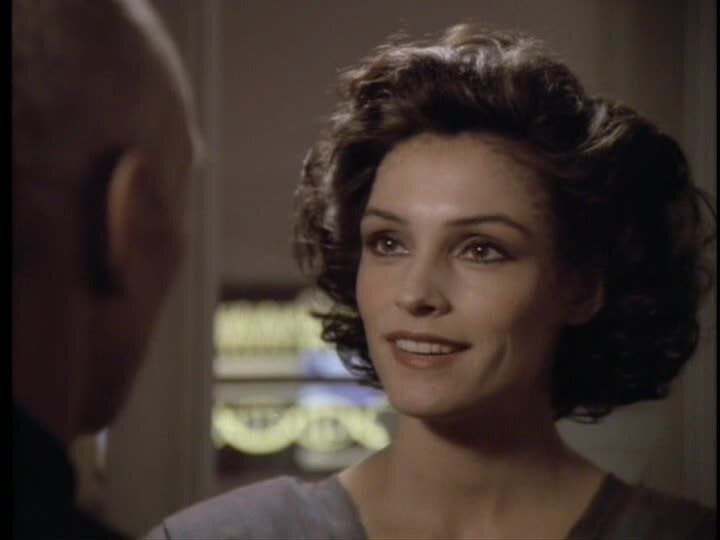
Famke Jannsen as Kamala in “The Perfect Mate”
THE FAIREST OF THEM ALL
The evil-Spock goatee universe featured in 1967’s “Mirror, Mirror” has been visited by numerous Trek series. In Star Trek Continues, the episode continues in the evil universe seamlessly from where the original ends, with the evil Kirk beaming back to the transporter pad as the good Kirk beams out. In the original episode, good Kirk planted seeds of doubt of evil Spock’s mind, and those seeds flourish in Star Trek Continues “Fairest of the All”. If you listen carefully, Michael Dorn (Worf from ST:TNG) is the computer’s voice on the evil Enterprise.

Asia de Marcos is a dead ringer for the original actress who played Marlena in “Mirror, Mirror”

THE WHITE IRIS
Every Star Trek series has an episode where the Captain is injured and goes through mental soul searching to recover. In “The White Iris”, Kirk is treated with an experimental drug after being critically injured, which causes him to see women from his past who died, nearly all of which were characters in ST:TOS episodes. The episode uses the holodeck, which also appears in the first Star Trek Continues episode, but feels a bit out-of-place considering Star Trek: the Next Generation treated it as new technology in it’s 1987 pilot, “Encounter at Farpoint”.

DIVIDED WE STAND
When the Enterprise encounters an old earth spaceship, Friendship 3, they unknowingly get infected with nanites. As the nanites spread through the ship’s systems, Kirk and McCoy are injured and infected. When they awake, they’ve been transported back to Earth’s civil war as soldiers on opposing sides.

This is a predictably heavy episode, with all of the civil war’s horrors of unanesthesized limb amputations and mistreatment of captured soldiers. Kirk gives some inspiring speeches about freedom and is happy to glimpse President Lincoln, who I recall from 1969’s “The Savage Curtain” is one of Kirk’s favorite presidents. There is an undercurrent of persevering with disabilities.
I had to Google Friendship 3 because it sounded familiar. Friendship 1 was featured in the Voyager episode, “Friendship One”. In it, the crew discovers an old Earth spaceship crashed on a nuclear-winter world. They find the inhabitants weren’t ready for the advanced technology found on the crashed ship, misusing it to destroy themselves.
COME NOT BETWEEN THE DRAGONS
A monster episode - sort of. When a rock-like creature crashes through the Enterprise, the crew becomes increasingly violent as they react to energy pulses that seem to be connected to the creature.

This episode reminded me a bit of the original series “Day of the Dove” where an energy creature fueled animosity between everyone on board, living off their anger.
EMBRACING THE WINDS
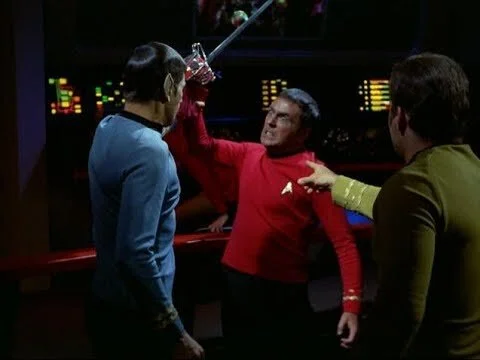
Trial episodes are a staple of Star Trek. In “Embracing the Winds”, the U.S.S Hood’s crew and captain are lost after a life-support failure, and Commodore Gray (Buck Roger’s Erin Gray) must assign a new captain. When she offers the position to Spock, another officer petitions on the grounds that Starfleet only assigns male captains to Constitution-class starships, and she is being overlooked as a female. The resulting trial to choose between Spock and Commander Garrett (Clare Kramer) navigates the waters between sexism and affirmative action. This episode could easily have stumbled through a minefield but managed to pull it off with grace. I think I especially like it because the 60s series, despite it’s manly captains and Kirk’s womanizing, was exceptionally diverse, and Star Trek has always been forward-leaning in its societal commentary.


Clare Kramer
At the episode’s end, Commander Garret says, “Who knows? Perhaps someday a Garrett will command the Enterprise?” It’s a nice nod forward to Star Trek: The Next Generation’s “Yesterday’s Enterprise”, where the Enterprise-C is commanded by Captain Rachel Garrett.

Captain Rachel Garrett in “Yesterday’s Enterprise”, who has the misfortune of being killed once in the past, only to travel to the future and get killed once again. But, her sacrifice quite literally saves the Federation from destruction.
STILL TREADS THE SHADOW
In 1968’s “The Tholian Web”, the Enterprise encounters a federation starship, the U.S.S. Defiant, which is phasing out of normal space. Kirk is trapped aboard, and memorably reappears to the crew throughout the episode as a ghostly version of himself in a spacesuit. Eventually, they rescue him. In “Still Treads the Shadow”, the Enterprise encounters the Defiant once again, only to discover that a copy of Kirk was made and, due to time progressing more quickly in Defiant’s space, has aged considerably. In all this time, the Defiant’s computer has become sentient.

This reminds me of two episodes: the original series “The Deadly Years” where the crew rapidly ages, and the Next Generation’s “Second Chances” where Riker finds a copy of himself duplicated eight years ago in a transporter mishap.

WHAT SHIPS ARE FOR
Star Trek episodes have a certain cadence, with a hook which occurs before the title sequence to keep you tuned in past the first commercial break. “What Ships are For” nails it, especially in tone with the original series, when the away team beams down to an inhabited asteroid to discover themselves and everything around them transformed into black and white. There they meet the ambassador (John de Lancie of ST:TNG Q fame) and his wife, who have asked for their help curing a plaque. There is a reason why everyone is in black and white, and the consequences of not being able to see color play out with twists that turn the episode into a morality play which also makes a statement on real-world events involving refugees. Kirk gives a classic “you can aspire to be better” monologue to the ambassador at the end, and the final twist has the panache of a well-written sci-fi short story. “Ships are safe in harbors,” Kirk says. “But that’s not what ships are for.”


TO BOLDLY GO, PART I and PART II
The two-part series finale goes all-in with a big plot that connects events from earlier episodes. When the Enterprise is diverted to the same area where multiple Federation ships were either lost or damaged, they find a colony supposedly wiped out by Romulans. The only two people left on the planet are a surviving Esper and a Romulan. All is not what it seems, and they find themselves pursuing a starship full of espers headed for the galactic barrier. There are phaser ground battles, starship battles, and more than a few characters lost.
The episode features the female Romulan commander from the original series “The Enterprise Incident”, played by Amy Rydell, who really resembles the original 60s series actress. As it turns out, she’s her daughter.

Amy Rydell from Star Trek Continues

Joanne Linville from the original series “The Enterprise Incident”
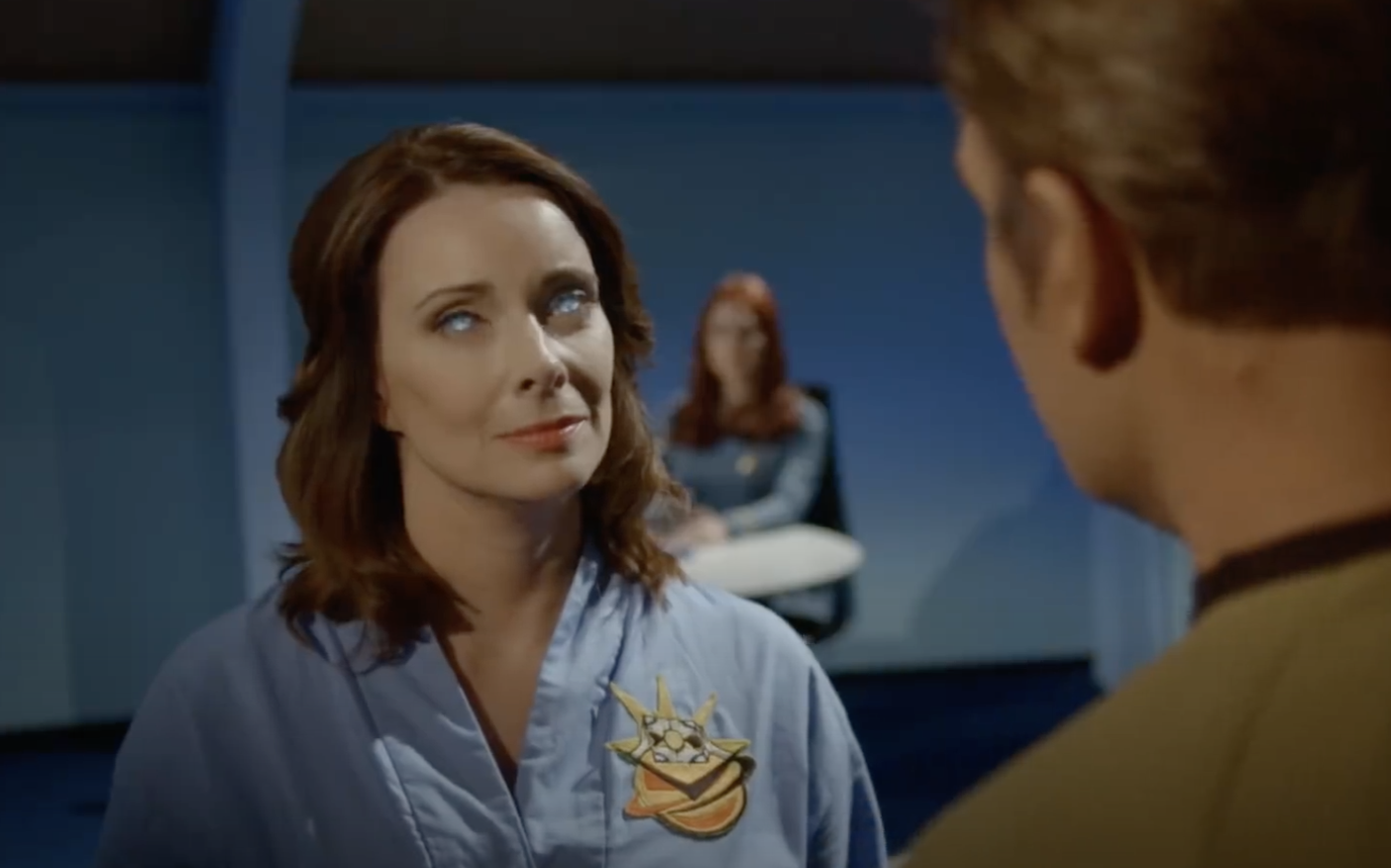
Dr. Who’s Nicola Bryant as an evil esper
Perhaps the best part of the episode is the epilogue, which segues into the setup for Star Trek: the Motion Picture.

Parting scene of Star Trek Continues, with Admiral Kirk on the bridge
I thoroughly enjoyed Star Trek continues. It scratches an itch of the need for quality programming which cherishes what made the original series great. There’s campiness, but there’s also some very good writing. Kirk’s speeches, in particular, are inspirational, and he oozes leadership. The gems of the bunch are Pilgrim of Eternity, Embracing the Winds, and What Ships are For. If you’re not sure about the series, start where I did, with What Ships are For. It’s the episode that made me believe that the original series had, in fact, continued.
When I’m not flying the virtual skies, I’m the sci-fi author of the Hayden’s World series. If you love exploration and adventure, be sure to check it out.

Flying the Virtual Skies in the Rift S
I take the red pill and dive into the matrix of X-Plane VR.
Earlier this year it was my birthday, and I considered a somewhat-pricey present: the Rift S virtual reality headset. My hesitation cycled through three questions: Could my Razer 15 handle it, would I use it for more than just for X-Plane, and, finally, would I really use it for X-Plane? While I waffled, it went out of stock globally, and remained out of stock for a few months.
Two weeks ago, the Rift S came back in stock briefly on the Oculus website. As my finger hovered over the buy button, the questions emerged. Fortunately, the fun side of my brain quickly subdued the thinking side by yelling, “You fool! While you’re waffling, someone else is buying the last headset.” So, I instantly clicked buy. Within two hours, the Rift S was out of stock once again. But I had mine. I almost giggled, as if I’d scoffed up the last Cabbage Patch Kid while a mob swarmed the toy aisle.
I’d experimented with X-Plane quasi-VR before using the iPhone app Ivry and a Google Cardboard headset. That setup gives three degrees of freedom tracking with a 3d image. That image hovers in front of your face, as if it were a miniature 3d tv, and, like 3d movies, you feel as though you are viewing a plane which has objects protruding from and into it. Your brain registers it as a 5” screen which has depth hovering a few inches in front of your face.
When I first put on the Rift S, its external cameras turned on and entered pass-through mode, showing me my desk overlaid with a 3d grid. Using the controller, I touched the floor, then traced a boundary for my play area. For a few seconds, my brain fizzled, wondering what I was seeing, because everything in my house was at 1:1 scale and exactly where it should be. So, you can imagine when the Oculus software overlaid the radial control panel in an arc where my actual keyboard was, it was there in my mind. When the WallE-style tutorial kicked in and enclosed me in a cluttered room with 90s video game consoles, the room replaced my physical room at the same scale. And this is perhaps the biggest difference with VR: scale. Things appear life-sized and encompass you. I had a moment where I turned around and saw the WallE room was indeed sealed up behind me. For my brain, I was now “in” the room. I felt like I’d stepped through the holodeck entrance, watched the entrance close and seamlessly fade into the scenery. I couldn’t wipe the grin off my face.

There are certain transformational technology leaps that you’ll always remember. The Atari logo appearing on your home tv’s screen when you first plugged in the 2600 wood-grained console. Whipping a bowling ball down an alley with a Wii controller and watching it hook and gutterball the same way it does when you throw a real bowling ball. Putting on a VR headset and tricking your brain that you’re inside the scene.
The first game I played with my entire family was Beat Saber. It’s a full-body experience with crouching, dodging, and slashing. I felt like a Jedi. The next game was Lone Echo, where you are weightless in a spaceship, grabbing and pushing off surfaces to navigate. Here the scale hit. The ship’s environments were huge. At one point, I came around a corner to collide with the other character who I didn’t realize was returning to the room. I nearly jumped out of my seat.

X-Plane took a fair amount of technical tweaking to get going. This is always true of X-Plane whether or not you’re using VR. Oculus has a feature called Asynchronous Space Warp which makes the head tracking perfectly smooth even if the scene is being rendered at lower frame rates. Scenes rendered anywhere from the low 20s to upper 40s for fps, but of course you could improve that by turning down details. Here’s the main things I noticed playing X-Plane in VR:
Scale - I cannot overstate what it’s like to see things full-sized surrounding you. You develop a certain mental model based on playing the game in 2D, and VR corrects it. I’d imagined cockpits as the size of my car’s dashboard, but nearly every one was smaller and more cramped. Looking outside the plane, wings were huge. I hadn’t realized just how big the prop is on an SR22, and the engines on my Piper Cheyenne were frighteningly large. When I flew over scenery, bridges were humongous.
Feeling movement - the first time I banked my plane into a standard left turn and looked over my left shoulder at the scenery, my stomach dropped out. I felt gravity shift and myself leaning. For fun, I followed that up with some stalls and spins. The sensations were crazy. Even when flying in a straight line I could feel the wind and tell you that it was pushing on the nose of the plane along a quartering angle. When you feel like you’re sitting in the place, you’re very in tune with how the plane is moving.
Resolution - the resolution is adequate for reading text. You can improve it, at the expense of fps, with supersampling. In 2d, I normally play on a 2k monitor. When you enlarge a 1080p image to the equivalent of a 55” monitor mounted a foot from your face, it’s going to look blocky. So, this is a downside compared to 2d.
Screen door effect - pixels do not seamlessly flow into other pixels on screens. There’s a little border around each. When magnified, the border shows up as a faint screen door effect. On the Rift S, it is present, but very mild. My brain tuned it out quickly.
Night scenes - I’m a bit spoiled by my iPhone X with an OLED screen, I remember how with my previous IPS screen iPhone, I could tell when it had turned on after a reboot when the black display suddenly turning dark gray. The Rift S is similar. Night scenes are okay, but it’s as if the contrast has been turned way down, with anything dark glowing as murky gray. There may be some more fiddling I can do to adjust this. I recall my 2k monitor also washed out night scenes until I got it set up correctly.
Hand controllers - the Rift S controllers are fantastic. Tracking is perfect, they have sensors to detect what your fingers are doing, and haptic feedback. X-Plane interactions are a bit wonky and have a learning curve. You expect you can press buttons with your extended finger or the controller tip, but both pass through objects. Instead, you squeeze the controller trigger and it fires a laser pointer. Depending on the target, you then may need to do a hand motion to move it. Dials, such as the heading bug, are intuitive and require you to rotate your wrist. Others pop up a gradient slider, which, depending on how the aircraft manufacturer coded it, is not always in the same orientation as the control (you may lift your hand up to slide a control forward). It’s considerably easier if you can reach the control and touch it with the controller. Using the laser pointer from a distance can be difficult, particularly with flip switches such as the battery or alternator. One of the odd quirks of 1:1 scale is that my play area is not the size of a Piper Arrow, so there are things I just can’t reach. Just about anything underneath the yoke is physically inside my real-life desk. For those, I’ve set up keyboard shortcuts. As an aside, I think the Rift S has the best controllers. The way they click when turning virtual knobs is very compelling, and grabbing a virtual pistol feels completely natural.
Motion sickness - I’ve had no motion sickness other than the intentional type (where I did several stalls and spins in a row and felt like I’d actually done them).
Field of view - Somewhat of a letdown. The FOV is 115 degrees, which is fairly standard for VR headsets. Much like looking through binoculars, your vision consists of two overlapping circles, surrounded by black. You do not see the edges of the rendered image; instead, you see the edges of the lens. Mentally you tune it out, but it’s a bit like viewing the world wearing a scuba mask. In games where you actually wear a mask or helmet, it blends well.
Realism - It’s hard to explain how much the airplanes feel like your own when they are 1:1 scale 3D objects. I had a moment sitting on my couch in the Piper Cheyenne where I looked over at the co-pilot seat, put my hand down, and touched the couch surface (which was at the same height as the Cheyenne seat). I put my controller on it and it sat there. Then I turned around and looked behind me. In real life, there is a wall. In VR, the passenger cabin extends back fifteen feet. My brain shorted out for a second. If my play area permitted, I could have stood up and walked around back there, greeting my virtual passengers.
Sound - comes 360 degrees from the VR headset’s headband. It’s pretty good - better than my laptop speakers - and gets loud enough that you’ll want to turn it down. Not nearly as rich as your own headphones, which you also have the option of using. There is also a decent built-in microphone. The only downside is that everyone in the room hears the speakers unless you use your own headphones.
Plugins - I only added three plugins to help with VR:
OVR Settings - lets you adjust supersampling and space warp on the fly, seeing the impact on an FPS counter
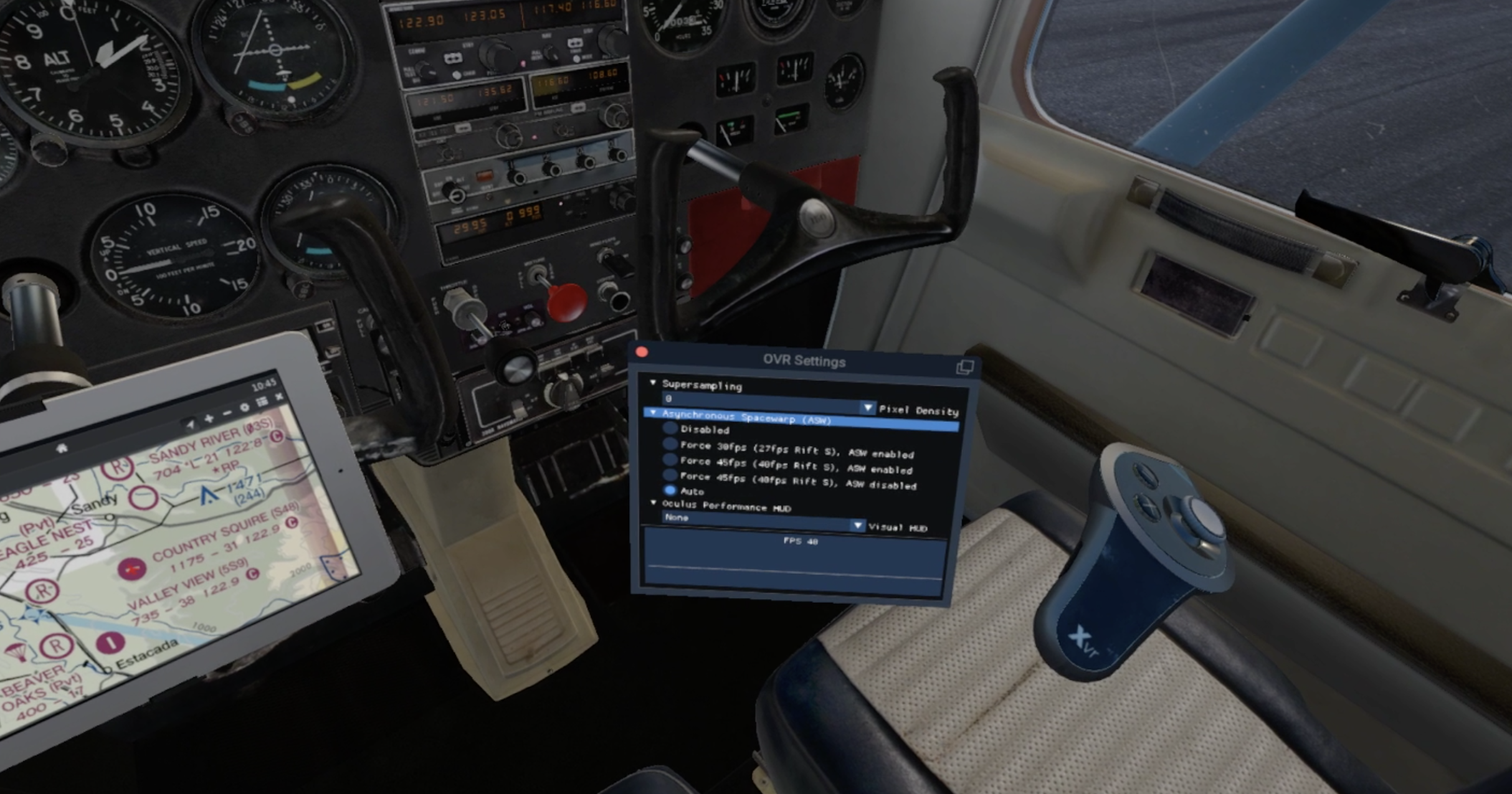
Move VR - this works both in VR and normal X-Plane, allowing you to drag external windows into X-Plane. You can view Skyvector, for example, in X-Plane. YouTube streamers often display their chats this way.

VR Tools - lets you easily edit your starting location in the cockpit and add new teleport spots, such as the co-pilot’s or passenger’s seats.

Not a plugin, but I downloaded Oculus Mirror, which creates a normal landscape image based on what your headset sees. Useful for recording/streaming so you don’t end up with the portrait-mode SteamVR image.
So, the verdict. Sometimes I’ll fly in VR, and sometimes in 2D. It depends on the type of flight. Hand-flying a GA aircraft through touch-and-goes is exponentially more awesome in VR. A long flight on autopilot where you want to take in all of the high-res scenery is better in 2D. As for other games besides X-Plane: they’re a blast! In a way, I sometimes prefer launching a game I purchased from the Oculus store, like Beat Saber, because it just works (compared to X-Plane, which requires tinkering). Games like Beat Saber and Lone Echo really only can be played in VR. Even Google Earth VR is a monumentally different experience in VR compared to what someone sees mirrored on the 2D screen (and it is an experience that will leave you grinning, as if you’re a guy in a Godzilla suit plodding through a scale model of a city).

I’m delighted with my purchase, and don’t know why I waffled for so long.

X-Plane KSNA John Wayne to L35 Big Bear City
Some amazing virtual scenery during my latest flight in the Cirrus SR22 from KSNA John Wayne to L35 Big Bear.
Waiting for Microsoft Flight Simulator 2020? You’d be surprised how good the visuals for X-Plane can look with just a few tweaks. Check out my latest flight in the SR22 from KSNA John Wayne to L35 Big Bear City.

X-Plane 07FA Ocean Reef to KEYW Key West
Well, I was in the mood for some Key Lime pie…
I get away from it all with a vacation flight from Key Largo to Key West.

X-Plane Airports
I share a few of the custom X-Plane airports featured on my YouTube channel.
Well, I blame James Hayden, the star of my Hayden’s World book series. In the stories, he’s an awesome pilot, and it’s hard to write about an awesome pilot without learning a thing or two about airplanes. What started out as curiosity evolved into hundreds of virtual flight hours in X-Plane. One of the brilliant things about X-Plane is that it is crowd-sourced. Its creators give you a free world editor called, not surprisingly, WorldEditor (or WED for short), and you can create your local airport or anyplace else in the world.
What started as a place to link flight videos for this blog grew into my YouTube channel. If you’ve been following it, you’ve seen me showcase some custom airport designs. I thought I’d create this page so that you could have them for yourself. These airports are designed to blend in with the Orbx TrueEarth series, and use libraries from that series to be seamless.
NOTE: I add zoom level 19 orthophotos as a base for my personal airports because Orbx orthophotos are ZL16 or ZL17 (depending on whether you purchase the SD or HD version of Orbx TrueEarth scenery). I do not have licensing to distribute orthophotos, however, so they are not included in the airport files. The screenshots show the airports with the orthophotos. With a little bit of elbow grease, WorldEditor, and Ortho4XP, you can add your own.
AIRPORTS
OREGON
4S9 MULINO STATE
Located south of Portland, Oregon, this untowered field is surrounded by lush green countryside.

Required Libraries:
3D People
CDB Library
FlyAgi Vegetation
Handy Objects
Mister X
NAPS
Open Scenery
RA Library
Orbx TrueEarth Oregon (Orbx_OrbixlibsXP)
S48 COUNTRY SQUIRE

Located southeast of Portland, Oregon, this untowered field is surrounded by lush green countryside and can be a challenge to find.
Required Libraries:
Handy Objects
Mister X
Open Scenery
Orbx TrueEarth Oregon (Orbx_OrbixlibsXP)
FLORIDA
07FA Ocean reef beach club
This private airfield is located south of Miami in Key Largo. A ninety-five mile flight west takes you to Key West.

Required Libraries:
CDB Library
Handy Objects
Mister X
Open Scenery
RA Library
RD Library
Orbx TrueEarth Florida (Orbx_OrbixlibsXP)
NEW JERSEY
N40 SKY MANOR
Located northeast of Philadelphia, this untowered field is surrounded by lush green countryside.
Required Libraries:
Handy Objects
Mister X
3D People
Open Scenery
JB Library
PPlibrary
Orbx TrueEarth (Orbx_OrbixlibsXP)

pennsylvania
kwbw wilkes-barre wyoming valley
Located near KAVP Wilkes-Barre Scranton International airport, this untowered field is surrounded by green mountains.
Required Libraries:
Handy Objects
CDB Library
Mister X
3D People
Open Scenery
JB Library
Segmented Circles

76n skyhaven
Located near KAVP Wilkes-Barre Scranton International airport, this untowered field is surrounded by green mountains.
Required Libraries:
Handy Objects
CDB Library
Mister X
3D People
Open Scenery
JB Library
Segmented Circles
Orbx TrueEarth (Orbx_OrbixlibsXP)

SKYCOLORS
Sky colors are one of the easiest ways to transform the visual appearance of X-Plane. I prefer Vivid Sky for most of my colors, but I made my own file for clean skies using actual sky photographs.



X-Plane KBKV Brooksville to KTLH Tallahassee
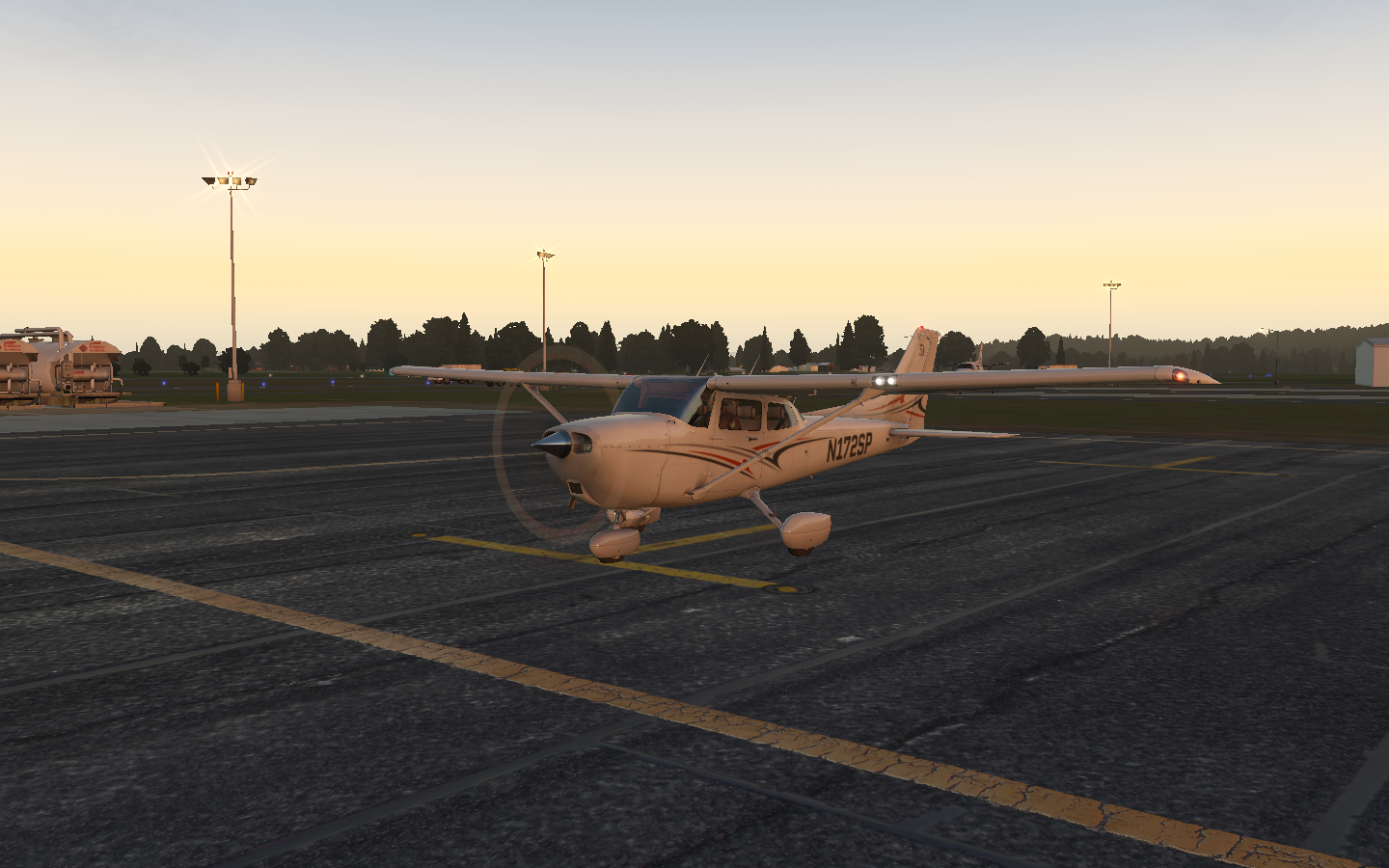
I have a need for speed in the Piper PA31T Cheyenne.
Continuing on my Florida tour, I needed to cover a greater distance in a reasonable time, and this required more speed than my usual single piston engine planes could muster. This job required a turboprop. I took Just Flights PA31T Piper Cheyenne II for a spin. Starting it up properly, and hearing the turbines come up to speed was half the fun.

Bernard's Promise: Deleted Scenes
No need to buy the director’s cut. You can read the deleted scenes from Bernard’s Promise right here.
I found myself thinking about Beckman (one of my favorite characters to write) and a short edited-out scene in Bernard’s Promise where the crew was interviewed. In it, Beckman responded to the question “What do you do here on the ship?” with the answer “My job.” There are many scenes which ended up on the cutting room floor, and I thought it’d be fun to share a few.
ORIGINAL BEGINNING OF CHAPTER 6: 18 DAYS
Hitoshi pauses at the entrance to the Sandpiper, looking up at the polarized blue and painted-on clouds of the brisk October sky. He closes his eyes, inhales the cool air and feels the warmth of the sun on his face. Someone’s hand sets softly upon his left shoulder and he turns. Ava waits with a gentle smile. Like him, she wears a Hayden-Pratt flight suit with mission patches on the sleeve. The newest sits in the top location, illustrated with two yellow stars and a single red dot crossed by four curved lines - Riggs Mission #59, Centauri. Ava inhales deeply and closes her eyes a moment before looking back at Hitoshi.
“Feels a little anti-climatic,” Hitoshi says. “I was at least hoping to get to use my slow-motion heroic walk and wave.”
Ava squints. “Yeah, I know. Feels like there should be cheering crowds or something.”
“Better that we launched from here. I’d be all nerves if it was someplace public.”
Isaac passes by them. “Tower’s live-streaming guys, if you want to wave or something.” He tilts his watch. On the screen, a miniature version of the Sandpiper plays.
“Really?” Hitoshi says. “Well in that case…” He reaches into his flight suit pocket and produces a pair of sunglasses, striding to the Sandpiper with a confident spring in his step. When he reaches the entryway he pauses with one hand on the doorframe. Producing his best smile, he looks over his shoulder and waves slowly at the tower.
Ava arrives behind him. “Wow. You looked very James-ish right there.”
Hitoshi speaks without breaking his smile. “I’ve been practicing.” He gives a thumbs up to the camera and tilts his head.
When he steps inside the Sandpiper, everyone has settled into his seat. Beckman and Willow are closest to the cockpit, followed by Julian, Isaac and Ava. The royal blue of Willow’s flight suit catches his eye. Before, when they assembled at the airport, he noticed the U.S. flag and circular Department of State eagle logo over her left chest pocket. It made sense, he thought. She’s not a Hayden-Pratt employee. She’s here to represent.
ORIGINAL END OF DAY 1 IN 18 DAYS
In James’s slate, Isaac smiles, orbital schematics sitting behind him. “Hi everyone,” he says, fidgeting. “Isaac Cartwright. Astrophysicist and navigator, specializing in planetary science. My job is to figure out how the worlds work which we find. It’s pretty cool. I like it a lot.” He waves. “Hi mom.”
Next is Ava. She smiles and is at ease before the camera. “I’m doctor Ava Kelly, mission xenobiologist. If we find life—and I think there’s a good chance we will—I’ll figure out what it is and how we can talk with it.”
When Julian is on camera, he looks and smiles like a model. He seems aware of his best camera angle and positions himself appropriately. When he speaks, it’s with a native French accent. “Julian Laurent, ship’s physician. My job is to keep everyone healthy during our journey. I’m learning more about xenobiology from Doctor Kelly, and may help her determine how any life we finds works.” He holds his hand over his heart. “I miss you, Celeste.”
Beckman simply says, “Beckman,” and glowers at the camera.
“Maybe tell them a little bit about what you do,” James says off camera.
“I do my job,” Beckman says.
“How about your title?”
Beckmam sighs. “Guthrie Beckman, operational security and drone specialist. If we launch it, I’ll track it. We get in trouble, I’ll take care of it.” He looks above the camera. “We good?”
“Thanks, Beckman,” James says.
When Willow is on camera, she’s poised and professional. “Hello everyone. I’m Willow Parker, Special Envoy and Coordinator for Space Affairs, U.S Department of State. Doctor Kelly spoke about the potential for finding intelligent life. If we find it, I’ll help determine what to say. There’s plenty to do on a starship and we all have more than one job, so I’ll also be operating communications for the trip.”
Hitoshi is excited for his turn, his arm slung casually over his workstation’s chair. He gives a strangely polished grin. When he speaks, James notices that he’s lowered the pitch of his voice a notch. “Hi. Hitoshi Matsushita. Chief Engineer for the Riggs program.” He points a finger towards the ceiling. “I know Promise like the back of my hand. Going to keep everything ship-shape for our trek into the wild frontier. If anything breaks, you can count on me to make it better.”
Ananke’s screen is its usual serene blue. “I am Ananke. I co-invented the Riggs drive with Bernard Riggs. I’m honored to be a part of the maiden voyage for the ship which bears his name. I’ll be the co-pilot for this journey, operating the ship when the crew is asleep and backing up James when the Riggs drive is engaged. As James would say, keep dreaming big, everyone.”
Lastly, James turns the camera around to himself. “James Hayden here. You guys know me. I’ll be the pilot, but I’m just one part of the team that makes it all work. Today’s not only my dream, it’s our dream. There’s three hundred billion stars waiting for us, and today we’re going to start on number one.”
FROM CHAPTER 5: 91 MINUTES
The Pintail slices through the crisp March sky, shedding contrails into wispy cirrus clouds. The blue band of Earth’s atmosphere fades into inky black marred by the Sun’s glare. James is in the pilot’s seat with Willow beside him.
Comms chimes. “Pintail Nine Three Foxtrot, cleared LEO Sierra Bravo transit. Climb and maintain three four zero.”
The navcon flags a dozen transorbital commercial flight trajectories as they enter the busiest part of low Earth orbit. As they continue to climb, the shell of traffic thins. When they near an altitude of three-hundred-and-forty kilometers, an alert chimes. Notice to airmen: Restricted Space R34 - Special Military Use. Contact Perseus on channel M34 for clearance requests. On his map, Bernard’s Promise floats in the center of the restricted space ellipsoid. The heavy assault cruiser U.N. Perseus flies five kilometers off Promise’s starboard bough.
James dials channel M34 on com2. “Perseus approach, Pintail Nine Three Foxtrot, level three four zero, fifty kilometers west, request clearance to transit Romeo 34 for Bernard’s Promise flyby. Be advised that Special Envoy Parker is on board.”
“Pintail Nine Three Foxtrot,” Perseus approach says, “cleared Romeo 34 for Bernard’s Promise flyby. Acknowledged U.S. State Department personnel present.”
“Have to give you a hand,” James says to Willow. “Your name does unlock a lot of doors.”
Up ahead, one of the stars blinks red and white. As it grows larger, the silhouette of a bulbous shape emerges backlit by the brilliant blues of Earth. The U.N. Perseus is a dark monster coasting one click to their port.
“Still not sure if that warship’s here to keep Promise safe or to light it up if I try anything funny,” James says.
“There’s always some level of protest with controversial topics,” Willow says. “Those with the strongest feelings can present security risks.” She pauses. “And there are some key players who need assurances in exchange for building here.”
“Right. So, both.”
“Give a little, take a little, and everyone wins.”
Beyond the warship, the brightly-lit construction ring is like a stadium in space. Bernard’s Promise is a semi-ellipse bathed in Earthshine, the aft tapering to a trapezoid. Four angled aerodynamic nacelles extend from the port and starboard sides, the outer surfaces painted with matte black rectangles. Ablative armor, just like the Perseus. Sections of each nacelle are incomplete, awaiting the future installation of the RF engines. Most of the aft section is an incomplete puzzle of structural beams and hull plates. On the front, a few hull plates have been removed in the area surrounding the two forward laser emitters.
“She’s a beauty,” Willow says. “Something the world’s never seen.”
James taps the controls and the Pintail glides five-hundred meters in front of the starship. “I’ve got a hell of a team. You know, what I love about Promise is that she was designed by her crew. Everyone got a shot at putting his unique vision into it. It’s everyone’s dream ship.”
“But there are still hearts to win. Have you been following the polls?”
The construction ring’s lights fall behind them over James’s left shoulder. He says, “I try not to get too hung up in social media. Lots of opinions flying around. Better than no one discussing it, though.”
“True, but currently they’re split evenly for and against the trip.”
He gives her a sideways grin. “I do my best work in the margins.”
“You should consider doing another promo, like the Jupiter one last year with the keep dreaming big sign. That was brilliant.”
“Right, sure.”
“I have a meeting with my U.N. counterpart on Monday and we’ll be discussing first contact policies. We may need to meet with Dr. Kelly and Cartwright, depending on how the discussion goes.”
“I’m sure Ava and Isaac would be happy to talk it.”
“There’s still a little swirl around that topic.”
James glances at her. “How’s that?”
“After the Silver Stars encounter, everyone’s realized that you could end up being Earth’s ambassadors.”
“Well, we’ll make sure we comb our hair and brush our teeth.”
Willow smiles. “Your first contact protocols are scientifically sound, but they’re about how to say something, not what to say.”
“I trust Ava,” James says.
“Something to be aware of. We’ve gotten this far. The next hurdle will be clearances.”
Comms chimes. “Pintail Nine Three Foxtrot, contact LEO Sierra Bravo Center. Monitor this frequency until clear of Romeo 34.”
James keys the mic. “Over to center, monitor until clear, Nine Three Foxtrot.” He looks over to Willow. “That’s our cue to get out of Dodge.”
“Well, this was a fun way to spend a Monday. The Space Command screens don’t do it justice once you’ve seen it with your own eyes.”
“Bottle that feeling and sell it to the U.N.,” James says.
FROM CHAPTER 3: WAKING DREAMS
The Skyline LEO laboratory is a white metallic starfish orbiting the Earth at 7.8 kilometers per second. Bernard and Ananke have rented space in the appropriately-named Hawking suite. As the lab slips into the blinding white sunlight, they watch from their remote connection in Pasadena. One gram of carbon atoms floats weightlessly in the g-wave array.
Bernard is in his ambulatory suit. Despite it’s name, it’s not terribly bulky, about the size and weight of a heavy jumpsuit, walking for him when he needs it and supporting his arms and hands. Currently he has it configured as a chair.
Ananke speaks as she reads the display. “Wave initiation in three, two, one, initiate.”
The carbon sphere pops like a firework. When replayed in ultra-slow-motion, the sphere swirls and distorts, shrinks to nothing, and reappears in a flash, offset from its original position.
“Distance traveled,” Ananke says. “One-point-two-one meters. Relative velocity, fifty-one percent light-speed.”
Bernard laughs. “And we are officially reproducible,” he says, his words slurred. “Do you know what this means?”
Ananke’s screen ripples orange and red. “We can publish.”
“That’s right,” he says. “The first Ananke-Riggs paper. I like the sound of it.”
* * * *
Ananke glows from a slate mounted on a desk in Bernard’s home. Pasadena is a sea of colorful lights twinkling through the living room’s windows. In the room’s corner rests a black grand piano, its lid closed and used as a photo shelf. Bernard is eighteen in the pictures, wearing a tuxedo, standing on stage in front of the same piano. His smile is infectious. Other family photos cover the desk, including one of Bernard and his father. In all this time his father’s never visited, and she hasn’t heard Bernard speak about him. On the piano easel rests a printed sheet music book. Apogee in G, Bernard Riggs. Bernard’s cleverness is ubiquitous.
Scattered around the room are automated implements to help him with daily life. The house monitors Bernard and will get help if needed, but Ananke prefers to be here. He’s welcomed her to stay over whenever she wants, and she spends her nights, like now, ensuring he’s okay. It’s 2076 and he’s beat the five-year survival rate.
Besides, tomorrow’s an important day for them both.
Hope you enjoyed the peak behind the scenes. As a writer, it’s always hard choosing what to cut. It reminds me of my Magic: The Gathering card game days, where you had to make a 60-card deck choosing from thousands of cards. Every card felt invaluable, but in the end, you did it.
Thanks as always for following my stories, and stay tuned for further space adventures.

Looking for something to read? Everything is free this weekend.
All my stories are yours for free this weekend.
Stock up on your sci-fi fun! Get all of the Hayden’s World stories for free March 27 - March 31.


X-Plane: KEYW Key West to KMTH Marathon
Enjoy the Florida Keys in this VFR X-Plane flight.
Enjoy a slice of key lime pie as you fly along over Orbx True Earth Florida from Key West to Marathon in the Piper Tomahawk.

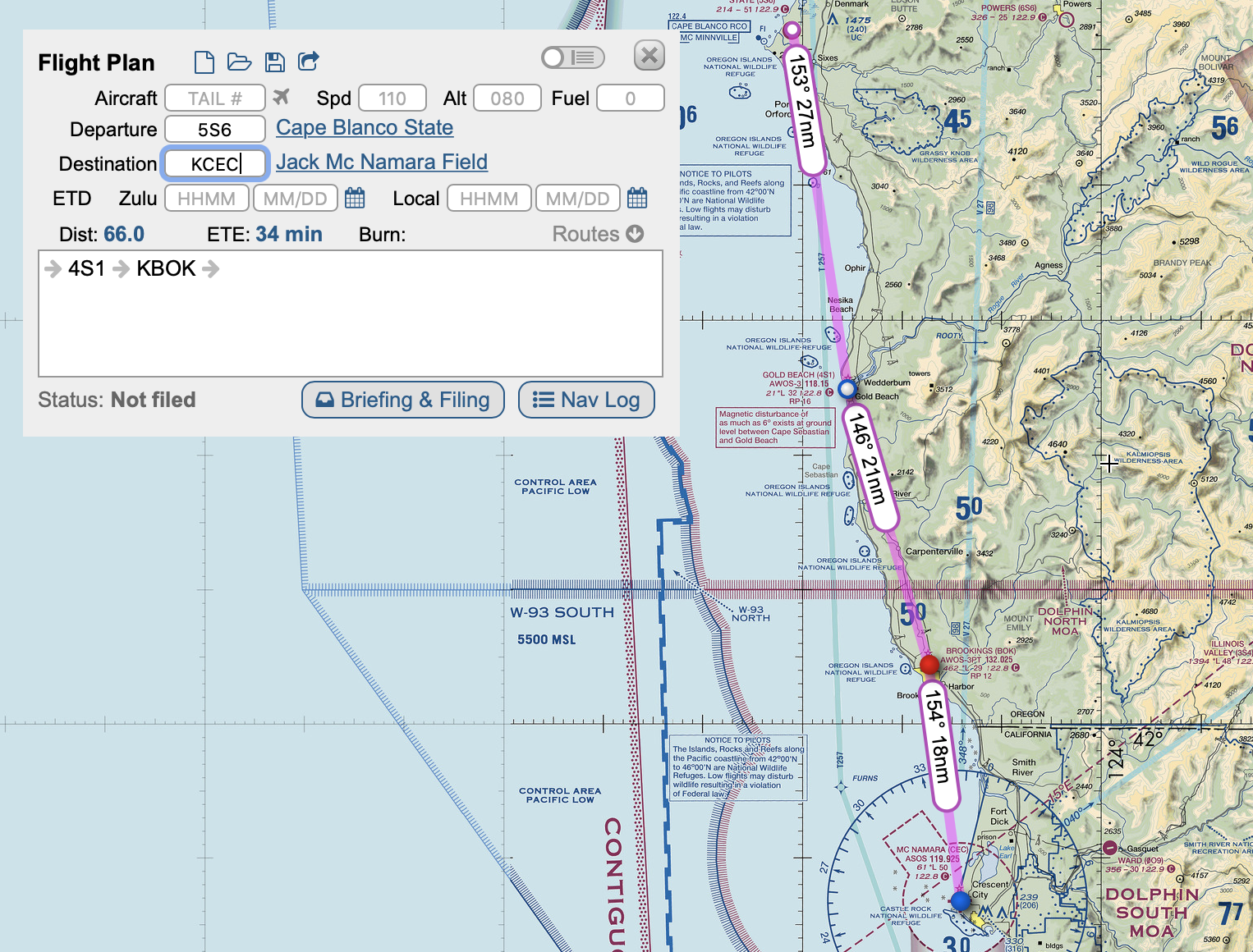
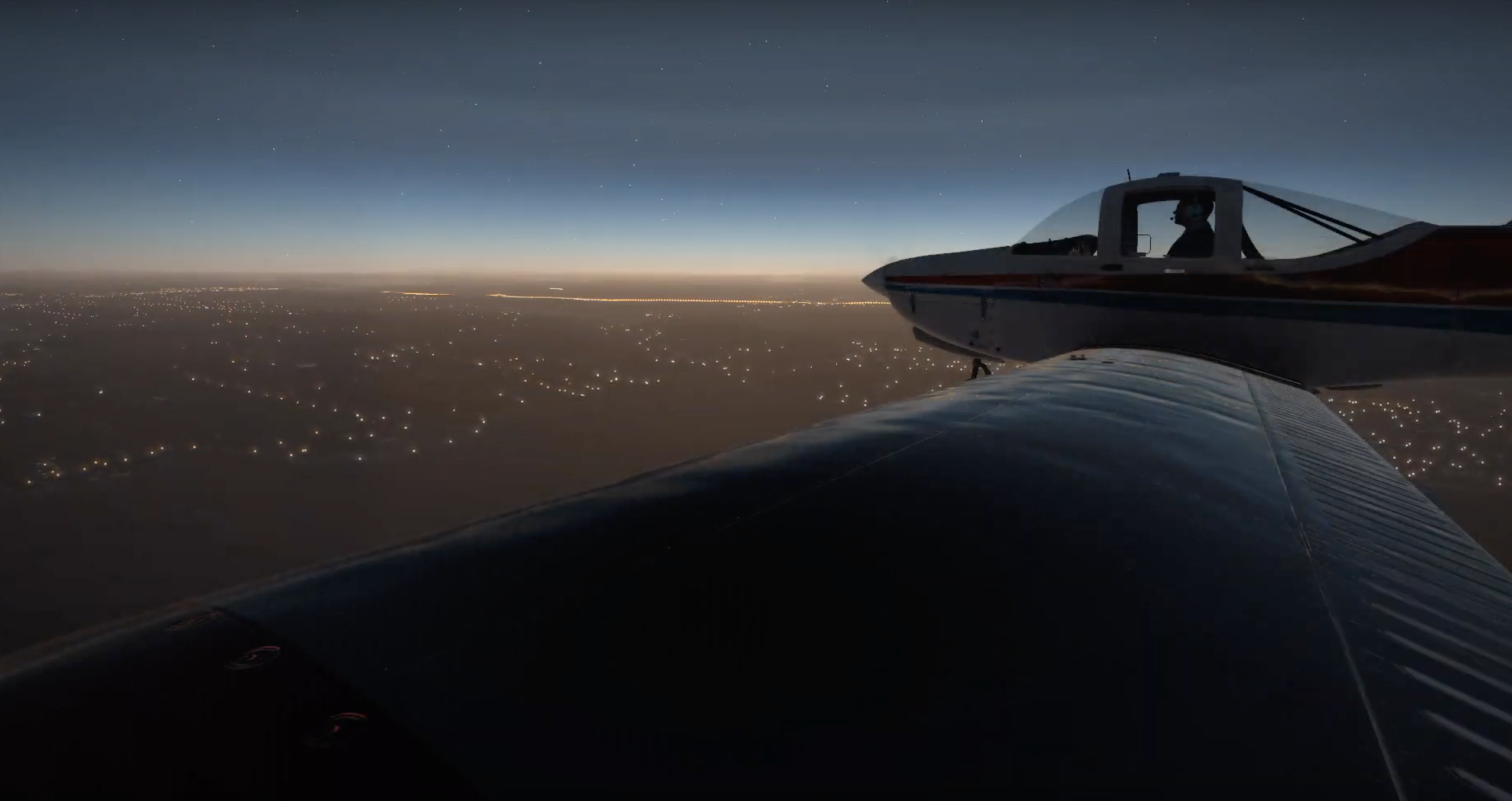
X-Plane: 5S6 Cape Blanco State to KCEC Crescent City
Ride along on a scenic VFR coastal flight in X-Plane from Cape Blanco State to Crescent City.
I took the Piper Arrow on a coastal flight from Oregon to California, flying from 5S6 Cape Blanco State to KCEC Crescent City. Check out the flight on my YouTube Channel.
X-Plane: Paine Field to Tacoma Narrows
Atomic turbines to power! I show off my new PC and graphics card with a twilight X-Plane flight around Seattle.
Now that I have a new PC with a nice graphics card, I have to put it through its paces. I took m PA38 Tomahawk on a twilight flight from KPAE Paine Field to KTIW Tacoma Narrows. Check out the flight on my YouTube Channel:

X-Plane: Tacoma Narrows Pattern Work
I fly a few laps around Orbx’s excellent KTIW Tacoma Narrows in Washington.
In my post A Rookie’s Guide to Starting on PilotEdge, I talk about flying a standard traffic pattern. Real-life pilots-in-training need to learn to fly this aerial traffic circle around airports, so as a virtual pilot I decided to practice the same maneuver, doing a touch-and-go (where you start to land, but take off again) and a landing at Orbx’s new payware scenery KTIW Tacoma Narrows. I get nice views of the famous Tacoma Narrows Bridge along the way, which is the bridge that twisted and turned in the wind in the 40s, tearing itself apart.

Check out the video of my flight here:

How Apple Lost Another Fan Boy
After years of monogamy with MacOS, I buy a Razer 15.
Years ago, when iPhones weren’t a thing and Macs were something you bought if you were a graphic designer, I had a Windows desktop that resided in a computer room. I recall Macs were novelties. I’d see them in photos with their translucent teal monitors, and just as quickly dismiss them when I realized none of the software I used would run on them. They did look cool, though.

Years later, I wanted a laptop. Around the same time, the “I’m a Mac, I’m a PC” commercials launched. With them, Macs moved to Intel CPUs and introduced the ability to run Windows via Bootcamp.
For me, this was the thing which sealed the deal. I could have the design of a Mac on a machine which could run both operating systems. It was like making the leap with a safety net. So, I bought a 15” MacBook Pro.
Shortly after, Apple launched the iPhone. As the years progressed, the software between the two became integrated, sharing notes, photos, and bookmarks seamlessly. My next purchase was a 13” MacBook Air, and then a 2016 13” MacBook Pro.
I do love Mac OS. There’s nothing wrong with Windows 10, but things are easier on a Mac. Apple has always had a minimalistic design language which extends to their software. They are in a class of their own when it comes to the build quality of their laptops.
In the days of Steve Jobs, Apple was willing to bend a bit to give their computers wider appeal. You can see it in the first Mac vs PC commercial in the video above. The Mac guy admits there are some things where PCs excel, and others where Macs fare better. Unfortunately, since then, Apple has increasingly taken a father-knows-best approach to its updates. It’s as if Steve Jobs had played the role of Kermit at the Muppet Theatre, reining in all of the design engineers to keep product meetings from devolving into cannonball fire and boomerang fish fights. Without Jobs, Apple is back to putting design before practicality.
I follow David Lee on YouTube, and he recently reviewed the 2019 Mac Pro (which is admittedly a workstation not designed for regular consumers.)
His most telling quote was where he discussed the cable-free design of the interior components. He said that it was a design choice which certainly drove up the price, that he can’t imagine anyone needing this feature, but was nonetheless cool. That’s probably the perfect description of Apple’s design approach.
For an example of this, just examine my 2016 MacBook Pro:
The memory is soldered, so I’m stuck with my purchase configuration
This was the last model to have a non-soldered SSD
This was the last model to have physical function keys. I actually bought the base model intentionally because the higher models all had the Touch Bar.
This was the first model to have the butterfly keyboard. Apple’s desire to have the thinnest laptop resulted in keys which have a fraction of a millimeter travel and become disabled by a crumb.
There are just two I/O ports, both USB-C. One of those is occupied by the power cable, so realistically there is one usable port.
Really, I can’t imagine anyone wanting any of those features. Who would want less ports, non-upgradeable components, and less key travel?
I’m a bit more forgiving about the other issue which has been problematic: gaming. I’m forgiving because Macs are not targeting gamers, and most games are only released for Windows. Some Macbook Pro models do have discrete graphics chips, but all Macbooks use USB-C charging, which limits their power bricks to a maximum of 100 watts. So, although there’s nothing to prevent Apple from slapping an RTX2080 into their 15” Macbook Pro, they would not be able to power it.
Mac did introduce eGPU support last year, and I bought a Gigabyte RX580 Gamebox. In Mac OS, it works moderately well, provided the game supports it. In Windows Bootcamp, it’s a nightmare. There is no official Windows Bootcamp support for eGPUs, so getting it to reliably work requires some technical magic. When it does work, I can play the Witcher 3 on Ultra settings at 30 fps, or Medium settings at 60 fps. More than often, however, the eGPU loses its mind because it was broken by a Windows update or simply refuses to power up.
I’ve been down this road before, and in the past I’ve purchased a separate Windows destop for gaming. Back then, I didn’t mind retreating to a computer room. Now, I’d rather have my laptop on the couch. Fortunately, there are thin and light gaming laptop options available. I pulled the plug and ordered one just before Christmas, and it arrived yesterday.
The Razer Blade 15” laptop has been called the Macbook Pro of Windows. The aluminum unibody, illuminated keys, and oversized glass trackpad clearly take their design cues from Apple. For me, this is a good thing. I didn’t want a gaming laptop which looked like a Ferrari with Christmas lights. Minimalistic works for me.
I’ve taken the past day setting it up the way I wanted. Here’s my initial impressions:
In terms of weight and size, it’s more appropriate to compare it to the Macbook Pro 15” (or the new 16”) than my 13” model. It’s similar to those. Although it’s bigger and heavier than my 13” Mac, the size difference isn’t as much as I thought it would be.

As expected, the build quality and aluminum unibody are fantastic, similar to Apple’s; however, the dark gray model is a fingerprint magnet. Whatever finish Apple uses on its Pros has a slight powdery feel to it, showing no fingerprints. The Razer has a matte metal finish, showing dark splotches.
There’s a glowing Razer logo on the back of the lid. Some of their other models just have the logo as matte metal, which I’d prefer. It’s the one gamer indulgence of the otherwise minimalistic laptop design.

The keyboard travel, at 1.2 mm, is perfect for me. It feels like my old Macbook Air, before Apple introduced the cringe-worthy butterfly keyboard.
The keyboard layout is a little wonky. Many reviewers commented on Razer’s choice to put the up arrow between the Shift and Question Mark key, presumably to save space. As a result, when you reach for the shift key with your right pinky, you may press the up arrow. It just takes a little bit of calibration to reach a little further. Most of my other adjustment is coming from the Apple keyboard. The Mac’s function keys are half the size of regular keys (because they have to fit where the Touch Bar sits on other models). The Razer’s are full size. I have a tendency to reach for them when going for the punctuation keys on the number row.

The keyboard lighting is single zone chroma, which you can adjust in the Razer Synapse software to be any color you like. There are effects like spectrum cycling, which I surprisingly like (I didn’t think I’d be one for blingy lighting effects). Light bleed around the keys is more pronounced than the Macbook’s. Note both the primary and secondary keys are illuminated, the same as the Mac’s.
The screen is 1080p, which is a downgrade from the Macbook’s Retina, but operates at 144 Hz, which is an upgrade from the Mac’s 60 Hz. It has a matte finish and the colors look vibrant.
The trackpad is oversized and glass but is cantilevered and physically clicks (unlike the Mac’s solid pad with virtual haptic clicks). It takes more force to physically click, but I’ve generally switched to single/double-tapping the surface instead of clicking. It’s very accurate, on par with Apple, but it has poor palm rejection. I’ve done entire Photoshop projects on the Mac using the trackpad, and the Razer is the first Windows computer where I’d consider doing the same.

The speakers flank the keyboard, similar to the Mac’s, but are poor (meaning, they are the typical laptop speakers which you would not want to use unless you had to). Sound is tinny and I’ve needed to mess with drivers due to crackling. Fortunately, I’ll mainly be using headphones with it. I am spoiled by the Macbook Pro in this category. Macbooks are in a league of their own for trackpads and speakers.
Although not as silent as a Mac in idle, the Razer is quiet when doing mundane tasks. Launch a game and the fans will spool up, but most of the time they are only slightly louder than the Macbook’s fans when it is playing a game. Play a demanding game for a while and the Razer’s fans can get considerably louder than the Macbook’s fans, but they still are not bad. Some other gaming laptops have fans that sound like hair dryers. The Razer’s aren’t even close to that noise level and are much better than I expected.
Heat is vented from the base of the laptop. Although the top never got uncomfortable to me, the base isn’t something you want on your lap when the fans are on. Even when the fans are on low, the hot air on your legs is uncomfortable. When the laptop is idle, though, the bottom is cool.
Battery life is not-surprisingly abysmal. When I was setting it up, at the 2 hour mark it went into battery-saver mode and asked me to plug it in. Granted, that was a lot of downloading and installing, which is different than light work. Others have reported 4-5 hours doing light work.
Performance is great. The Razer has a full RTX2060 graphics card, 16 GB memory, and an i7 9750. I could run VR from it.
There are ports galore. Three USB-A, one USB-C/Thunderbolt 3, one HDMI, one mini-display, one LAN jack. It’ll be awesome not to have to use any dongles.
Transitioning to Windows has been surprisingly easy. Apple has Windows apps for iTunes, iCloud, etc, and bookmarks migrate over with them.
I still have my Macbook Pro. There is some software which I use for writing that is only available on MacOS. So, I haven’t abandoned my Mac (like the title suggests), but it got downgraded from ‘the’ tool to do the job to ‘one of the tools’, which, I admit, I have mixed feelings about. There’s a certain elegance to not having different computers for different tasks, but unfortunately Apple’s design choices the past few years don’t allow it.
I’ll write another post after my first month of use. More to come.

Thoughts on Ad Astra
Moon pirates, killer monkeys, and father issues. A few rambling thoughts on Ad Astra.
I have a certain fondness for cerebral sci-fi. In a sea of CGI-nonsense offerings like Jupiter Ascending, finding a carefully-thought-out character-driven story is a gem. Ad Astra fits into this category. In it, Brad Pitt is a near-future astronaut who must mount a solo mission to Neptune to stop the power surges emanating there. The catch is that the surges appear to be emanating from his father’s lost-in-space ship, and they may be intentional.

Pitt’s character is very much like Ryan Gosling’s Armstrong in First Man, both portraying an emotionally-detached cool-as-ice rocket man capable of handling any life-and-death situation, as long as it doesn’t involve feelings. First Man starts with an amazing trans orbital flight and near-crash piloted by Armstrong; Ad Astra kicks off with a space-tower catastrophe and calm fall by Pitt.

What’s great about both of these openings is that they’re directly related to the plot. In Pitt’s case, the antenna searches for alien signals, and the catastrophe is caused by the Neptune surge. Unfortunately, the same can’t be said about the action scenes in the rest of the movie.
I sympathize with cerebral sci-fi. Nearly anytime the story involves a long journey, complicating factors must occur to keep it interesting. It works best when those complications are related to the overall story. 2014’s Interstellar had a partially-mad astronaut stranded from the previous expedition as the threat. Ad Astra fares worse. In no time, Pitt is chased by Moon pirates and killer monkeys on mayday ships. Neither has any relationship to the plot, other than flavor for the world-building. The moon attack is awesome to watch - Mad Max with moon buggies - and felt like something new that I hadn’t seen in sci-fi before.

The plot points which put Pitt there didn’t make much sense, just as the subsequent obstacles along his Neptune journey were a mess. Pitt is asked to send a transmission to his father to try and get the surges stopped. So far, so good. Instead of doing this from Earth, he is flown to the Moon’s spaceport. From there, he must take an overland buggy ride to another spaceport to get on a rocket to Mars. Despite the military drivers warning of pirate attacks, the buggies are unarmed (except for sidearms) and there is no recon or support. Enroute to Mars they receive a distress signal from a random ship. When Pitt objects to the side quest (he is literally trying to solo-save the entire solar system, after all), he is overruled. Their plan to split-up and search the derelict ship doesn’t end well.
And so the plot trudges, throwing obstacles in front of Pitt so he has something to do. We get his constant narration along the way. In some ways, this works, and reminds me, in tone, of George Clooney in 2002’s introspective Solaris.

In other places, it doesn’t. For example, when the Mars crew encounters the distress signal, the camera lingers on the fidgeting co-pilot, who responds to the captain’s request for him to go on the away team with a hesitant, “Sure, doesn’t matter.” Pitt narrates, “He’s scared,” in case none of us are capable of reading human expressions. The movie itself even narrates to us. The opening screen had the unnecessary text, “In the near-future…” This seems like something the viewer would quickly figure out in the first space-antenna scene.
Ad Astra does, however, nail the visuals. If you’ve seen Interstellar, you’ll be familiar with realistic space-flight shots where the camera is mounted to the fuselage and star fields swing as maneuvering jets fire.

The moon buggy fight not only looks real, with the harsh unfiltered lunar sunlight we previously saw in First Man, but even the way the buggies wreck and shred looks authentic to the moon’s reduced gravity. Visuals fare scientifically well, but plot points don’t. During a rocket ship take-off from Mars, Pitt and crew conduct a fight inexplicably in zero-gee, rocket engines blaring plumes of fire underneath the ship.
So, what to make of Ad Astra? Despite my nitpicking, it’s worth seeing. The space imagery is terrific, and the feeling that Pitt is traversing massive, open space and high-altitude visas is something that only movies like Gravity have accomplished. Even the plot points I grumbled about - moon pirates and all - are still great fun to watch and a refreshing change from standard sci-fi visuals. The story itself is about Pitt’s relationship with his father, and the journey is more of an allegory than a physical one. It’s ripe with visuals of Pitt falling and ascending. In the movie Gravity, there’s a scene where Sandra Bullock takes a moment to feel safe, floating in zero gee in her underwear, airline draped like an umbilical. Ad Astra does much of this same thing.

Pitt’s psychological state is a focus as well, with him taking verbal tests throughout the story where he must persuade a virtual therapist that he is fit for space travel. It reminds me of Gosling’s replicant baseline tests in Bladerunner 2049. Similar to Gosling, when his calm assurances mismatch his actual emotions, consequences occur.

Overall, I recommend it if you enjoy movies like Solaris. Disconnect the scientific gripes of your brain, and just enjoy the space ride.
Thoughts on the Mandalorian
Disney takes a little more of my money so I can watch the Mandalorian
Not long ago, I went to Disney with my family. Much had changed since my previous trip in the 90s. In particular, Imperial music blared as Captain Phasma led Stormtroopers past me at Hollywood Studios. I have to admit, I find the Star Wars/Disney merger a bit disjointing — the studio of endlessly happy animatronic children singing It’s a Small World colliding with rifle-toting Storm Troopers seems a little out-of-theme for the theme park.
When the new Disney/JJ Abrams Star Wars movies were announced, I was worried. After all, even George Lucas made a mess of the prequels. To my pleasant surprise, The Force Awakens was a very good Star Wars movie. The scene where Rey and Finn first hop in the Millenium Falcon and shoot-it-out with tie fighters managed to be more Star Wars than just about anything that happened in the prequels.

Rey force-grabbing the lightsaber in the climactic battle was a goosebump moment.

Since then, we’ve had a sequel which somehow managed to squander having Mark Hamill as a star, and a swirl of mostly-unnecessary backstories. Nostalgia is the common theme stringing these together, and each in some way recycles the originals. Destroy the Death Star. Fight the AT-ATs. Keep the droid with the hidden message away from the Empire. Say what you may about the George Lucas prequels, they expanded the Star Wars universe into mostly new directions instead of simply conjuring larger Death Stars to destroy.
So, I greeted the release of the Disney+ original series, the Mandalorian, with trepidation. Was this a Boba Fett backstory, similar to Solo? Clicking the signup button, I gave it a try.
SPOILERS AHEAD
It is not a Boba Fett back story. In fact, it’s set five years after the fall of the Empire (after 1983’s The Return of the Jedi). You’ll recall that Boba Fett rocket-packed himself into the Sarlacc’s pit during Luke’s battle with Jabba, so, presumably, he’s been dead for five years. The Mandalorian is an actual Mandalorian warrior, earning his Beskar armor piece-by-piece, like a squire on a quest to become a full-fledged knight. He’s a member of the Bounty Hunter’s Guild and is also a part of a hidden enclave of fellow Mandalorians. We never see what he looks like — indeed, one of the religious tenets of being a Mandalorian warrior is that you cannot remove your helmet in the presence of others. He’s the type of character who answers dumb questions with a silent stare.
Star Wars always was a space Western, but the DIsney+ series goes all-in on this theme. The Mandalorian is the highly-skilled gunslinger, wandering into a new town each episode, inevitably crossing paths with whatever is causing the town’s problems. Usually, he’ll get what he needs in exchange for helping. It reminds me a bit of the 1978 Battlestar Galactica episode “The Lost Warrior”, which has Apollo stranded on a low-tech frontier world where a local crook has programmed a Cylon as his muscle man. Only Apollo, with his blaster, can take down the Cylon and save the town. He does so in classic cowboy showdown style.

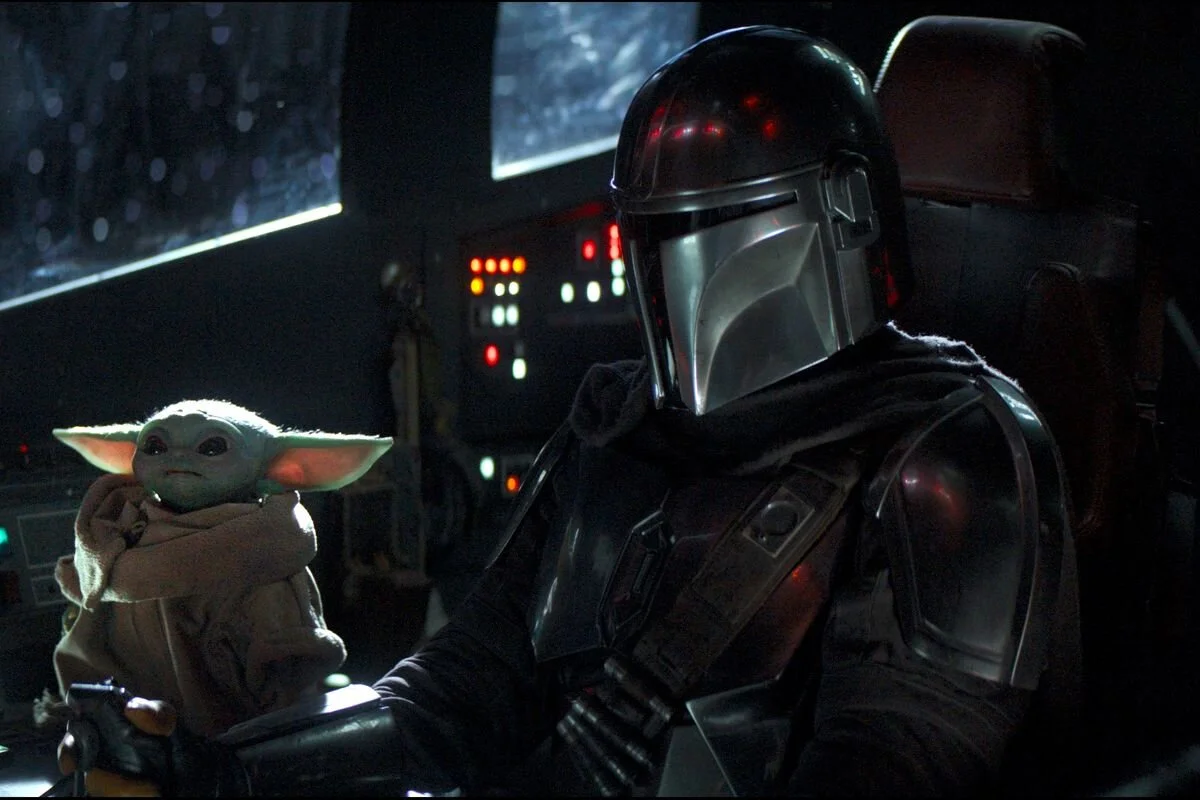
What keeps the Mandalorian moving on to endless new towns is that he’s got the MacGuffin. And here’s where the writers pulled a bit of magic. Normally the MacGuffin is just something everyone wants - plans to the Death Star, the Jewel of the Nile - but in this case it’s a child version of Yoda’s race, dubbed “Baby Yoda” by fans (it’s not Yoda - Yoda died back in the Empire Strikes Back). Baby Yoda has no spoken lines, but steals every scene. So, he’s not a true MacGuffin; it would matter if you swapped him out with something else. The story wouldn’t be the same.

Sometimes the camera even switches to his POV, taking in all of the weird sights and sounds of whatever new town he’s arrived. When scenes of violence unfold before him, he watches passively, tilting his head. You get the sense that he’s judging what type of person the Mandalorian is, or may become.
The truly remarkable thing about Baby Yoda is that Star Wars managed to pull off cute without corny. Just about any time that George Lucas tried to make something cute, lovable, or funny, it backfired. You can tell George has a certain cartoon-like “step on a rake, get hit in the face by the handle” sense of humor which flops in the Star Wars universe.

Baby Yoda ends up being a perfect add to the self-sufficient warrior who is not used to being responsible for other’s welfare. This could quickly degenerate into Three Men and a Baby hijinks, but fortunately doesn’t. Now, granted, cinema has a well-worn trope of tough guys given a job to deliver a package, only to find out it’s a person, causing them to break their own rules to save them:

…but it’s one that works, which is probably why it’s so reusable.
I mentioned many of the recent Star Wars movies propped themselves up with too high a dose of nostalgia. The Mandalorian isn’t any different, but it goes about it in a slightly more subtle way. I remember back in the 80s collecting the Star Wars action figures, and there were always some pieces that you asked “was this even in the movie?” Case in point:

The Bounty Hunter Droid, IG-88, was in the Empire Strikes Back, standing right next to Boba Fett:

So, when a similar droid appears in Chapter 1 of the Mandalorian and fights beside the protagonist, it’s a nice, subtle bit of nostalgia. Plus, the writers fully realize how a bounty droid might operate, and watching it in action is a big addition, not just a nod, to the original films. It constantly swivels and fires on multiple targets in opposite directions in a way only a droid could.

In Chapter 2, when Jawas strip the Mandalorian’s ship, his resulting tactics - an all-out failed assault on a Sandcrawler, followed by threats, followed by reluctant negotiations - are fun. The Jawas chant their desired quest item - The Egg - like a frat party chanting toga and laugh at the Mandalorian’s attempts to speak Jawa, telling him he speaks like a Wookie.

And, as fun as this episode was, it also reveals the weakness in the series. The plot is very much video-game structured. Each episode unfurls like this:
The Mandalorian sets down on a planet because a part of his ship needs repairs
To get money for repairs, he must accept a quest from the locals.
Although the locals don’t have enough to pay him, usually it all works out.
If he collects enough Beskar pieces, he can upgrade his armor at the smith’s.
That’s really the plot so far. Start of episode: broken ship; end of episode: fixed ship. I just finished Chapter 5: The Gunslinger and had exactly that question: what was the point? At the end, he got his shipped fixed and nothing new was learned about him or Baby Yoda. The episode had its watchable moments - the speader bike journey over the desert and the conversation with the Tuskan Raiders were highlights - but I’m left feeling sometimes the series suffers from the same thing that scifi movies do…great visual artists but only okay writers. The ending credits illustrate this by scrolling through the concept art for the episode.

Unlike Netflix, Disney+ is releasing the episodes weekly, so the series isn’t complete yet. It’s good popcorn fun, though, and enjoyable. I just hope there’s more to the plot than just snacks in the remaining episodes.

A Rookie's Guide to Starting on PilotEdge
For those aspiring virtual pilots who want to try flying with online ATC, I pen a primer to help get you started.
I think most people who use X-Plane go through an evolution where they launch flights directly from the runway with engines running, then they’ll want to try starting their plane up from cold and dark, and eventually, they want to fly procedures and do things by the book.

Gauges. So many gauges.
When I signed up for the online ATC network, PilotEdge, I became aware I’d need to at least somewhat learn how to do things by the book. It was a bit intimidating. Even a basic thing like how to fly a traffic pattern is confusing if you’ve never done it before, let alone what to say to ATC when departing a towered airport.
So, after a few months, I’m still a rookie on PilotEdge, but I thought I’d write a post summarizing a few things I figured out along the way. This is intended for people like me who didn’t have previous aviation knowledge or experience with online ATC like VATSIM.
MOSTLY UNNECESSARY DISCLAIMER: I’m just a guy playing a video game. Don’t take any of this as real-world aviation advice. It’d be like taking medical advice from someone who’s played a lot of Surgeon Simulator.
Basics:
For PilotEdge, you need a headset with a mic (don’t be the guy using his laptop’s built-in mic who sounds like he’s underwater while watching Grey’s Anatomy).
When you connect to the network, your aircraft needs to be parked on a ramp.
Your callsign (configured in the PilotEdge settings) must follow FAA guidelines
Most people use real weather, but it’s not a requirement.
You only have to talk to ATC if you’re flying somewhere where you have to talk to ATC.
Tips:
PilotEdge has a rating program for both VFR and IFR pilots. It’s a good way to learn the ropes.
PilotEdge also has free video workshops covering the basics.
Things to know before starting (if you want to fly VFR):
You should know how to read a VFR map, fly a traffic pattern, and make CTAF calls.
Reading a VFR Map:
Go to Skyvector to view VFR maps. Airspaces are color-coded with magenta or blue lines.

Class B Airspace: Thick solid blue lines. To enter this airspace, you need to be talking to ATC and hear the magic words, “Cleared to enter the Bravo airspace”

Class C Airspace: Thick solid magenta lines. To enter this airspace, you need to be talking to ATC and they need to use your callsign in their response.

Class D Airspace: Thin dashed blue lines: To enter this airspace, you need to be talking to ATC and they have to use your callsign in their response
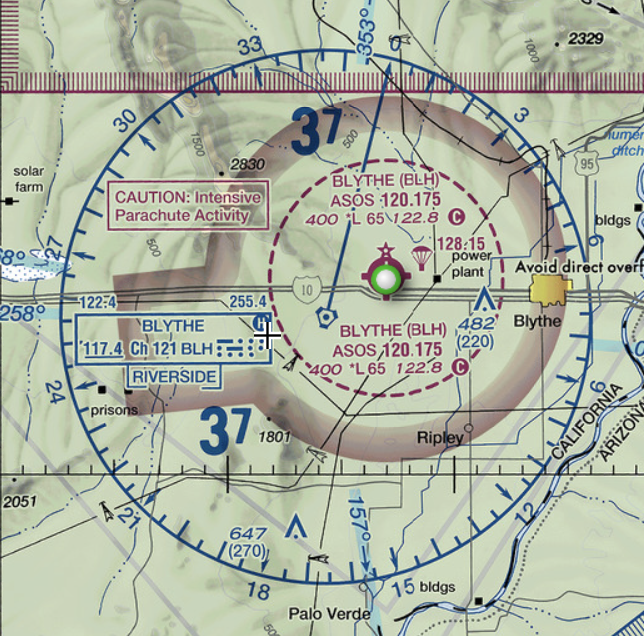
Class E Airspace: Most of the time, Class E airspace exists between 1200 feet AGL and 18,000 feet MSL. Sometimes it starts lower, in which cases it’s marked on the map as either a thin dashed magenta line (indicating starting at surface), or magenta gradients (indicating starting at 700 feet AGL). Class E is controlled airspace (that exists for IFR flight), and you do not have to talk to ATC when flying VFR. When it does start lower than 1200 feet AGL, it is to protect for an instrument approach at a nearby field.

TRSA (Terminal Radar Services Area) - Thick solid gray lines. Optional radar services are provided in this area. Pilots are encouraged, but not required, to use these services.

Restriced: Hashed blue lines, usually around military areas. You need permission to enter.
MOA (military operations area): Hashed magenta lines. You are not required to talk to ATC to enter, but it’s generally a good idea to do so, especially if the MOA is active. Each MOA has a name, such as “Abel North MOA”, and you can find its schedule printed in the margins of the VFR chart.

Towered airport - blue solid circle or blue solid runway lines. Lines show number of runways and approximate orientation. The star indicates it has a beacon, the squares sticking out indicate fuel services available.

Non-towered airport - magenta solid circle. The number next to the C that looks like the copyright symbol is the CTAF frequency. In this case, it’s 122.8. Beneath it, “RP 26” indicates Runway 26 uses Right Pattern traffic. “*L” means it is lighted, but the asterisk indicates with limitations (for example, the pilot may need to activate the lights with his radio). The 2222 is the field elevation. The bolded 134.625 is the weather frequency. The red flag indicates this spot is a VFR visual reporting point that can be used to tell ATC where you are located.
Not depicted on sectionals:
Class A Airspace: IFR only, extending from 18,000 feet MSL to 60,000 feet MSL. The realm of jetliners.
Class G Airspace: The only uncontrolled airspace, usually between the surface and wherever Class E starts (usually 1200 feet AGL). No ATC or radar services in Class G. In some remote parts of the US where there is no ATC, Class G may be specifically called out on the sectional as a blue gradient, in which case it extends from the surface up to 14,500 feet MSL. You’re on your own in Class G.
Airspaces are divided into shelves which begin and end at different altitudes. Inside each shelf, you will find two numbers which look like a fraction printed in the same color as the airspace lines. The top number is the top of airspace, in hundreds of feet, and the bottom number is the bottom of the airspace:

“40/SFC” means the inner ring extends from the surface to 4000 feet. “40/15” means the outer ring extends from 1500 feet to 4000 feet. If you fly above or below these numbers, you are not in the airspace. So, if you flew over Santa Barbara at 6000 feet, you would not need talk to ATC because you are not within Santa Barbara’s airspace.

Smaller airports may only have one shelf. Instead of a fraction, the shelf height is written as a number in a dashed square. The “28” in the dashed square means the airspace extends from surface to 2800 feet.
FLY A TRAFFIC PATTERN
This one was a bit of a mystery to me initially, but it’s straightforward:
The pattern is like a traffic circle, except it’s a rectangle. Planes enter and exit at a set location. It defaults to 1000 feet above ground or the traffic pattern altitude listed on the airport’s chart. The four legs of the rectangle are:
Downwind - runs parallel to the runway 1/2 mile away, flying with the wind. For low-wing aircraft, a rule of thumb is that the tip of the wing should visually just touch the runway when you look out the plane’s window. For high-wing aircraft, the runway should visually appear half-way up the wing strut. Typically you begin to descent in the downwind once you are abeam your touchdown point.
Base - when flying the downwind, you should turn 90 degrees onto the base leg when the runway is over your shoulder along a 45-degree line. You continue the descent started in the downwind all throughout the base leg.
Final or Upwind - you should always land flying into the wind (upwind, or with a headwind). This is because with a tailwind your plane will have to travel faster (relative to the ground) to generate the same lift compared to flying into a headwind. In other words, you’ll have to land at a higher ground speed and take more runway to stop. If you are flying on the runway’s extended centerline you are on Final. If you are flying parallel and offset to the runway (usually intending to go around the runway and not land) you are on the Upwind. When you turn base to final, typically you are 500 feet above the ground.
Crosswind - when you are between 500 - 700 feet above ground, you can turn 90 degrees onto the crosswind leg. You would then continue climbing to pattern altitude. When the runway is along a line 45 degrees behind you, you turn onto the Downwind.
The pattern is either clockwise (right traffic) or counterclockwise (left traffic). For left traffic, you make all left turns; for right, all right turns. This is usually published on the airport chart. Many airports also have a segmented circle on the ground which shows the pattern direction, usually with a windsock in its center.
For non-towered airports, planes should enter the pattern level on the downwind along a 45 degree angle. This gives them the best visibility to see planes already in the pattern; however, in reality planes may enter any leg of the pattern, including the upwind, if it makes more sense due to direction of travel or terrain.
For non-towered airports, it is recommended planes depart straight out or on a 45 degree, but in reality planes may depart any leg of the pattern based upon what makes sense for direction of travel.
Arriving/Departing Non-Towered Airports
The runway number is roughly the heading of the runway, minus the zero. Runway 18 is along magnetic heading 180.
When you get the weather for an airport, it will give you the direction the wind is coming from. Ideally, you’d like to landing flying into the wind, so you try to match the wind direction to the closet runway heading. If the wind is coming from heading 240, then you’d like to land on runway 24, or the nearest number to 24. The same rule is true for choosing a runway for take off. If there’s no wind, refer to the airport plate to see if there is a preferred runway, or see which runway everyone else is using.
When arriving, generally you’ll descend to pattern altitude, enter the downwind on a 45 degree, turn base, turn final, and land.
When departing, generally you’ll fly straight out and climb to 500 feet above pattern altitude, then turn to your desired heading and continue climbing to cruise altitude.
Arriving/Departing Towered Airports
You must talk with ATC prior to entering the airspace of a towered airport. More on that later.
If flying to a towered airport, ATC will give you instructions based on what makes sense for the direction you’re arriving. They may have you fly straight in or enter any segment of the pattern. Don’t automatically enter the downwind on a 45 degree. For towered airports, you enter the pattern where they tell you.
When leaving a towered airport, you’ll follow ATC instructions. Similar to arrival, ATC may have you depart from a specific leg of the pattern or along a specific heading.
If they give you no instructions, then you’ll probably depart the same way you would from a non-towered airport. In that case, you have no restrictions and are free to fly per the normal VFR rules.
NEXT: Making CTAF Calls
When approaching a non-towered airport, you self-broadcast your intentions on a common frequency, called CTAF, which you get from the VFR sectional or airport chart.
It’s kind of like using a blinker in a car. Imagine if, instead of using your blinker, you rolled down your car window and yelled, “LA traffic, Nissan Rogue, turning left!”. That’s pretty much what a CTAF call is.
The format is easy: “(airport name) traffic, (callsign), (what I’m going to do), (airport name)”
An example is “Banning traffic, November Three Five Niner Golf Charlie, entering left downwind runway eight, Banning.”
The calls you’ll probably make are:
Taxiing to the runway: “Banning traffic, November Three Five Niner Golf Charlie, taxi runway eight, Banning.”
Taking off: “Banning traffic, November Three Five Niner Golf Charlie, departing runway eight, straight out departure, climbing three thousand five hundred, Banning.”
10 Miles from Destination “Banning traffic, November Three Five Niner Golf Charlie, ten miles south at three thousand five hundred, entering left downwind, runway eight, full stop, Banning.”
Entering the Downwind: “Banning traffic, November Three Five Niner Golf Charlie, entering left downwind, runway eight, full stop, Banning.”
Turning Base: “Banning traffic, November Three Five Niner Golf Charlie, turning base, runway eight, full stop, Banning.”
Turning Final: “Banning traffic, November Three Five Niner Golf Charlie, final, runway eight, full stop, Banning.”
Clear of Runway after Landing: “Banning traffic, November Three Five Niner Golf Charlie, clear, runway eight, Banning.”
CTAF calls are only for CTAF frequencies. Do not make CTAF calls when on ATC frequencies.
NEXT: Talking with ATC to Depart a Towered Airport:
First, it helps to understand the sequence of frequencies at a towered airport. In order:
Clearance Delivery: Used for IFR clearance and VFR departure at some larger airports. The airport’s ATIS will give you directions if VFR departures need to contact clearance delivery.
Depending on what you’re doing, you may get restrictions, a departure frequency, and squawk code. They will be in this format:
On departure fly heading…
Maintain VFR at or below…
Departure frequency…
Squawk…
You will need to read back all of that, so have it written down.
Ground: If you want to use a taxiway or runway, you need permission from Ground.
Before you contact Ground, get the weather by tuning to the airport’s ATIS or AWOS. It’s updated hourly and there’s a phonetic letter code that identifies it. Write down the code.
For a basic VFR departure: “(airport) Ground, (callsign), (location in the airport), (departure direction), taxi with (weather code information)”
Example: “John Wayne Ground, November Three Five Niner Golf Charlie, east ramp, west departure, taxi with kilo.”
The ground controller will respond with a runway and directions to get there: “Runway 20 Left at kilo, taxi via alpha, hotel, charlie.”
You then repeat back the instructions.
Depending on what you’re doing, you may get restrictions/departure frequency/squawk code at this point (if Ground is the first person you’re talking to)
Tower: When you taxi, it will usually be to the hold short lines for a specific runway. At that point, you switch to Tower frequency. You can switch on your own without Ground telling you to. “Tower, November three five niner golf charlie, holding short, runway 20 left at kilo.”
At this point, tower will likely clear you for takeoff. “Runway 20 left at kilo, cleared for takeoff.” You may also get departure directions, such as “Left downwind departure approved”, which means you would take off, turn crosswind, turn downwind, and continue on the downwind heading climbing to cruise altitude (or the altitude restriction you were given)
DO NOT SWITCH OFF THE TOWER FREQUENCY UNTIL INSTRUCTED BY TOWER TO DO SO.
If you will continue to have radar services once you leave tower’s airspace (if you have requested flight following), or for larger airports which have Departure manage their outer airspace rings, tower will tell you to change frequencies to Departure. You’d respond with “Over to departure” and change frequencies.
If you will not have radar services after leaving tower’s airspace, you probably won’t hear from Tower again. Once clear of their airspace, you can change frequencies on your own.
Talking with ATC to Land at a Towered Airport
For a small Class D airport, this is simple:
Get the airport weather before making the call
Contact Tower before entering the airspace: “San Luis Tower, November Three Fine Niner Golf Charlie, twelve miles east, full stop landing with kilo.”
Tower will then issue instructions, usually giving you a report location (“report three-mile final”). When you report, you will be given a landing clearance.
For larger airports that have inner and outer rings to their airspace, you would typically call Approach first. Approach manages the outer ring and the surrounding area, while Tower manages the inner ring. You can get Approach frequencies from the airport’s diagram.
COMMON MISTAKES ON PILOTEDGE
You’ll find the controllers on PE are helpful and give you tips when you make mistakes. There are a few common mistakes that you’ll hear over comms:
Switching from Tower to Departure on your own (You must stay on frequency until told to switch)
Not realizing you need permission to taxi at a towered airport. (Contact Ground for permission to taxi)
Having a callsign with O or I, which is not a valid FAA callsign.
Confusing right/left instructions, such as entering a right base when told to enter a left base.
Not knowing where you’re at in the airport or being vague when calling Ground. Some large airports may have multiple transient parking locations and seprate east/west ramps, so just saying transient parking may not be enough.
Not having the weather before contacting ATC.
Not giving another pilot a chance to read back ATC instructions before you broadcast your request.
PILOTEDGE QUIRKS:
Usually, there are only one or two controllers covering all of the areas. So, even though you change frequencies, it will be the same person.
If you are tuned to any frequency where you can hear a controller, you’ll hear everything they say on all frequencies. This is to help you avoid stepping on transmissions you can’t hear. So, if you hear them give a long clearance, you should know that someone has to read all of that back and you should wait before speaking.
At peak times, the number of online pilots is in the twenties. You probably will not encounter another player unless you are at a popular large airport, like KSNA John Wayne. PilotEdge also publishes focus fields each week, which encourages pilots to congregate at a specific field.
PilotEdge has drones, which are NPC AI aircraft flying routes a bit like World Traffic. Like World Traffic, they are oblivious to your presence, and will land on top of you. Their many purpose is to give you and ATC targets to look out for, when looking for traffic.
Phew! Okay, that was a lot of info. And that’s just VFR flying. I didn’t touch on VFR with flight following or IFR. Hope this helps, and see you on PilotEdge.
While you’re here, be sure to subscribe to my YouTube channel for fun flight sim adventures.
When I’m not flying the virtual skies, I’m the sci-fi author of the Hayden’s World series. If you love exploration and adventure, be sure to check it out.

Hayden's World: Volume 2
Get the Hayden’s World bundle of Janus 2 and Bernard’s Promise and save 20% versus the individual ebook price.
Hayden’s World: Volume 2, which is a bundle of Janus 2 and Bernard’s Promise, is now available on Amazon in Kindle and paperback. When you buy the bundle, you save 20% versus buying the individual ebooks. Get it here.


Bernard's Promise (First Chapter - 2800 words)
As James hikes north along the rocky flats, a translucent map on his faceplate rotates so that his forward position is always up. It’s a bit like playing a video game. Pulsing icons show Ava and Hitoshi’s positions beside him. Overhead, the sky is crystal blue with a hint of aquamarine, the sun just a touch brighter and larger than Earth’s. One moon and the speck of another follow the extended line of the ecliptic to the sky’s apex. Behind James’s group, the rocky landscape slopes back towards the ship. Even from two kilometers, it’s still prominent. They’ve lost sight of the red team, last seen descending west from the ship behind some plateaus.
One
Astris
As James hikes north along the rocky flats, a translucent map on his faceplate rotates so that his forward position is always up. It’s a bit like playing a video game. Pulsing icons show Ava and Hitoshi’s positions beside him. Overhead, the sky is crystal blue with a hint of aquamarine, the sun just a touch brighter and larger than Earth’s. One moon and the speck of another follow the extended line of the ecliptic to the sky’s apex. Behind James’s group, the rocky landscape slopes back towards the ship. Even from two kilometers, it’s still prominent. They’ve lost sight of the red team, last seen descending west from the ship behind some plateaus.
Ava walks beside James, matching his pace. “You know, when you came to me last year at Cayman, if you said I’d be hiking on Astris next Thanksgiving, I’d have thought you were nuts.”
James squints. “Has it been that long?”
“Time flies.” She chuckles. “Especially for us.”
“Well, what do you think?”
“It’s uncanny how Earth-like it is. People could probably live here. The soil could likely be terraformed to grow Earth crops. It raises all kinds of ethical questions if there is pre-existing life and we introduce new life.”
“Oh,” James says, “that’s the scientist speaking. But what do you think?”
She slows as they approach the overlook. When James takes a few big zig-zagging steps to the apex, the entirety of the basin comes into view, sloping mountains fading into the distant haze. Another kilometer out, swathes of green vegetation welcome them and the red-and-white splash of their probe’s parachutes are small disks a few hundred meters shy of the field. Ava takes a deep breath. “It’s unbelievable. It’s a dream, really, to be here.”
Hitoshi approaches James and sets his hands on his hips. “Have to admit, this does look pretty awesome.”
James points to the right. The slope along the cliff face is gradual, with exposed slabs forming natural steps. “Here we go. Watch where you put your feet.” When he walks to the edge, the first step down is almost casual, although the sense of height — ninety meters — is intimidating. Nothing worse than he had hiked with Will back at Yosemite. He advances twenty meters and descends a few smaller step-downs to another ledge. The rhythm is starting to kick in. “This reminds me a bit of hiking down the crater wall at Janus. Not quite as cold, though.”
“You freaked us all out with that one, boss,” Hitoshi says.
“Silver Star was there. Had to go find out what it was all about. Just like our mystery grass.”
“I’m curious,” Ava says. “How’d you decide to do all that? Take your ship down to Janus, knowing you couldn’t take off, hike to the crater with your last bit of air. You couldn’t have been sure Gossamer Goose would’ve made it there in time.”
James shuffles sideways along the slope. Loose pebbles skitter down the landscape. “I didn’t expect anyone to rescue me. Didn’t really think about it and decide, either. It was just what had to be done.”
“Always seems to work for you, though,” Hitoshi says.
James continues leading the group down. In fifteen minutes they’ve reached the bottom, everyone breathing a little more quickly. From here, the basin stretches forward, covered by sandy drifts and scattered boulders. He toggles to COM2. “Red team, how’s it going?”
Isaac’s voice responds. “Hi, James. We’ve arrived. It’s quite remarkable! Have a look.”
The video inset reads Cartwright.I EV Suitcam 3 11.21.83 10:03. In it, Willow’s blue-and-white State department suit is prominent as she kneels beside a wash of purple and green, grabbing something with forceps and depositing it into a sample container. The video view pans down to Isaac’s orange forearm, his left glove typing on a keypad. When the view lifts back to Willow, a reticule zooms onto a trumpet-like purple bell. The bell’s top is smooth with a divot at its center. Isaac narrates. “Twenty centimeters tall. Found some with spores intact on the bell. We have not removed any living ones, but found some broken stems which we collected.”
Ava joins the channel. “It’s very similar to Cooksonia. Spore bearing, possible vascular system.”
“Spectral analysis suggests presence of chlorophyll,” Isaac says.
James glances at Ava. She’s grinning ear-to-ear. “Alien evolution of chloroplasts is a bit of a holy grail for xenobiology. If it’s similar to how it evolved on Earth, that means there’s probably cyanobacteria, which live in water. I’ll be very curious to see the results of the sea sample.”
Isaac pans around, showing the purple plants covering the area like grass. “We found single patches of these along the way. Spores probably carried by air. Now for the red stuff.” When he turns, mossy red undulates in hypnotic patterns along the cliff face. “All the vertical walls are coated in this. Also shows possible chlorophyll.”
“Interesting,” Ava says. “Might be accessory pigments like anthocyanin.” She looks over at James. “It’s what makes autumn leaves so colorful.”
“We’ve got a few more samples to collect, and then we’re going to the beach. Should be there in twenty minutes,” Isaac says.
James nods. “Great. We’re at the cliff base now and walking to the green patch. Stay safe.” He closes the channel and glances up into the aquamarine sky. So Earth-like. Just over a year ago, he piloted Bernard’s Beauty back home to a similar sky.
In his memory, he’s there, a blistering summer day with cirrocumulus clouds dappling the sky like fish scales. Four Needletail aerospace interceptors flank Bernard’s Beauty, bristling with armaments.
James sits in Bernard’s cockpit next to Beckman and Isaac. When he glances over his right shoulder, the nearest Needletail is close enough that he can see the pilot’s mirrored visor. James raises his hand, points two fingers, and gives a casual salute.
“Easy,” Beckman says. “They’re not the honor guard. Shooty-McTrigger-Finger there might get a little twitchy.”
“I know,” James says. “This is my old stomping ground.” He taps the coms icon, and the video feed shows Hitoshi sitting on a jump seat in the engine compartment. “How’s everything looking back there, Hitoshi?”
Hitoshi shimmies from the ship’s atmospheric buffeting. “I just want you to know that this was a horrible idea. Right now there are lots of red blinking lights that I know probably aren’t going to kill us. We could have at least finished repairs first.”
“Didn’t get much of a choice with the Hermes holding our hand all the way here.”
“You know they’re not going to give it back once they quarantine it.”
“Yes, they will,” James says. “It’s the only Riggs ship we have.”
Coms pings and a voice says, “Bernard’s Three Five Niner, turn left, heading two two three.”
James keys the mic. “Left two two three, Bernard’s Three Five Niner.” He turns Bernard’s and the horizon pans, a wash of sandy tans and sun-bleached rock. Up ahead, Rogers Lake is a dry kidney-shape looking like spilled flour across creamy coffee. Just beyond it, the runways of Edward’s Air Force Base stretch towards him.
“Cleared to land, runway two two left.”
James repeats the instruction and taps the overhead intercom. “Crew, secure for landing.” A glance at the video feed from the galley area shows Ava and Julian sitting in fold-down seats along the wall. James toggles back over to tower. “Edwards Tower, you, uh, know I don’t have wheels, right?”
“Affirmative.”
“So, it’s going to be a really short rollout. Pretty much wherever the struts touch down.”
“Roger.”
“Don’t really need the runway, then. It’s more like landing a jump fighter than a jet. Sure you don’t want me to plop her down on the main apron?”
The voice hesitates. “That’s a negative. We’ll bring out tugs and tow it.”
James glances over to Beckman, who smirks.
Beckman says, “What’d you do the last time you were here, crash into something?”
James clicks the mic. “Acknowledged. Final, runway two two left.” He shrugs. “They just want to separate us from the ship, get a good look at it. Not sure if they realize Goose was the one that made all the contact, not Bernard’s. No worries.”
Beckman tilts his head. “Well, Bernard’s was alone on Janus all that time.”
“Yeah, that’s true.”
The runway widens as they descend, flattening out parallel to Bernard’s flight path. James pulses the forward thrusters, and everyone leans as the white runway lines tick by. Just before midfield he hovers the ship to a stop and descends onto the struts.
“Work for you?” James says to the tower.
“Affirmative. Power down and exit the vehicle.”
James unhooks his harness and taps the intercom. “Alright, game on.” He looks over towards Ananke. “Got everything?”
“Core download complete,” Ananke says.
“Wipe it.”
“Riggs control system erased.”
“Okay,” James says. “If they want to reverse-engineer the Riggs tech, they’re going to have to earn it. The emitters are the easy part. Software’s the pain in the ass.”
“I knew there was something I liked about you,” Beckman says.
He flicks a few more switches and completes the shutdown checklist. After a moment he unhooks Ananke and attaches her to his belt mount. Beckman moves to the left towards the narrow aft passage as Ava and Julian emerge from the starboard galley corridor. The group proceeds towards the airlock, joining up with Hitoshi, before opening the door.
James looks left and right. Everyone wears his brick-red and navy-blue Hayden-Pratt flight suits with the Janus 2 patch on his sleeve. Beckman, Hitoshi, and Isaac’s faces still bear scratches over yellowing bruises, and Beckman’s right arm is in a gel cast. Ahead, through the sunlit door, two military vehicles with flashing police lights coast to a stop. A half-dozen men disembark.
“Here we go,” James says, moving forward onto the stairway. The desert heat blasts him as he emerges onto the runway. He walks towards the military group.
The group’s leader is a forty-something man with cropped salt-and-pepper hair and airman camos. As he approaches James, he smiles. “James Hayden, you old dog.” He claps James on the back and shoulder-hugs him.
James pats him. “Who’s old? Good to see you, Jackson. How’s Emily?”
“Keeping me on my toes.”
The Needletails rocket across the sky with thunder rumbling behind them. James motions upwards. “Really rolled out the red carpet for us.”
Jackson sets his hands on his hips. “Orders are orders. You know how it is. Follow me, we’ve got some rooms set up for you.” He turns and starts walking.
James takes the cue and follows. Based on the five soldiers with him, it’s not a request. “You know, I’m sure we can find a Marriott around here.”
Jackson chuckles. “Still the same James. You’re our guests overnight, and then we’ll get transport back tomorrow morning. Once everyone gets settled in, we’ve got to do a debrief. Going to need access to Bernard’s logs, sensor data, and all your EV suit cameras.”
“The guys on the Hermes were pretty thorough with their debrief back at Cassini,” James says.
Jackson reaches the military vehicle and opens the door, pausing. “That’s a U.N. ship, and this is a U.S. base.”
James squints. “Wouldn’t it be awesome if we could all work together?”
Jackson swings into the driver’s seat. “It would.” He closes the door.
The solider beside James opens the rear door, waiting. James slides into the back seat. Beckman comes in next to him. In the other car, Julian, Isaac, and Hitoshi fill the seats. The air conditioning is on full, and the crisp breeze is refreshing. When James looks over his left shoulder, three tank-treaded tugs amble down the north taxiway, orange lights flashing.
“Whatcha going to do with my ship?” James says.
Jackson slips on a pair of sunglasses and looks back over his shoulder. “Putting it in the north hangar. Sorry, but it’s grounded until further notice.”
James leans forward. “I’m not okay with that. Didn’t have much choice to bring it here, what with the battleship escort and interceptor handoff.”
“You can take it up with Senator Larson,” Jackson says, engaging the truck’s engine. As it turns in an arc heading towards the south buildings, he adds, “when you testify before him next week.”
* * *
The Senate Space Committee watches the media screen from their seats along the panel. James sits at a table with his hands clasped, Ananke to his right and Beckman to his left. At the second table sit Hitoshi, Ava, Isaac, and Julian.
The video reads Gossamer Goose Emergency Escape Vehicle, airlock camera #1, July 28th, 2082, 22:31 Earth UTC. The view is a fisheye ceiling mount capturing most of Goose’s passenger cabin. Crimson light strobes as a three-meter tall metal wrecking ball spins through the ship, tearing up everything it contacts. It resembles a chrome asterisk with pulsing embers at every arm. Hitoshi is in the cabin against the wall, curled up into a ball as the wrecking ball rolls towards him. A muscular figure appears just inside the camera’s view on the lower left, both arms extended holding a pistol. The gun flashes. Pop. Pop. Pop. Pop. Pop. The cabin flares with blue as each pulse connects with the alien shape, orange sparks spinning and bouncing off the deck. The figure — they can see Beckman’s face now — advances. Pop. Pop. Pop. One of the asterisk’s arms fragments and spirals out of view. The alien cycles its lights from red to cyan, retracting its arms, and rolls in a blur towards Beckman. Beckman doesn’t flinch. Pop. Pop. Pop. The wrecking ball collides with him as the video pauses.
The Senate panel shifts and murmurs, turning back towards Beckman.
Beckman straightens, the gel cast still on his arm. The bruises and scratches on his face are mostly healed.
Senator Larson takes a deep breath. “Well, Mister Beckman.”
Beckman nods. “Senator.”
“You shot it.”
“I did.”
Larson references his notepad, counting. “Nine, ten, eleven. Eleven times.”
“I know,” Beckman says, pausing. “In hindsight, I wish I’d grabbed a second gun.”
“Aren’t you worried you might’ve started an interstellar war?”
“No, I was worried Hitoshi was about to become hamburger.”
Larson rubs the spot on his forehead between his eyes, pinching the bridge of his nose.
Beckman adds, “I’d like to remind you that four minutes later that thing destroyed Gossamer Goose.”
“Because you shot it,” Larson says. It wasn’t intended as a question.
“Pretty sure that was going to happen either way. It wanted Ananke, and it took her.”
Larson writes something down. While he does, Senator Richards speaks up. “Ananke, why do you think that was?”
Ananke’s screen pulses blue and red. “Dr. Kelly is better qualified to answer questions on extrasolar intelligences, but I suspect it was because I am a quantum intelligence. It’s reasonable to infer that the alien probe has either previously encountered, or is, a quantum intelligence.”
“You think the probe may be an AI?”
From the second table, Ava Kelly clears her throat. “We theorize the probe may be related to the crystal cavern life we found on Janus,” she says. “They don’t have to be created. Intelligence could have simply evolved differently.”
“You were successful in communicating with it?” Richards says.
“Very basic logic patterns using our suit lights. Getting Ananke back was more of a leap of faith than science.”
Larson waves his hand, interrupting. “People are fairly agitated, Mister Hayden. Video of this is already out there.”
James leans forward. “I know, but the leak didn’t come from us.”
“We traced it to the Hermes, and someone’s got hell to pay,” Larson says. “Even if that didn’t happen, it wouldn’t be hard for people to pick up on the fact that two ships went out and only one came back. It’s flooding the news feed and our offices. You’ve got protestors already. Down with the Riggs program. Quit poking the bear.”
James unclasps his hands, leaning back. “You’ve got just as many people who want more Riggs ships, even the odds.”
Larson leans forward, pointing with his thumb over his closed first. “Are you finally agreeing, then, Mister Hayden, that we need to apply this technology to military applications?”
“No,” James says, “that is not what the Riggs program is about.” He gives a sideways glance to Ananke. Ananke’s screen glows a bit brighter, orange ripples mixing with the blue. “But we do need to install armaments on the Riggs ships so that we can defend ourselves against threats.”
“Ships?” Larson says. “Last I checked, you had one ship, and it was parked at Edwards.”
James nods with a slight smile. “You can keep me from getting to the one grounded at Edwards, for now, but you can’t keep me from building a new one.”
Larson sets his notepad aside, folding his hands. “Now how do you plan to launch your fancy new ship once we yank your clearances?”
James hooks an elbow over his chair, leaning. “Space is big, Senator. No one says I have to launch it from Earth.”
* * * *

Bernard's Promise - Paperback
Get Bernard’s Promise as a paperback, and get the Kindle version for free.
Bernard’s Promise is now available as a paperback from Amazon. Plus, if you buy the paperback, you get the Kindle version for free. Get it here.


PilotEdge Flight: KSNA to KAVX
I take the Piper Archer out for a PilotEdge flight with flight following from KSNA John Wayne.
This weekend I rolled the Piper Archer out of its hangar and did a VFR flight with flight following out of KSNA John Wayne, which is in Class C airspace, to KAVX Catalina, a non-towered airport on an island off the west coast of California. KSNA is popular on PilotEdge, and two other player pilots, a Piper Warrior and Cessna Skyhawk, were also leaving the airport at the same time. I listened to them on ground communications as I watched them taxi, then I was up.
If you enjoy X-Plane (or other popular flight simulators liked Prepar3D or Microsoft Flight Simulator), PilotEdge greatly ups the immersion by adding professional ATC and other pilots. I find I do a lot of planning for a flight on PilotEdge. If you join, it’s up to you how much interaction you want. You can fly between non-towered airports and not talk with ATC at all, or fly into LAX and get the full experience of entering a Bravo. In my case, I like flying small general aviation craft like the Archer, and flying VFR, so flight following (ATC providing advisories of other traffic) gave me some fun interaction. Plus, just getting out of a Class C airport involved following ground instructions and departure restrictions. Check out the condensed version of the flight here: