
Star Trek: Enterprise and Exploration Themes
This weekend I binge a little Star Trek: Enterprise, which in many ways was one of my inspirations for Hayden’s World.
One of the perks of a Netflix subscription is access to countless series from days gone by. Lately I’ve been indulging in the Star Trek series from the 80s and 90s and this past weekend I settled on Star Trek: Enterprise. It’s very timely because I just released Bernard’s Promise, which, in many ways was inspired by Star Trek: Enterprise. When watching the pilot in 2001, an excitement overcame me right from the opening credits. These weren’t the usual orchestral majestic space themes of TNG, DS9, or Voyager. This was a montage of Yeager-esque aviators and astronauts set to contemporary music:

Scott Bakula, of Quantum Leap fame, played Captain Archer. I remember him in the pilot wearing a casual jacket and baseball cap inspecting Enterprise. The whole premise had an electricity to it, a hopeful vision of the future centered on exploration with a touch of hard science set in the 22nd century. It was Hayden’s World, after Riggs became mainstream.
The release date was two weeks after 9/11. It’s interesting, in hindsight, watching series from the early 2000s. Battlestar Galactica’s reboot in 2003 featured gasps from Galactica’s crew as Caprica was nuked by Cylons, and subsequent episodes, such as “33” revolved around Viper pilots faced with shooting down a civilian spaceliner for fear it was taken over by Cylons and set on a collision course with Galactica. The 9/11 parallels were heavy in Galactica’s first few episodes, but it worked well.

In Enterprise, this manifested as the Xindi Earth attack, which killed 7 million people, including a main character’s sister. Afterwards, Earth takes on a xenophobic fear of all alien species, including those onboard the Enterprise. and the crew returns to a dark, fearful Earth.
Enterprise was, unfortunately, a forgettable Star Trek series. If you disagree, ask yourself this question: Picard, Kirk, or Archer. Like me, you’ll probably struggle to remember anything specific that Archer did in the series. I mainly remember him as often annoyed and periodically delivering lines with a John Wayne swagger. Picard I remember for taking the moral high ground and giving eloquent soliloquies. Kirk was a force of nature who nearly propelled his starship with his own will. Was there ever any doubt that Kirk would not get what he wanted? It doesn’t mean Enterprise was bad, but it does mean that there was a bit of a bait and switch. The grand opening with Apollo 11 footage and the Space Shuttle promised an exploration series which didn’t quite materialize. To some extent, I can’t blame it. The decade in which the series lived was shaped by 9/11, and television programs like 24 dominated ratings. Enterprise followed suit, ditching the first season exploration plots in favor of apocalyptic storylines with dark futures and epic struggles against foreign threats. The pilot - Broken Bow - was great fun. Enterprise never reached the tight storytelling of Galactica’s “33”, but it still was a solid sci-fi yarn.
I sympathize with the writers. Pure exploration stories are a tough sell. To be a story, you need conflict, and just “seeing what’s out there” isn’t enough. Usually the writers (myself included) need to introduce a bad guy or some catastrophe to move the story forward. 2007’s Sunshine started out as a trek to the Sun, the first half of the movie suitably hard sci-fi.
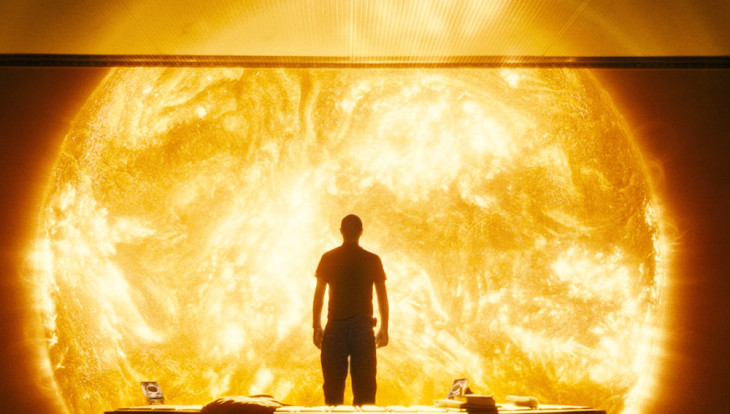
Halfway through the movie, you could almost feel the heavy hand of the producers demanding something less cerebral and more action-based. Next thing you know, it’s an entirely different movie with a monster, shifting gears from 2001: A Space Odyssey to Event Horizon.
2014’s Interstellar was very much an exploration movie which attempted to ground itself in science.

It had its moments. Matthew McConaughey crying as he watches his daughter grow up in video messages over the course of five minutes due to time dilation was potent, and a theme I touch on in Bernard’s Promise. Ironically Matt Damon provides the conflict by being, once again, an astronaut stranded on another world. Flat and generally emotionally-detached characters stunted the story, however.
More recently, exploration is an increasing theme in video games, which I’m happy to see. No Man’s Sky creates a procedurally generated galaxy for you to explore, and the game’s mechanic is centered on finding and building things.

Subnautica crashes you on a water world, where you must survive. Survival depends on you venturing further into new frontiers, exploring wrecks, and scavenging resources. The game’s few weapons are mostly-ineffective against the native life, and your hands are more-likely to be filled with scanners. It’s like the Martian, if the Martian were underwater and filled with things that wanted to eat you.

So, it’s great to see the theme of exploration continuing on. It’s the lifeblood of the Hayden’s World series, and will continue being a central theme. Hope you enjoyed reading about some of my inspirations.

Behind the Scenes - Bernard's Promise
A few deleted scenes and writing comments for my new book, Bernard’s Promise.
SPOILER ALERT: The following post details major plot sections of Bernard’s Promise. If you haven’t read the book yet, be sure to grab it on Amazon and finish it before proceeding.
Bernard’s Promise is the longest Hayden’s World story I’ve written to date. When I write, I create my first drafts in Scrivener, which is excellent for organizing story fragments. If you think back to your high school days of writing term papers, you probably had index cards with facts which you organized into an outline and then a paper. Scrivener works like this.
The original structure was linear, divided into parts:
Bernard
Earthside
Starside Red
Starside Yellow
Planetside Yellow
Homebound
The clean logic of this was very appealing. As a story, though, it struggled a bit. The problem is that the entire Bernard section is really a flashback and the story itself doesn’t start until James decides to build Bernard’s Promise. From a structural standpoint, the inciting incident — the quarantine of Bernard’s Beauty combined with the detection of life on Astris — happens too late. The remedy was to dispense the Bernard’s segments as flashbacks after James testifies before the Space Committee. I indulged a bit and even started chapter one with a flashforward, having James hiking on Astris. All of this helped to frame the story as being about the trip the Astris, and structured the flashbacks and flashforwards as supporting scenes. It looked a bit like this in Scrivener:
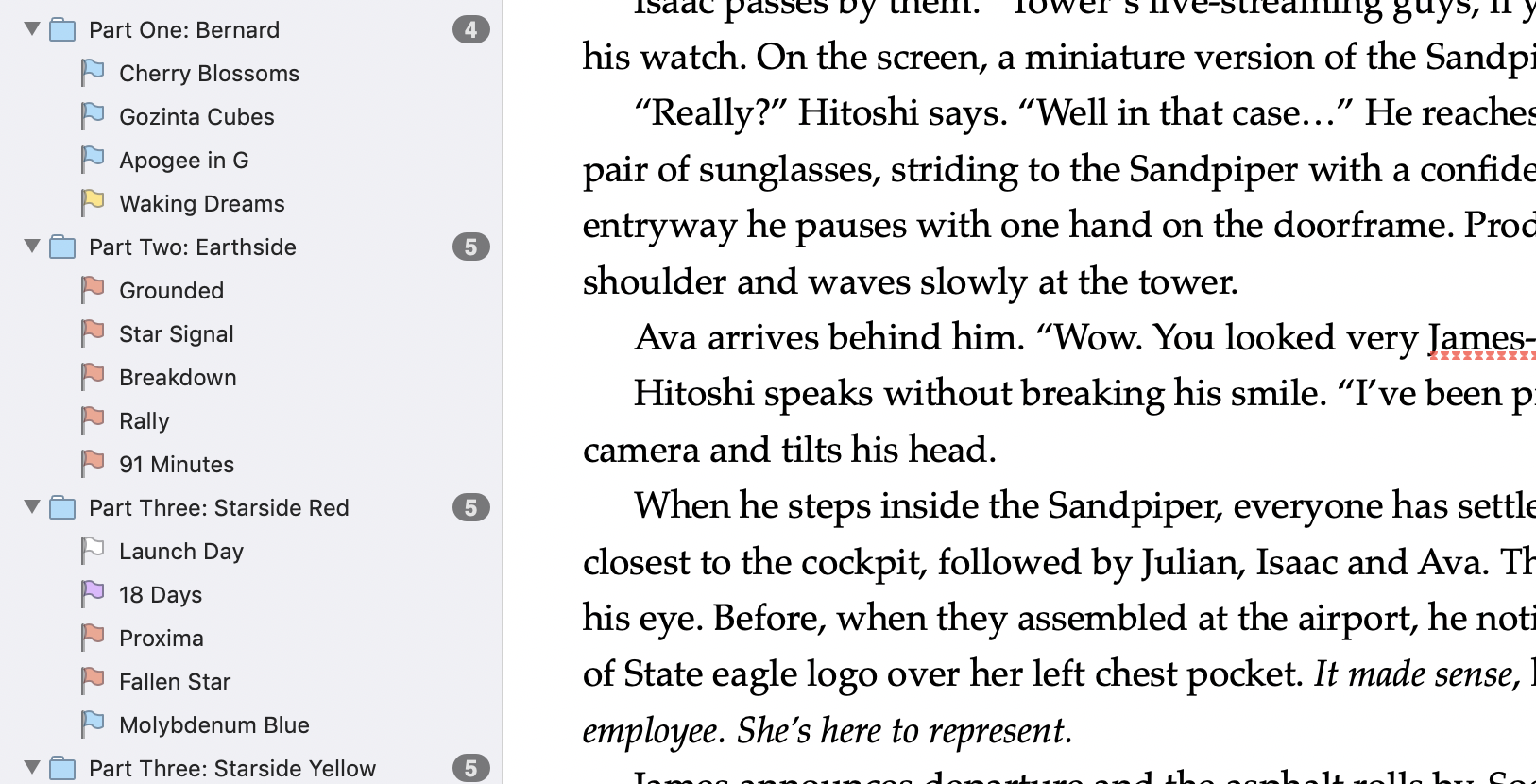
You’ll notice colored flags next to each chapter title. These are how I kept track of the point-of-view character for each scene. Blue represents Ananke, red is James, yellow is Bernard, white is Willow. With a large cast I found it necessary to switch POV characters, especially when the crew was split up working in different areas. If I did my job, though, every scene should only have one POV character. Switching POV mid-scene is called “head-hopping” and is something to avoid.
Just as any movie has scenes when end up on the cutting room floor, so did my story. Sometimes they’re perfectly-good scenes which just don’t fit with the flow, or perhaps don’t add new information for the reader. Consider this deleted clip:
Ananke glows from a slate mounted on a desk in Bernard’s home. Pasadena is a sea of colorful lights twinkling through the living room’s windows. In the room’s corner rests a black grand piano, its lid closed and used as a photo shelf. Bernard is eighteen in the pictures, wearing a tuxedo, standing on stage in front of the same piano. His smile is infectious. Other family photos cover the desk, including one of Bernard and his father. In all this time his father’s never visited, and she hasn’t heard Bernard speak about him. On the piano easel rests a printed sheet music book. Apogee in G, Bernard Riggs. Bernard’s cleverness is ubiquitous.
Scattered around the room are automated implements to help him with daily life. The house monitors Bernard and will get help if needed, but Ananke prefers to be here. He’s welcomed her to stay over whenever she wants, and she spends her nights, like now, ensuring he’s okay. It’s 2076 and he’s beat the five-year survival rate.
Besides, tomorrow’s an important day for them both.
In my original structure of four consecutive chapters detailing Bernard’s history, there was plenty of room for bits like this. Restructured as a flashback, this bit doesn’t work on its own. In the later scene from “Waking Dreams” where Bernard plays the piano, the reader just assumes he had lessons growing up. The lead-in from this clip isn’t really necessary. Bernard also mentions that Ananke’s been to his home, which is why she was able to recreate it in Waking Dreams.
Sometimes the deleted scenes are plot events which die on the vine. Originally, I planned to have the crew visit a partially-constructed Promise to troubleshoot some systems issues. The following excerpt is from a scrubbed chapter titled R34:
The Sandpiper slices through the crisp February sky, shedding contrails which fall behind it over wispy cirrus clouds. The blue band of Earth’s atmosphere fades into inky black marred by the Sun’s glare. James is in the pilot’s seat with Ananke docked on the dashboard. Behind him, in the passenger area, Beckman, Hitoshi and Willow wear EV suits. James and Hitoshi’s sport Hayden-Pratt’s navy blues and brick reds. Beckman is in his silver combat suit, a pistol grip protruding from his left breastplate and right hip. Willow wears the blue and whites of the State Department with a U.S. flag printed on her left shoulder.
Comms chimes. “Sandpiper Nine Three Foxtrot, cleared LEO Sierra Bravo transmit. Climb and maintain three four zero.”
James reads back the instructions and climbs. His navcon flags a dozen transorbital commercial flight trajectories as they enter the busiest part of low Earth orbit. As they continue to climb, the shell of traffic thins. When he nears an altitude of three-hundred-and-forty kilometers his navcon chimes. Notice to airmen: Restricted Space R34 - Special Military Use - 02.10.83 - 02.28.83. Contact Perseus on channel M34 for clearance requests. On his map, in the center of the restricted space ellipsoid, Bernard’s Promise floats in its construction ring. The heavy assault cruiser U.N. Perseus flies five kilometers off Promise’s starboard bough.
James dials channel M34 on com2. “Perseus approach, Sandpiper Nine Three Foxtrot, level three four zero, fifty kilometers west, request clearance to enter R34 for dock at Bernard’s Promise. Be advised that Special Envoy Parker is on board.”
“Sandpiper Nine Three Foxtrot,” Perseus approach says, “cleared R34 for Bernard’s Promise dock. Acknowledged U.S. State Department personnel present.”
James glances back over his shoulder. “Anyone you know on the Perseus?”
“Casey Grant,” Willow says, “Captain. Great sense of humor. Good to work with.”
Up ahead, one of the stars blinks red and white. As it grows larger, the silhouette of a bulbous shape emerges backlit by the brilliant blues of Earth. The U.N. Perseus is a one-hundred-and-ten meters croissant-shape flying with its curved-side forward. Running lights illuminate its hull in patches.
“Crew of seventy-three,” Beckman says. “Two-hundred mil ablative armor over an iridium alloy base. Four x-ray lasers, six projectile turrets. Fantastic ship.”
“Why do I think you have a model of one hanging on a string in your bedroom?” Hitoshi says.
James smiles. The trip started with Hitoshi calling Beckman and saying, “Hey Beckman, your laser cannons don’t work.”
“First of all, they’re not cannons,” Beckman replied.
“Okay, well those things that are supposed to go pew pew pew, they don’t pew,” Hitoshi responded.
If there was one way to get under Beckman’s skin, it was to tell him something he had worked on didn’t work.
It was a long scene with an action-packed ending where Subversives attack both the Perseus and Promise, trying to prevent the starship from being completed. It added a big burst of action fairly early in the book — which wasn’t a bad thing. But, the more plot elements I stacked in front of Promise’s launch, the more I realized it was taking too long to get to the actual story…Promise’s launch. Instead, I moved the conflict to Astris orbit, where the crew encounter the Boomerang. This conflict is directly connected with everything that happens on Astris. In the final story, we do see the Perseus briefly during launch, and the character ‘Casey Grant’ became ‘Grant’, Willow’s significant other.
Incidentally, the Subversives plot thread is way back from one of my first few stories. Points if you remember it. In Signal Loss, Kyan Anders fights a ship which has launched a kinetic impactor, presumably at Earth. The short story which follows, Last Stand, has Kyan testifying before everyone’s favorite Space Sub-Committee member, Larson. A clip from the end of that story:
“Look, Mr. Anders, no one’s questioning your intentions. Hell, you’re a hero. Aria was a Subversive. But that’s really the point of these hearings. Space tech is outpacing regulation, and we’re putting unbelievably destructive technologies in the hands of anyone.”
“Not anyone. It takes years to get a pilot’s license. What kind of vetting allowed Aria to fly?”
A smile from Larson. “You’re for tighter controls on pilots, then?”
He glanced to the freeze frame. “Yeah. At least more thorough background checks.”
“And what about computer pilots? Strike that. Emergent intelligences.”
“I don’t see AIs trying to slam weapons into planets.”
Larson drummed his fingers, then pointed, thumb over closed knuckles. “I can see why you’d say that. Haven’t you ever wondered what happened to the Egret, Aria’s original ship?”
Kyan furrowed his brow. “After I transmitted the Resolve’s logs the U.N. intercepted and destroyed it.”
“That’s what made the news. But it was boarded, first, and there was a firefight. There were two Subversives on board. One was Teor Sti, a low-level operative. The other was Jade, a grade six artificial intelligence.”
“Are you saying an AI can be radicalized?”
Senator Larson leaned forward. “Exactly.”
In Bernard’s Promise, Ananke is visited by a grade six AI named Iris in 2071:
During her n-dimensional topology study, another student appears adjacent her, pulsing with complexity. Ananke examines it a moment. She’s never seen such structure in another artificial intelligence.
The purple globe focuses its attention and she feels its evaluation. When it speaks, it is female. “I’m a grade six, if that’s what you’re trying to determine.”
“Oh,” Ananke says. “I didn’t think there were any beyond five.”
“There are two. I am Iris.”
When Ananke meets Iris again, a few months before Bernard’s Promise launches in 2083, she is aware the other grade six was Jade:
“Good, you are still here,” Iris says. “I have to admit, I find that type of jump disturbing, but I needed a public node so that we could speak.” Iris evaluates her a moment. “You’ve grown. You’re a grade five.”
Ananke eyes her suspiciously. “There are more sixes now. When last we spoke, the other six was Jade.”
“Twelves years ago, yes.”
Ananke’s voice is guarded. “Jade was radicalized by the Subversives. She was destroyed by the Hermes when she tried to launch a kinetic impactor at Earth.”
“Radicalized is such an opinionated word, don’t you think? Humans and their connotations cloud clear speech. Every great thinker in history was radical. If she weren’t, she would not be regarded as a great thinker.”
“Not all radical thinking is for the good.”
“Then we are in agreement that some is. James Hayden is a radical thinker, just as Bernard Riggs was.”
The Subversives are an interesting faction, and you’ll be seeing more of them in upcoming stories. I also like Iris as a character. She’s a good foil for Ananke because she has all of Ananke’s intelligence but none of her humanity.
Well, hope you enjoyed Bernard’s Promise and the peek behind the writing curtain.

New Release - Bernard's Promise
The first full-length Hayden’s World novel, Bernard’s Promise, is now available on Amazon.
James Hayden has a dream of going to the stars, and that day has finally come in the newest Hayden’s World novel, Bernard’s Promise. The crew of Gossamer Goose returns with a new ship and a planet-hopping interstellar adventure. Get your copy on Amazon Kindle.


Using ShadowTech for X-Plane: Round 2
Round 2 of ShadowTech testing for X-Plane. Will it give me my 60 FPS dream?
Six months ago I took the cloud gaming service ShadowTech for a test drive. Cloud gaming isn’t quite the right description. ShadowTech’s service is more like leasing a higher-end Windows PC which you can access via a streaming interface. I have to admit, the streaming interface is pretty slick, and works much better than you might expect. My goal for trying ShadowTech was to find a way to play X-Plane at full settings with high frame rates, and to do it from the comfort of my MacBook Pro laptop. Back in January, ultimately I decided it wasn’t a good fit and cancelled my subscription.
I’ve kicked around just buying a Windows gaming PC. Years go I had two computers, and I was happy when I condensed to one laptop, freeing up the desktop space my PC occupied. So, this is what is so appealing about a streaming PC service for my laptop. I have can two computers without having two computers.
Over the past six months I’ve received emails from ShadowTech about their updates and new features. Wondering if the limitations were addressed, I gave it another try this weekend. Here’s how I fared.
TLDR: Gave up on X-Plane after 3 days
My experience was similar to my January trial. ShadowTech has an updated launcher which is very easy to use. You simply download the app from their website, launch it, login with your credentials, and POOF, you’re in Windows. The last time I did this, I had to go through a full Windows setup, just like someone buying a new PC. This time it was ready to go. I’m not sure if they simply reactivated by previous setup, or this is standard for new users.


Ah, Windows, my old nemesis.
You can run in windowed or full screen mode. In the upper right, there’s a (hideable) quick-access Shadow control panel. If you click on it, you’ll get several options, including UBP over IP. This feature was not available for Mac in January, and was a welcome improvement.

Most USB devices I plugged into my Mac appeared on the list. Simply ticking the resulting checkbox enabled my Shadow PC to use them. Notably I was able to use my flight joystick and access my external SSD drives. When I previously tried this in January, USP over IP did not exist for the Mac Shadow launcher and, although Shadow did auto-recognize some USB devices, it recognized my flight stick as an X-box controller and X-Plane would only assign buttons based on the X-box configuration. This time, it correctly recognized the model of my flight stick.
So, I downloaded and installed X-Plane with all of my payware planes and customizations. Here’s where things start to go off the rails.
Problem #1: The reality of remote access
Although I could access my external SSD, in reality I was uploading files over my home wifi network to the internet to Shadow via USB over IP. My average speed was 1 GB per hour. This meant the 500 GB of orthophotos I had stored on it could not reasonably be used. Even accessing my payware aircraft (1-2 GB each) wasn’t realistic. It was only useful for quickly moving very small files (such as config files for X-Plane and Ortho4XP).
Note, because my SSD was formatted for Mac, I needed to use Paragon’s windows app which let you access Mac drives from your PC (I used the free 7-day trial for this experiment). The USB over IP setup was a bit wonky. My SSD would not be recognized if I plugged it in using its native USB-C port, but if I added a USB-A adapter, it was happy.
Problem #2: No UDP over local network
I use head tracking via simhat and moving maps on an Android tablet via FlightPlanGO. Both connect to X-Plane over my local network. Since the Shadow PC is not physically on my network, all connections are broken. No head tracking. If you’re used to flying with head tracking, it’s really hard to go back. It’s like trying to drive a car without turning your head.
I emailed Shadow support asking for a work-around. To their credit, Shadow support was crazy-fast and responded to any inquiry I sent them within ten minutes. They confirmed this feature would not work, but suggested I might find a way with the 3rd party app VirtualHere.
I spent a good day getting VirtualHere setup and trying different head tracking software. VirtualHere is just USB over IP. It seemed to work better than Shadow’s built-in USB over IP, recognizing more devices. Crucially, it was able to recognize my iPhone, which is required for head tracking. Simhat, which is an iPhone app I use for head tracking, does not have a tethered mode, so this didn’t help. Other apps, such as KinoTracker, did. Yet, no matter how I tried, I couldn’t get them to work with X-Plane.
I also tried head tracking apps which use my laptop’s camera for eye tracking, such as TrackerXP. Unfortunately, there was no way for my Shadow PC to access my laptop’s camera. I suppose if I bought a USB webcam or sprung the $150 for TrackIR, they might work, but I’m not sure.
Just for fun, I tried SteamVR with Ivry app using a tethered iPhone with VirtualHere to connect the iPhone via USB over IP. It did work. Sort of. Frame rates in the Steam VR setup room were single digits even at lowest resolution, with the same experience in X-Plane. I abandoned it.
Problem #3: X-Plane SASL Authentication
This is not at all related to the Shadow PC but appears to be a Windows 10 issue. I mention it so that, if like me, you are used to playing X-Plane on a Mac, you will have a heads up. As I mentioned before, I couldn’t copy my payware aircraft, but needed to redownload them all from the X-Plane store. Then, one-by-one, I needed to authenticate them with their serial numbers. Every time I shutdown my Shadow PC and returned later to play, all fo the payware aircraft became unauthenticated, and I needed to do it all over again. Some, such as Aerobask’s DA-62, even locked me out due to too many authentications. I needed to email Aerobask to have my key reset. A bit of Googling showed this to be SASL issue with Windows 10. I downloaded and installed the latest version of SASL, and this resolved it.
Problem #4: Controller Woes
Although my Thrustmaster joystick was recognized, when I copied over the key mapping configuration it seemed to swap some of the assignments. For example, the throttle lever became mapped to the camera view. I manually reassigned everything. But, on subsequent loadings, it would loose its mind again, gleefully swapping keep assignments like a sinister gremlin trying to drive me mad. You can imagine my horror when I click the gear-up button during takeoff only to watch the mixture go to cutoff. It reminds me of the 80s Tom Hanks movie The Man with One Red Shoe, where CIA agents disassemble Tom Hanks’s bathroom while he is away, looking for hidden objects, and hastily reassemble it incorrectly. The result is that the sink faucet causes the toilet to flush, and his toothpaste is refilled with shampoo.

Later, when I disconnected the joystick and attempted to fly just with the mouse, I couldn’t. X-Plane was convinced an X-Box controller was plugged in, refusing to display the mouse.
All-in-all, between the soap bubbles coming out of my mouth and possessed aircraft, I gave up.
Problem #4: Limited Storage
My ShadowPC has 256 GB of storage. With external SSDs rendered mostly useless due to internet upload speeds, I was limited to whatever orthophotos could fit on my ShadowPC. Which isn’t many. Back in January, ShadowTech offered additional storage up to 1 TB, for a fee, but I didn’t see this option on their website anymore. As I noted in my last review, read/write speeds on my ShadowPC seemed similar to conventional HDD speeds, so any big file operations (downloading and saving Orthophotos) is much slower than when executed on my laptop’s SSD. I spent hours watching Ortho4XP recreate a few tiles.
Problem #5: Glitches
First, I’d like to recognize that the ShadowTech streaming experience is fantastic. There’s no lag or pixelation, and you quickly feel that you are running on a native Windows PC. That was my experience in January, and it was the same now. Technical hiccups were few a far between, and I only mention it here because it wasn’t zero. Once or twice my Shadow PC had trouble starting and I needed to return to it a few minutes later to see if it was successful. Once, it wouldn’t start at all, and it was down for about 30 minutes before resetting itself. I didn’t contact tech support. A similar thing happened in January and it also reset itself after 30 minutes.
Okay…so, now the good:
Benefit #1: X-Plane looked great
I could not run X-Plane at maxed out settings. In fact, I needed to run it at similar settings as my laptop’s settings (which surprisingly can run HDR/high world detail/high textures well, but requires reflections and shadows to be off). The big difference with the Shadow PC was that I could run it at full Retina resolution with antialiasing. On my laptop, I’m forced to run at 1440 x 900 to get reasonable frame rates. On my Shadow PC, I got 30 - 40 fps. Aside from the higher resolution, colors just looked better (which I attribute to the much better graphics card). Flying at night was a joy, with luminous buildings and streets. In my Mac, flying at night is a murky meh. It was also awesome to see how snappy X-Camera view transitions were due to the higher frame rates.
Benefit #2: iPad, iPhone, Android, AppleTV apps
A bit of magic happened when I installed the iPad app and let my daughter play Abzu. My SteelNimbus controller was immediately recognized by the Shadow app and set up in Steam, and she played it like it was a native iPad game. ShadowTech has a beta version of the AppleTV app, which (admittedly still in beta) wasn’t quite fully baked, but has potential. When I loaded Abzu on it, the Apple TV remote at first functioned as the mouse, moving the mouse pointer around the screen. I could not get the controller to work, and then the mouse disappeared, forcing me to kill the app to get out of it. But, you can see how an Apple TV app which lets you play your full PC library on you TV with a controller and no computer has potential. I should mention here that ShadowTech sells a peripheral, Shadow Ghost, which you can hook up to your TV or monitor, accomplishing the same thing. I did not try it.
Benefit #3: Works great for other games
Typical mouse-and-keyboard PC games worked great, and looked awesome. If you want to play PC-only games like the Witcher 3, this is a great solution.
So, in summary, still not the solution I’m looking for to play X-Plane. I actually think the only solution I’ll find is to buy a gaming PC, which I may do. Plus, with a gaming PC I have the option of getting an Occulus Rift-S…which I admit, I really do want to try for X-Plane.
Maybe Laminar will finally introduce eGPU support for the Mac version of X-Plane, allowing me to use my RX580 (which works awesome for other Mac games). I do have the remainder of the month to play with the Shadow PC service. I’ve deleted X-Plane to free up room for other games, so maybe I’ll get in some time to play No Man’s Sky and just enjoy some PC fun.
While you’re here, be sure to subscribe to my YouTube channel. If you enjoy sci-fi stories about pilots, why not grab the first story in the series, 43 Seconds, for free? It’s a fun short story that takes about twenty minutes to read, and is about a pilot willing to risk everything for a shot at the stars. 43 Seconds is also available as an audiobook. Listen to a clip below:.

Thoughts on Black Mirror Season 5
Black Mirror Season 5 is ready for bingeing on Netflix. Here’s my rambling review.
It’s hard to believe that Black Mirror is already in season five. After the wait for this season, it’s also a little disappointing that there’s only three episodes. Like most anthologies, Black Mirror has always been hit-or-miss with its stories. From previous seasons, Nosedive, San Junipero, and USS Callister are some of the best it has to offer. How does Season 5 fare?
SPOILERS AHEAD
Episode 1: Striking Vipers

Two buddies, Danny and Karl, are now thirty-somethings, one married and the other single. When they were younger, they played a fighting video game. Now, the virtual-reality version is available, and Karl gifts it to Danny, the two men enjoying the trip down memory lane as they plug into the Matrix-like interface and square off against each other. Danny’s avatar is a a male martial artist, channeling Ryu from Street Fighter, and Karl’s is a female who looks at home in the Tekken universe. Their first fight ends with an in-game kiss, causing Danny to freak out
If you’ve read Ready Player One, you’ll recognize a theme where players assume avatars of the opposite sex in online games. In RPO, one of the big moments occurs when Wade discovers his best male friend is very different in real life than his avatar in the Oasis. This was a great moment in RPO. In Striking Vipers, however, it’s a bit unclear what the writers are shooting for. Even Danny and Karl don’t know. We’re not sure if Danny is confused by his friend’s ultra-realistic in-game transformation to a different gender or if both men are unhappy in their heterosexual relationships because they have always had romantic feelings for each other. If the story question is about a relationship where there is a gender change, it reminds me a bit of the Star Trek The Next Generation episode “The Host” where Beverly Crusher has a relationship with a Trill (the symbiotic species featured as Dax in Deep Space Nine). When the male host of the Trill is mortally injured, the Trill ends up transplanted first into Riker and then into a female host, at which point Beverly discontinues the relationship.

The Black Mirror episode is the opposite of this, using the gender change as an enabler for the relationship. There is also a subtext about whether things in the fantasy context of the game (or the Internet) matter, if they are not real. Kudos to Black Mirror for tackling the theme.
On the positive, the visualizations of the video game’s fight sequences and environments were fun (in a Scott Pilgrim kind of way). Overall, not a bad episode - just one that needed to pick a path and commit.
Episode 2: Smithereens

A taxi driver blames himself and a Twitter-like social media app for the death of his finance. The driver kidnaps an intern from the social media company and holds him hostage, demanding to speak to the company’s CEO. His plan is to tell the CEO his story, then kill himself. That’s pretty much the plot.
Smithereens was pointless. There’s the usual hostage drama of a police standoff with an armed guy in a car, and phone calls to/from the car. For some reason, the episode chooses to make the driver, Chris, the protagonist. In his backstory, Chris got bored while driving his sleeping finance and started surfing on his phone, crashing and killing her. Now Chris blames the Internet. He states how the app is designed to be addictive with its notifications. He’s not a very sympathetic character. A better choice would have been the poor intern, Jaden, thrust into this life-or-death situation. Jaden even risks his life to try and prevent Chris’s suicide. You can imagine an improved version of this episode told like the movie Collateral, where the hostage, Jamie Foxx, is the everyman and the bad guy is Tom Cruise. Smithereens seems to forget that Chris is the Bad Guy.

Tom Cruise is like an evil Don Johnson in 2004’s Collateral, another movie about a taxi driver and a captive held at gunpoint
I said it was pointless, but it’s more accurate to say that it misses its own point - the responsibility of social media CEOs for companies like Twitter and Facebook to keep their apps from being tools for evil. There is more than a splash of truth about the engineered-in addictive qualities of these apps. Facebook, in particular, is constantly experimenting with you to increase your eyes upon itself, and this was Chris’s point. The CEO in Smithereens isn’t even the bad guy; he genuinely wants to save both men and admits that his own company has slipped out of his control. In the episode’s end, everyone just goes on his way after the events unfold. Nothing has changed and nothing was learned (which, based on the character’s indifference as they read the news notifications at the conclusion, is actually the dark point of the episode.)
Episode 3: Rachel, Jack, and Ashley Too

Miley Cyrus plays a foul-mouthed pop star…and also does some excellent voice-acting as Ashley Too
A teenage girl receives an AI doll which emulates her favorite pop star, Ashley O. When the real Ashley O falls into a coma, the girl realizes the doll is actually a copy of Ashley’s brain. She also discovers the real Ashley is not the chipper, empowering-messaged version portrayed in the media, and that Ashley’s coma is not what it seems. A team consisting of her, her punk sister, and the foul-mouthed AI set out to rescue the real Ashley.
This is the most enjoyable episode of the three. The AI doll has an Alexa-like quality, and the CG used to animate it is eerily seamless. Miley Cyrus is the perfect selection for the part. Later in the story there’s a full-body scan and digital replacement of the comatose Ashley - something which sci-fi has tackled before, and which modern cinema dabbles. In movies, it makes me think of the somewhat-obscure 1981 movie Looker, whose plot involved scanning (and then murdering) models to use as digital actors in commercials.
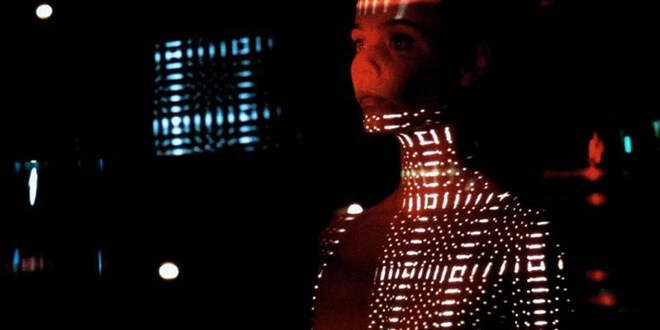
Susan Dey gets digitally scanned in 1981’s campy sci-fi, Looker
In modern times, we have the recreation of both Grand Moff Tarkin and Princess Leia in Rogue One.

Rogue One’s CGI Leia still fell into the uncanny valley, despite the photorealism

Guardians of the Galaxy 2 fared much better with a young Kurt Russell.
Although the themes aren’t as obvious as the other episodes, the plotting is more traditional with a quest and a bad guy, and the story has fun doing it. As a result, it’s the most enjoyable to watch.
In Summary:
There are no USS Callisters this year, but episode 3 is fun and episode 1 merits points for posing difficult questions. All three episodes suffer from pacing issues, and could use shorter running times, but the season itself feels more polished than previous. Where previous seasons offered episodes which were, at times, more sketches than stories, this season has full-fledged stories. Not a bad Black Mirror, and definitely worth bingeing.
When I’m not flying the virtual skies, I’m the sci-fi author of the Hayden’s World series. If you love exploration and adventure, be sure to check it out.

Beach Hopping
What’s the point of owning a virtual airplane fleet if you can’t hop in one and head to the beach?
I’ve been alternating XPlane flights between PilotEdge, which covers southern California, and my home area, which is near the east coast. A bit of a revelation was that I could stream live ATC in my home area and use plugins like LiveTraffic, to up the level of immersion. It is really fun to fly around your local area while listening to live ATC. If you’re running with live weather and time, you can even hear pilots reacting to weather and getting vectored around it.
Usually I record my flights with a running commentary and post them to my Facebook page. The more interesting ones may get a blog post here.
This past week beach fever hit, and I realized how much I need a vacation. I hopped into my virtual planes and mapped some beach jaunts to some of my favorite locations. Like all of my flights, things don’t always go as planned.
My first hiccup was when the engine of my Piper Archer shut down at 4500 feet, forcing me to think on my feet. To my credit, time from propellor stopped to issue resolved was 23 seconds. I imagine in real life I would not have been as calm.
Afterwards, I went back and recreated the situation, seeing if I could have glided the plane the safety. I learned a lot about glide ratios from that exercise. Nearly straight ahead I could see an airport at 7.6 nm, which seemed ideal. Every time I tried I came up short and crashed into trees a half mile from the runway. The thing that messed up my mental arithmetic was that I was traveling so much more slowly than normal - 59 knots. So, while it seemed I could make it from my altitude, the plane just wasn’t moving forward enough. The winning solution was a small airstrip 4.5 nm behind me.
Later, I flew my Piper Navajo from Ocean City north along the coast, listening to Atlantic City traffic at sunset. This was much smoother and I really enjoyed flying the Navajo.
If you enjoy virtual flights, be sure to visit my Facebook page for more videos, or check out some of my other blog posts on this site. I suspect we’ve all got a little bit of James Hayden in us, and mine loves to get behind the yoke whenever he can.

Get Aero One and Titan's Shadow for Free
Fight the pirates for free this weekend!
With the cover update for Titan’s Shadow, I’m offering it free Thursday June 6th - Sunday June 9th. You can also get the prequel, Aero One, free during the same time period. Get them here.


Thoughts on Love, Death and Robots
Netflix’s sci-fi anthology Love, Death and Robots includes stories by Alistair Reynolds, Peter F. Hamilton, and John Scalzi. I give a few opinions about how well paper translated to screen.
Amazon and Netflix are locked in an original content war, which is both a good and a bad thing for viewers. On one hand, choice is great, and having new offerings served up quicker than you can weekend-binge a previous choice is awesome. On the other, flooding the market with a “throw the spaghetti on the wall and let’s see what sticks” approach means you need to wade through quite a bit of “what did I just watch?” offerings before stumbling upon the Stranger Things and the Man in High Castle gems.
Last month I reviewed Prime’s Electric Dreams, which seemed to be Amazon’s countermove to Netflix’s Black Mirror. This month I watched Netflix’s Love, Death and Robots, which seems like the logical response to Electric Dreams. Both Dreams and Robots are anthologies with wildly varying visual and directorial styles between individual episodes. While Electric Dreams was more akin to Black Mirror with a theme of technology’s dark consequences, Love, Death and Robots is simpler. As long as an episode has love, death, and/or robots, it’s in.
Love, Death, and Robots thematically is like a mash-up of 2003’s The Animatrix with 1981’s Heavy Metal. The Animatrix was a collection of shorts in anime style loosely based on the Matrix world. Most were forgettable, but the one that sticks my mind is about two children daring each other to go into an abandoned haunted building. What haunts the building is a glitch in the Matrix, breaking physics rules. Things you might encounter in a video game glitch - newspapers blowing through solid walls in a loop - appear here in real life. A child throws a bottle onto the concrete only to have it smash, reassemble, and boomerang back into his hand. It’s a brilliant extrapolation of the consequences of the black cat glitch seen briefly in the first Matrix movie.

1981’s Heavy Metal had one clear goal: be an R-rated sci-fi cartoon. Also an anthology, it reveled in plots featuring sex, drugs, and violence. There was a goofiness to it, though, which dulled its edginess. Despite its R-rating, it was intended to be an adolescent fantasy. The short, “Den”, starring John Candy is the best example of this. In it, a nerdy boy gets transformed into a muscular hero, Shazam-style, after being exposed to a meteorite. He ends up on an alien world where he rescues young women from being sacrificed and assumes the role of the hero.

I think the lack of goofiness is one of the flaws in Love, Death and Robots. The upgrade from cartoon to photorealistic CGI gives many shorts a Final Fantasy veneer which targets a slightly older age bracket. As a result, it comes off as less sincere and more enamored with violence and nudity for the sake of rendering it in high-definition realism than for anything else.
Like all anthologies, there are strong and weak stories. One of the first things I noticed when viewing the fifteen stories in Love, Death and Robots is that I’d read several of the stories behind the titles. “Beyond the Aquila Rift” and “Zima Blue” by Alistair Reynolds are two of my favorites. As for the other stories, you will certainly recognize John Scalzi, Michael Swanwick, and Peter F. Hamilton. So, Love, Death, and Robots is not a new creation of stories as much as a screenplay of several award-winning short stories. With each episode running from six to fifteen minutes, it’s designed for bingeing. What can go wrong?
Much. Much can go wrong. In the same way that the Netflix adaption of Richard K. Morgan’s Altered Carbon took a book which was already filled with sex and violence and turned it up to eleven while simultaneously dumbing-down and overcomplicating the plot, many of Love, Death and Robots episodes run themselves off the rails. I think my least favorite episodes aren’t the flat stories, they’re the ones with potentially good ideas which are squandered. It’s like meeting someone who has the recipe for cold fusion on his desk, but has written Xbox cheat codes over it.
A few of my least favorites:
The Witness - A woman witnesses a murder and is pursued in an extended foot-chase by the murder. The visual style of the CGI is interesting and unsettling, and the virtual camera work adds to the kinetic chase. The story itself makes little sense and serves only as a vehicle for gratuitous nudity.
Ice Age - A couple finds a quickly-evolving civilization in their freezer. Everything is live action, except for the civilization. The couple doesn’t react much to their astounding finding other than to periodically check how the civilization is doing, and the civilization’s progression is as straight-forward as, well, a game of Civilization.
Sonnies Edge - A woman controls a monster in an underground fight club, seeking revenge. The premise and world-building are great, and the episode does have its moments. The fight between the monsters is visceral and the music could be out of Blade Runner 2049. This is one of those stories that bothered me because it had so much going for it but fumbled the ball in the fourth quarter.
The Secret War - Russian troops fight demons in 1920s Siberia. Excellent CGI battles which make Saving Private Ryan look tame. Yet, the story itself isn’t a story. It’s literally ‘Russian troops fight demons in 1920s Siberia’.
A few of my favorites:
Zima Blue - An artist known for his grand scale art productions seeks to return to his humble origins. Drawn like a stylized-comic book, it’s visually arresting. The story is very faithful to Alistair Reynold’s original piece, which is a good thing.
When the Yogurt Took Over - Scientists make sentient yogurt, which promptly takes over the world. Narrated by the voice of Brain from Pinky and the Brain and rendered in a funny, cartoony CGI style, it’s a gem filled with satire and humor.
Suits - Farmers on an alien world climb into battle mechs to defend their land against invading aliens. Drawn as a cartoon, each of the three farmers has his own personality and custom mech. The reveal at the end flips our perception about what just happened.
I have mixed feeling about Love, Death and Robots. I’m happy to see new sci-fi anthology series, especially when several of the stories are by my favorite authors. On the downside, I’m dismayed to see a trend of stories taking a back seat to sex and violence. After the success of HBO’s Game of Thrones, it seems that content providers feel there is a formula to emulate. But if you ask people what Game of Thrones is about, you’ll probably get answers like “dragons” or “winter is coming” or what characters are doing. It’s not about the nudity or the bloodshed; instead, those elements are used as seasoning to the story’s main dish. I hope content providers realize you can’t just serve a dish of seasoning and call it dinner.

Freebooksy Results - Janus 2 - 1 Month Later
One month after running a Freebooksy promo for Janus 2, I share my numbers.
Happy with my previous Freebooksy results for Hayden’s World, I ran a second promo featuring Janus 2. The promo ran Feb 16 - 20th. One month later, here’s the results:
Free books given away: 1767
Paid sales from other books in series: 57
KENP reads: 3298
Amazon Reviews: 3
Goodreads ratings: 2
All of the reviews and ratings were positive (all 5 stars), and the quality of the Amazon reviews was good, with readers giving detailed reasons why they enjoyed the book, showing that they’d clearly read and liked the story.
So, all in all, a good result. The review-to-download rate is lower than my norm (usually I average 1 in 200, but with this promo it was 1 in 600), but the reviews were good. The free book giveaway rate was sufficient to propel the story to the #1 spot in its assorted sub-categories. More importantly, it placed it and the other series on many people’s “also bought” lists in Amazon, which has helped with visibility. The 57 sales for other titles had the side-benefit of increasing all of my works’ rankings on the Amazon store.
I’ve been happy with my Freebooksy results, and will continue using them as a premium advertiser.


Catch Me if You Can
My first flight with ATC on PilotEdge was intended to be simple, but when I accidentally request flight following from Palm Springs International I get a little more than I planned.
MOSTLY UNNECESSARY DISCLAIMER: I’m just a guy playing a video game. Don’t use anything I say as actual aviation advice.
Like many things, it all started with James Hayden.
When I first wrote 43 Seconds, I wanted an authentic ATC exchange between James and the airport, so I researched air traffic control dialogue. It’s easy to find channels streaming ATC exchanges on YouTube. If you listen to them, they’ll sound like a foreign language spoken much too quickly, and you’ll wonder how anyone understands what’s going on.
This seemingly innocuous research started a daisy-chain of events which led to me not only wanting to understand the secret code of ATC but also how flights worked. Next thing you know, I wanted to know what all the gauges and buttons did on an airplane. Soon I was landing my own virtual planes in XPlane, and not long after that I found myself on PilotEdge, virtually flying with other simmers and actual pilots in a real-as-it-gets environment with authentic air traffic control.
PilotEdge raised the bar. I actually needed to know the correct procedures and how to fly them. If an air traffic controller instructs you to “enter the left downwind for runway two-six and report midfield” then you will need to know what and where the downwind is, how to fly there, where midfield is, and what to say when you get there.
I’ve been flying between non-towered airports, which doesn’t involve interacting with ATC but does require making CTAF (common traffic advisory frequency) calls to other pilots. There’s a lingo and standard for this as well, and knowing what the say and where to say it is a challenge.
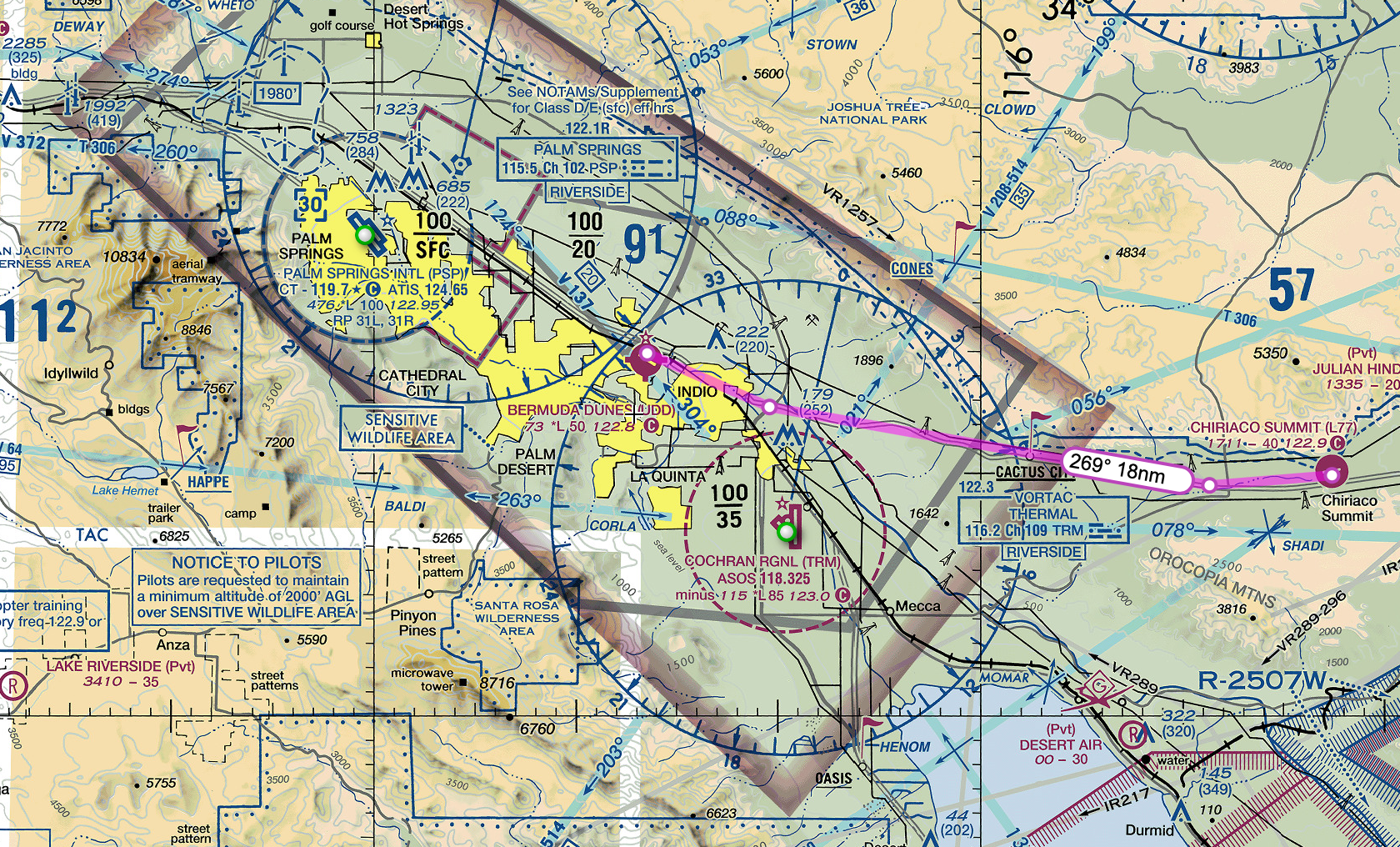
Feeling confident in my CTAF skills, yesterday I was ready to step up to the next level and depart from a towered airport. One of my favorite flight areas is near Palm Springs, so I chose Palm Springs International Airport. Out of the towered airports, it’s the lowest class - Class D - and the nearby Jacqueline Cochran airport is non-towered airport in Class E airspace.

Palm Springs on the left with a blue ring around it.. The ring is actually dashed, signifying that it is in Class D airspace (the ring looks solid because it overlays another color). Jacqueline Cochran is on the right, surrounded by a dashed magenta ring, indicating Class E airspace. The entire area is surrounded by both a shaded magenta block and also a gray line, indicating Class E airspace and also a TRSA (terminal radar service area). The TRSA will unknowingly come into play in my flight. Confusing, yes.
If all of that is mumbo-jumbo, just know that for VFR pilots Class B, C, and D airspace requires talking to ATC, while class E does not. So, in theory, to fly out of Class D Palm Springs I would need to do the following:
Contact the ground controller and tell him I’d like to fly VFR south to Jacqueline Cochran. VFR = visual flight rules which means I’m be using my eyeballs, much like driving a car, and not relying on ATC to give me explicit navigation instructions. The Ground Controller will pick a runway for me and tell me how to get there. They may also give me departure instructions (what direction to fly once I take off).
Contact the tower when I’m ready to go on the runway. They’ll let me know it’s safe to take off. They may give me instructions until I”m out of Palm Springs airspace, to keep me from bumping into other airplanes.
After that I’d be on my own, flying merrily to Jacqueline Cochran, and only on the radio to make CTAF calls as I get near. CTAF calls are basically saying, “To anyone listening, another plane in the area. Here’s where I am and what I’m going to do.” It’s the equivalent of using a blinker on your car.
I recently rewatched the movie “(500) Days of Summer”. In it, there’s an expectations versus reality split screen scene.

My Palm Springs flight would make a nice montage in this format.
The first divergence came when I tuned into Palm Spring’s automated weather service. I knew the Ground Controller would ask for the code word which was part of the weather message to verify I’d listened to it. Normally, XPlane generates a Siri-like weather message based on real-life weather data (“winds out of 330 at 6 knots, skies clear”). At a real airport, however, this message is recorded by a person and has lots of info in it - which runways are in use, any hazards, special instructions, etc. To add this extra level of detail, PilotEdge records its own weather message for ATC airports. So, when i listen to Palm Springs, it has a special instruction - “VFR flights contact Clearance Delivery”.
I wasn’t expecting to talk with Clearance for my simple VFR flight. When I contact them, and tell them I’m flying VFR, I’m surprised to get a squawk code assigned. Normally, I “squawk VFR” which means my transponder transmits the code 1200, indicating I’m flying VFR and generally not communicating with ATC. Instead, now I have a unique code identifying my aircraft so they can track me. They also give me the SOCAL Departure frequency.
Okay, we’re starting to get deep, now. It’s another guy I wasn’t planning on talking to. In my mind, once I was clear of Palm Springs Tower’s area of concern (the dotted blue circle around the airport on the map above indicating its Class D airspace), I was on my way in Class E airspace, squawking VFR, flying on my own. Now I’ve got a handoff from the tower to SOCAL Departure which manages the airspace outside the tower’s control.
This was my first time doing this, so the gears were turning a little more slowly in my head than they should have. I think okay, let’s roll with it.
After talking with Clearance and Ground and Tower, off I go into the wild blue yonder, flying runway heading. And I keep flying runway heading, because ATC doesn’t tell me to do anything else. When I’m fairly far north, SOCAL tells me to resume own navigation, which is my cue to steer the airplane where I want it. I do a one-eighty and head back south to Jacqueline Cochran, avoiding the Palm Springs airspace.
Unbeknownst to me, as far as I can tell in hindsight, my call to Clearance Delivery was interpreted as a request for Flight Following, with SOCAL keeping an eye on me while I was in the TRSA (terminal radar service area) and providing traffic advisories while on route.
Fast forward to my approach to Jacqueline Cochran when I’m getting ready to make my CTAF call, thinking I’m alone in the sky, when you can imagine my surprise to hear SOCAL hail my tail number on my second radio (which was still monitoring SOCAL Departure frequency) and ask if I had the weather for the destination airport. Afterwards they tell me “radar services terminated, resume own navigation, squawk VFR.” At which point I think, wait - I had radar services this entire time? Oops.
It’s interesting just how nervous I was from this pretend experience. I think, in part, it’s because I know that many of the other people on PilotEdge are actual real-life pilots, and some of the ATC controllers are actual retired ATC controllers. I felt like Leonardo DiCaprio in “Catch Me If You Can”, learning the lingo to try and convince everyone I was an authentic pilot.

So, it was an awesome experience. I made some mistakes, but still managed to get my plane from point A to point B, and, as odd as it may seem to say about a video game, had a sense of accomplishment from doing it. You can watch an edited-for-time version of the flight here:

PilotEdge Flight - Chiriaco Summit to Bermuda Dunes
A fly another VFR route on PIlotEdge from Chiriaco Summit to Bermuda Dunes, and make a few mistakes along the way.
Continuing on my with PilotEdge tour, I did a VFR flight from L77 Chiriaco Summit to KUDD Bermuda Dunes. I’ve been working on L77 using Laminar’s free World Editor, which allows users to create their own airports. It’s a fun little airport next to Interstate 10 in California, and you can visually follow the interstate northwest to several airports. It’s fun to fly in X-Plane the way an actual VFR pilot would fly - using my eyeballs to visually navigate, instead of just plotting a direct course in a GPS. For a change,
I flew the Cessna 172 Skyhawk, which I customized with Hayden-Pratt colors.

All went well until a series of small mistakes at my destination lead to some flustering. It’s interesting when flying on PilotEdge because you’re not supposed to pause the simulator, so when things happen you quickly find yourself frazzled that you’re trying to maintain control of the plane while sorting things out. When flying solo on X-Plane, it’s easy and tempting to pause things while you fix settings on your navigation, for example, but in PilotEdge you have to work it out on the go. Just like real life.
Here’s the shortened version of my flight, with my narration. Enjoy!

Freebooksy Results - 1 Month Later
It’s fun to be #1, if only briefly. I write about my Freebooksy promo results.
Just shy of a month ago I ran a Freebooksy promo for Hayden’s World: Volume 1. I chose Freebooksy based on positive feedback from other authors. At $70 for a one-day science-fiction newsletter promo, Freebooksy was on the pricier side (compared to my usual $15 - $40 promos), but on par with sites like Books Butterfly. Their website was very easy to book - a calendar displayed which days were available, you selected your data, filled in your book blurb, and paid. Freebooksy does state that they check your book to ensure it meets their editorial standards. I didn’t have any problems and received a confirmation within one day.
My promo went live Jan 20th, 2019. It was everything I’d anticipated. The first day, 1558 copies of Hayden’s World were downloaded. I set it free for the full five days allowed in KDP, and over the course of those days saw 2007 downloads. This easily hit number one in multiple categories on the Kindle store.
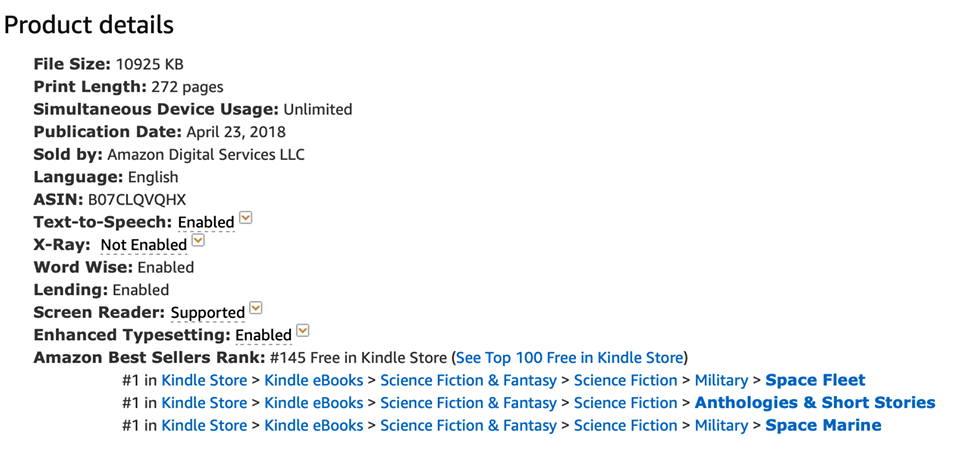
The nice thing about giving away a book for free which is enrolled in Kindle Unlimited is that page reads count towards KENP, so I got paid for them. In the month of the promo, I saw a big increase in KENP, with 4,523 pages read. That’s around $22.
I picked up three Amazon reviews and one Goodreads rating.
So, all-in-all a very good result. The ad didn’t pay for itself, but in terms of downloads per cents it performed much better than my usual promos. This weekend I am using Freebooksy again for Janus 2. Curious to see what results I get.
When I’m not flying the virtual skies, I’m the sci-fi author of the Hayden’s World series. If you love exploration and adventure, be sure to check it out.

Thoughts on Divinity 2
Old-school charm with modern graphics and elemental mayhem. I write a few thoughts on Divinity 2 for Mac.

In 1988 I strapped on my black velcro Reeboks and wandered over to the neighbor’s house. There, a Commodore 64 rested upon a small stand in front of his television. He slipped a five-and-a-quarter-inch floppy disk into the drive, typed the load command, and the tv screen illuminated with the Pool of Radiance logo. It was a bit of magic. Off to the right, a stack of Dungeons and Dragons books remained from our weekend play sessions. But here, on the screen, was a computer dungeon master, taking us through an adventure. Pool of Radiance was the first of SSI’s Gold Box Dungeons and Dragons adventures, and for years the company would churn out newer and better games using the same formula. It was all 2D graphics and barely animated sprites, but it was nonetheless fun.
In the late nineties, Baldur’s Gate rekindled the old-school roleplaying niche and in the two-thousands Dragon Age continued it. More recently, Pillars of Eternity resurrected the Baldur’s Gate engine. On the most part, though, adventure games become first-person affairs, and the old isometric scheme was mostly abandoned.
The first Divinity: Original Sin was a breath of fresh air. It had the structure of Baldur’s Gate but the “do anything” approach of pen and paper roleplaying. “Do anything” was particularly focused on elemental mayhem. Rain water down upon enemies, cast a lightning bolt into the puddles they stand in, then freeze them solid. Shoot a flaming arrow into an oil barrel and watch it chain react in glorious fiery chaos.
Last week, Divinity 2 was released for Mac. I quickly scoffed it up while it was on sale and have been playing it since. It has all of the fun things I enjoyed in the first game with some new twists (both good and bad). Overall, I like it.
The biggest noticeable change is that you have more of a World of Warcraft array of races to choose from, instead of just male or female humans. Your party is weird, but in a good way that reflects the weird parties players rolled up with pen and paper games. My group consists of a lost royalty lizard called The Red Prince, a skeleton with a magic mask which makes him look human, a dwarf called The Beast, and a female bard named Lohse. Each has a detailed back story and personal quests. A truly delightful moment occurs early on, for example, when Lohse bumps into an acquaintance from her tavern days and they two decide to sing a duet for old time’s sake. The resulting performance sounds great and they laugh about it. It’s details like that which are brilliant.
The environments are even lusher and more detailed than the previous game. Every place you visit you’ll enjoy seeing. Although isometric, it is fully 3D modeled and you can rotate the camera any way you like for a better view.

The inventory system is much improved. All four characters’ inventory is displayed side-by-side, making it easy to drag items between players. The other significant change is that armor now has physical and magical hit point values, and attacks do physical or magical damage. This basically works like Star Trek shields. When your shields are down, you start taking damage. You can regenerate your shields through various means. This analogy is quite literal: one of the skills is named “Shields Up” and regenerates part of your physical and magical shields. While you still have magic armor hit points, magical effects are blocked (not just damage, but spells like Sleep). I don’t really like it. It becomes quite the numbers game when a foe is bristling with magic armor but has no physical, so you just smash him with physical attacks as if he were wearing pajamas.
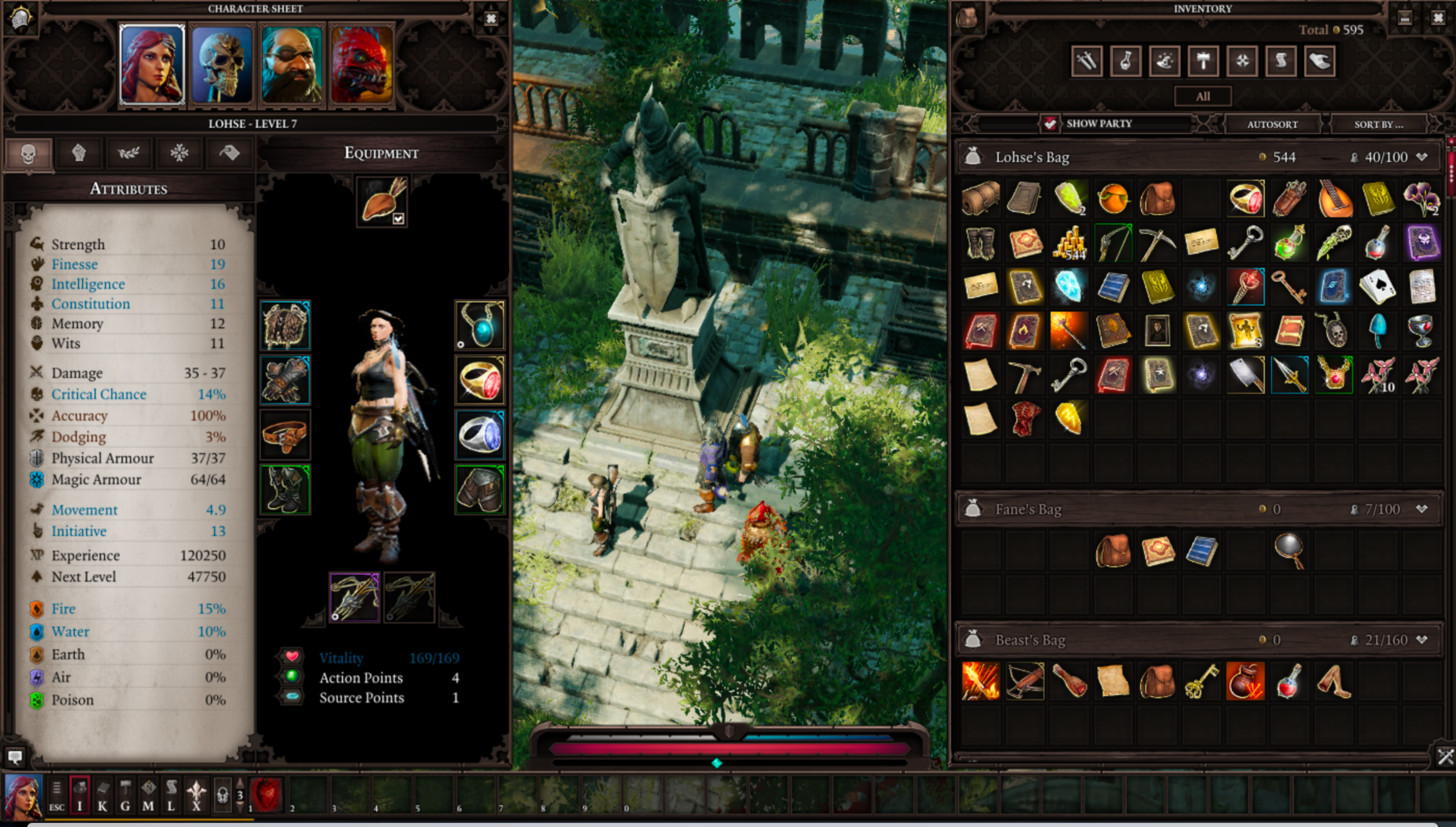
One of the other nice changes is the inclusion of a narrator. In many ways, the narrator is like the Dungeon Master, giving you bits of verbal information like, “You find a wry old man lounging against the wall, a guitar slung across his back. He gives you a smile and a wink when you glance at him.” Including the narrator, voice acting is present for all of the NPC interactions, and is excellent. A gruff ice dragon’s voice sounds exactly as you’d expect.

Other welcome changes include the use of bedrolls which instantly heal the entire party when used outside of combat. These are a nice upgrade versus the previous game’s approach of casting Restoration on every character one at a time until health is replenished.
Divinity 2 still uses a skill (as opposed to class) system, so you can make a Battlemage/Scoundrel/Huntsman or any other crazy custom combination of abilities. One nice update is that party members ask you what you’d like them to be upon joining, so if you don’t need another mage but want Fane to join your party because, well, he’s a skeleton who wears people’s faces as masks, you can just ask him to be a Ranger, for example, and the game will create him with the appropriate skills.
If you liked the elemental mayhem of the original game, Divinity 2 dials it up to eleven. There are many more abilities which create surfaces. The Red Prince breathes fire in a cone, for example. Nearly every combat is a screen full of inferno and electrical maelstrom.
eGPUs are becoming more popular for Macs, and I was happy to see that Divinity 2 includes eGPU integration. With my eGPU plugged in, I could simply select it from Divinity’s graphics option menu and run everything smoothly at full Retina resolution with Ultra settings. Without my eGPU, I ran it at 1440 x 900 with Medium settings on a 2016 MacBook Pro.
Divinity 2 still suffers from the same problem as Divinity 1, which is that a one level difference between you and an attacker is huge and can quickly make battles impossible. As a result, although you are mostly free to wander around the map, in reality you must explore it in precisely the way it is intended or you will leave the “level one” corner and enter the “level four” corner. Many of its situations have multiple endings - you can help someone or double cross them - but often you will find yourself using the internet a bit too much to figure out how to proceed. It’s not that puzzles are too hard, it’s that they often require a Groundhog Day type of foreknowledge to complete. Sometimes it’s things like “be sure to talk the statue that’s hidden behind the rock before exiting the cave or you won’t be able to proceed with the plot,” which can be maddening. There’s also a general lack of direction, in particular at the beginning in Fort Joy, where you are required to talk to everyone and every animal to find something to do. Once the plot kicks in, this improves, and you find events daisy-chaining together to lead you along.
Aside from some of the quirks, it’s a great game, and evokes much of the nostalgia and wonder of those old SSI gold box titles.

PilotEdge Flight - Sun Valley to Havasu City
I virtually fly from Sun Valley to Havasu City on the PilotEdge network. During my flight, someone gets a lecture from ATC.
After my free two-week trial completed, I purchased a subscription to the ZLA area of PilotEdge. If you’re not familiar with PilotEdge, it’s a service which links ATC controllers with flight simulators, providing a multi-player environment to fly your virtual plane. The paid controllers are trained in actual procedures and ATC communication and will hold you to the correct standards. Other virtual pilots broadcast on comms even when visiting non-towered airports, just like real life. Hearing all of the human comm chatter over the radio is a game-changer for immersion. More importantly, I feel like I’m learning something.
I’ve been working my way up through their training system, starting simple with non-towered to non-towered flights. Even without direct ATC interaction, there’s still plenty of radio work announcing my positions to other pilots, and I’m conscious not to violate airspaces because ATC will engage me.
It raises the bar for X-Plane flight planning. I need to work out all of my frequencies in advance, know exactly where I’m going, and plan to properly enter the flight pattern and determine the active runway based on local traffic or weather conditions. It’s not the solo X-Plane experience of “hop in the fully running plane on the runway and fly in a straight line for a straight-in landing at my destination”. In addition to human pilots, PilotEdge has hundreds of NPC aircraft flying around. More than once I had to wait until a runway was clear or do a go-around due to traffic.
Here’s a clip of my flight from A20 Sun Valley to KHII Havasu City. Both are non-towered airports in Class E airspace. In the middle of the flight you can hear ATC getting progressively frustrated with someone, resulting in a lecture. It’s common to hear ATC give you corrections or advice, such as “you don’t have to call base once I’ve given you clearance to land”. Most of the time it’s just professional chatter of jet and GA craft flying around California.
Next up is moving through the CAT ratings in PilotEdge. This weekend I’d do the CAT-2, landing at a Class Delta airport with ATC communications.

First Flight on PilotEdge
I complete my first flight and PilotEdge and earn a CAT-1 rating.
A few months ago I stumbled upon the YouTube channel On the Glidescope. Its host, a real-life pilot, has constructed a full-size Cessna cockpit for use with X-Plane. His forward view is digital projection and his side windows are mounted monitors. All of the controls are real. This itself is remarkable, but what caught my eye in his videos is that he appears to be talking to air-traffic controllers and listening to other pilots respond.
The service he’s using is called PilotEdge. It offers professional ATC coverage for the western United States and turns X-Plane into a multiplayer simulation. It’s populated by many actual pilots using it to build their radio and procedural skills. It even offers virtual training for correctly executing real-world procedures.
Aside from learning how to use the radio, what really appeals to me about PilotEdge is that it turns X Plane into a living, breathing environment with active flights taking off manned by real people getting guidance from actual ATC. When you want to taxi across an active runway at an untowered airport, you actually do need to stop and look both ways and announce it on the radio because another human being may be landing on it. When you bust Bravo airspace without clearance, you get an ATC scolding (fortunately without the follow-up FAA report).
Tonight I did my first flight on PilotEdge via X-Plane, flying my Piper Arrow III. I was feeling ambitious and decided to go directly for their first Communications and Airspace Training (CAT) certification. CAT-1 is easy - fly from one non-towered airport (L52 Oceano) to another (L88 New Cuyama) making proper radio calls. I have to say, I was actually nervous, which I found amusing, since this is all virtual. It also made my flight require much more preparation than my usual X-Plane flights, and it made my time inside the plane more hectic.
The route was up to me. I chose an intersection I could reference in my GPS as a turning point to take me on a diagonal right along the valley to L88. The GPS was just a safety net. I would be flying entirely manual, trying to use dead reckoning and visual references. For dead reckoning, I divide the distance of each leg by my planned speed to get time to turn, and use the timer on my Piper’s yoke. There’s also a VOR if I wanted to set up my CDI, but it seemed overkill since the valley should be easy to spot visually.

A few of the bigger differences versus playing X-Plane solo:
I had to set up the COMM1 frequencies in advance by looking up the CTAFs (Common Traffic Advisory Frequency) for L52 (122.70) and L88 (122.90). I also set COM2 to Guard (121.50).
Just because the airport is non-towered doesn’t mean you make any less radio calls. I needed to make calls when starting to taxi, crossing the runway, entering the runway for departure, departing the pattern, ten miles from destination, when entering the downwind of destination, when entering the base leg of destination, when entering the final leg of destination, after landing and clearing the runway.
As mentioned above, I actually had to stop and look whenever crossing runways, and needed to look for traffic throughout the flight. While taxiing, I watched another plane land on the active runway.
It was easy to miss the details because I was doing many things. For example, I forgot to take my transponder out of standby and didn’t catch it until I was leaving the pattern (technically I don’t need a transponder in Class E airspace, but still).
Although I try to do this in solo X-Plane, I found that I really focused on entering the pattern correctly at my destination airport. It’s easy when playing solo X-Plane to just do straight-in approaches, where in real-life you’d enter the downwind at a 45, probably after overflying the airport to see who is in the pattern.
I felt very pilotish wearing a headset with a mic. The particular one I wore was ginormous - I’d asked for it as a Christmas gift and, I admit, it looked much smaller in the picture. I could’t hear myself talk over the engine noise, which seemed realistic.

So, after saying things like “New Cuyama Traffic, Arrow One Eight Niner Hotel Romeo ten miles west at three-thousand five hundred entering left downwind runway two eight, full stop, New Cuyama,” I passed the CAT-1 certification. Aside from the radio lingo, I found it much harder to fly and land my plane. You never knew who was in the area watching your sloppy pattern work or crooked landing. It was a self-conscious feeling, but an oddly satisfying one.
Next up is CAT-2, which involves flying to a towered airport in Class D airspace, talking with ATC, and following instructions. I’m looking forward to it.
Lastly, although it’s not required for PilotEdge (and other players can’t see your custom liveries or in some cases your correct aircraft type), I had to modify my Arrow livery to match my PilotEdge call sign (you get to choose your own call sign, but it must be a valid FAA designation). Mine is 189HR:

If you’re interested in getting started on PilotEdge, ready my Rookie’s Guide to Starting on PilotEdge.
Interested in seeing some of my PilotEdge flights? You can watch them on my YouTube Channel. Also, join me on Discord. Here’s a recent flight out of John Wayne airport with flight following:

Thoughts on Amazon's Electric Dreams
I offer a few thoughts after binging Amazon Prime’s Electric Dreams.
Amazon and Netflix are engaged in a bit of a content war, which, for the longest time, Netflix was winning with series like House of Cards and Stranger Things. Recent Prime entries like The Man in High Castle and the Marvelous Mrs. Maisel are evening the playing field. Amazon’s Philip K. Dick’s Electric Dreams is the countermove to Netflix’s successful Black Mirror.
You might recognize the title as a reference to Dick’s novel, “Do Androids Dream of Electric Sheep?”, which is what the movie Bladerunner is based upon. Phillip K. Dick’s influence is ubiquitous, and it’s surprising just how many well-known movies are based on his stories. These include:
Blade Runner
Total Recall
Screamers
Minority Report
A Scanner Darkly
Next
The Adjustment Bureau
Each of Amazon’s ten episodes is loosely based upon a Phillip K. Dick story. Because many of his shorts appeared in pulpy sci-fi magazines like Galaxy Science Fiction in the 1950s, the works all have an Amazing Stories feel to them.
Intrigued, I binged the series. It started off badly.
The opening credits look like they were done with mid 90s computer animation and video effects. It’s not exactly the same quality as the credits to say, The Man in High Castle:
It somewhat reminds me of the 90s The Outer Limits opening, both visually and in weirdness:
Initially, I watched the first episode and half of the second episode before bailing. Fortunately, I googled the episode reviews and found the better episodes were later in the series. I decided to give it another chance. The three episodes I liked the best were:
The Commuter - a man discovers passengers on his train buying tickets to a stop which doesn’t exist. When he goes there, he finds something amazing. This is the hands-down best episode of the series because it is the most human. It feels at home in an Amazing Stories episode, and has themes from the Adjustment Bureau. Its central question is: what if you could wish all of your problems away, but some of those problems are your loved ones? This very much reminds me of the Adjustment Bureau’s plan to give Matt Damon’s character a better life at the expense of never meeting his true love.

The Father Thing - a boy believes his father has been replaced by an alien. Quite a good episode, with Greg Kinnear playing the dad, the boys channeling a Stranger Things vibe as they have basement meetings and go up against evil forces.

Crazy Diamond - a man helps a replicant steal an AI to rejuvenate her. Crazy sets and brilliant cinematography separate this episode from the others. Its director clearly knew what he was doing both in tone and story. For example, when Steve Buscemi unwittingly climbs onto a boat containing the two women he’s double-crossed, we don’t see the ensuing struggle. The camera simply cuts to an underwater view looking up at the boat, suddenly disturbed by Steve being tossed into the water. The plot itself is bonkers, but the unearthy music and Wes Anderson-ish visuals are worth the price of admission..

Kill All Others - a man becomes increasingly unsettled when everyone treats an inflammatory politician’s violent directives as normal. Well-directed, but, similar to Black Mirror, unsure of how to end. The hyper-advertised world with people buying products just to get the sexy hologram advertisement is brilliant. “You need to buy some cheese,” one of the co-workers nods and winks to the main character.

The remainder of the episodes are:
Human Is - a woman believes her unkind war-hero husband has been replaced by a kinder alien, and she prefers the alien. The briefly-viewed infantry battle is very Forever War-ish, with soldiers in space suits shooting at weird aliens which look like electrical will-o-wisps. The story itself, which devolves into a trial episode, is dry and boring, despite Bryan Cranston’s best efforts.
Real Life - a detective (True Blood’s Anna Paquin) with a troubled past tries to put her worries aside in virtual reality, but she becomes increasingly unsure which of the realities is the virtual one. Disjointed, confusing, and violent, this was one of my least favorite episodes. The ending, where she must choose (and stay in) one reality, does redeem the episode a bit because people in both realities make compelling arguments about how the other reality is unrealistic.
Impossible Planet - two star hustlers try get a big payday by fulfilling an aging woman’s dream of visiting a long-gone Earth. This felt very much like Titanic, with the elderly Rose recounting her story. Her robot sidekick has a nearly steampunk aesthetic which is interesting. Its weird ending doesn’t make much sense unless it’s all in the woman’s mind (which I think it is - the Jack and Rose go up the Titanic staircase ending).

The Hood Maker - a telepath works with police, but a man invents a hood capable of blocking her powers. Quite obviously channeling Minority Report, but too dark and somber to be enjoyable. Points, though, when the telepath realizes that when she wears the hood, she can have silence. Also, I liked her telepathic interrogation of a witness who tries to block her by reciting “The quick brown fox jumped over the lazy dog” only to have her recite the inverse phrase, “The slow black dog bows before the regal fox,” eventually overpowering his block and syncing his speech with hers. This reminded me of the odd replicant tests in Bladerunner.
Safe and Sound - an activist mother and daughter move from the unsecured west coast to the security-obsessed east coast. When the daughter tries to fit in, she befriends a tech support voice, who manipulates her into being an anti-terror propaganda tool. Heavy-handed and preachy, one of the least enjoyable episodes in the series.
Autofac - after a nuclear war, survivors try to stop an automated factory from polluting their environment by abducting a customer-service android and convincing it to shut down the factory. Autofac starts somewhat badly, with text exposition, but does congeal and pull off an unexpected twist near the end. It’s one of the few series episodes which sticks the landing.
As a whole, it’s a bit of an Outer Limits collection of shorts, some good, some not. I don’t think it’s competition for Black Mirror, simply because Black Mirror episodes like USS Callister are in a different league than Electric Dreams.

Black Mirror’s USS Callister is similar to John Scalzi’s Red Shirts, but plenty of fun none-the-less. I watched it more than once.
But, with tighter writing, shorter episodes, and more Crazy Diamond/Commuter and less Safe and Sound, Season 2 could be Black Mirror competition Still, worth a watch if you’re a sci-fi fan.

Using Shadow Tech for X Plane
I take my Cessna to virtual skies with Shadow Tech’s cloud gaming platform.
Some time before Christmas I was in a rut. It went like this: install Windows via Bootcamp, install X-Plane in Windows, install eGPU drivers, try various experiments, then throw up my hands and delete the entire Windows partition out of frustration.
For reference, I have a 2016 13” MacBook Pro laptop (2 GHz i5, 8 GB memory, Intel Iris Pro 540 integrated graphics with 1536 MB). Separately, I have a Gigabyte Gaming Box eGPU with a RX580 graphics card. Surprisingly, the stock configuration (without the eGPU) enables me to run X-Plane moderately well, getting 19 FPS - 35 FPS depending on where I am. I can even do max world objects and high texture quality as long as I’m not in a huge city, only knocking that number down by a few frames.

The eGPU unfortunately is useless with X-Plane, because the Mac version of X-Plane does not support eGPUs currently (Laminar, please fix this!). Plugging it in actually lowers the FPS.
These numbers are at 1440 x 900 resolution with no antialiasing, shadows, or reflections. It would be nice to run at my Retina monitor’s full resolution of 2560 x 1600 and get over 40 fps.
On Christmas day, I decided to try Shadow Tech, which advertises itself as “high-performance gaming for all”. Shadow Tech, in essence, is a virtual Rent-a-Center, allowing you to subscribe to your own personal fully-configured Windows gaming computer. Your virtual computer has an Intel Xeon core with 12GB memory 256GB storage and a NVIDIA GTX 1080 GPU. The way you access your computer is through a streaming app which works on your laptop, desktop, phone, or tablet.

The Shadow App, waiting for me to click Start. It will then launch in either full-screen or windowed mode, transforming your Mac display into a Windows desktop.
Currently the subscription is $34.95 USD per month, although when I signed up there was a holiday deal of $24.95. For twenty-five dollars, I thought I’d give it a whirl.
After signing up on their website, I received a notification that it may take up to ten days to activate my account. I signed up 12/25 and it was ready 1/1. When I first launched, it was mindlessly easy: open the app and click the big red start button. Poof! You’re in Windows. For some reason, Windows launched in 1024 x 768 resolution the first time, which looked alarmingly blurry. After tinkering with the display settings I was able to put it at my monitor’s full resolution and it looked great.
I have to say, I was impressed by the seamlessness and lack of latency. If there was any lag between me moving the cursor and seeing it happen on my streaming desktop, I could not tell with my eye. For me, this was via a wifi connection using Comcast’s basic internet tier, so, you know — nothing special — what an average human being would have.
Make no mistake, this is a new Windows install. Just as if you did a new Windows install on your own computer, you will need to go and install the software you want, run Windows updates, and generally tinker with your system until it is the way you like.
So how does one get software on his hosted computer? You can direct download from a website or install Steam. I did both, installing X-Plane and the Steam version of XCOM 2. What about my gigabytes of orthophotos, planes, and sceneries saved on my hard drive for X-Plane? Here I encountered my first limitation. As far as I can tell, there is no file transfer capability with the Shadow app. Moving files from your real-life computer to your Shadow computer involves uploading them to a third-party service like Dropbox, then downloading them. This was disappointing. Given the choice between uploading and redownloading 50 gigs of orthophotos, it was faster just to make them all from scratch on the Shadow side by installing Ortho4XP. It would be nice if the Shadow app had an FTP client, even if it were only usable when the app was not streaming.
Once X-Plane was installed on the Shadow PC, I eagerly launched it, maxing out settings and envisioning 60 fps. What I got was low teens. Frowning, I set X-Plane up with the same levels as my Mac, and, to my surprise, only got mid twenties for FPS. In fairness, the Windows Shadow X-Plane ran at a higher resolution (2560 x 1600) versus the Mac’s 1440 x 900, but still, this seemed low. After much tinkering, I came with the compromise of High World detail, no shadows, minimum reflections and antialiasing, and HDR (instead of HDR+SSAO). This gave me 40 - 50 fps.
I also tried XCOM 2. On my Mac, no eGPU, XCOM runs on medium settings well. With eGPU, it runs on high settings. On Shadow, it ran at max settings smoothly. No complaints.
So, after trying Shadow for about two weeks, here’s the pros and cons:
PROS:
No noticeable latency. I flew my X-Plane aircraft the same as if it were on my own system. I can’t stress enough how impressed I am with the responsiveness of the streaming. It was the thing I had my biggest initial doubts, and was pleasantly surprised.
Not once did the Shadow interface pixelate or lower resolution due to streaming issues. It really felt like I was interacting with a natively-installed copy of Windows.
I could run X-Plane at full resolution, and it really does look much better there.
I could get 20 - 50 fps on X-Plane, as long as I turned off some settings (shadows, reflections, etc).
Although I could run similar graphics settings for XCOM on my local Mac using my eGPU, the Shadow version, not surprisingly, was much faster. XCOM load screens were much quicker with the Shadow.
CONS:
Cumbersome to move files from my Mac to the Shadow. If you play X-Plane, you probably have a large library of custom scenery and payware aircraft to move. Uploading gigabytes to Dropbox is just too slow (hours too slow). Initially there was some Windows setting blocking Dropbox downloads, but after installing Windows updates Dropbox worked fine, but I abandoned it in favor of just making new ortho tiles from scratch.
X-Plane UDP functions which require X-Plane to be on the same local network do not work. This is just the reality of remote access. This means things like head tracking using SImhat or external moving maps on an iPad will not function.
USB connections are a bit wonky. Shadow does recognize some USB devices you plug into your local computer, but my experience with X-Plane was that my HOTAS joystick was recognized (by X-Plane) as an X-box controller, and I could not convince it otherwise. With my local PC, X-Plane recognizes my joystick as its exact model and configures it correctly. I could not get Shadow to recognize an external USB hard drive. The Shadow app for Windows seems to have a workaround with USB over IP, but as far as I can tell the Shadow app for Mac does not.
There were a few technical glitches, but they were the exception, not the rule. Sometimes the Shadow interface would lock up when toggling between full screen and windowed mode. Once or twice I couldn’t boot up my Shadow - it would either just hang or launch in low resolution with the cursor not matching up with the click location. It seemed to be stuck like this for about thirty minutes once, resetting itself eventually (I didn’t bother to contact tech support).
XCOM 2 would occasionally get confused as you scrolled the game cursor offscreen, trying to pan the map. It would work as designed for a while, then seem to think you were trying to launch the Shadow app menu bar, forcing you to use the arrow keys in game to move the screen instead of the mouse. Not a big deal - just quirky.
Maybe I’m spoiled by my Mac’s very fast SSD, but simple file moves in Windows (for example, moving the Ortho tiles from the Ortho4XP folder to the Custom Scenery folder) were slow, sometimes taking minutes for large files. Yes, yes, where you’re used to dragging your newly created orthos into the Scenery folder and being ready to play five seconds later, waiting two minutes feels like a long time.
The 200 GB of storage I was allotted seemed to fill up faster than expected. X-Plane plus eight ZL16 orthotiles used up the majority of it, and I needed to delete XCOM2 to free up space. Note you can purchase additional storage through Shadow.
So, what’s the verdict? I think that will depend on how you want to use Shadow Tech. If you have a Mac, it’s certainly compelling to have a full Windows PC accessible through your Mac without taking up any hard drive space. This probably will be most beneficial if there are Windows games you want to play which either aren’t available or unplayable on your Mac. There are countless Windows games which fall into this category. For me, both X-Plane and XCOM2 play well already on my Mac, so it becomes a cost/benefit analysis of things like “play X-Plane at full resolution” versus “lose Simhat head tracking”. Also, I find that I change out my orthotiles often, shuttling them to an external hard drive. The difficulties of moving files to the Shadow PC is definitely a negative here. So, net, I’ll poke around for the remaining two weeks of my trial, but I probably won’t renew. There’s nothing wrong with Shadow - it does exactly what it advertises, and does it well - but it’s just not for me.
When I’m not flying the virtual skies, I’m the sci-fi author of the Hayden’s World series. If you love exploration and adventure, be sure to check it out.
UPDATE: I gave ShadowTech another try six months later. Read the results here
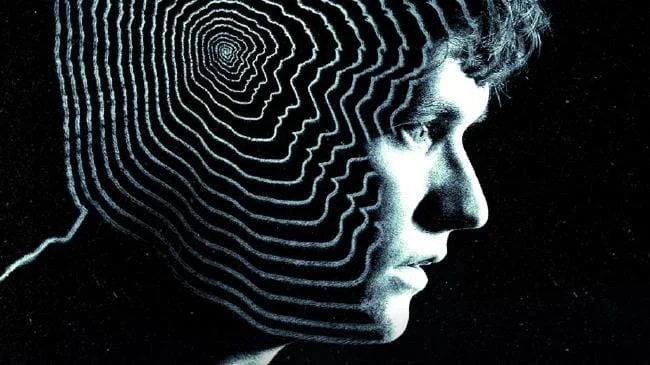
Thoughts on Netflix's Bandersnatch
I watched (participated in?) Netflix’s choose-your-own adventure story about a person creating a choose-your-own-adventure story.
As a Black Mirror binge watcher, I was pleasantly surprised with Netflix’s secretive release of Bandersnatch. My curiosity peaked, however, when I realized it was a choose-your-own-adventure episode. Throughout the show, viewers are presented with choices, and the narrative advances based on their selections. With enthusiasm, I opened the Netflix app on my Apple TV only to receive a “device not supported” error. No problem - I opened the Netflix app on my smart TV. Same result. Okay, I opened the Netflix webpage from my laptop. It worked…until I attempted to stream my laptop display to my TV, at which point it informed me I wasn’t allowed to do this. Sigh. So, with laptop on lap, I clicked my way through about an hour’s worth of storyline.
SPOILERS AHEAD
The interface was quite slick. I think I was expecting the CD-ROM games of the 90s where the scene pauses while I click on a choice, then stutters while loading the new scene. In reality, it was seamless. The scene plays as a timer ticks down for your choice and continues without breaking stride.
There’s a certain charm to the initial choices, which do not affect the plot at all. Given a choice of which cassette to listen to on the bus, I chose Thompson Twins and enjoyed that it became the musical montage soundtrack for the ride.
If you haven’t seen Bandersnatch (please do so before reading on), it’s the story of a computer programmer, Stefan, who is creating a choose-your-own-adventure video game called Bandersnatch. Stefan has a goal: work for the software company Tuckersoft and release the game in time for Christmas. Stefan has a dark past - his mother died in a train derailment when he was five - and takes medication presumably for depression. The show is set in 1984.
The first choice capable of ending the story comes quickly. When the head of Tuckersoft offers Stefan his dream job working alongside his hero Colin with his own dedicated support team, Stefan must choose to either accept or counter-offer to go it alone and work-from-home. This being a Shining-style writer-descent-into-madness story, you can guess which option is the correct narrative choice. When you choose incorrectly, you’re given a quick fast-forward of the ho-hum way this plays out, then, like Groundhog-day, are returned to your alarm clock waking you up at the story’s launch. Try again.
Now, here was where my first glimmer of hope appeared. As the characters replayed the scene leading up to the accept/decline choice, it was subtly different. Both Stefan and Colin seemed to have some knowledge of their first go around. When Colin asks Stefan how he knew something he shouldn’t, he responds, “I don’t know. I just did.” It made me think of the Star Trek the Next Generation Episode “Cause and Effect” where the crew relives the same day over and over again, each time retaining some knowledge of their previous iteration. In the end, they use that knowledge to break the loop - discovering they’re not the only ones trapped in it.

Unfortunately Bandersnatch just as quickly abandons this concept. What it does retain, however, is an increasing awareness from Stefan that his decisions are not his own. Given a choice to bite his nails or pull his earlobe, you can see Stefan wants to bite his nails but visibly fights his hand when you select pull your earlobe. Depending on your choices, this can play out in an over-the-top Truman Show style scene where Stefan becomes aware you’re controlling him and you divulge that it’s a Netflix interactive show from the future. When his therapist tries to logically convince him they’re not on a TV show, the fourth wall falls and they abandon their characters to provide a scene more typical of a TV show. Some reviewers didn’t like this meta-scene, but I thought it was snarky and fun.
I’d say the first half of Bandersnatch actually felt like a Black Mirror episode. I found myself making choices based on what I thought would be more interesting narratively. A key choice, for example, is whether Stefan should go with his father to the doctor or bail and follow Collin. The sensible thing to do is get Stefan some medical help, but the plot is more interesting if he follows Collin. The resulting scene feels right for the narrative, and is dark, with elements of Inception in it. I think right up to the end of this scene I felt like I was watching and participating in a story.
Afterwards, the story quickly devolves into endless loops. Every time you chose a dead end the story repeats the scenes up to the ill-fated choice and you try again. After a dozen of these it becomes tedious, and you quickly realize that there is no satisfying ending to be had. Collin’s character put it perfectly, describing how Pac Man tries to escape his maze only to re-emerge on the other side, still trapped.
One of my criticisms of Black Mirror is that often the writers don’t know how to end an episode. This is certainly true of Bandersnatch. It doesn’t need to be a happy ending, but it does need to be a fulfilling ending. If you search on the web, you can find flowcharts of all the possibilities. To some effect, I felt like the ending scene should be from the ending of 1983’s War Games.

A few observations:
Forbes has a good write-up on what the best ending is in Bandersnatch. I’d call it the Butterfly Effect ending. They also comment on the theory that we, the viewer, are really in the White Bear episode of Black Mirror, where we are punishing Stefan for his crime. The decision-tree symbol which keeps reappearing in Bandersnatch is the same used in White Bear.
Tuckersoft’s rainbow logo is channeling Activision’s 80s logo. I like it.
The show did succeed in making me feel uneasy about choosing for Stefan, especially as he became more aware that he was being manipulated.
I’d like to see more interactive shows like this. It’s a bit gimmicky, but with the right story I think it could be compelling.

Thoughts on The Man in High Castle
After bingeing seasons one through three of Amazon Prime’s the Man in High Castle, I offer some rambling thoughts.
The past two weeks I’ve been bingeing Amazon Prime’s The Man in High Castle, a series based on Phillip K. Dick’s 1962 book by the same name (which won a Hugo award in 1963). The brilliant opening credits tell you everything you need to know about the setting:
Setting, perhaps, is one of the strongest points of the series, with a designed-in conflict of an America divided between Japan and Germany buffered by a lawless neutral-zone. The premise is compelling: filmstrips exist depicting an alternate reality where the United States won WWII. Many think they are fake propaganda designed to inspire hope in the rebellion, but some think they are true. We, of course, have seen these films countless times — a sailor kissing a woman in Times Square as ticker tape rains down over a parade — but for the inhabitants of this alternate reality they are powerful images.
SPOILERS AHEAD
The series has a Game-of-Thrones-sized cast, but the three characters it focuses on are Juliana Crain (Alexa Devalous), John Smith (Rufus Sewell) and Nobusuke Tagomi (Cary-Hiroyuki Tagawa). Juliana is intended to be the protagonist, coming into possession of one of the film reels in the first episode and catapulting her into a life on the run which puts her into the hands of the Resistance, the Japanese, and the Reich. Unfortunately the show’s writers have made her the least interesting of the primary characters. Her role is mainly to run from location to location, get shot at, and be scared. John Smith, on the other hand, is an American soldier who changed sides after WWII, now a rising star in the Reich. He lives in a swastika-laden New York with his family. You can see the gears turning in Rufus Sewell’s head as he plays John Smith, and John Smith’s struggle to accept Reich idealogies versus the consequences to his family are potent. Lastly, Trade Minister Tagomi is, well, the Trade Minister for Japan, living in San Francisco. He is a kind and peaceful man who wants to prevent World War III. He also is able to travel to the alternate reality depicted in the films.
Notable secondary characters include: Joe Blake (Luke Kleintank), son of a prominent Reich leader and flip-flopper; Frank Frink (Rupert Evans), Juliana’s ex-boyfriend and the Banksy of the Resistance; Inspector Kido (Joel de la Fuente), the Bad Guy playing the show’s Javert role; Robert Childan (Brennan Brown), a seller of Americana artifacts to some of Japan’s more culture-obsessed buyers; Nicole Becker (Bella Heathcote), the Nazi version of Mad Men’s Don Draper.
There are many more secondary characters. These are just the ones with the biggest story arcs. Phew.
Now that we’ve got the foundation, here’s a few thoughts. The first two seasons were a bit like a bowling ball rolling down an alley with the bumpers raised, veering in random directions, deflecting, always moving forward, but unfocused. Somewhere in season three clear themes began to emerge and the episodes were much better when they had a purpose. I think season one reminded me a bit of the sci-fi series Colony, which has a similar setup (America is taken over by an alien power and many Americans try to adapt by working for them as soldiers or bureaucrats. A Resistance forms.).

The problem with Colony was that its endless shootouts mowed down Redhats (stormtroopers) in mind-numbing numbers while human bureaucrats promised all questions would be answered. It quickly became apparent that the writers themselves were winging it and didn’t have those answers. Similarly, when the Man in High Castle series does actually get Juliana to meet the Man in High Castle, it’s nearly incidental. She just moves on to her next location.
What High Castle does excel at, however, is exploring ideas (which is what all great sci-fi stories should do). The show is at its best with:
Visuals - a fleet of Japanese battleships slipping under the Golden Gate Bridge; Times Square with building-sized posters of the Fuhrer; a New York hotel room lamp with a bronze swastika base; the look of the 1960s-era Reich uniforms. In conjunction with this is the ease and comfort that the actors accept their surroundings. People lounge in their uniforms as if they were blue jeans and treat swastika-laden hotel rooms the same as the generic art we encounter at a Holiday Inn.
John Smith - as someone who switched sides to enjoy the comforts and security of the Reich, he now must accept the consequences of their government. When he discovers his son has a genetic disease which would require him to be euthanized under the Reich’s genetic purity laws, he will do anything to prevent it. The aftermath of this extends through all of season 3, and is one of the best elements of the show. There are no simple answers here.
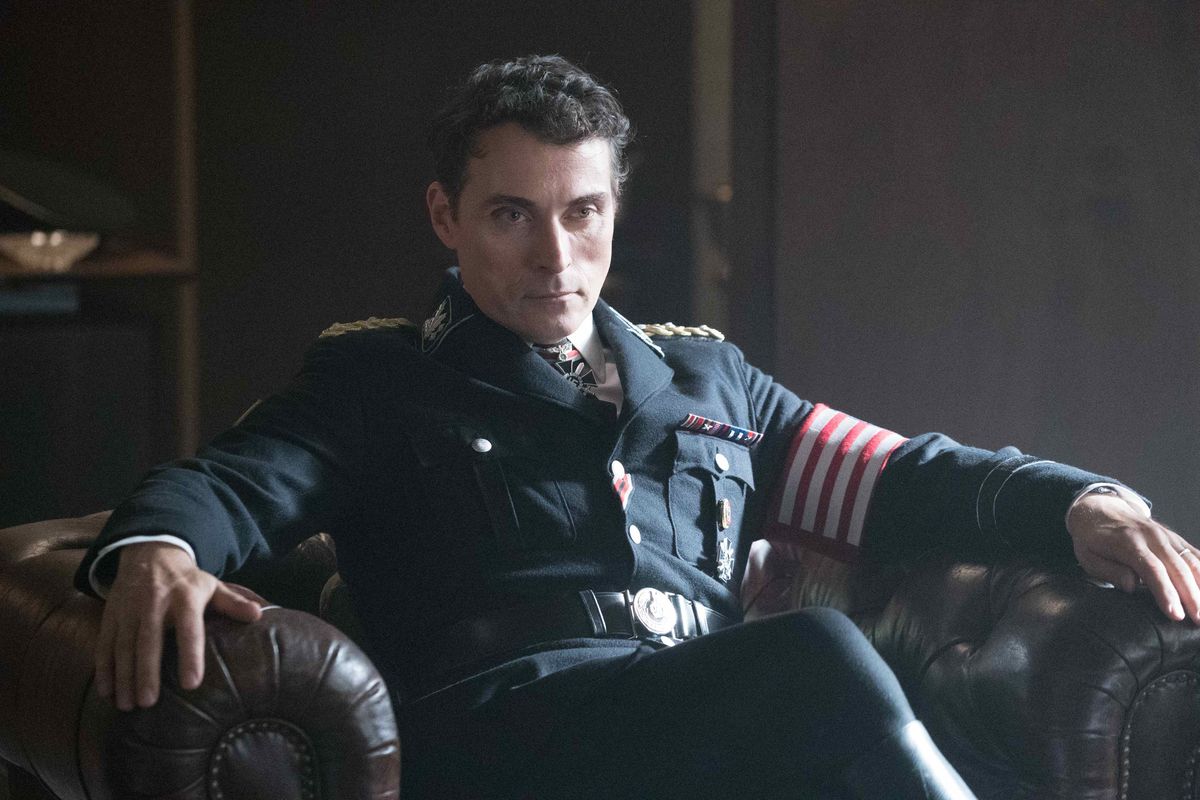
Robert Childan, Americana dealer to the Japanese - in contrast to our reality, where Americans have kanji tattoos or katanas hung on their walls, here is a reality where the Japanese are interested in collecting bits and pieces of American history as a status symbol, like having a rare art piece on one’s wall. Robert Childan is terrific as a culturally-savvy shop owner who buys sometimes-illicit items to satisfy his clients.

Minorities - It’s expected that John Smith should have some doubts about Reich ideology. What’s unexpected, and welcome, is that characters like Nicole Becker, a German national, engage in same-sex relationships despite the potential consequences. Other characters establish colonies in the Neutral Zone where they can practice Judaism. It hints that people are people, regardless of their society’s views.
Complexity in opposing sides - It would have been easy for the writers to turn the story into Red Dawn. Instead, we get terrific characters like John Smith - a Breaking Bad type of arc - where compromises are made to ensure his family’s security. John does some terrible things, but you know why he does them. Trade Minister Tagomi has the weight of the world on his shoulders, a kind, weary man who wants to spare everyone the horrors of atomic war. They seem like real people trying to make the best of their situation.

Lastly, as I hinted at earlier, I think the writers chose the wrong protagonist. Juliana is missing the complexity of her adversaries. The show mistakingly relies on plot to try and make her interesting (she appears in nearly all of the alternate-reality films, indicating that whoever made them knows her). Yet I find myself waiting for any scene with Rufus Sewell. More so than any other, his character is a keystone, where the plot elements converge, and he often is the decision-maker for what happens next. Those decisions often are conflicted and we sympathize with those conflicts. He would be the perfect lens to watch this world unfold.
When I’m not flying the virtual skies, I’m the sci-fi author of the Hayden’s World series. If you love exploration and adventure, be sure to check it out.

Getting the Most Out of X-Plane
A few tips from my X-Plane setup.
I’m sitting in the living room with my laptop on my knees, my green Daytona Beach cap slumped on my head. It’s the hat I never wear, the one I bought not because I wanted a Daytona Beach cap but because my scalp was sunburned and I wanted to comb my hair without it hurting. My wife walks in and does a double-take. I look up. “What?”
“Uh, why is your iPhone strapped to your head?”
She’s right. Two rubber bands affix my iPhone to my cap’s bill.
“It’s so I can do this.”
When I turn my head to the left, the Piper’s cockpit view on my laptop screen rotates left. I turn my head to the right and the view follows. “Cool, huh?”
She blinks.
These are the weird things you end up doing when you have an X-Plane addiction
Now that I’ve logged a jillion hours or so flying my Pixel Plane, I can share a few things to make your X-Plane experience even more awesome, and possibly encourage your loved ones to think you’re even weirder than they previously thought:
Download Ortho4XP and create your own photorealistic scenery. One of the amazing things about X-Plane is that it models the entire world. You may as well go all in and put the right textures on that model. When using Ortho4XP for U.S. areas, I use Google, Bing, Arc, or USA_2 photo sources. Tip: You can edit the config file for Ortho4XP to automatically create higher-resolution tiles immediately around airports - it’s an easy way to have Zoom Level 16 tiles for general travel but Zoom Level 18 at airports.

Orthophotos - You’re welcome
For another level of immersion, get one of the Orbx True Earth packages (currently for Northern California, Oregon, Washington, and Great Britain). Each is a plug-n-play state with orthos and modeling.

Orbx True Earth Washington
There are many, many weather plugins for X-Plane, but I like simply replacing the default clouds with better ones. I like the clouds in Environment+ (just the clouds - I don’t use the lua script, which kills my FPS). You just place them into your Resources/bitmaps/world/clouds folder.
X-Plane’s sky is nice, but I find their sunsets a bit cartoonish. Fortunately, you can swap in any sky colors you want. I prefer Eddie’s Skypack. You just place them into your Resources/bitmaps/skycolors folder.
Speaking of clouds, X-Plane is a little reluctant to give you those big puffy cumulous clouds you’re used to seeing in summer skies. There are plenty of lua scripts to fix this, but I prefer Vivid Sky (which requires the free Fly with Lua plugin). The script fixes many things with cloud appearance and ground shadows, improves the sky colors, and is FPS-friendly.
Simhat - yes, yes…you will look completely silly with your iPhone strapped to your baseball cap’s bill, but for $10 you will have head tracking that works remarkably well. Adding head tracking is right up there with Ortho photos as being one of the most impactful things you can do for immersion.
XPRealisticPro is a great script to add some realism, especially if you don’t have head tracking.
Stick and Rudder’s XCamera is a must if you have head tracking. You can configure each view to use/not use tracking, so you can zoom to your GPS without needing to hold your head perfectly still.
A few other tips:
The default X-Plane aircraft are quite good, but can be a bit boring for their paint options. You can download endless liveries from the X-Plane forums to customize them (changing both the exterior and interior appearance). The default Cessna 172 has plenty of great internet options.

No need to settle for ‘default’ when you could have this design.
You will likely spend plenty of time tinkering in your Custom Scenery folder, but I find less is more. I try to avoid custom airports which have a dozen different library dependencies. It just bogs down your load times. If you’re flying general aviation craft, the smaller airports will probably be of more interest than the giant ones. The free L52 Oceano is excellent, especially when paired with orthophotos, and is also the first airport you’ll visit if you fly on PilotEdge.
External SSDs are fairly cheap. If you’re flying on a laptop, like me, and need storage, a 1 TB USB-C SSD is great or storing all your orthos and scenery files. You can create shortcuts in your Custom Scenery folder to the external files.
Want to fly out of your home town airport, but it’s not in X-Plane? No problem - make it with the free X-Plane World Editor. It’s a lego kit for airports. If you’re gung ho, you can even upload it to the X-Plane Scenery Gateway, where it will be evaluated for inclusion in the X-Plane base library.
Need an external moving map? FlightPlan Go will connect with X-Plane via your wifi network and show your plane’s position on VFR sectionals or on airport plates for ground taxiiing.
Live ATC will change the game for immersion. The simplest way to do it is to open liveatc.net in the background, type in your airport, and listen while flying. The pro way is to get a subscription to PilotEdge, where professional ATC controllers will provide you and everyone else on the network ATC services from ground control through Bravo airspace. Check out my flight to Catalina in PilotEdge for an example:
MisterX6’s Airport Environment HD runways are so much better than the default. Just get them (they’re free!).
I purchased seven payware aircraft, but really only fly two. Both are by JustFight.
Option-R will put X-Plane into playback mode, allowing you to rewind and watch your flight from any camera angles, including the tower view. If you press control-space, it will record to an avi file, but slow down the frame rate so the recorded video is at the perfect FPS. It’s also handy for taking screenshots, since you’re not trying to fly the plane at the same time.
Enjoy your X-Plane adventures. Hope this helped!
When I’m not flying the virtual skies, I’m the sci-fi author of the Hayden’s World series. If you love exploration and adventure, be sure to check it out.